SUBSCRIBE TO OUR FREE NEWSLETTER
Daily news & progressive opinion—funded by the people, not the corporations—delivered straight to your inbox.
5
#000000
#FFFFFF
To donate by check, phone, or other method, see our More Ways to Give page.
Daily news & progressive opinion—funded by the people, not the corporations—delivered straight to your inbox.
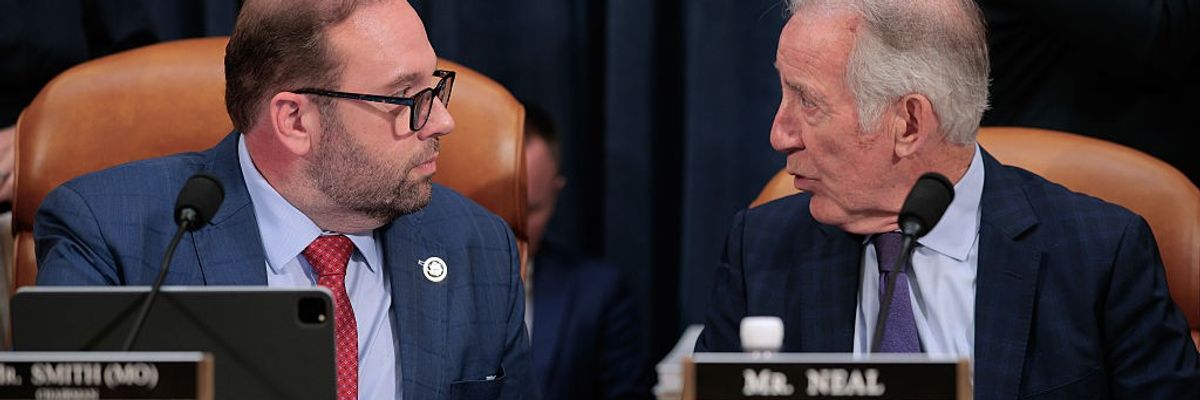
House Ways and Means Committee Chair Jason Smith (R-Mo) (left) and Ranking Member Richard Neal (D-Mass.) talk before a markup hearing in the Longworth House Building on Capitol Hill on May 13, 2025 in Washington, D.C.
"This measure would undoubtedly be weaponized by a White House with a track record of attacks against any speech that displeases our authoritarian president," warned one critic.
Free press, civil liberties, and community groups on Wednesday sounded the alarm after House Republicans added a provision in their budget reconciliation package that would empower U.S. President Donald Trump's administration to revoke the tax-exempt status of any nonprofit the executive branch deems supportive of a terrorist organization.
The House Ways and Means Committee voted along party lines to advance Republicans' reconciliation bill, which contains an amendment based on the language of the Stop Terror-Financing and Tax Penalties on American Hostages Act, or H.R. 9495.
The ACLU warned Tuesday that the provision—dubbed the "nonprofit killer" by critics—would grant the executive branch the power to "effectively shut down" entities including independent media like Common Dreams, universities, religious institutions, political organizations, advocacy groups, and charities under the guise of combating terrorism. The contentious language was buried on page 380 of the reconciliation bill prior to its markup.
"No president should have the right to destroy nonprofits for no reason."
More than 200 groups collectively condemned the proposal in a Wednesday statement, warning, "Charities that feed the hungry, churches and faith communities that comfort the grieving, veterans' groups that care for our heroes, and countless other service providing organizations are at risk today because of this legislation."
"Nonprofits are on the frontlines of meeting every community need," the coalition continued. "Whether it's an organization providing healthcare in a disaster, a small rural church, or a local food bank, no organization is safe if this becomes law."
H.R. 9495 was first introduced in the previous Congress but failed to receive a Senate vote before the legislative term expired last year. It allows the treasury secretary "to accuse any nonprofit of supporting terrorism—and to terminate its tax-exempt status without due process," the advocacy group Free Press Action explained in statement, warning the ostensibly anti-terror provision would be used to "crush dissent."
Civil liberties groups say its lack of clarity regarding the determination of whether or how a nonprofit supports terrorism would enable Trump to follow through on his threats to cancel the tax-exempt status for organizations he does not like.
"Today, the legislation formerly known as H.R. 9495 has returned to wreak havoc against dissenting voices across the country's nonprofit sector," Free Press Action advocacy director Jenna Ruddock said Wednesday.
"Like too many other overbroad and easily abused powers, this measure would undoubtedly be weaponized by a White House with a track record of attacks against any speech that displeases our authoritarian president," Ruddock continued.
"The bill would have a widespread chilling effect not only on nonprofit groups but on the millions of people across the United States who rely on these organizations to help them access crucial services and engage in the political process," she added.
"We've already seen the Trump administration falsely conflate students protesting in support of Palestinian rights with Hamas, deport immigrants to a [Salvadoran] prison without due process, and detain students thousands of miles away from their loved ones for criticizing U.S. foreign policy," ACLU senior policy counsel Kia Hamadanchy said Tuesday.
"It is not a stretch to imagine how this bill could be used to pressure universities to shut down student groups, scare human rights organizations away from working with vulnerable communities, and further stifle dissent in this country," Hamadanchy added.
Ruddock of Free Press Action said that "it's not hard to imagine how the Trump administration would use [the bill] to exact revenge on groups that have raised questions about or simply angered the president and other officials in his orbit."
Lia Holland, campaigns and communications director at the digital rights group Fight for the Future, called the proposal "a five-alarm fire for nonprofits nationwide."
"This is a First Amendment issue—no president should have the right to destroy nonprofits for no reason," Holland added.
While the provision's proponents argue it is necessary to crack down on nonprofits that raise money to fund terrorism, Holland said that is "a bald-faced lie, as there are already laws that prohibit and punish such activities without taking away our civil liberties."
Ruddock warned: "Chilling free speech doesn't keep Americans safe. Instead, it gives an authoritarian regime another tool to violate the rights that form the foundation of a healthy democracy."
Dear Common Dreams reader, It’s been nearly 30 years since I co-founded Common Dreams with my late wife, Lina Newhouser. We had the radical notion that journalism should serve the public good, not corporate profits. It was clear to us from the outset what it would take to build such a project. No paid advertisements. No corporate sponsors. No millionaire publisher telling us what to think or do. Many people said we wouldn't last a year, but we proved those doubters wrong. Together with a tremendous team of journalists and dedicated staff, we built an independent media outlet free from the constraints of profits and corporate control. Our mission has always been simple: To inform. To inspire. To ignite change for the common good. Building Common Dreams was not easy. Our survival was never guaranteed. When you take on the most powerful forces—Wall Street greed, fossil fuel industry destruction, Big Tech lobbyists, and uber-rich oligarchs who have spent billions upon billions rigging the economy and democracy in their favor—the only bulwark you have is supporters who believe in your work. But here’s the urgent message from me today. It's never been this bad out there. And it's never been this hard to keep us going. At the very moment Common Dreams is most needed, the threats we face are intensifying. We need your support now more than ever. We don't accept corporate advertising and never will. We don't have a paywall because we don't think people should be blocked from critical news based on their ability to pay. Everything we do is funded by the donations of readers like you. When everyone does the little they can afford, we are strong. But if that support retreats or dries up, so do we. Will you donate now to make sure Common Dreams not only survives but thrives? —Craig Brown, Co-founder |
Free press, civil liberties, and community groups on Wednesday sounded the alarm after House Republicans added a provision in their budget reconciliation package that would empower U.S. President Donald Trump's administration to revoke the tax-exempt status of any nonprofit the executive branch deems supportive of a terrorist organization.
The House Ways and Means Committee voted along party lines to advance Republicans' reconciliation bill, which contains an amendment based on the language of the Stop Terror-Financing and Tax Penalties on American Hostages Act, or H.R. 9495.
The ACLU warned Tuesday that the provision—dubbed the "nonprofit killer" by critics—would grant the executive branch the power to "effectively shut down" entities including independent media like Common Dreams, universities, religious institutions, political organizations, advocacy groups, and charities under the guise of combating terrorism. The contentious language was buried on page 380 of the reconciliation bill prior to its markup.
"No president should have the right to destroy nonprofits for no reason."
More than 200 groups collectively condemned the proposal in a Wednesday statement, warning, "Charities that feed the hungry, churches and faith communities that comfort the grieving, veterans' groups that care for our heroes, and countless other service providing organizations are at risk today because of this legislation."
"Nonprofits are on the frontlines of meeting every community need," the coalition continued. "Whether it's an organization providing healthcare in a disaster, a small rural church, or a local food bank, no organization is safe if this becomes law."
H.R. 9495 was first introduced in the previous Congress but failed to receive a Senate vote before the legislative term expired last year. It allows the treasury secretary "to accuse any nonprofit of supporting terrorism—and to terminate its tax-exempt status without due process," the advocacy group Free Press Action explained in statement, warning the ostensibly anti-terror provision would be used to "crush dissent."
Civil liberties groups say its lack of clarity regarding the determination of whether or how a nonprofit supports terrorism would enable Trump to follow through on his threats to cancel the tax-exempt status for organizations he does not like.
"Today, the legislation formerly known as H.R. 9495 has returned to wreak havoc against dissenting voices across the country's nonprofit sector," Free Press Action advocacy director Jenna Ruddock said Wednesday.
"Like too many other overbroad and easily abused powers, this measure would undoubtedly be weaponized by a White House with a track record of attacks against any speech that displeases our authoritarian president," Ruddock continued.
"The bill would have a widespread chilling effect not only on nonprofit groups but on the millions of people across the United States who rely on these organizations to help them access crucial services and engage in the political process," she added.
"We've already seen the Trump administration falsely conflate students protesting in support of Palestinian rights with Hamas, deport immigrants to a [Salvadoran] prison without due process, and detain students thousands of miles away from their loved ones for criticizing U.S. foreign policy," ACLU senior policy counsel Kia Hamadanchy said Tuesday.
"It is not a stretch to imagine how this bill could be used to pressure universities to shut down student groups, scare human rights organizations away from working with vulnerable communities, and further stifle dissent in this country," Hamadanchy added.
Ruddock of Free Press Action said that "it's not hard to imagine how the Trump administration would use [the bill] to exact revenge on groups that have raised questions about or simply angered the president and other officials in his orbit."
Lia Holland, campaigns and communications director at the digital rights group Fight for the Future, called the proposal "a five-alarm fire for nonprofits nationwide."
"This is a First Amendment issue—no president should have the right to destroy nonprofits for no reason," Holland added.
While the provision's proponents argue it is necessary to crack down on nonprofits that raise money to fund terrorism, Holland said that is "a bald-faced lie, as there are already laws that prohibit and punish such activities without taking away our civil liberties."
Ruddock warned: "Chilling free speech doesn't keep Americans safe. Instead, it gives an authoritarian regime another tool to violate the rights that form the foundation of a healthy democracy."
Free press, civil liberties, and community groups on Wednesday sounded the alarm after House Republicans added a provision in their budget reconciliation package that would empower U.S. President Donald Trump's administration to revoke the tax-exempt status of any nonprofit the executive branch deems supportive of a terrorist organization.
The House Ways and Means Committee voted along party lines to advance Republicans' reconciliation bill, which contains an amendment based on the language of the Stop Terror-Financing and Tax Penalties on American Hostages Act, or H.R. 9495.
The ACLU warned Tuesday that the provision—dubbed the "nonprofit killer" by critics—would grant the executive branch the power to "effectively shut down" entities including independent media like Common Dreams, universities, religious institutions, political organizations, advocacy groups, and charities under the guise of combating terrorism. The contentious language was buried on page 380 of the reconciliation bill prior to its markup.
"No president should have the right to destroy nonprofits for no reason."
More than 200 groups collectively condemned the proposal in a Wednesday statement, warning, "Charities that feed the hungry, churches and faith communities that comfort the grieving, veterans' groups that care for our heroes, and countless other service providing organizations are at risk today because of this legislation."
"Nonprofits are on the frontlines of meeting every community need," the coalition continued. "Whether it's an organization providing healthcare in a disaster, a small rural church, or a local food bank, no organization is safe if this becomes law."
H.R. 9495 was first introduced in the previous Congress but failed to receive a Senate vote before the legislative term expired last year. It allows the treasury secretary "to accuse any nonprofit of supporting terrorism—and to terminate its tax-exempt status without due process," the advocacy group Free Press Action explained in statement, warning the ostensibly anti-terror provision would be used to "crush dissent."
Civil liberties groups say its lack of clarity regarding the determination of whether or how a nonprofit supports terrorism would enable Trump to follow through on his threats to cancel the tax-exempt status for organizations he does not like.
"Today, the legislation formerly known as H.R. 9495 has returned to wreak havoc against dissenting voices across the country's nonprofit sector," Free Press Action advocacy director Jenna Ruddock said Wednesday.
"Like too many other overbroad and easily abused powers, this measure would undoubtedly be weaponized by a White House with a track record of attacks against any speech that displeases our authoritarian president," Ruddock continued.
"The bill would have a widespread chilling effect not only on nonprofit groups but on the millions of people across the United States who rely on these organizations to help them access crucial services and engage in the political process," she added.
"We've already seen the Trump administration falsely conflate students protesting in support of Palestinian rights with Hamas, deport immigrants to a [Salvadoran] prison without due process, and detain students thousands of miles away from their loved ones for criticizing U.S. foreign policy," ACLU senior policy counsel Kia Hamadanchy said Tuesday.
"It is not a stretch to imagine how this bill could be used to pressure universities to shut down student groups, scare human rights organizations away from working with vulnerable communities, and further stifle dissent in this country," Hamadanchy added.
Ruddock of Free Press Action said that "it's not hard to imagine how the Trump administration would use [the bill] to exact revenge on groups that have raised questions about or simply angered the president and other officials in his orbit."
Lia Holland, campaigns and communications director at the digital rights group Fight for the Future, called the proposal "a five-alarm fire for nonprofits nationwide."
"This is a First Amendment issue—no president should have the right to destroy nonprofits for no reason," Holland added.
While the provision's proponents argue it is necessary to crack down on nonprofits that raise money to fund terrorism, Holland said that is "a bald-faced lie, as there are already laws that prohibit and punish such activities without taking away our civil liberties."
Ruddock warned: "Chilling free speech doesn't keep Americans safe. Instead, it gives an authoritarian regime another tool to violate the rights that form the foundation of a healthy democracy."