
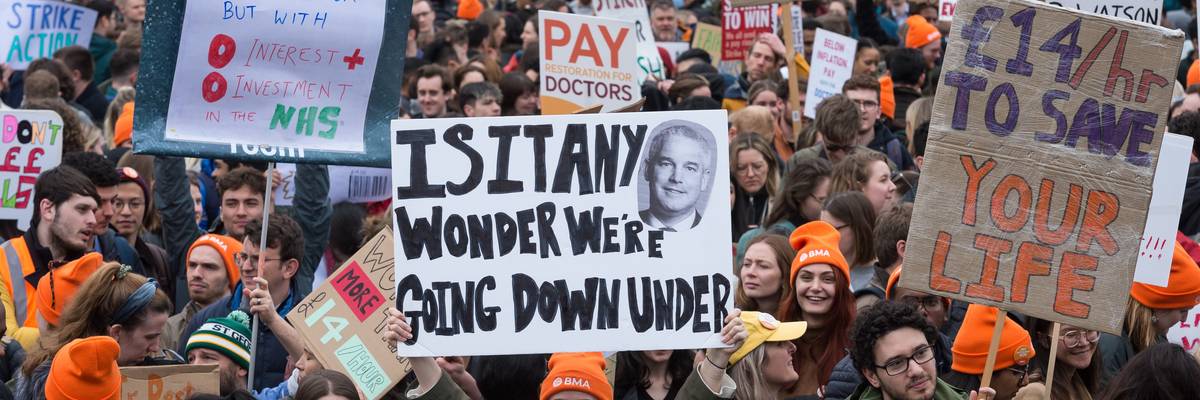
Junior doctors and supporters gather for a rally in Trafalgar Square in London on April 11, 2023.
Rejecting Tory Government Pay Offer as Inadequate, NHS Workers to Resume Strike
"It is quite frankly a joke that NHS workers are being forced to fight for a decent pay rise after years of pay freezes and all their sacrifices during the pandemic," said one union leader.
A leading union that represents thousands of National Health Service workers in the U.K. announced Friday that its members voted to reject the right-wing Tory government's latest pay offer, setting the stage for large-scale strikes to resume next week.
"Unite was clear from the start it was very unlikely this offer would be accepted," Sharon Graham, the union's general secretary, said in a statement. "It is quite frankly a joke that NHS workers are being forced to fight for a decent pay rise after years of pay freezes and all their sacrifices during the pandemic."
"The government should be delivering generous rewards for that instead of a parade of insults, bullying, and lies about our industrial action. Unite will be backing our NHS members 100%," Graham added. "Unite's members will now return to the picket line to continue their fight."
Unite said the latest pay proposal by the U.K. government, led by Tory Prime Minister Rishi Sunak, was inadequate in the face of persistently high inflation, which has led to real pay cuts for many healthcare workers who have been striking on and off for months.
The government offered a 5% pay increase for this year and 2024, along with a lump-sum payment for last year. Of all the Unite members who voted on the government's proposal, 52% opposed it, the union said.
"It is increasingly clear that there is money to fund a fair pay rise, particularly from properly taxing the huge increases in profits made from the cost of living crisis by corporate profiteers," said Onay Kasab, Unite's national lead officer. "The government is choosing to let the NHS collapse. It must make the right decision, return to negotiations, and put forward a better deal."
"Until there is a significantly improved offer, we are forced back to the picket line."
While the members of some unions have voted to accept the government's offer, major labor organizations—including the Royal College of Nursing (RCN) and now Unite—have rejected the proposal and vocally denounced it.
According to a recent analysis by the Trades Union Congress, U.K. bankers have seen their pay rise more than three times faster than that of nurses since the 2008 financial crisis.
"What has been offered to date is simply not enough," Pat Cullen, RCN's general secretary and chief executive, wrote in a letter to U.K. health secretary Steve Barclay earlier this month. "The government needs to increase what has already been offered and we will be highly critical of any move to reduce it."
"Until there is a significantly improved offer, we are forced back to the picket line," Cullen continued. "Meetings alone are not sufficient to prevent strike action and I will require an improved offer as soon as possible. In February, you opened negotiations directly with me and I urge you to do the same now."
Instead of meeting the demands of RCN—which has called for a pay raise of 5% above inflation—and other unions, Sunak's government has repeatedly attacked the labor organizations and supported proposals to crack down on worker strikes.
On Thursday, a U.K. judge sided with the government and ordered RCN to cut its upcoming strike action short by a day, arguing the original strike plans would have fallen outside of the limits of the union's strike mandate. The strike was supposed to run from Sunday through Tuesday evening, but it will now end on Monday.
"It is the darkest day of this dispute so far—the government taking its own nurses through the courts in bitterness at their simple expectation of a better pay deal," Cullen said Thursday. "Nursing staff will be angered but not crushed by today's interim order. It may even make them more determined to vote in next month's reballot for a further six months of strike action."
"The government has won this legal battle," Cullen added. "But they have lost the support of nursing staff and the public. The most trusted profession has been taken through the courts, by the least trusted people."
We are at a crossroads
This country and this world are at a monumental crossroads. In a few short weeks, US voters will have an opportunity to beat back the forces of fascism and confront the billionaires who are rigging the economy, our media system, and our democracy, making it increasingly impossible for ordinary people to get by. We’re not just talking about the election. We’re talking about what must be done once these fascist elements are vanquished from power. We need a bolder set of solutions than what either major party has so far been willing to offer and a working-class movement ready to fight like hell for it. Trump didn't emerge from nowhere. The conditions that fueled MAGA authoritarianism were created by decades of radical neoliberal economic policies and a corrupt political system dominated by corporate interests. They slashed taxes on the super-rich, promising that the benefits would trickle down. They said giveaways to the corporate titans would make life more affordable for the rest of us. It was all bullshit. And when a bitter, betrayed populace searches for someone to blame, right-wing demagogues have little trouble finding scapegoats. People know when they're being lied to, but you won't hear any of this from the corporate media. Only independent journalism—powered and funded by people who believe in building a better world—can deliver truly trustworthy daily news. Our Fall Campaign is underway, and we need your help. To power our newsroom through the rest of the year, we need to raise $125,000 by midnight on October 31. So if you share our vision, please contribute whatever you can to sustain our work. |
A leading union that represents thousands of National Health Service workers in the U.K. announced Friday that its members voted to reject the right-wing Tory government's latest pay offer, setting the stage for large-scale strikes to resume next week.
"Unite was clear from the start it was very unlikely this offer would be accepted," Sharon Graham, the union's general secretary, said in a statement. "It is quite frankly a joke that NHS workers are being forced to fight for a decent pay rise after years of pay freezes and all their sacrifices during the pandemic."
"The government should be delivering generous rewards for that instead of a parade of insults, bullying, and lies about our industrial action. Unite will be backing our NHS members 100%," Graham added. "Unite's members will now return to the picket line to continue their fight."
Unite said the latest pay proposal by the U.K. government, led by Tory Prime Minister Rishi Sunak, was inadequate in the face of persistently high inflation, which has led to real pay cuts for many healthcare workers who have been striking on and off for months.
The government offered a 5% pay increase for this year and 2024, along with a lump-sum payment for last year. Of all the Unite members who voted on the government's proposal, 52% opposed it, the union said.
"It is increasingly clear that there is money to fund a fair pay rise, particularly from properly taxing the huge increases in profits made from the cost of living crisis by corporate profiteers," said Onay Kasab, Unite's national lead officer. "The government is choosing to let the NHS collapse. It must make the right decision, return to negotiations, and put forward a better deal."
"Until there is a significantly improved offer, we are forced back to the picket line."
While the members of some unions have voted to accept the government's offer, major labor organizations—including the Royal College of Nursing (RCN) and now Unite—have rejected the proposal and vocally denounced it.
According to a recent analysis by the Trades Union Congress, U.K. bankers have seen their pay rise more than three times faster than that of nurses since the 2008 financial crisis.
"What has been offered to date is simply not enough," Pat Cullen, RCN's general secretary and chief executive, wrote in a letter to U.K. health secretary Steve Barclay earlier this month. "The government needs to increase what has already been offered and we will be highly critical of any move to reduce it."
"Until there is a significantly improved offer, we are forced back to the picket line," Cullen continued. "Meetings alone are not sufficient to prevent strike action and I will require an improved offer as soon as possible. In February, you opened negotiations directly with me and I urge you to do the same now."
Instead of meeting the demands of RCN—which has called for a pay raise of 5% above inflation—and other unions, Sunak's government has repeatedly attacked the labor organizations and supported proposals to crack down on worker strikes.
On Thursday, a U.K. judge sided with the government and ordered RCN to cut its upcoming strike action short by a day, arguing the original strike plans would have fallen outside of the limits of the union's strike mandate. The strike was supposed to run from Sunday through Tuesday evening, but it will now end on Monday.
"It is the darkest day of this dispute so far—the government taking its own nurses through the courts in bitterness at their simple expectation of a better pay deal," Cullen said Thursday. "Nursing staff will be angered but not crushed by today's interim order. It may even make them more determined to vote in next month's reballot for a further six months of strike action."
"The government has won this legal battle," Cullen added. "But they have lost the support of nursing staff and the public. The most trusted profession has been taken through the courts, by the least trusted people."
A leading union that represents thousands of National Health Service workers in the U.K. announced Friday that its members voted to reject the right-wing Tory government's latest pay offer, setting the stage for large-scale strikes to resume next week.
"Unite was clear from the start it was very unlikely this offer would be accepted," Sharon Graham, the union's general secretary, said in a statement. "It is quite frankly a joke that NHS workers are being forced to fight for a decent pay rise after years of pay freezes and all their sacrifices during the pandemic."
"The government should be delivering generous rewards for that instead of a parade of insults, bullying, and lies about our industrial action. Unite will be backing our NHS members 100%," Graham added. "Unite's members will now return to the picket line to continue their fight."
Unite said the latest pay proposal by the U.K. government, led by Tory Prime Minister Rishi Sunak, was inadequate in the face of persistently high inflation, which has led to real pay cuts for many healthcare workers who have been striking on and off for months.
The government offered a 5% pay increase for this year and 2024, along with a lump-sum payment for last year. Of all the Unite members who voted on the government's proposal, 52% opposed it, the union said.
"It is increasingly clear that there is money to fund a fair pay rise, particularly from properly taxing the huge increases in profits made from the cost of living crisis by corporate profiteers," said Onay Kasab, Unite's national lead officer. "The government is choosing to let the NHS collapse. It must make the right decision, return to negotiations, and put forward a better deal."
"Until there is a significantly improved offer, we are forced back to the picket line."
While the members of some unions have voted to accept the government's offer, major labor organizations—including the Royal College of Nursing (RCN) and now Unite—have rejected the proposal and vocally denounced it.
According to a recent analysis by the Trades Union Congress, U.K. bankers have seen their pay rise more than three times faster than that of nurses since the 2008 financial crisis.
"What has been offered to date is simply not enough," Pat Cullen, RCN's general secretary and chief executive, wrote in a letter to U.K. health secretary Steve Barclay earlier this month. "The government needs to increase what has already been offered and we will be highly critical of any move to reduce it."
"Until there is a significantly improved offer, we are forced back to the picket line," Cullen continued. "Meetings alone are not sufficient to prevent strike action and I will require an improved offer as soon as possible. In February, you opened negotiations directly with me and I urge you to do the same now."
Instead of meeting the demands of RCN—which has called for a pay raise of 5% above inflation—and other unions, Sunak's government has repeatedly attacked the labor organizations and supported proposals to crack down on worker strikes.
On Thursday, a U.K. judge sided with the government and ordered RCN to cut its upcoming strike action short by a day, arguing the original strike plans would have fallen outside of the limits of the union's strike mandate. The strike was supposed to run from Sunday through Tuesday evening, but it will now end on Monday.
"It is the darkest day of this dispute so far—the government taking its own nurses through the courts in bitterness at their simple expectation of a better pay deal," Cullen said Thursday. "Nursing staff will be angered but not crushed by today's interim order. It may even make them more determined to vote in next month's reballot for a further six months of strike action."
"The government has won this legal battle," Cullen added. "But they have lost the support of nursing staff and the public. The most trusted profession has been taken through the courts, by the least trusted people."