

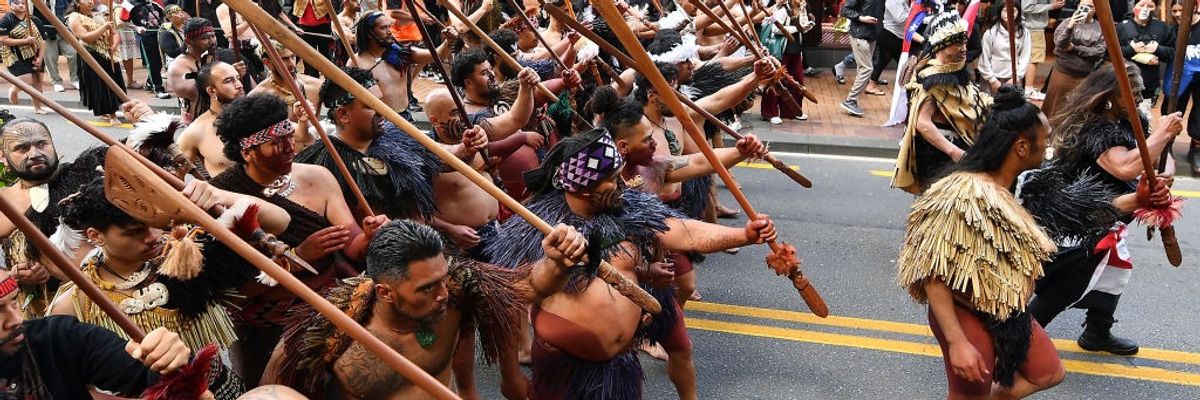
Māori and allies marched to protest a proposal to dilute Indigenous rights in Wellington, New Zealand on November 19, 2024.
Tens of Thousands March for Indigenous Rights at New Zealand Parliament
The Māori Party co-leader called Parliament's consideration of a bill that would reinterpret a key treaty "the deepest betrayal that we've ever had from a National government."
An estimated 55,000 people marched outside New Zealand's Parliament in Wellington on Tuesday to protest legislation that critics argue would dilute Indigenous rights by reinterpreting a treaty signed in 1840 by the British Crown and more than 500 Māori chiefs.
The peaceful demonstration was the culmination of a nine-day march, or hīkoi, that began at Cape Reinga, the northernmost point of New Zealand and the most spiritually significant place in the country for Māori, who are about 20% of the 5.3 million-person population.
Reuters reported that some "dressed in traditional attire with feathered headgear and cloaks and carried traditional Māori weapons, while others wore T-shirts emblazoned with Toitu te Tiriti (Honor the Treaty). Hundreds carried the Māori national flag."
"We have gathered in our tens of thousands, not just Māori, but others who support an inclusive, diverse, equal partnership that our country has been a world leader in pioneering."
The Treaty Principles Bill targeting the Treaty of Waitangi, or Te Tiriti o Waitangi, is being pushed by the ACT New Zealand party, a junior partner in the center-right coalition government, which also includes the National Party and New Zealand First (NZF).
Although the National and NZF have said that they are only supporting the legislation for the first of the three readings—meaning it is highly unlikely to pass—Debbie Ngarewa-Packer, co-leader of the Māori Party, or Te Pāti Māori, told the podcast The Front Page that even allowing it to be tabled is a "deep shame."
"We deserve better than to be used as political pawns," Ngarewa-Packer argued. "The fact that National has decided that we were tradeable and the mana of the coalition agreement was so much more important than the mana of Te Tiriti and tāngata is the deepest betrayal that we've ever had from a National government."
Pointing to U.S. President-elect Donald Trump, who won earlier this month after being ousted in the previous cycle, Ngarewa-Packer added, "We're a country that had the first women's vote, we have always punched above our weight in the anti-nuclear space, the anti-discrimination space, and here we are in 2024 with the sort of Trump-like culture coming into our politics."
The New York Times noted Tuesday that "a year before American voters' anger over the cost of living helped Donald J. Trump win the presidency, similar sentiments in New Zealand thrust in the nation's most conservative government in decades. Now, New Zealand bears little resemblance to the country recently led by Jacinda Ardern, whose brand of compassionate, progressive politics made her a global symbol of anti-Trump liberalism."
As the newspaper detailed:
The new government—a coalition of the main center-right party and two smaller, more populist ones—has reversed many of Ms. Ardern's policies. It has rescinded a world-leading ban on smoking for future generations, repealed rules designed to address climate change, and put a former arms industry lobbyist in charge of overhauling the nation's strict gun laws.
And in a country that has been celebrated for elevating the status of Māori, its Indigenous people, it has challenged their rights and the prominence of their culture and language in public life, driving a wedge into New Zealand society and setting off waves of protests.
Parliament was briefly suspended last Thursday after Maori members staged a traditional dance called a haka to disrupt the first reading. The haka—which garnered global attention—was started by Member of Parliament Hana-Rawhiti Maipi-Clarke, who tore up a copy of the bill.
Speaking to the Wellington crowd on Tuesday, Maipi-Clarke—who at 22 is the country's youngest MP—said, "We are the sovereign people of this land and the world is watching us here, not because of the system, not because of the rules, but because we haka."
Other participants in the Tuesday action included the Māori Queen, Ngā Wai Hono i te Pō, and Te Pāti Māori Co-Leader Rawiri Waititi, who led the crowd in a chant to "kill the bill."
According to The Northern Advocate, ACT Leader David Seymour, "the architect of the Treaty Principles Bill, was booed back inside the Beehive today by the tens of thousands protesting against his controversial bill."
While Seymour has framed the bill as an effort to end division and ensure equal rights for all, critics like Ella Henry, professor of Māori Entrepreneurship at Auckland University of Technology, warn that it is an effort to roll back New Zealand's previous progress in terms of relations with Indigenous people.
"So we have gathered in our tens of thousands, not just Māori, but others who support an inclusive, diverse, equal partnership that our country has been a world leader in pioneering," Henry told SBS News. "Those are the people who are marching."
Hayley Komene, who is from the Ngāti Kauwhata tribe, similarly told The Guardian that there was a "real strength and pride" at the march, and "there are people from lots of different backgrounds here for the same reason—it's beautiful."
Komene also slammed the government's Māori policies as "absolutely ridiculous" and stressed that "Te Tiriti is a constitutional document of our country."
We are at a crossroads
This country and this world are at a monumental crossroads. In a few short weeks, US voters will have an opportunity to beat back the forces of fascism and confront the billionaires who are rigging the economy, our media system, and our democracy, making it increasingly impossible for ordinary people to get by. We’re not just talking about the election. We’re talking about what must be done once these fascist elements are vanquished from power. We need a bolder set of solutions than what either major party has so far been willing to offer and a working-class movement ready to fight like hell for it. Trump didn't emerge from nowhere. The conditions that fueled MAGA authoritarianism were created by decades of radical neoliberal economic policies and a corrupt political system dominated by corporate interests. They slashed taxes on the super-rich, promising that the benefits would trickle down. They said giveaways to the corporate titans would make life more affordable for the rest of us. It was all bullshit. And when a bitter, betrayed populace searches for someone to blame, right-wing demagogues have little trouble finding scapegoats. People know when they're being lied to, but you won't hear any of this from the corporate media. Only independent journalism—powered and funded by people who believe in building a better world—can deliver truly trustworthy daily news. Our Fall Campaign is underway, and we need your help. To power our newsroom through the rest of the year, we need to raise $125,000 by midnight on October 31. So if you share our vision, please contribute whatever you can to sustain our work. |
An estimated 55,000 people marched outside New Zealand's Parliament in Wellington on Tuesday to protest legislation that critics argue would dilute Indigenous rights by reinterpreting a treaty signed in 1840 by the British Crown and more than 500 Māori chiefs.
The peaceful demonstration was the culmination of a nine-day march, or hīkoi, that began at Cape Reinga, the northernmost point of New Zealand and the most spiritually significant place in the country for Māori, who are about 20% of the 5.3 million-person population.
Reuters reported that some "dressed in traditional attire with feathered headgear and cloaks and carried traditional Māori weapons, while others wore T-shirts emblazoned with Toitu te Tiriti (Honor the Treaty). Hundreds carried the Māori national flag."
"We have gathered in our tens of thousands, not just Māori, but others who support an inclusive, diverse, equal partnership that our country has been a world leader in pioneering."
The Treaty Principles Bill targeting the Treaty of Waitangi, or Te Tiriti o Waitangi, is being pushed by the ACT New Zealand party, a junior partner in the center-right coalition government, which also includes the National Party and New Zealand First (NZF).
Although the National and NZF have said that they are only supporting the legislation for the first of the three readings—meaning it is highly unlikely to pass—Debbie Ngarewa-Packer, co-leader of the Māori Party, or Te Pāti Māori, told the podcast The Front Page that even allowing it to be tabled is a "deep shame."
"We deserve better than to be used as political pawns," Ngarewa-Packer argued. "The fact that National has decided that we were tradeable and the mana of the coalition agreement was so much more important than the mana of Te Tiriti and tāngata is the deepest betrayal that we've ever had from a National government."
Pointing to U.S. President-elect Donald Trump, who won earlier this month after being ousted in the previous cycle, Ngarewa-Packer added, "We're a country that had the first women's vote, we have always punched above our weight in the anti-nuclear space, the anti-discrimination space, and here we are in 2024 with the sort of Trump-like culture coming into our politics."
The New York Times noted Tuesday that "a year before American voters' anger over the cost of living helped Donald J. Trump win the presidency, similar sentiments in New Zealand thrust in the nation's most conservative government in decades. Now, New Zealand bears little resemblance to the country recently led by Jacinda Ardern, whose brand of compassionate, progressive politics made her a global symbol of anti-Trump liberalism."
As the newspaper detailed:
The new government—a coalition of the main center-right party and two smaller, more populist ones—has reversed many of Ms. Ardern's policies. It has rescinded a world-leading ban on smoking for future generations, repealed rules designed to address climate change, and put a former arms industry lobbyist in charge of overhauling the nation's strict gun laws.
And in a country that has been celebrated for elevating the status of Māori, its Indigenous people, it has challenged their rights and the prominence of their culture and language in public life, driving a wedge into New Zealand society and setting off waves of protests.
Parliament was briefly suspended last Thursday after Maori members staged a traditional dance called a haka to disrupt the first reading. The haka—which garnered global attention—was started by Member of Parliament Hana-Rawhiti Maipi-Clarke, who tore up a copy of the bill.
Speaking to the Wellington crowd on Tuesday, Maipi-Clarke—who at 22 is the country's youngest MP—said, "We are the sovereign people of this land and the world is watching us here, not because of the system, not because of the rules, but because we haka."
Other participants in the Tuesday action included the Māori Queen, Ngā Wai Hono i te Pō, and Te Pāti Māori Co-Leader Rawiri Waititi, who led the crowd in a chant to "kill the bill."
According to The Northern Advocate, ACT Leader David Seymour, "the architect of the Treaty Principles Bill, was booed back inside the Beehive today by the tens of thousands protesting against his controversial bill."
While Seymour has framed the bill as an effort to end division and ensure equal rights for all, critics like Ella Henry, professor of Māori Entrepreneurship at Auckland University of Technology, warn that it is an effort to roll back New Zealand's previous progress in terms of relations with Indigenous people.
"So we have gathered in our tens of thousands, not just Māori, but others who support an inclusive, diverse, equal partnership that our country has been a world leader in pioneering," Henry told SBS News. "Those are the people who are marching."
Hayley Komene, who is from the Ngāti Kauwhata tribe, similarly told The Guardian that there was a "real strength and pride" at the march, and "there are people from lots of different backgrounds here for the same reason—it's beautiful."
Komene also slammed the government's Māori policies as "absolutely ridiculous" and stressed that "Te Tiriti is a constitutional document of our country."
An estimated 55,000 people marched outside New Zealand's Parliament in Wellington on Tuesday to protest legislation that critics argue would dilute Indigenous rights by reinterpreting a treaty signed in 1840 by the British Crown and more than 500 Māori chiefs.
The peaceful demonstration was the culmination of a nine-day march, or hīkoi, that began at Cape Reinga, the northernmost point of New Zealand and the most spiritually significant place in the country for Māori, who are about 20% of the 5.3 million-person population.
Reuters reported that some "dressed in traditional attire with feathered headgear and cloaks and carried traditional Māori weapons, while others wore T-shirts emblazoned with Toitu te Tiriti (Honor the Treaty). Hundreds carried the Māori national flag."
"We have gathered in our tens of thousands, not just Māori, but others who support an inclusive, diverse, equal partnership that our country has been a world leader in pioneering."
The Treaty Principles Bill targeting the Treaty of Waitangi, or Te Tiriti o Waitangi, is being pushed by the ACT New Zealand party, a junior partner in the center-right coalition government, which also includes the National Party and New Zealand First (NZF).
Although the National and NZF have said that they are only supporting the legislation for the first of the three readings—meaning it is highly unlikely to pass—Debbie Ngarewa-Packer, co-leader of the Māori Party, or Te Pāti Māori, told the podcast The Front Page that even allowing it to be tabled is a "deep shame."
"We deserve better than to be used as political pawns," Ngarewa-Packer argued. "The fact that National has decided that we were tradeable and the mana of the coalition agreement was so much more important than the mana of Te Tiriti and tāngata is the deepest betrayal that we've ever had from a National government."
Pointing to U.S. President-elect Donald Trump, who won earlier this month after being ousted in the previous cycle, Ngarewa-Packer added, "We're a country that had the first women's vote, we have always punched above our weight in the anti-nuclear space, the anti-discrimination space, and here we are in 2024 with the sort of Trump-like culture coming into our politics."
The New York Times noted Tuesday that "a year before American voters' anger over the cost of living helped Donald J. Trump win the presidency, similar sentiments in New Zealand thrust in the nation's most conservative government in decades. Now, New Zealand bears little resemblance to the country recently led by Jacinda Ardern, whose brand of compassionate, progressive politics made her a global symbol of anti-Trump liberalism."
As the newspaper detailed:
The new government—a coalition of the main center-right party and two smaller, more populist ones—has reversed many of Ms. Ardern's policies. It has rescinded a world-leading ban on smoking for future generations, repealed rules designed to address climate change, and put a former arms industry lobbyist in charge of overhauling the nation's strict gun laws.
And in a country that has been celebrated for elevating the status of Māori, its Indigenous people, it has challenged their rights and the prominence of their culture and language in public life, driving a wedge into New Zealand society and setting off waves of protests.
Parliament was briefly suspended last Thursday after Maori members staged a traditional dance called a haka to disrupt the first reading. The haka—which garnered global attention—was started by Member of Parliament Hana-Rawhiti Maipi-Clarke, who tore up a copy of the bill.
Speaking to the Wellington crowd on Tuesday, Maipi-Clarke—who at 22 is the country's youngest MP—said, "We are the sovereign people of this land and the world is watching us here, not because of the system, not because of the rules, but because we haka."
Other participants in the Tuesday action included the Māori Queen, Ngā Wai Hono i te Pō, and Te Pāti Māori Co-Leader Rawiri Waititi, who led the crowd in a chant to "kill the bill."
According to The Northern Advocate, ACT Leader David Seymour, "the architect of the Treaty Principles Bill, was booed back inside the Beehive today by the tens of thousands protesting against his controversial bill."
While Seymour has framed the bill as an effort to end division and ensure equal rights for all, critics like Ella Henry, professor of Māori Entrepreneurship at Auckland University of Technology, warn that it is an effort to roll back New Zealand's previous progress in terms of relations with Indigenous people.
"So we have gathered in our tens of thousands, not just Māori, but others who support an inclusive, diverse, equal partnership that our country has been a world leader in pioneering," Henry told SBS News. "Those are the people who are marching."
Hayley Komene, who is from the Ngāti Kauwhata tribe, similarly told The Guardian that there was a "real strength and pride" at the march, and "there are people from lots of different backgrounds here for the same reason—it's beautiful."
Komene also slammed the government's Māori policies as "absolutely ridiculous" and stressed that "Te Tiriti is a constitutional document of our country."