SUBSCRIBE TO OUR FREE NEWSLETTER
Daily news & progressive opinion—funded by the people, not the corporations—delivered straight to your inbox.
5
#000000
#FFFFFF
To donate by check, phone, or other method, see our More Ways to Give page.
Daily news & progressive opinion—funded by the people, not the corporations—delivered straight to your inbox.
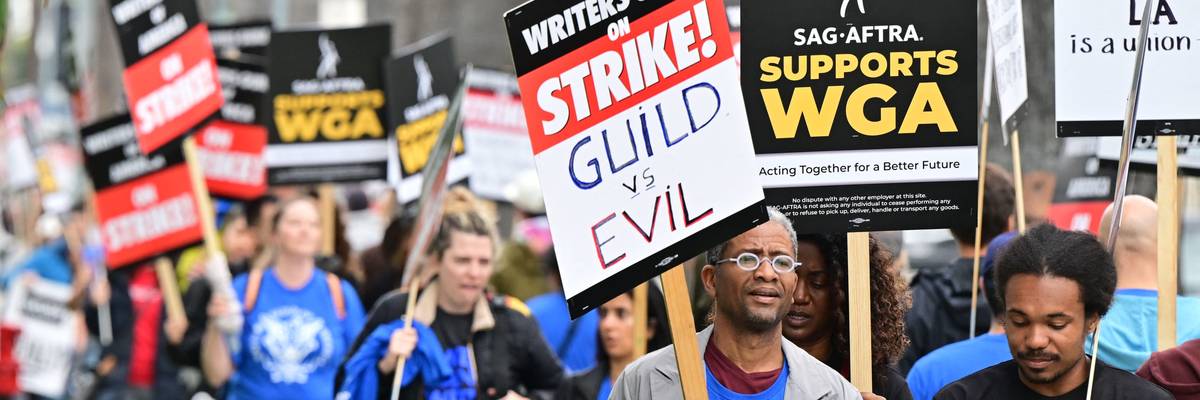
Writers on strike march with signs in front of Netflix headquarters in Hollywood, California on May 5, 2023.
"I wonder how it feels to have a group of people challenge your pay and worth," said one labor leader sarcastically.
Television writers who have been on strike for a month applauded a vote at Netflix's annual shareholder meeting on Thursday in which the streaming company's investors rejected an executive pay package that critics said exemplified the greed of Hollywood CEOs and their unfair treatment of the workers behind their lucrative content.
A majority of the shareholders voted against a pay package for executives including co-CEOs Greg Peters and Ted Sarandos as well as Netflix co-founder and board chair Reed Hastings.
Under the proposed pay package, Sarandos would earn up to $40 million in base salary, a bonus, and stock options, while Peters would take home $34.6 million.
"I wonder how it feels to have a group of people challenge your pay and worth,"
tweeted labor leader Lindsay Dougherty sardonically. Dougherty is secretary-treasurer of Teamsters Local 399 and represents more than 6,000 TV and film workers.
Meredith Stiehm, president of the Western branch of the Writers Guild of America (WGA), noted in the union's letter to studio executives last week that the shareholders were also asked to give retroactive approval to the company's 2022 CEO pay package, which amounted to $166 million.
"While investors have long taken issue with Netflix's executive pay, the compensation structure is even more egregious against the backdrop of the strike," wrote Stiehm, noting that in contrast to the executives' annual pay, "the proposed improvements the WGA currently has on the table would cost Netflix an estimated $68 million per year."
Thursday's vote was non-binding, and could be overturned by the company's board of directors, but writer Jelena Woehr tweeted that shareholders' rejection of Netflix's pay structure could ultimately pressure TV studios to meet the demands of the WGA, including higher residual pay and better compensation for writers who are hired before a show has been given a greenlight for production.
The WGA West noted that executive pay packages rarely fail to get approval from shareholders.
"Shareholders should send a message to Comcast that if the company could afford to spend $130 million on executive compensation last year," she wrote, "it can afford to pay the estimated $34 million per year that writers are asking for in contract improvements and put an end to this disruptive strike."
Dear Common Dreams reader, It’s been nearly 30 years since I co-founded Common Dreams with my late wife, Lina Newhouser. We had the radical notion that journalism should serve the public good, not corporate profits. It was clear to us from the outset what it would take to build such a project. No paid advertisements. No corporate sponsors. No millionaire publisher telling us what to think or do. Many people said we wouldn't last a year, but we proved those doubters wrong. Together with a tremendous team of journalists and dedicated staff, we built an independent media outlet free from the constraints of profits and corporate control. Our mission has always been simple: To inform. To inspire. To ignite change for the common good. Building Common Dreams was not easy. Our survival was never guaranteed. When you take on the most powerful forces—Wall Street greed, fossil fuel industry destruction, Big Tech lobbyists, and uber-rich oligarchs who have spent billions upon billions rigging the economy and democracy in their favor—the only bulwark you have is supporters who believe in your work. But here’s the urgent message from me today. It's never been this bad out there. And it's never been this hard to keep us going. At the very moment Common Dreams is most needed, the threats we face are intensifying. We need your support now more than ever. We don't accept corporate advertising and never will. We don't have a paywall because we don't think people should be blocked from critical news based on their ability to pay. Everything we do is funded by the donations of readers like you. When everyone does the little they can afford, we are strong. But if that support retreats or dries up, so do we. Will you donate now to make sure Common Dreams not only survives but thrives? —Craig Brown, Co-founder |
Television writers who have been on strike for a month applauded a vote at Netflix's annual shareholder meeting on Thursday in which the streaming company's investors rejected an executive pay package that critics said exemplified the greed of Hollywood CEOs and their unfair treatment of the workers behind their lucrative content.
A majority of the shareholders voted against a pay package for executives including co-CEOs Greg Peters and Ted Sarandos as well as Netflix co-founder and board chair Reed Hastings.
Under the proposed pay package, Sarandos would earn up to $40 million in base salary, a bonus, and stock options, while Peters would take home $34.6 million.
"I wonder how it feels to have a group of people challenge your pay and worth,"
tweeted labor leader Lindsay Dougherty sardonically. Dougherty is secretary-treasurer of Teamsters Local 399 and represents more than 6,000 TV and film workers.
Meredith Stiehm, president of the Western branch of the Writers Guild of America (WGA), noted in the union's letter to studio executives last week that the shareholders were also asked to give retroactive approval to the company's 2022 CEO pay package, which amounted to $166 million.
"While investors have long taken issue with Netflix's executive pay, the compensation structure is even more egregious against the backdrop of the strike," wrote Stiehm, noting that in contrast to the executives' annual pay, "the proposed improvements the WGA currently has on the table would cost Netflix an estimated $68 million per year."
Thursday's vote was non-binding, and could be overturned by the company's board of directors, but writer Jelena Woehr tweeted that shareholders' rejection of Netflix's pay structure could ultimately pressure TV studios to meet the demands of the WGA, including higher residual pay and better compensation for writers who are hired before a show has been given a greenlight for production.
The WGA West noted that executive pay packages rarely fail to get approval from shareholders.
"Shareholders should send a message to Comcast that if the company could afford to spend $130 million on executive compensation last year," she wrote, "it can afford to pay the estimated $34 million per year that writers are asking for in contract improvements and put an end to this disruptive strike."
Television writers who have been on strike for a month applauded a vote at Netflix's annual shareholder meeting on Thursday in which the streaming company's investors rejected an executive pay package that critics said exemplified the greed of Hollywood CEOs and their unfair treatment of the workers behind their lucrative content.
A majority of the shareholders voted against a pay package for executives including co-CEOs Greg Peters and Ted Sarandos as well as Netflix co-founder and board chair Reed Hastings.
Under the proposed pay package, Sarandos would earn up to $40 million in base salary, a bonus, and stock options, while Peters would take home $34.6 million.
"I wonder how it feels to have a group of people challenge your pay and worth,"
tweeted labor leader Lindsay Dougherty sardonically. Dougherty is secretary-treasurer of Teamsters Local 399 and represents more than 6,000 TV and film workers.
Meredith Stiehm, president of the Western branch of the Writers Guild of America (WGA), noted in the union's letter to studio executives last week that the shareholders were also asked to give retroactive approval to the company's 2022 CEO pay package, which amounted to $166 million.
"While investors have long taken issue with Netflix's executive pay, the compensation structure is even more egregious against the backdrop of the strike," wrote Stiehm, noting that in contrast to the executives' annual pay, "the proposed improvements the WGA currently has on the table would cost Netflix an estimated $68 million per year."
Thursday's vote was non-binding, and could be overturned by the company's board of directors, but writer Jelena Woehr tweeted that shareholders' rejection of Netflix's pay structure could ultimately pressure TV studios to meet the demands of the WGA, including higher residual pay and better compensation for writers who are hired before a show has been given a greenlight for production.
The WGA West noted that executive pay packages rarely fail to get approval from shareholders.
"Shareholders should send a message to Comcast that if the company could afford to spend $130 million on executive compensation last year," she wrote, "it can afford to pay the estimated $34 million per year that writers are asking for in contract improvements and put an end to this disruptive strike."