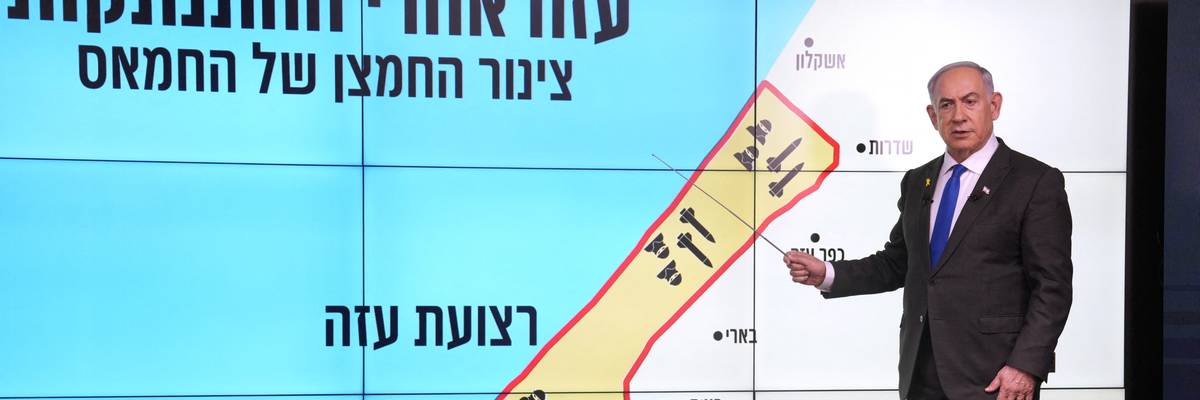
Israeli Prime Minister Benjamin Netanyahu speaks during a news conference in Jerusalem on September 2, 2024.
IDF Attacks Gazans Buying Bread as Netanyahu Tanks Cease-Fire Hopes
"The only appropriate course of action for the U.S. and other governments is to sanction and suspend weapons to Israel."
Israeli Prime Minister Benjamin Netanyahu reiterated his hardline demands for any cease-fire agreement with Hamas late Monday as he faced massive domestic protests over hostage deaths in the Gaza Strip, where Israel's U.S.-armed military continues to commit horrific atrocities and fuel a humanitarian emergency that has left much of the enclave's population at growing risk of disease and starvation.
Netanyahu said in his first public address since Israeli forces recovered the bodies of six hostages on Sunday that he is committed to Israeli control of the Philadelphi corridor, a narrow strip of land along Gaza's border with Egypt. Hamas has rejected that proposed condition as a nonstarter, calling it tantamount to "permanent occupation of the Gaza Strip."
Continued Israeli military presence at the Philadelphi corridor, which Netanyahu characterized as "the oxygen of Hamas," is among the new demands the far-right prime minister has pushed in cease-fire negotiations in recent weeks, prompting accusations that he is attempting to ensure the talks fail by pursuing conditions he knows are unacceptable to Hamas and other parties to the discussions, including Egypt.
Luciano Zaccara, professor in Gulf Studies at Qatar University, said in response to the prime minister's address that the Philadelphi corridor demand is "one of the main problems in reaching a cease-fire agreement," along with "the permanence of Israeli troops in the Rafah crossing."
"[U.S. President Joe] Biden said that Netanyahu is not doing enough, and the fact he doesn't want to change that red line will be, I think, the final issue that will break any prospect of future negotiations," Zaccara added.
"The Israeli government is not interested in a cease-fire or ending its mass slaughter of Palestinians."
Sarah Leah Whitson, executive director of Democracy for the Arab World Now (DAWN), said in a statement late Monday that Netanyahu's speech "once again made explicitly clear" that "the Israeli government is not interested in a cease-fire or ending its mass slaughter of Palestinians."
"The only appropriate course of action for the U.S. and other governments is to sanction and suspend weapons to Israel, as the U.K. today announced it will do, in compliance with domestic and international laws around the world," said Whitson.
Netanyahu's remarks, during which he used a map that erases the occupied West Bank, came amid global outrage over the Israeli military's latest deadly attack on Gaza civilians seeking food.
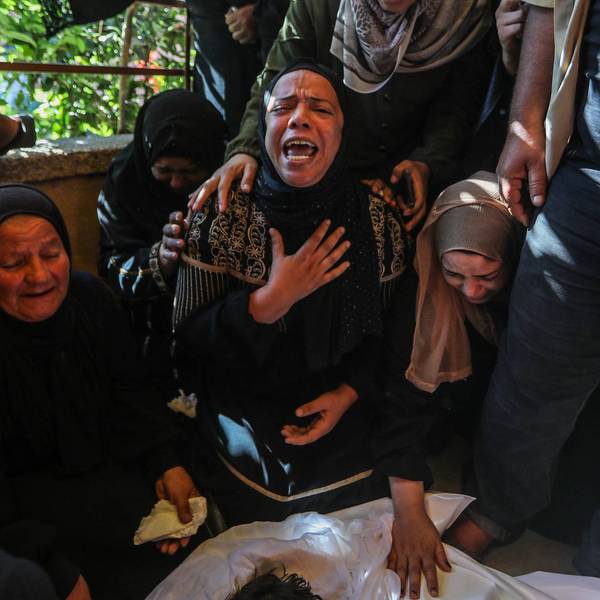
Al Jazeera's Moath al-Kahlout reported Monday that "the Israeli army deliberately targeted a group of civilians at the entrance" of a United Nations-run school in Gaza's Jabalia refugee camp.
"I am standing at the site that has been hit by Israeli forces," said al-Kahlout. "This is a bread stand and people and civilians were hit while buying bread from this mini stall. It is located at the entrance to the UNRWA school, which used to shelter thousands of Palestinians. This is a very crowded street as this is an evacuation center and thousands of people are using this place as a shelter."
At least eight people were reportedly killed in the Israeli attack.
In the West Bank, meanwhile, Israeli forces killed three Palestinian children on Sunday. Defense for Children International—Palestine (DCIP) said in a statement Monday that Israeli soldiers gunned down two of the boys "as they returned from Jenin after delivering bags of bread."
"Israeli forces have deliberately killed at least five Palestinian children in the northern occupied West Bank since launching a massive military incursion on Wednesday," said Ayed Abu Eqtaish, accountability program director at DCIP. "Countries must immediately enact an arms embargo and sanction the Israeli government to protect Palestinian children and their families."
We are at a crossroads
This country and this world are at a monumental crossroads. In a few short weeks, US voters will have an opportunity to beat back the forces of fascism and confront the billionaires who are rigging the economy, our media system, and our democracy, making it increasingly impossible for ordinary people to get by. We’re not just talking about the election. We’re talking about what must be done once these fascist elements are vanquished from power. We need a bolder set of solutions than what either major party has so far been willing to offer and a working-class movement ready to fight like hell for it. Trump didn't emerge from nowhere. The conditions that fueled MAGA authoritarianism were created by decades of radical neoliberal economic policies and a corrupt political system dominated by corporate interests. They slashed taxes on the super-rich, promising that the benefits would trickle down. They said giveaways to the corporate titans would make life more affordable for the rest of us. It was all bullshit. And when a bitter, betrayed populace searches for someone to blame, right-wing demagogues have little trouble finding scapegoats. People know when they're being lied to, but you won't hear any of this from the corporate media. Only independent journalism—powered and funded by people who believe in building a better world—can deliver truly trustworthy daily news. Our Fall Campaign is underway, and we need your help. To power our newsroom through the rest of the year, we need to raise $125,000 by midnight on October 31. So if you share our vision, please contribute whatever you can to sustain our work. |
Israeli Prime Minister Benjamin Netanyahu reiterated his hardline demands for any cease-fire agreement with Hamas late Monday as he faced massive domestic protests over hostage deaths in the Gaza Strip, where Israel's U.S.-armed military continues to commit horrific atrocities and fuel a humanitarian emergency that has left much of the enclave's population at growing risk of disease and starvation.
Netanyahu said in his first public address since Israeli forces recovered the bodies of six hostages on Sunday that he is committed to Israeli control of the Philadelphi corridor, a narrow strip of land along Gaza's border with Egypt. Hamas has rejected that proposed condition as a nonstarter, calling it tantamount to "permanent occupation of the Gaza Strip."
Continued Israeli military presence at the Philadelphi corridor, which Netanyahu characterized as "the oxygen of Hamas," is among the new demands the far-right prime minister has pushed in cease-fire negotiations in recent weeks, prompting accusations that he is attempting to ensure the talks fail by pursuing conditions he knows are unacceptable to Hamas and other parties to the discussions, including Egypt.
Luciano Zaccara, professor in Gulf Studies at Qatar University, said in response to the prime minister's address that the Philadelphi corridor demand is "one of the main problems in reaching a cease-fire agreement," along with "the permanence of Israeli troops in the Rafah crossing."
"[U.S. President Joe] Biden said that Netanyahu is not doing enough, and the fact he doesn't want to change that red line will be, I think, the final issue that will break any prospect of future negotiations," Zaccara added.
"The Israeli government is not interested in a cease-fire or ending its mass slaughter of Palestinians."
Sarah Leah Whitson, executive director of Democracy for the Arab World Now (DAWN), said in a statement late Monday that Netanyahu's speech "once again made explicitly clear" that "the Israeli government is not interested in a cease-fire or ending its mass slaughter of Palestinians."
"The only appropriate course of action for the U.S. and other governments is to sanction and suspend weapons to Israel, as the U.K. today announced it will do, in compliance with domestic and international laws around the world," said Whitson.
Netanyahu's remarks, during which he used a map that erases the occupied West Bank, came amid global outrage over the Israeli military's latest deadly attack on Gaza civilians seeking food.
Al Jazeera's Moath al-Kahlout reported Monday that "the Israeli army deliberately targeted a group of civilians at the entrance" of a United Nations-run school in Gaza's Jabalia refugee camp.
"I am standing at the site that has been hit by Israeli forces," said al-Kahlout. "This is a bread stand and people and civilians were hit while buying bread from this mini stall. It is located at the entrance to the UNRWA school, which used to shelter thousands of Palestinians. This is a very crowded street as this is an evacuation center and thousands of people are using this place as a shelter."
At least eight people were reportedly killed in the Israeli attack.
In the West Bank, meanwhile, Israeli forces killed three Palestinian children on Sunday. Defense for Children International—Palestine (DCIP) said in a statement Monday that Israeli soldiers gunned down two of the boys "as they returned from Jenin after delivering bags of bread."
"Israeli forces have deliberately killed at least five Palestinian children in the northern occupied West Bank since launching a massive military incursion on Wednesday," said Ayed Abu Eqtaish, accountability program director at DCIP. "Countries must immediately enact an arms embargo and sanction the Israeli government to protect Palestinian children and their families."
Israeli Prime Minister Benjamin Netanyahu reiterated his hardline demands for any cease-fire agreement with Hamas late Monday as he faced massive domestic protests over hostage deaths in the Gaza Strip, where Israel's U.S.-armed military continues to commit horrific atrocities and fuel a humanitarian emergency that has left much of the enclave's population at growing risk of disease and starvation.
Netanyahu said in his first public address since Israeli forces recovered the bodies of six hostages on Sunday that he is committed to Israeli control of the Philadelphi corridor, a narrow strip of land along Gaza's border with Egypt. Hamas has rejected that proposed condition as a nonstarter, calling it tantamount to "permanent occupation of the Gaza Strip."
Continued Israeli military presence at the Philadelphi corridor, which Netanyahu characterized as "the oxygen of Hamas," is among the new demands the far-right prime minister has pushed in cease-fire negotiations in recent weeks, prompting accusations that he is attempting to ensure the talks fail by pursuing conditions he knows are unacceptable to Hamas and other parties to the discussions, including Egypt.
Luciano Zaccara, professor in Gulf Studies at Qatar University, said in response to the prime minister's address that the Philadelphi corridor demand is "one of the main problems in reaching a cease-fire agreement," along with "the permanence of Israeli troops in the Rafah crossing."
"[U.S. President Joe] Biden said that Netanyahu is not doing enough, and the fact he doesn't want to change that red line will be, I think, the final issue that will break any prospect of future negotiations," Zaccara added.
"The Israeli government is not interested in a cease-fire or ending its mass slaughter of Palestinians."
Sarah Leah Whitson, executive director of Democracy for the Arab World Now (DAWN), said in a statement late Monday that Netanyahu's speech "once again made explicitly clear" that "the Israeli government is not interested in a cease-fire or ending its mass slaughter of Palestinians."
"The only appropriate course of action for the U.S. and other governments is to sanction and suspend weapons to Israel, as the U.K. today announced it will do, in compliance with domestic and international laws around the world," said Whitson.
Netanyahu's remarks, during which he used a map that erases the occupied West Bank, came amid global outrage over the Israeli military's latest deadly attack on Gaza civilians seeking food.
Al Jazeera's Moath al-Kahlout reported Monday that "the Israeli army deliberately targeted a group of civilians at the entrance" of a United Nations-run school in Gaza's Jabalia refugee camp.
"I am standing at the site that has been hit by Israeli forces," said al-Kahlout. "This is a bread stand and people and civilians were hit while buying bread from this mini stall. It is located at the entrance to the UNRWA school, which used to shelter thousands of Palestinians. This is a very crowded street as this is an evacuation center and thousands of people are using this place as a shelter."
At least eight people were reportedly killed in the Israeli attack.
In the West Bank, meanwhile, Israeli forces killed three Palestinian children on Sunday. Defense for Children International—Palestine (DCIP) said in a statement Monday that Israeli soldiers gunned down two of the boys "as they returned from Jenin after delivering bags of bread."
"Israeli forces have deliberately killed at least five Palestinian children in the northern occupied West Bank since launching a massive military incursion on Wednesday," said Ayed Abu Eqtaish, accountability program director at DCIP. "Countries must immediately enact an arms embargo and sanction the Israeli government to protect Palestinian children and their families."