SUBSCRIBE TO OUR FREE NEWSLETTER
Daily news & progressive opinion—funded by the people, not the corporations—delivered straight to your inbox.
5
#000000
#FFFFFF
To donate by check, phone, or other method, see our More Ways to Give page.
Daily news & progressive opinion—funded by the people, not the corporations—delivered straight to your inbox.
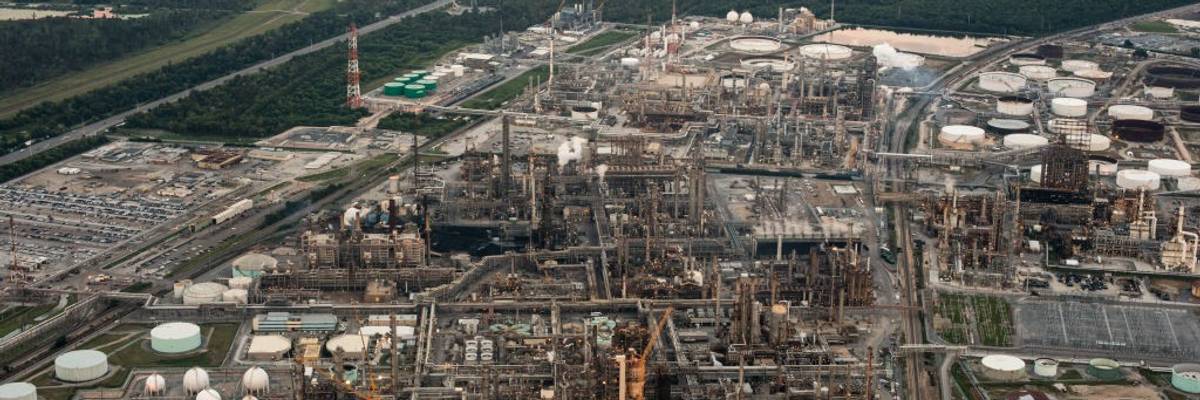
Chemical plants and factories line the roads of Baton Rouge, Louisiana, in a photograph from 2013. "Cancer Alley" is a roughly 85-mile stretch of petrochemical plants and residential home that runs from Baton Rouge to New Orleans.
"Louisiana has given industrial polluters open license to poison Black and brown communities for generations," and the new ruling from a Trump-appointed judge will only magnify the problem, a campaigner said.
A right-wing federal judge in Louisiana on Thursday permanently blocked two federal agencies from enforcing civil rights legislation that could protect Black communities from disproportionate pollution in the state, drawing condemnation from environmental justice advocates.
The two-page ruling, issued by U.S. District Court Judge James Cain, who was appointed to the federal bench in 2019 by then-President Donald Trump, is a setback in the push for accountability for corporate polluters, most notably in "Cancer Alley," a roughly 85-mile stretch that runs along the Mississippi River from Baton Rouge to New Orleans.
Cancer Alley is home to a disproportionate number of poor and working-class Black people who have highly escalated risks of cancer thanks to the long line of petrochemical plants in the corridor. A recent study showed that the air there is far worse than previously realized.
"Louisiana has given industrial polluters open license to poison Black and brown communities for generations, only to now have one court give it a permanent free pass to abandon its responsibilities," Patrice Simms, a vice president at Earthjustice, said in a statement.
The ruling forbids the U.S. Environmental Protection Agency (EPA) and the U.S. Department of Justice from enforcing "disparate-impact requirements" under Title VI the 1964 Civil Rights Act in the state of Louisiana. The ruling affects permitting for industrial projects and could, according to Earthjustice, even be applied to "basic services such as sewage, drinking water, and health services." Cain opted not to make the ruling effective nationwide.
The main events leading up to Thursday's decision began in January 2022, when Earthjustice filed a complaint to the EPA on behalf of St. John the Baptist Parish, a majority-Black community in the heart of Cancer Alley. The EPA then opened an investigation into whether Louisiana state agencies had failed to protect the parish from environmental health threats. The agency was preparing to negotiate reforms with the Louisiana Department of Environmental Quality. This was part of a nationwide EPA effort to tackle environmental racism.
However, Louisiana, like other states, fired back. In May 2023, then-Attorney General Jeff Landry, who is now governor, filed a lawsuit—the same lawsuit Cain ultimately ruled on—against the EPA to block the investigation. The next month, the EPA dropped its investigation, disappointing parish residents and human rights groups. The Intercept later reported that the agency dropped the investigation because of fear the state's case would reach the U.S. Supreme Court.
Cain could then have dropped Louisiana's suit, but, in a move that may have been aimed at preventing future such investigations, he moved forward with it, issuing a 77-page temporary injunction in January that laid the groundwork for today's far briefer decision, which made the ruling permanent.
In the temporary injunction, Cain put forth ahistorical and power-blind arguments about race that are common in right-wing circles.
"To be sure, if a decision-maker has to consider race, to decide, it has indeed participated in racism," the judge wrote. "Pollution does not discriminate."
Earthjustice warned that though Cain's ruling applies only in Louisiana, "it may embolden other states to seek similar exceptions and create a chilling effect on civil rights enforcement by other federal agencies."
Dear Common Dreams reader, It’s been nearly 30 years since I co-founded Common Dreams with my late wife, Lina Newhouser. We had the radical notion that journalism should serve the public good, not corporate profits. It was clear to us from the outset what it would take to build such a project. No paid advertisements. No corporate sponsors. No millionaire publisher telling us what to think or do. Many people said we wouldn't last a year, but we proved those doubters wrong. Together with a tremendous team of journalists and dedicated staff, we built an independent media outlet free from the constraints of profits and corporate control. Our mission has always been simple: To inform. To inspire. To ignite change for the common good. Building Common Dreams was not easy. Our survival was never guaranteed. When you take on the most powerful forces—Wall Street greed, fossil fuel industry destruction, Big Tech lobbyists, and uber-rich oligarchs who have spent billions upon billions rigging the economy and democracy in their favor—the only bulwark you have is supporters who believe in your work. But here’s the urgent message from me today. It's never been this bad out there. And it's never been this hard to keep us going. At the very moment Common Dreams is most needed, the threats we face are intensifying. We need your support now more than ever. We don't accept corporate advertising and never will. We don't have a paywall because we don't think people should be blocked from critical news based on their ability to pay. Everything we do is funded by the donations of readers like you. When everyone does the little they can afford, we are strong. But if that support retreats or dries up, so do we. Will you donate now to make sure Common Dreams not only survives but thrives? —Craig Brown, Co-founder |
A right-wing federal judge in Louisiana on Thursday permanently blocked two federal agencies from enforcing civil rights legislation that could protect Black communities from disproportionate pollution in the state, drawing condemnation from environmental justice advocates.
The two-page ruling, issued by U.S. District Court Judge James Cain, who was appointed to the federal bench in 2019 by then-President Donald Trump, is a setback in the push for accountability for corporate polluters, most notably in "Cancer Alley," a roughly 85-mile stretch that runs along the Mississippi River from Baton Rouge to New Orleans.
Cancer Alley is home to a disproportionate number of poor and working-class Black people who have highly escalated risks of cancer thanks to the long line of petrochemical plants in the corridor. A recent study showed that the air there is far worse than previously realized.
"Louisiana has given industrial polluters open license to poison Black and brown communities for generations, only to now have one court give it a permanent free pass to abandon its responsibilities," Patrice Simms, a vice president at Earthjustice, said in a statement.
The ruling forbids the U.S. Environmental Protection Agency (EPA) and the U.S. Department of Justice from enforcing "disparate-impact requirements" under Title VI the 1964 Civil Rights Act in the state of Louisiana. The ruling affects permitting for industrial projects and could, according to Earthjustice, even be applied to "basic services such as sewage, drinking water, and health services." Cain opted not to make the ruling effective nationwide.
The main events leading up to Thursday's decision began in January 2022, when Earthjustice filed a complaint to the EPA on behalf of St. John the Baptist Parish, a majority-Black community in the heart of Cancer Alley. The EPA then opened an investigation into whether Louisiana state agencies had failed to protect the parish from environmental health threats. The agency was preparing to negotiate reforms with the Louisiana Department of Environmental Quality. This was part of a nationwide EPA effort to tackle environmental racism.
However, Louisiana, like other states, fired back. In May 2023, then-Attorney General Jeff Landry, who is now governor, filed a lawsuit—the same lawsuit Cain ultimately ruled on—against the EPA to block the investigation. The next month, the EPA dropped its investigation, disappointing parish residents and human rights groups. The Intercept later reported that the agency dropped the investigation because of fear the state's case would reach the U.S. Supreme Court.
Cain could then have dropped Louisiana's suit, but, in a move that may have been aimed at preventing future such investigations, he moved forward with it, issuing a 77-page temporary injunction in January that laid the groundwork for today's far briefer decision, which made the ruling permanent.
In the temporary injunction, Cain put forth ahistorical and power-blind arguments about race that are common in right-wing circles.
"To be sure, if a decision-maker has to consider race, to decide, it has indeed participated in racism," the judge wrote. "Pollution does not discriminate."
Earthjustice warned that though Cain's ruling applies only in Louisiana, "it may embolden other states to seek similar exceptions and create a chilling effect on civil rights enforcement by other federal agencies."
A right-wing federal judge in Louisiana on Thursday permanently blocked two federal agencies from enforcing civil rights legislation that could protect Black communities from disproportionate pollution in the state, drawing condemnation from environmental justice advocates.
The two-page ruling, issued by U.S. District Court Judge James Cain, who was appointed to the federal bench in 2019 by then-President Donald Trump, is a setback in the push for accountability for corporate polluters, most notably in "Cancer Alley," a roughly 85-mile stretch that runs along the Mississippi River from Baton Rouge to New Orleans.
Cancer Alley is home to a disproportionate number of poor and working-class Black people who have highly escalated risks of cancer thanks to the long line of petrochemical plants in the corridor. A recent study showed that the air there is far worse than previously realized.
"Louisiana has given industrial polluters open license to poison Black and brown communities for generations, only to now have one court give it a permanent free pass to abandon its responsibilities," Patrice Simms, a vice president at Earthjustice, said in a statement.
The ruling forbids the U.S. Environmental Protection Agency (EPA) and the U.S. Department of Justice from enforcing "disparate-impact requirements" under Title VI the 1964 Civil Rights Act in the state of Louisiana. The ruling affects permitting for industrial projects and could, according to Earthjustice, even be applied to "basic services such as sewage, drinking water, and health services." Cain opted not to make the ruling effective nationwide.
The main events leading up to Thursday's decision began in January 2022, when Earthjustice filed a complaint to the EPA on behalf of St. John the Baptist Parish, a majority-Black community in the heart of Cancer Alley. The EPA then opened an investigation into whether Louisiana state agencies had failed to protect the parish from environmental health threats. The agency was preparing to negotiate reforms with the Louisiana Department of Environmental Quality. This was part of a nationwide EPA effort to tackle environmental racism.
However, Louisiana, like other states, fired back. In May 2023, then-Attorney General Jeff Landry, who is now governor, filed a lawsuit—the same lawsuit Cain ultimately ruled on—against the EPA to block the investigation. The next month, the EPA dropped its investigation, disappointing parish residents and human rights groups. The Intercept later reported that the agency dropped the investigation because of fear the state's case would reach the U.S. Supreme Court.
Cain could then have dropped Louisiana's suit, but, in a move that may have been aimed at preventing future such investigations, he moved forward with it, issuing a 77-page temporary injunction in January that laid the groundwork for today's far briefer decision, which made the ruling permanent.
In the temporary injunction, Cain put forth ahistorical and power-blind arguments about race that are common in right-wing circles.
"To be sure, if a decision-maker has to consider race, to decide, it has indeed participated in racism," the judge wrote. "Pollution does not discriminate."
Earthjustice warned that though Cain's ruling applies only in Louisiana, "it may embolden other states to seek similar exceptions and create a chilling effect on civil rights enforcement by other federal agencies."