

SUBSCRIBE TO OUR FREE NEWSLETTER
Daily news & progressive opinion—funded by the people, not the corporations—delivered straight to your inbox.
5
#000000
#FFFFFF
To donate by check, phone, or other method, see our More Ways to Give page.
Daily news & progressive opinion—funded by the people, not the corporations—delivered straight to your inbox.
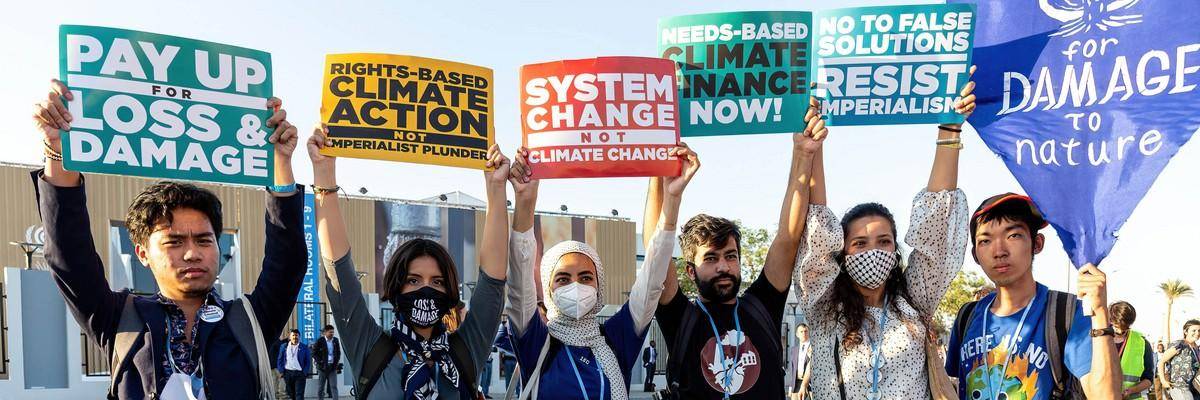
Activists protest for loss and damage reparations outside the United Nations Climate Change Conference (COP27) in Sharm el-Sheikh, Egypt on November 11, 2022.
"The damages resulting from the industry’s operations are disproportionately borne by people who did not cause the crisis," said one campaigner.
A modest tax on the world's seven largest oil and gas companies could generate hundreds of billions of dollars by the end of the decade to assist poor and vulnerable communities with the impact of the climate crisis, according to a new analysis out Monday from the groups Greenpeace International and Stamp Out Poverty.
The groups found that a tax on fossil fuel extraction, which would increase each year, combined with additional taxes on excess profits would grow the UN's Fund for Responding to Loss and Damage by more than 2,000%.
The loss and damage fund was created two years ago during the COP27 summit in Egypt with the aim of helping vulnerable countries confront the risings costs of climate disasters. Last year, a group of nations that included the United States made their first financial pledges to the fund—though the size of the U.S. pledge was panned as "paltry" by climate justice advocates. As one of the world's largest fossil fuel emitters, the initial pledge of $17.5 million was miniscule relative to the hundreds of billions in fossil fuel subsidies the U.S. government handed out in 2022.
Total commitments to the loss and damage fund currently hover at around $720 million, according to The New York Times.
This year, at COP29 in Baku, Azerbaijan, boosting the money in the fund is top of mind for a number of UN leaders.
"The $700 million is obviously insufficient," Jorge Moreira da Silva, the executive director of the United Nations Office for Project Services, told the Times.
"In an era of climate extremes, loss & damage finance is a must. And we must get serious about the level of finance required. At #COP29, I urged governments to deliver. In the name of justice," U.N. Sectary-General António Guterres wrote on X as the summit kicked off last week.
The joint analysis—which focused on world's largest publicly traded oil and gas companies, a group that includes ExxonMobil, Shell, Chevron, TotalEnergies, BP, Equinor, and Eni—illustrates how major polluters could be tapped to support the fund.
Stamp Out Poverty researchers have "found that home government collection of volume-based [climate damages tax] is feasible, with many countries already collecting volume-based revenue from oil and gas producers," according to the report.
The briefing notes that the Climate Damages Tax "would be a fee on the extraction of each tonne of coal, barrel of oil or cubic metre of gas, calculated at a consistent rate based on how much CO2e [carbon dioxide equivalent] is embedded within the fossil fuel."
To illustrate the impact of this tax, Greenpeace and Stamp Out Poverty looked at the estimated costs associated with multiple extreme weather events in 2024 alongside the hypothetical tax revenue.
Hurricane Beryl, which impacted multiple Caribbean islands, Mexico and the U.S. Gulf Coast, caused at least $6.6 billion in estimated damages and losses, according to the report. Meanwhile, imposing a hypothetical Climate Damages Tax on the 2023 carbon emissions from ExxonMobil alone would raise enough money to cover nearly half of that price tag.
ExxonMobil made $38.6 billion in adjusted earnings for 2023, so levying a tax of $5 per tonne of CO2e in 2023 would yield $3.19 billion. Over the first year, the combined revenue from all seven companies would be over $15 billion. As the levy was increased over the two following years, that annual figure would grow to over $37 billion. The analysis, according to its authors "contributes to the growing civil society call for long term tax on fossil fuel extraction."
The report comes on the heels of two weeks of worldwide protests by Greenpeace activists and allies, during which some demonstrators confronted fossil fuel executives about their role in fueling climate disaster and demanded that they "pay for the climate damage they cause."
Dear Common Dreams reader, It’s been nearly 30 years since I co-founded Common Dreams with my late wife, Lina Newhouser. We had the radical notion that journalism should serve the public good, not corporate profits. It was clear to us from the outset what it would take to build such a project. No paid advertisements. No corporate sponsors. No millionaire publisher telling us what to think or do. Many people said we wouldn't last a year, but we proved those doubters wrong. Together with a tremendous team of journalists and dedicated staff, we built an independent media outlet free from the constraints of profits and corporate control. Our mission has always been simple: To inform. To inspire. To ignite change for the common good. Building Common Dreams was not easy. Our survival was never guaranteed. When you take on the most powerful forces—Wall Street greed, fossil fuel industry destruction, Big Tech lobbyists, and uber-rich oligarchs who have spent billions upon billions rigging the economy and democracy in their favor—the only bulwark you have is supporters who believe in your work. But here’s the urgent message from me today. It's never been this bad out there. And it's never been this hard to keep us going. At the very moment Common Dreams is most needed, the threats we face are intensifying. We need your support now more than ever. We don't accept corporate advertising and never will. We don't have a paywall because we don't think people should be blocked from critical news based on their ability to pay. Everything we do is funded by the donations of readers like you. When everyone does the little they can afford, we are strong. But if that support retreats or dries up, so do we. Will you donate now to make sure Common Dreams not only survives but thrives? —Craig Brown, Co-founder |
A modest tax on the world's seven largest oil and gas companies could generate hundreds of billions of dollars by the end of the decade to assist poor and vulnerable communities with the impact of the climate crisis, according to a new analysis out Monday from the groups Greenpeace International and Stamp Out Poverty.
The groups found that a tax on fossil fuel extraction, which would increase each year, combined with additional taxes on excess profits would grow the UN's Fund for Responding to Loss and Damage by more than 2,000%.
The loss and damage fund was created two years ago during the COP27 summit in Egypt with the aim of helping vulnerable countries confront the risings costs of climate disasters. Last year, a group of nations that included the United States made their first financial pledges to the fund—though the size of the U.S. pledge was panned as "paltry" by climate justice advocates. As one of the world's largest fossil fuel emitters, the initial pledge of $17.5 million was miniscule relative to the hundreds of billions in fossil fuel subsidies the U.S. government handed out in 2022.
Total commitments to the loss and damage fund currently hover at around $720 million, according to The New York Times.
This year, at COP29 in Baku, Azerbaijan, boosting the money in the fund is top of mind for a number of UN leaders.
"The $700 million is obviously insufficient," Jorge Moreira da Silva, the executive director of the United Nations Office for Project Services, told the Times.
"In an era of climate extremes, loss & damage finance is a must. And we must get serious about the level of finance required. At #COP29, I urged governments to deliver. In the name of justice," U.N. Sectary-General António Guterres wrote on X as the summit kicked off last week.
The joint analysis—which focused on world's largest publicly traded oil and gas companies, a group that includes ExxonMobil, Shell, Chevron, TotalEnergies, BP, Equinor, and Eni—illustrates how major polluters could be tapped to support the fund.
Stamp Out Poverty researchers have "found that home government collection of volume-based [climate damages tax] is feasible, with many countries already collecting volume-based revenue from oil and gas producers," according to the report.
The briefing notes that the Climate Damages Tax "would be a fee on the extraction of each tonne of coal, barrel of oil or cubic metre of gas, calculated at a consistent rate based on how much CO2e [carbon dioxide equivalent] is embedded within the fossil fuel."
To illustrate the impact of this tax, Greenpeace and Stamp Out Poverty looked at the estimated costs associated with multiple extreme weather events in 2024 alongside the hypothetical tax revenue.
Hurricane Beryl, which impacted multiple Caribbean islands, Mexico and the U.S. Gulf Coast, caused at least $6.6 billion in estimated damages and losses, according to the report. Meanwhile, imposing a hypothetical Climate Damages Tax on the 2023 carbon emissions from ExxonMobil alone would raise enough money to cover nearly half of that price tag.
ExxonMobil made $38.6 billion in adjusted earnings for 2023, so levying a tax of $5 per tonne of CO2e in 2023 would yield $3.19 billion. Over the first year, the combined revenue from all seven companies would be over $15 billion. As the levy was increased over the two following years, that annual figure would grow to over $37 billion. The analysis, according to its authors "contributes to the growing civil society call for long term tax on fossil fuel extraction."
The report comes on the heels of two weeks of worldwide protests by Greenpeace activists and allies, during which some demonstrators confronted fossil fuel executives about their role in fueling climate disaster and demanded that they "pay for the climate damage they cause."
A modest tax on the world's seven largest oil and gas companies could generate hundreds of billions of dollars by the end of the decade to assist poor and vulnerable communities with the impact of the climate crisis, according to a new analysis out Monday from the groups Greenpeace International and Stamp Out Poverty.
The groups found that a tax on fossil fuel extraction, which would increase each year, combined with additional taxes on excess profits would grow the UN's Fund for Responding to Loss and Damage by more than 2,000%.
The loss and damage fund was created two years ago during the COP27 summit in Egypt with the aim of helping vulnerable countries confront the risings costs of climate disasters. Last year, a group of nations that included the United States made their first financial pledges to the fund—though the size of the U.S. pledge was panned as "paltry" by climate justice advocates. As one of the world's largest fossil fuel emitters, the initial pledge of $17.5 million was miniscule relative to the hundreds of billions in fossil fuel subsidies the U.S. government handed out in 2022.
Total commitments to the loss and damage fund currently hover at around $720 million, according to The New York Times.
This year, at COP29 in Baku, Azerbaijan, boosting the money in the fund is top of mind for a number of UN leaders.
"The $700 million is obviously insufficient," Jorge Moreira da Silva, the executive director of the United Nations Office for Project Services, told the Times.
"In an era of climate extremes, loss & damage finance is a must. And we must get serious about the level of finance required. At #COP29, I urged governments to deliver. In the name of justice," U.N. Sectary-General António Guterres wrote on X as the summit kicked off last week.
The joint analysis—which focused on world's largest publicly traded oil and gas companies, a group that includes ExxonMobil, Shell, Chevron, TotalEnergies, BP, Equinor, and Eni—illustrates how major polluters could be tapped to support the fund.
Stamp Out Poverty researchers have "found that home government collection of volume-based [climate damages tax] is feasible, with many countries already collecting volume-based revenue from oil and gas producers," according to the report.
The briefing notes that the Climate Damages Tax "would be a fee on the extraction of each tonne of coal, barrel of oil or cubic metre of gas, calculated at a consistent rate based on how much CO2e [carbon dioxide equivalent] is embedded within the fossil fuel."
To illustrate the impact of this tax, Greenpeace and Stamp Out Poverty looked at the estimated costs associated with multiple extreme weather events in 2024 alongside the hypothetical tax revenue.
Hurricane Beryl, which impacted multiple Caribbean islands, Mexico and the U.S. Gulf Coast, caused at least $6.6 billion in estimated damages and losses, according to the report. Meanwhile, imposing a hypothetical Climate Damages Tax on the 2023 carbon emissions from ExxonMobil alone would raise enough money to cover nearly half of that price tag.
ExxonMobil made $38.6 billion in adjusted earnings for 2023, so levying a tax of $5 per tonne of CO2e in 2023 would yield $3.19 billion. Over the first year, the combined revenue from all seven companies would be over $15 billion. As the levy was increased over the two following years, that annual figure would grow to over $37 billion. The analysis, according to its authors "contributes to the growing civil society call for long term tax on fossil fuel extraction."
The report comes on the heels of two weeks of worldwide protests by Greenpeace activists and allies, during which some demonstrators confronted fossil fuel executives about their role in fueling climate disaster and demanded that they "pay for the climate damage they cause."

