SUBSCRIBE TO OUR FREE NEWSLETTER
Daily news & progressive opinion—funded by the people, not the corporations—delivered straight to your inbox.
5
#000000
#FFFFFF
To donate by check, phone, or other method, see our More Ways to Give page.
Daily news & progressive opinion—funded by the people, not the corporations—delivered straight to your inbox.
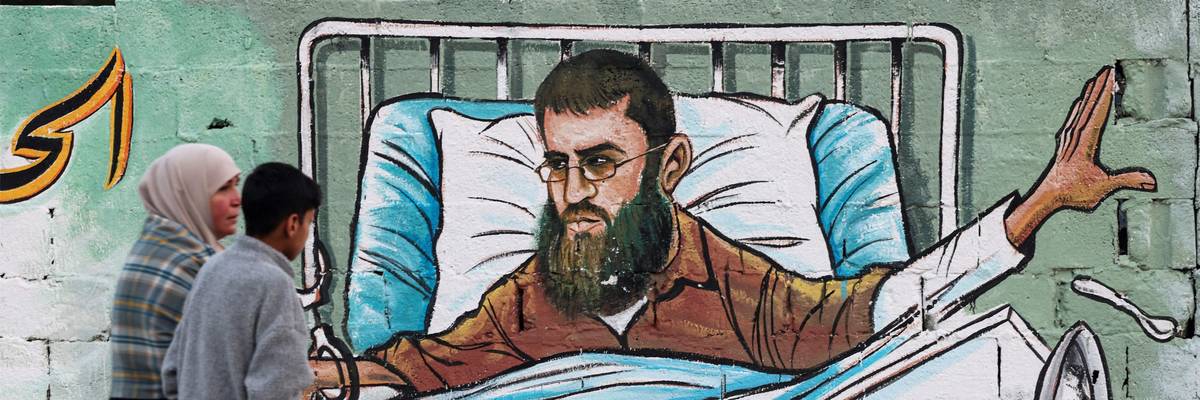
Palestinians walk by a mural of hunger-striking prisoner Khader Adnan in Gaza City on May 2, 2023—the day he died.
"Beyond the medical, professional, and ethical failures, Khader Adnan's story demonstrates Israel's fear of addressing the main issue against which Adnan protested for so many years—the injustices of the occupation," said one human rights group.
Resistance fighters in Gaza launched a volley of rockets at Israel amid protests and a call for a general strike after Palestinian activist Khader Adnan, who had been on a nearly three-month hunger strike, died in an Israeli prison early Tuesday.
Adnan, a 45-year-old father of nine and member of the resistance group Palestinian Islamic Jihad, died in Nitzan Prison in Ramle on the 87th day of a hunger strike to protest the Israeli practice of administrative detention—indefinite imprisonment without charge or trial.
"My flesh has melted, my bones have gnawed, and my strength has weakened from my imprisonment," Adnan said in his will, written a month ago. "My dear Palestinian people… do not despair. Regardless of what the occupiers do, and no matter how far they go in their injustice and aggression, our victory is close."
Palestinian media report hundreds of people gathered outside Adnan's home in the Israeli-occupied West Bank town of Arraba. Randa Musa, Adnan's widow, urged Palestinians to remain peaceful.
"We do not want a single drop of bloodshed," she said. "We do not want rockets to be fired, or a following strike on Gaza."
The Associated Press reports Palestinian militants launched 22 rockets from Gaza into southern Israel after Adnan's death, wounding three people—all foreigners—at a construction site in Sderot.
"This is an initial response to this heinous crime that will trigger reactions from our people," a coalition of Gaza-based Palestinian militant groups led by Hamas said in a statement.
Israeli Minister of National Security Itamar Ben-Gvir, who oversees Palestinian prisoners, responded to Adnan's death by ordering the Israel Prison Service (IPS) to show "zero-tolerance toward hunger strikes."
According to Middle East Eye, Adnan spent a total of 316 days on hunger strikes in various Israeli prisons over the past two decades:
Growing up under Israeli military rule, Adnan became involved in anti-occupation work from a young age.
He was first arrested by Israeli forces while he was still a student at Birzeit University in Ramallah, where he graduated with a degree in economic mathematics in 2001.
His first detention lasted four months without charge or trial. He was then rearrested and held for another year.
Over the next two decades, Adnan was arrested 10 more times, spending a total of eight years behind bars.
The Palestinian Prisoners Society (PPS), an umbrella advocacy group, called Adnan a "true fighter" who waged "long battles with his empty stomach to gain his freedom."
"Today we lost a true leader," PPS said in a statement, adding that Adnan "carried the voice of Palestinian prisoners to the world."
Physicians for Human Rights Israel (PHRI) tweeted: "When he was arrested for the last time, Adnan again protested his detention. The hunger strike was Adnan's last resort to nonviolently protest the oppression he and his people face every day. These strikes were a protest not only against his own administrative detentions but also against its decadeslong use as a tool of political oppression against Palestinians."
PHRI continued:
For weeks, following a severe deterioration in his condition, we tried to convince the Health Ministry, Kaplan Hospital, and the Israel Prison Service to keep Adnan hospitalized. The IPS clinic was not equipped to monitor Adnan and could not provide emergency intervention in case of sudden deterioration. After visiting Adnan a few days before his death, PHRI chairperson Dr. Lina Qasem-Hassan published a medical report warning that he faces imminent death and must be urgently transferred to a hospital for observation. Unfortunately, our efforts to raise these concerns judicially and individually fell on deaf ears. Even the request to allow Adnan's family to visit him in prison—when it was clear this may be their final meeting—was denied by the IPS.
"Beyond the medical, professional, and ethical failures, Khader Adnan's story demonstrates Israel's fear of addressing the main issue against which Adnan protested for so many years—the injustices of the occupation," the group added.
PPS said Adnan is the 237th Palestinian since 1967 to die while imprisoned by Israel. According to Middle East Eye, at least seven other Palestinians previously died while on hunger strike in Israeli prisons; the last such death occurred in 1992.
"By incarcerating him in the first place and purposely subjecting him to medical neglect the Israeli regime is responsible for Khader Adnan's death. But it is important to understand hunger strikes as acts of resistance in a context where prisoners are stripped of all agency," Palestinian academic Yara Hawari tweeted.
"Whilst it may seem that by inflicting damage on the body is oppositional to liberation, hunger strikes allow prisoners to seize back the power of life and death from the incarceration regime," she added. "This is why they have long been used as a tool of resistance around the world."
According to the Addameer Prisoner Support and Human Rights Association, a Palestinian advocacy group, Israel currently imprisons nearly 5,000 Palestinians, including more than 1,000 administrative detainees and 160 children.
Dear Common Dreams reader, It’s been nearly 30 years since I co-founded Common Dreams with my late wife, Lina Newhouser. We had the radical notion that journalism should serve the public good, not corporate profits. It was clear to us from the outset what it would take to build such a project. No paid advertisements. No corporate sponsors. No millionaire publisher telling us what to think or do. Many people said we wouldn't last a year, but we proved those doubters wrong. Together with a tremendous team of journalists and dedicated staff, we built an independent media outlet free from the constraints of profits and corporate control. Our mission has always been simple: To inform. To inspire. To ignite change for the common good. Building Common Dreams was not easy. Our survival was never guaranteed. When you take on the most powerful forces—Wall Street greed, fossil fuel industry destruction, Big Tech lobbyists, and uber-rich oligarchs who have spent billions upon billions rigging the economy and democracy in their favor—the only bulwark you have is supporters who believe in your work. But here’s the urgent message from me today. It's never been this bad out there. And it's never been this hard to keep us going. At the very moment Common Dreams is most needed, the threats we face are intensifying. We need your support now more than ever. We don't accept corporate advertising and never will. We don't have a paywall because we don't think people should be blocked from critical news based on their ability to pay. Everything we do is funded by the donations of readers like you. When everyone does the little they can afford, we are strong. But if that support retreats or dries up, so do we. Will you donate now to make sure Common Dreams not only survives but thrives? —Craig Brown, Co-founder |
Resistance fighters in Gaza launched a volley of rockets at Israel amid protests and a call for a general strike after Palestinian activist Khader Adnan, who had been on a nearly three-month hunger strike, died in an Israeli prison early Tuesday.
Adnan, a 45-year-old father of nine and member of the resistance group Palestinian Islamic Jihad, died in Nitzan Prison in Ramle on the 87th day of a hunger strike to protest the Israeli practice of administrative detention—indefinite imprisonment without charge or trial.
"My flesh has melted, my bones have gnawed, and my strength has weakened from my imprisonment," Adnan said in his will, written a month ago. "My dear Palestinian people… do not despair. Regardless of what the occupiers do, and no matter how far they go in their injustice and aggression, our victory is close."
Palestinian media report hundreds of people gathered outside Adnan's home in the Israeli-occupied West Bank town of Arraba. Randa Musa, Adnan's widow, urged Palestinians to remain peaceful.
"We do not want a single drop of bloodshed," she said. "We do not want rockets to be fired, or a following strike on Gaza."
The Associated Press reports Palestinian militants launched 22 rockets from Gaza into southern Israel after Adnan's death, wounding three people—all foreigners—at a construction site in Sderot.
"This is an initial response to this heinous crime that will trigger reactions from our people," a coalition of Gaza-based Palestinian militant groups led by Hamas said in a statement.
Israeli Minister of National Security Itamar Ben-Gvir, who oversees Palestinian prisoners, responded to Adnan's death by ordering the Israel Prison Service (IPS) to show "zero-tolerance toward hunger strikes."
According to Middle East Eye, Adnan spent a total of 316 days on hunger strikes in various Israeli prisons over the past two decades:
Growing up under Israeli military rule, Adnan became involved in anti-occupation work from a young age.
He was first arrested by Israeli forces while he was still a student at Birzeit University in Ramallah, where he graduated with a degree in economic mathematics in 2001.
His first detention lasted four months without charge or trial. He was then rearrested and held for another year.
Over the next two decades, Adnan was arrested 10 more times, spending a total of eight years behind bars.
The Palestinian Prisoners Society (PPS), an umbrella advocacy group, called Adnan a "true fighter" who waged "long battles with his empty stomach to gain his freedom."
"Today we lost a true leader," PPS said in a statement, adding that Adnan "carried the voice of Palestinian prisoners to the world."
Physicians for Human Rights Israel (PHRI) tweeted: "When he was arrested for the last time, Adnan again protested his detention. The hunger strike was Adnan's last resort to nonviolently protest the oppression he and his people face every day. These strikes were a protest not only against his own administrative detentions but also against its decadeslong use as a tool of political oppression against Palestinians."
PHRI continued:
For weeks, following a severe deterioration in his condition, we tried to convince the Health Ministry, Kaplan Hospital, and the Israel Prison Service to keep Adnan hospitalized. The IPS clinic was not equipped to monitor Adnan and could not provide emergency intervention in case of sudden deterioration. After visiting Adnan a few days before his death, PHRI chairperson Dr. Lina Qasem-Hassan published a medical report warning that he faces imminent death and must be urgently transferred to a hospital for observation. Unfortunately, our efforts to raise these concerns judicially and individually fell on deaf ears. Even the request to allow Adnan's family to visit him in prison—when it was clear this may be their final meeting—was denied by the IPS.
"Beyond the medical, professional, and ethical failures, Khader Adnan's story demonstrates Israel's fear of addressing the main issue against which Adnan protested for so many years—the injustices of the occupation," the group added.
PPS said Adnan is the 237th Palestinian since 1967 to die while imprisoned by Israel. According to Middle East Eye, at least seven other Palestinians previously died while on hunger strike in Israeli prisons; the last such death occurred in 1992.
"By incarcerating him in the first place and purposely subjecting him to medical neglect the Israeli regime is responsible for Khader Adnan's death. But it is important to understand hunger strikes as acts of resistance in a context where prisoners are stripped of all agency," Palestinian academic Yara Hawari tweeted.
"Whilst it may seem that by inflicting damage on the body is oppositional to liberation, hunger strikes allow prisoners to seize back the power of life and death from the incarceration regime," she added. "This is why they have long been used as a tool of resistance around the world."
According to the Addameer Prisoner Support and Human Rights Association, a Palestinian advocacy group, Israel currently imprisons nearly 5,000 Palestinians, including more than 1,000 administrative detainees and 160 children.
Resistance fighters in Gaza launched a volley of rockets at Israel amid protests and a call for a general strike after Palestinian activist Khader Adnan, who had been on a nearly three-month hunger strike, died in an Israeli prison early Tuesday.
Adnan, a 45-year-old father of nine and member of the resistance group Palestinian Islamic Jihad, died in Nitzan Prison in Ramle on the 87th day of a hunger strike to protest the Israeli practice of administrative detention—indefinite imprisonment without charge or trial.
"My flesh has melted, my bones have gnawed, and my strength has weakened from my imprisonment," Adnan said in his will, written a month ago. "My dear Palestinian people… do not despair. Regardless of what the occupiers do, and no matter how far they go in their injustice and aggression, our victory is close."
Palestinian media report hundreds of people gathered outside Adnan's home in the Israeli-occupied West Bank town of Arraba. Randa Musa, Adnan's widow, urged Palestinians to remain peaceful.
"We do not want a single drop of bloodshed," she said. "We do not want rockets to be fired, or a following strike on Gaza."
The Associated Press reports Palestinian militants launched 22 rockets from Gaza into southern Israel after Adnan's death, wounding three people—all foreigners—at a construction site in Sderot.
"This is an initial response to this heinous crime that will trigger reactions from our people," a coalition of Gaza-based Palestinian militant groups led by Hamas said in a statement.
Israeli Minister of National Security Itamar Ben-Gvir, who oversees Palestinian prisoners, responded to Adnan's death by ordering the Israel Prison Service (IPS) to show "zero-tolerance toward hunger strikes."
According to Middle East Eye, Adnan spent a total of 316 days on hunger strikes in various Israeli prisons over the past two decades:
Growing up under Israeli military rule, Adnan became involved in anti-occupation work from a young age.
He was first arrested by Israeli forces while he was still a student at Birzeit University in Ramallah, where he graduated with a degree in economic mathematics in 2001.
His first detention lasted four months without charge or trial. He was then rearrested and held for another year.
Over the next two decades, Adnan was arrested 10 more times, spending a total of eight years behind bars.
The Palestinian Prisoners Society (PPS), an umbrella advocacy group, called Adnan a "true fighter" who waged "long battles with his empty stomach to gain his freedom."
"Today we lost a true leader," PPS said in a statement, adding that Adnan "carried the voice of Palestinian prisoners to the world."
Physicians for Human Rights Israel (PHRI) tweeted: "When he was arrested for the last time, Adnan again protested his detention. The hunger strike was Adnan's last resort to nonviolently protest the oppression he and his people face every day. These strikes were a protest not only against his own administrative detentions but also against its decadeslong use as a tool of political oppression against Palestinians."
PHRI continued:
For weeks, following a severe deterioration in his condition, we tried to convince the Health Ministry, Kaplan Hospital, and the Israel Prison Service to keep Adnan hospitalized. The IPS clinic was not equipped to monitor Adnan and could not provide emergency intervention in case of sudden deterioration. After visiting Adnan a few days before his death, PHRI chairperson Dr. Lina Qasem-Hassan published a medical report warning that he faces imminent death and must be urgently transferred to a hospital for observation. Unfortunately, our efforts to raise these concerns judicially and individually fell on deaf ears. Even the request to allow Adnan's family to visit him in prison—when it was clear this may be their final meeting—was denied by the IPS.
"Beyond the medical, professional, and ethical failures, Khader Adnan's story demonstrates Israel's fear of addressing the main issue against which Adnan protested for so many years—the injustices of the occupation," the group added.
PPS said Adnan is the 237th Palestinian since 1967 to die while imprisoned by Israel. According to Middle East Eye, at least seven other Palestinians previously died while on hunger strike in Israeli prisons; the last such death occurred in 1992.
"By incarcerating him in the first place and purposely subjecting him to medical neglect the Israeli regime is responsible for Khader Adnan's death. But it is important to understand hunger strikes as acts of resistance in a context where prisoners are stripped of all agency," Palestinian academic Yara Hawari tweeted.
"Whilst it may seem that by inflicting damage on the body is oppositional to liberation, hunger strikes allow prisoners to seize back the power of life and death from the incarceration regime," she added. "This is why they have long been used as a tool of resistance around the world."
According to the Addameer Prisoner Support and Human Rights Association, a Palestinian advocacy group, Israel currently imprisons nearly 5,000 Palestinians, including more than 1,000 administrative detainees and 160 children.