SUBSCRIBE TO OUR FREE NEWSLETTER
Daily news & progressive opinion—funded by the people, not the corporations—delivered straight to your inbox.
5
#000000
#FFFFFF
To donate by check, phone, or other method, see our More Ways to Give page.
Daily news & progressive opinion—funded by the people, not the corporations—delivered straight to your inbox.
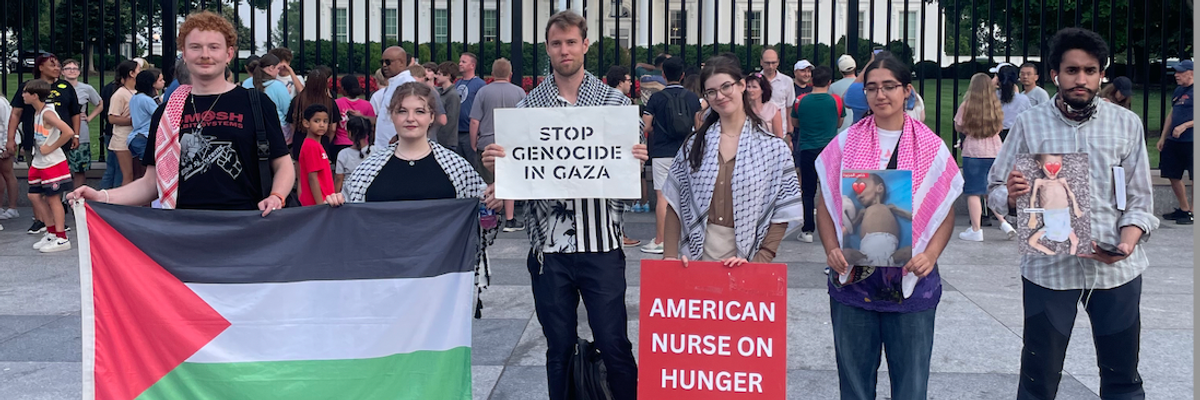
Nurse Practitioner Jennifer Koonings and other advocates stand outside the White House to protest the genocide in Gaza.
As Palestinians starve, we cannot be comfortable.
I am on day 10 of a voluntary hunger strike while Palestinians in Gaza are being starved to death. It is estimated that 3,500 children are at risk of death in the coming weeks due to starvation. Two million people are trapped in the besieged Gaza strip, almost half of them under the age of 18.
There were roughly 1,000 aid trucks entering weekly before May 6, 2024—grossly inadequate for the need—but since the start of Israel’s ground offensive into Rafah, only a trickle of aid trucks have made it through, deepening the humanitarian crisis and man-made famine.
I was recently a participant on the latest Gaza Freedom Flotilla that aimed to bring 5,500 metric tons of lifesaving humanitarian aid to Gaza, but unfortunately that mission was sabotaged by Israeli interference with the country that flagged our ships.
After being in Palestine, in the West Bank, you realize that the people living there look at us like we have the power to change something.
Concerned civilians are not even allowed to carry out our moral and legal obligation of delivering lifesaving aid when our governments fail to do so. The aid we hoped to bring directly to Gaza ended up getting delivered to Egypt to get in the miles-long line of trucks waiting to cross the border, some of the perishable food rotting away in the desert sun.
Hoping there would only be a minor delay until we boarded the flotilla, I made my way to the West Bank to be a human rights observer. In my two weeks in the West Bank, it felt like I had stepped onto the set of a horror movie. An acutely horrific phase of a fast genocide is being carried out in Gaza, but in the West Bank, a slow genocide is happening—funded and fueled by the United States and kept hidden away from the rest of the world.
Palestinians in the West Bank are kept under the Israeli Occupation’s thumb—their every move surveilled, their every step controlled, their every word policed. The sense of being “caged in” is inescapable. When I left the West Bank, I felt like I could finally take a deep breath again.
After I left the West Bank while in Amman, Jordan, in my seemingly helpless desperation about the sadistic suffering imposed on the Palestinians, I thought about starting a hunger strike. I decided to begin one upon my return to the United States and have that strike in front of U.S. President Joe Biden at the White House.
People have asked me: Why do you do a hunger strike?
Do you really think you will change anything with this?
Why don’t you just eat something?
And my explanation for being on a hunger strike is: After being in Palestine, in the West Bank, you realize that the people living there look at us like we have the power to change something.
Being too comfortable in our excess here in the West has kept many from being true allies in this fight.
Here in America we may think our voices do not matter, but we have access to the people, the decisions, and the places of incredible power that those in the colonized world could never dream of—inside our Congress and across from the White House.
In Palestine, when people would hear I was from America, in every conversation, they wanted to talk about the encampments on college campuses. They were so proud of the students, and the encampments gave them some hope after the occupation had taken just about everything from them.
What I saw and experienced in the West Bank was so frightening that I knew upon my return I had to do all I could to amplify their truth and fight for the liberation of Palestine and her people: I owed it to them.
As many have reminded me, I am not famous, I am not important. I am just one person—yes, I know this.
But how could I amplify my one small voice as loud as possible to advocate for those suffering under this sadistic occupation? I decided to go to the belly of the beast (D.C.) and protest in a way that’s not the norm.
People look at me like I am suffering needlessly for the cause, and I would point out that while I have not eaten in 10 days, I still have every other comfort available to me, while those in Gaza do not. I have clean water. I have a hot shower and indoor plumbing. I have a bed to sleep in and a roof over my head. I am not being bombed.
So no, I am not suffering. Giving up the “comfort” of food has been an incredible exercise in solidarity and something I would recommend to almost anyone interested in trying.
Being too comfortable in our excess here in the West has kept many from being true allies in this fight. We all need to get uncomfortable. Discomfort is how we grow. Comfortable is stagnant, and we cannot afford to be stagnant in this moment. Our world, our people, and our future depend on it.
Dear Common Dreams reader, It’s been nearly 30 years since I co-founded Common Dreams with my late wife, Lina Newhouser. We had the radical notion that journalism should serve the public good, not corporate profits. It was clear to us from the outset what it would take to build such a project. No paid advertisements. No corporate sponsors. No millionaire publisher telling us what to think or do. Many people said we wouldn't last a year, but we proved those doubters wrong. Together with a tremendous team of journalists and dedicated staff, we built an independent media outlet free from the constraints of profits and corporate control. Our mission has always been simple: To inform. To inspire. To ignite change for the common good. Building Common Dreams was not easy. Our survival was never guaranteed. When you take on the most powerful forces—Wall Street greed, fossil fuel industry destruction, Big Tech lobbyists, and uber-rich oligarchs who have spent billions upon billions rigging the economy and democracy in their favor—the only bulwark you have is supporters who believe in your work. But here’s the urgent message from me today. It's never been this bad out there. And it's never been this hard to keep us going. At the very moment Common Dreams is most needed, the threats we face are intensifying. We need your support now more than ever. We don't accept corporate advertising and never will. We don't have a paywall because we don't think people should be blocked from critical news based on their ability to pay. Everything we do is funded by the donations of readers like you. When everyone does the little they can afford, we are strong. But if that support retreats or dries up, so do we. Will you donate now to make sure Common Dreams not only survives but thrives? —Craig Brown, Co-founder |
I am on day 10 of a voluntary hunger strike while Palestinians in Gaza are being starved to death. It is estimated that 3,500 children are at risk of death in the coming weeks due to starvation. Two million people are trapped in the besieged Gaza strip, almost half of them under the age of 18.
There were roughly 1,000 aid trucks entering weekly before May 6, 2024—grossly inadequate for the need—but since the start of Israel’s ground offensive into Rafah, only a trickle of aid trucks have made it through, deepening the humanitarian crisis and man-made famine.
I was recently a participant on the latest Gaza Freedom Flotilla that aimed to bring 5,500 metric tons of lifesaving humanitarian aid to Gaza, but unfortunately that mission was sabotaged by Israeli interference with the country that flagged our ships.
After being in Palestine, in the West Bank, you realize that the people living there look at us like we have the power to change something.
Concerned civilians are not even allowed to carry out our moral and legal obligation of delivering lifesaving aid when our governments fail to do so. The aid we hoped to bring directly to Gaza ended up getting delivered to Egypt to get in the miles-long line of trucks waiting to cross the border, some of the perishable food rotting away in the desert sun.
Hoping there would only be a minor delay until we boarded the flotilla, I made my way to the West Bank to be a human rights observer. In my two weeks in the West Bank, it felt like I had stepped onto the set of a horror movie. An acutely horrific phase of a fast genocide is being carried out in Gaza, but in the West Bank, a slow genocide is happening—funded and fueled by the United States and kept hidden away from the rest of the world.
Palestinians in the West Bank are kept under the Israeli Occupation’s thumb—their every move surveilled, their every step controlled, their every word policed. The sense of being “caged in” is inescapable. When I left the West Bank, I felt like I could finally take a deep breath again.
After I left the West Bank while in Amman, Jordan, in my seemingly helpless desperation about the sadistic suffering imposed on the Palestinians, I thought about starting a hunger strike. I decided to begin one upon my return to the United States and have that strike in front of U.S. President Joe Biden at the White House.
People have asked me: Why do you do a hunger strike?
Do you really think you will change anything with this?
Why don’t you just eat something?
And my explanation for being on a hunger strike is: After being in Palestine, in the West Bank, you realize that the people living there look at us like we have the power to change something.
Being too comfortable in our excess here in the West has kept many from being true allies in this fight.
Here in America we may think our voices do not matter, but we have access to the people, the decisions, and the places of incredible power that those in the colonized world could never dream of—inside our Congress and across from the White House.
In Palestine, when people would hear I was from America, in every conversation, they wanted to talk about the encampments on college campuses. They were so proud of the students, and the encampments gave them some hope after the occupation had taken just about everything from them.
What I saw and experienced in the West Bank was so frightening that I knew upon my return I had to do all I could to amplify their truth and fight for the liberation of Palestine and her people: I owed it to them.
As many have reminded me, I am not famous, I am not important. I am just one person—yes, I know this.
But how could I amplify my one small voice as loud as possible to advocate for those suffering under this sadistic occupation? I decided to go to the belly of the beast (D.C.) and protest in a way that’s not the norm.
People look at me like I am suffering needlessly for the cause, and I would point out that while I have not eaten in 10 days, I still have every other comfort available to me, while those in Gaza do not. I have clean water. I have a hot shower and indoor plumbing. I have a bed to sleep in and a roof over my head. I am not being bombed.
So no, I am not suffering. Giving up the “comfort” of food has been an incredible exercise in solidarity and something I would recommend to almost anyone interested in trying.
Being too comfortable in our excess here in the West has kept many from being true allies in this fight. We all need to get uncomfortable. Discomfort is how we grow. Comfortable is stagnant, and we cannot afford to be stagnant in this moment. Our world, our people, and our future depend on it.
I am on day 10 of a voluntary hunger strike while Palestinians in Gaza are being starved to death. It is estimated that 3,500 children are at risk of death in the coming weeks due to starvation. Two million people are trapped in the besieged Gaza strip, almost half of them under the age of 18.
There were roughly 1,000 aid trucks entering weekly before May 6, 2024—grossly inadequate for the need—but since the start of Israel’s ground offensive into Rafah, only a trickle of aid trucks have made it through, deepening the humanitarian crisis and man-made famine.
I was recently a participant on the latest Gaza Freedom Flotilla that aimed to bring 5,500 metric tons of lifesaving humanitarian aid to Gaza, but unfortunately that mission was sabotaged by Israeli interference with the country that flagged our ships.
After being in Palestine, in the West Bank, you realize that the people living there look at us like we have the power to change something.
Concerned civilians are not even allowed to carry out our moral and legal obligation of delivering lifesaving aid when our governments fail to do so. The aid we hoped to bring directly to Gaza ended up getting delivered to Egypt to get in the miles-long line of trucks waiting to cross the border, some of the perishable food rotting away in the desert sun.
Hoping there would only be a minor delay until we boarded the flotilla, I made my way to the West Bank to be a human rights observer. In my two weeks in the West Bank, it felt like I had stepped onto the set of a horror movie. An acutely horrific phase of a fast genocide is being carried out in Gaza, but in the West Bank, a slow genocide is happening—funded and fueled by the United States and kept hidden away from the rest of the world.
Palestinians in the West Bank are kept under the Israeli Occupation’s thumb—their every move surveilled, their every step controlled, their every word policed. The sense of being “caged in” is inescapable. When I left the West Bank, I felt like I could finally take a deep breath again.
After I left the West Bank while in Amman, Jordan, in my seemingly helpless desperation about the sadistic suffering imposed on the Palestinians, I thought about starting a hunger strike. I decided to begin one upon my return to the United States and have that strike in front of U.S. President Joe Biden at the White House.
People have asked me: Why do you do a hunger strike?
Do you really think you will change anything with this?
Why don’t you just eat something?
And my explanation for being on a hunger strike is: After being in Palestine, in the West Bank, you realize that the people living there look at us like we have the power to change something.
Being too comfortable in our excess here in the West has kept many from being true allies in this fight.
Here in America we may think our voices do not matter, but we have access to the people, the decisions, and the places of incredible power that those in the colonized world could never dream of—inside our Congress and across from the White House.
In Palestine, when people would hear I was from America, in every conversation, they wanted to talk about the encampments on college campuses. They were so proud of the students, and the encampments gave them some hope after the occupation had taken just about everything from them.
What I saw and experienced in the West Bank was so frightening that I knew upon my return I had to do all I could to amplify their truth and fight for the liberation of Palestine and her people: I owed it to them.
As many have reminded me, I am not famous, I am not important. I am just one person—yes, I know this.
But how could I amplify my one small voice as loud as possible to advocate for those suffering under this sadistic occupation? I decided to go to the belly of the beast (D.C.) and protest in a way that’s not the norm.
People look at me like I am suffering needlessly for the cause, and I would point out that while I have not eaten in 10 days, I still have every other comfort available to me, while those in Gaza do not. I have clean water. I have a hot shower and indoor plumbing. I have a bed to sleep in and a roof over my head. I am not being bombed.
So no, I am not suffering. Giving up the “comfort” of food has been an incredible exercise in solidarity and something I would recommend to almost anyone interested in trying.
Being too comfortable in our excess here in the West has kept many from being true allies in this fight. We all need to get uncomfortable. Discomfort is how we grow. Comfortable is stagnant, and we cannot afford to be stagnant in this moment. Our world, our people, and our future depend on it.