SUBSCRIBE TO OUR FREE NEWSLETTER
Daily news & progressive opinion—funded by the people, not the corporations—delivered straight to your inbox.
5
#000000
#FFFFFF
To donate by check, phone, or other method, see our More Ways to Give page.
Daily news & progressive opinion—funded by the people, not the corporations—delivered straight to your inbox.
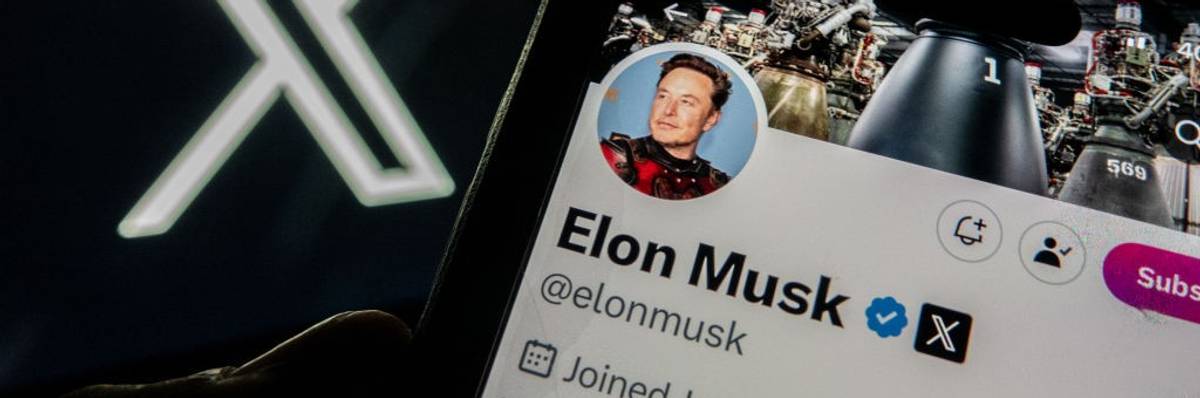
A photo illustration shows X owner Elon Musk on a smartphone on September 8, 2024.
"It's not about a violation of X's policies," wrote Ken Klippenstein. "What else would you call this but politically motivated?"
Independent journalist Ken Klippenstein said Friday that he was privately informed by the Elon Musk-owned social media platform X that his account has been permanently banned, a decision that Klippenstein argued was "politically motivated."
X, formerly Twitter, suspended Klippenstein on Thursday after he posted to the platform a link to his Substack article containing a download link for a 271-page dossier that Republican nominee Donald Trump's campaign prepared to vet Sen. JD Vance (R-Ohio), who was ultimately chosen as the former president's running mate.
The dossier, Klippenstein noted, "reportedly comes from an alleged Iranian government hack of the Trump campaign," and major news outlets such as Politico declined opportunities to publish it. The U.S. Justice Department on Friday charged three men with allegedly carrying out a hack against the Trump campaign.
In a statement issued late Thursday afternoon as it faced backlash, X said that "Ken Klippenstein was temporarily suspended for violating our rules on posting unredacted private personal information, specifically Sen. Vance's physical addresses and the majority of his Social Security number."
On Friday, Klippenstein—who has previously worked for The Intercept and The Nation—shared a private message from X informing him that his account is "permanently in read-only mode, which means you can't post, Repost, or Like content" or "create new accounts."
"The two-step dance X is doing here—avoiding further backlash by pretending like my suspension is just a temporary thing, no big deal, while privately suspending me permanently—only makes sense when you consider the political dimensions," Klippenstein wrote on his Substack. "Elon Musk is an outspoken supporter of Donald Trump and JD Vance's political campaign. The Wall Street Journal reported that he promised $45 million a month for a pro-Trump Super PAC (Musk subsequently disputed this). So X clearly doesn't want to give the appearance that my ban was politically motivated. But a careful look at the pretext X cites for my suspension makes it obvious that this is political."
"The media is going to see the case of the Vance dossier and conclude that reporting on similar documents isn't worth losing their social media accounts over."
Observers have noted the obvious parallels between the social media platform's handling of the Vance dossier and a 2020 New York Post story on the contents of Hunter Biden's laptop. At the time, Twitter—not yet under Musk's ownership—placed restrictions on sharing of the Post story, limits that were reversed months later.
Klippenstein noted Friday that Musk—a self-proclaimed "free speech absolutist"—was "so incensed by Twitter's previous owners' decision to block the story on its platform that he took the extraordinary step of releasing Twitter's internal correspondence to independent journalist Matt Taibbi so he could report on how the decision came about. (I support his transparency, by the way.)"
"Now, anyone posting a link to my article finds their account locked, which is exactly how Twitter handled the Hunter Biden laptop story by the New York Post," Klippenstein wrote.
Journalist Lee Fang pointed out shortly after Klippenstein's ban that "the Hunter Biden laptop—which had newsworthy info that was fair game—also had personal dox info, far more than this Vance doc."
"The Biden laptop had bank/credit cards, personal addresses, nudity, etc," Fang added. "You can still link to those Biden docs on X, but Vance doc link banned?"
Klippenstein argued that "the biggest tell that this is political" is that X did not offer him a chance to restore his account by removing the post that resulted in his ban, as the platform typically does with users accused of violating its policies.
"As an experiment, last night my editor and I decided to redact all 'private' information from the Vance dossier in my story here at Substack," Klippenstein wrote Friday. "Despite filing an appeal in which I mention this, I remain banned. So it's not about a violation of X's policies. What else would you call this but politically motivated?"
"Boo hoo, poor me, I lost my account. That's not the point here," he continued. "If you were frustrated with the media's refusal to publish the Vance dossier, prepare for a future that's worse. The media is going to see the case of the Vance dossier and conclude that reporting on similar documents isn't worth losing their social media accounts over. Why take the risk when you can just blather on about the horse race? As always, it's the public that loses out the most."
Dear Common Dreams reader, It’s been nearly 30 years since I co-founded Common Dreams with my late wife, Lina Newhouser. We had the radical notion that journalism should serve the public good, not corporate profits. It was clear to us from the outset what it would take to build such a project. No paid advertisements. No corporate sponsors. No millionaire publisher telling us what to think or do. Many people said we wouldn't last a year, but we proved those doubters wrong. Together with a tremendous team of journalists and dedicated staff, we built an independent media outlet free from the constraints of profits and corporate control. Our mission has always been simple: To inform. To inspire. To ignite change for the common good. Building Common Dreams was not easy. Our survival was never guaranteed. When you take on the most powerful forces—Wall Street greed, fossil fuel industry destruction, Big Tech lobbyists, and uber-rich oligarchs who have spent billions upon billions rigging the economy and democracy in their favor—the only bulwark you have is supporters who believe in your work. But here’s the urgent message from me today. It's never been this bad out there. And it's never been this hard to keep us going. At the very moment Common Dreams is most needed, the threats we face are intensifying. We need your support now more than ever. We don't accept corporate advertising and never will. We don't have a paywall because we don't think people should be blocked from critical news based on their ability to pay. Everything we do is funded by the donations of readers like you. When everyone does the little they can afford, we are strong. But if that support retreats or dries up, so do we. Will you donate now to make sure Common Dreams not only survives but thrives? —Craig Brown, Co-founder |
Independent journalist Ken Klippenstein said Friday that he was privately informed by the Elon Musk-owned social media platform X that his account has been permanently banned, a decision that Klippenstein argued was "politically motivated."
X, formerly Twitter, suspended Klippenstein on Thursday after he posted to the platform a link to his Substack article containing a download link for a 271-page dossier that Republican nominee Donald Trump's campaign prepared to vet Sen. JD Vance (R-Ohio), who was ultimately chosen as the former president's running mate.
The dossier, Klippenstein noted, "reportedly comes from an alleged Iranian government hack of the Trump campaign," and major news outlets such as Politico declined opportunities to publish it. The U.S. Justice Department on Friday charged three men with allegedly carrying out a hack against the Trump campaign.
In a statement issued late Thursday afternoon as it faced backlash, X said that "Ken Klippenstein was temporarily suspended for violating our rules on posting unredacted private personal information, specifically Sen. Vance's physical addresses and the majority of his Social Security number."
On Friday, Klippenstein—who has previously worked for The Intercept and The Nation—shared a private message from X informing him that his account is "permanently in read-only mode, which means you can't post, Repost, or Like content" or "create new accounts."
"The two-step dance X is doing here—avoiding further backlash by pretending like my suspension is just a temporary thing, no big deal, while privately suspending me permanently—only makes sense when you consider the political dimensions," Klippenstein wrote on his Substack. "Elon Musk is an outspoken supporter of Donald Trump and JD Vance's political campaign. The Wall Street Journal reported that he promised $45 million a month for a pro-Trump Super PAC (Musk subsequently disputed this). So X clearly doesn't want to give the appearance that my ban was politically motivated. But a careful look at the pretext X cites for my suspension makes it obvious that this is political."
"The media is going to see the case of the Vance dossier and conclude that reporting on similar documents isn't worth losing their social media accounts over."
Observers have noted the obvious parallels between the social media platform's handling of the Vance dossier and a 2020 New York Post story on the contents of Hunter Biden's laptop. At the time, Twitter—not yet under Musk's ownership—placed restrictions on sharing of the Post story, limits that were reversed months later.
Klippenstein noted Friday that Musk—a self-proclaimed "free speech absolutist"—was "so incensed by Twitter's previous owners' decision to block the story on its platform that he took the extraordinary step of releasing Twitter's internal correspondence to independent journalist Matt Taibbi so he could report on how the decision came about. (I support his transparency, by the way.)"
"Now, anyone posting a link to my article finds their account locked, which is exactly how Twitter handled the Hunter Biden laptop story by the New York Post," Klippenstein wrote.
Journalist Lee Fang pointed out shortly after Klippenstein's ban that "the Hunter Biden laptop—which had newsworthy info that was fair game—also had personal dox info, far more than this Vance doc."
"The Biden laptop had bank/credit cards, personal addresses, nudity, etc," Fang added. "You can still link to those Biden docs on X, but Vance doc link banned?"
Klippenstein argued that "the biggest tell that this is political" is that X did not offer him a chance to restore his account by removing the post that resulted in his ban, as the platform typically does with users accused of violating its policies.
"As an experiment, last night my editor and I decided to redact all 'private' information from the Vance dossier in my story here at Substack," Klippenstein wrote Friday. "Despite filing an appeal in which I mention this, I remain banned. So it's not about a violation of X's policies. What else would you call this but politically motivated?"
"Boo hoo, poor me, I lost my account. That's not the point here," he continued. "If you were frustrated with the media's refusal to publish the Vance dossier, prepare for a future that's worse. The media is going to see the case of the Vance dossier and conclude that reporting on similar documents isn't worth losing their social media accounts over. Why take the risk when you can just blather on about the horse race? As always, it's the public that loses out the most."
Independent journalist Ken Klippenstein said Friday that he was privately informed by the Elon Musk-owned social media platform X that his account has been permanently banned, a decision that Klippenstein argued was "politically motivated."
X, formerly Twitter, suspended Klippenstein on Thursday after he posted to the platform a link to his Substack article containing a download link for a 271-page dossier that Republican nominee Donald Trump's campaign prepared to vet Sen. JD Vance (R-Ohio), who was ultimately chosen as the former president's running mate.
The dossier, Klippenstein noted, "reportedly comes from an alleged Iranian government hack of the Trump campaign," and major news outlets such as Politico declined opportunities to publish it. The U.S. Justice Department on Friday charged three men with allegedly carrying out a hack against the Trump campaign.
In a statement issued late Thursday afternoon as it faced backlash, X said that "Ken Klippenstein was temporarily suspended for violating our rules on posting unredacted private personal information, specifically Sen. Vance's physical addresses and the majority of his Social Security number."
On Friday, Klippenstein—who has previously worked for The Intercept and The Nation—shared a private message from X informing him that his account is "permanently in read-only mode, which means you can't post, Repost, or Like content" or "create new accounts."
"The two-step dance X is doing here—avoiding further backlash by pretending like my suspension is just a temporary thing, no big deal, while privately suspending me permanently—only makes sense when you consider the political dimensions," Klippenstein wrote on his Substack. "Elon Musk is an outspoken supporter of Donald Trump and JD Vance's political campaign. The Wall Street Journal reported that he promised $45 million a month for a pro-Trump Super PAC (Musk subsequently disputed this). So X clearly doesn't want to give the appearance that my ban was politically motivated. But a careful look at the pretext X cites for my suspension makes it obvious that this is political."
"The media is going to see the case of the Vance dossier and conclude that reporting on similar documents isn't worth losing their social media accounts over."
Observers have noted the obvious parallels between the social media platform's handling of the Vance dossier and a 2020 New York Post story on the contents of Hunter Biden's laptop. At the time, Twitter—not yet under Musk's ownership—placed restrictions on sharing of the Post story, limits that were reversed months later.
Klippenstein noted Friday that Musk—a self-proclaimed "free speech absolutist"—was "so incensed by Twitter's previous owners' decision to block the story on its platform that he took the extraordinary step of releasing Twitter's internal correspondence to independent journalist Matt Taibbi so he could report on how the decision came about. (I support his transparency, by the way.)"
"Now, anyone posting a link to my article finds their account locked, which is exactly how Twitter handled the Hunter Biden laptop story by the New York Post," Klippenstein wrote.
Journalist Lee Fang pointed out shortly after Klippenstein's ban that "the Hunter Biden laptop—which had newsworthy info that was fair game—also had personal dox info, far more than this Vance doc."
"The Biden laptop had bank/credit cards, personal addresses, nudity, etc," Fang added. "You can still link to those Biden docs on X, but Vance doc link banned?"
Klippenstein argued that "the biggest tell that this is political" is that X did not offer him a chance to restore his account by removing the post that resulted in his ban, as the platform typically does with users accused of violating its policies.
"As an experiment, last night my editor and I decided to redact all 'private' information from the Vance dossier in my story here at Substack," Klippenstein wrote Friday. "Despite filing an appeal in which I mention this, I remain banned. So it's not about a violation of X's policies. What else would you call this but politically motivated?"
"Boo hoo, poor me, I lost my account. That's not the point here," he continued. "If you were frustrated with the media's refusal to publish the Vance dossier, prepare for a future that's worse. The media is going to see the case of the Vance dossier and conclude that reporting on similar documents isn't worth losing their social media accounts over. Why take the risk when you can just blather on about the horse race? As always, it's the public that loses out the most."