SUBSCRIBE TO OUR FREE NEWSLETTER
Daily news & progressive opinion—funded by the people, not the corporations—delivered straight to your inbox.
5
#000000
#FFFFFF
To donate by check, phone, or other method, see our More Ways to Give page.
Daily news & progressive opinion—funded by the people, not the corporations—delivered straight to your inbox.
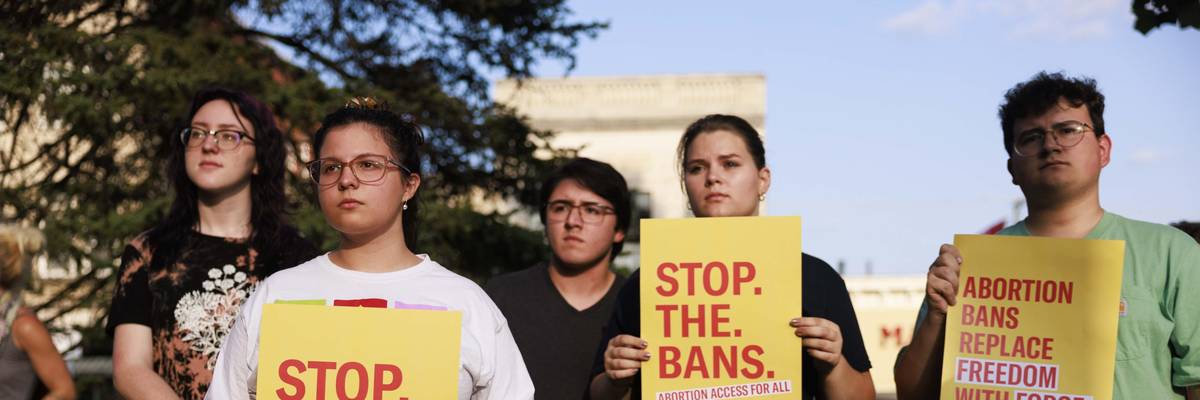
Abortion rights activists gather at the Monroe County Courthouse in Bloomington, Indiana for a protest vigil a few hours before the state's near total abortion ban goes into effect on September 15, 2022.
"This is an attempt to blatantly disregard the will of the people."
Kansas voters left little room for interpretation when a sizable majority voted in August to reject a ballot measure that would have paved the way for a statewide abortion ban—but that isn't stopping Republicans from attempting to force residents to continue unwanted pregnancies by imposing city-by-city bans.
State Sen. Chase Blasi on Thursday introduced Senate Bill 65, which would authorize cities and counties "to enact local laws more stringent than state law regarding regulation of abortion" and would repeal the state law which prohibits "political subdivisions" from enacting bans.
The proposal's language makes clear that cities and counties would not be permitted to protect abortion rights if a state ban were to be imposed in the future—only to pass bans if abortion care remains legal in Kansas.
"The irony of this bill is too much," Anamarie Rebori Simmons, a spokesperson for Planned Parenthood Great Plains Votes, told The New Republic on Friday. "The party that tried to remove fundamental protections from the state constitution didn't get the outcome they wanted when Kansans overwhelmingly supported abortion access. This is an attempt to blatantly disregard the will of the people."
Blasi proposed the legislation five months after 59% of Kansas voters rejected a ballot measure which would have removed the right to abortion care from the state constitution. In 2019, the Kansas Supreme Court ruled that under the constitution, pregnant people have a "right to personal autonomy" and that Kansans could legally obtain abortion care even if Roe v. Wade was overturned as it was last year.
The rejection of the ballot measure in August was seen as a major victory for abortion rights advocates and a clear illustration of the fact that Americans in both red and blue states "want to make their own decisions about abortion," as Nancy Northrup, president and CEO of the Center for Reproductive Rights, said at the time.
Since then, voters in Michigan, California, Kentucky, Montana, and Vermont have been asked whether they support or oppose restricting reproductive rights, and in all the states they have voted in favor of abortion access.
Washington Post reporter Caroline Kitchener noted that proposals like Blasi's "could become part of the playbook for combating the success of ballot initiatives that protect the right to abortion."
In Kansas, Rebori Simmons told The New Republic, "Abortion rights won in a landslide, including in the home county of the bill’s sponsor."
"Politicians serve as the voice of the people in the legislature," she said, "and Republican lawmakers should know better than to silence those they represent."
Dear Common Dreams reader, It’s been nearly 30 years since I co-founded Common Dreams with my late wife, Lina Newhouser. We had the radical notion that journalism should serve the public good, not corporate profits. It was clear to us from the outset what it would take to build such a project. No paid advertisements. No corporate sponsors. No millionaire publisher telling us what to think or do. Many people said we wouldn't last a year, but we proved those doubters wrong. Together with a tremendous team of journalists and dedicated staff, we built an independent media outlet free from the constraints of profits and corporate control. Our mission has always been simple: To inform. To inspire. To ignite change for the common good. Building Common Dreams was not easy. Our survival was never guaranteed. When you take on the most powerful forces—Wall Street greed, fossil fuel industry destruction, Big Tech lobbyists, and uber-rich oligarchs who have spent billions upon billions rigging the economy and democracy in their favor—the only bulwark you have is supporters who believe in your work. But here’s the urgent message from me today. It's never been this bad out there. And it's never been this hard to keep us going. At the very moment Common Dreams is most needed, the threats we face are intensifying. We need your support now more than ever. We don't accept corporate advertising and never will. We don't have a paywall because we don't think people should be blocked from critical news based on their ability to pay. Everything we do is funded by the donations of readers like you. When everyone does the little they can afford, we are strong. But if that support retreats or dries up, so do we. Will you donate now to make sure Common Dreams not only survives but thrives? —Craig Brown, Co-founder |
Kansas voters left little room for interpretation when a sizable majority voted in August to reject a ballot measure that would have paved the way for a statewide abortion ban—but that isn't stopping Republicans from attempting to force residents to continue unwanted pregnancies by imposing city-by-city bans.
State Sen. Chase Blasi on Thursday introduced Senate Bill 65, which would authorize cities and counties "to enact local laws more stringent than state law regarding regulation of abortion" and would repeal the state law which prohibits "political subdivisions" from enacting bans.
The proposal's language makes clear that cities and counties would not be permitted to protect abortion rights if a state ban were to be imposed in the future—only to pass bans if abortion care remains legal in Kansas.
"The irony of this bill is too much," Anamarie Rebori Simmons, a spokesperson for Planned Parenthood Great Plains Votes, told The New Republic on Friday. "The party that tried to remove fundamental protections from the state constitution didn't get the outcome they wanted when Kansans overwhelmingly supported abortion access. This is an attempt to blatantly disregard the will of the people."
Blasi proposed the legislation five months after 59% of Kansas voters rejected a ballot measure which would have removed the right to abortion care from the state constitution. In 2019, the Kansas Supreme Court ruled that under the constitution, pregnant people have a "right to personal autonomy" and that Kansans could legally obtain abortion care even if Roe v. Wade was overturned as it was last year.
The rejection of the ballot measure in August was seen as a major victory for abortion rights advocates and a clear illustration of the fact that Americans in both red and blue states "want to make their own decisions about abortion," as Nancy Northrup, president and CEO of the Center for Reproductive Rights, said at the time.
Since then, voters in Michigan, California, Kentucky, Montana, and Vermont have been asked whether they support or oppose restricting reproductive rights, and in all the states they have voted in favor of abortion access.
Washington Post reporter Caroline Kitchener noted that proposals like Blasi's "could become part of the playbook for combating the success of ballot initiatives that protect the right to abortion."
In Kansas, Rebori Simmons told The New Republic, "Abortion rights won in a landslide, including in the home county of the bill’s sponsor."
"Politicians serve as the voice of the people in the legislature," she said, "and Republican lawmakers should know better than to silence those they represent."
Kansas voters left little room for interpretation when a sizable majority voted in August to reject a ballot measure that would have paved the way for a statewide abortion ban—but that isn't stopping Republicans from attempting to force residents to continue unwanted pregnancies by imposing city-by-city bans.
State Sen. Chase Blasi on Thursday introduced Senate Bill 65, which would authorize cities and counties "to enact local laws more stringent than state law regarding regulation of abortion" and would repeal the state law which prohibits "political subdivisions" from enacting bans.
The proposal's language makes clear that cities and counties would not be permitted to protect abortion rights if a state ban were to be imposed in the future—only to pass bans if abortion care remains legal in Kansas.
"The irony of this bill is too much," Anamarie Rebori Simmons, a spokesperson for Planned Parenthood Great Plains Votes, told The New Republic on Friday. "The party that tried to remove fundamental protections from the state constitution didn't get the outcome they wanted when Kansans overwhelmingly supported abortion access. This is an attempt to blatantly disregard the will of the people."
Blasi proposed the legislation five months after 59% of Kansas voters rejected a ballot measure which would have removed the right to abortion care from the state constitution. In 2019, the Kansas Supreme Court ruled that under the constitution, pregnant people have a "right to personal autonomy" and that Kansans could legally obtain abortion care even if Roe v. Wade was overturned as it was last year.
The rejection of the ballot measure in August was seen as a major victory for abortion rights advocates and a clear illustration of the fact that Americans in both red and blue states "want to make their own decisions about abortion," as Nancy Northrup, president and CEO of the Center for Reproductive Rights, said at the time.
Since then, voters in Michigan, California, Kentucky, Montana, and Vermont have been asked whether they support or oppose restricting reproductive rights, and in all the states they have voted in favor of abortion access.
Washington Post reporter Caroline Kitchener noted that proposals like Blasi's "could become part of the playbook for combating the success of ballot initiatives that protect the right to abortion."
In Kansas, Rebori Simmons told The New Republic, "Abortion rights won in a landslide, including in the home county of the bill’s sponsor."
"Politicians serve as the voice of the people in the legislature," she said, "and Republican lawmakers should know better than to silence those they represent."