SUBSCRIBE TO OUR FREE NEWSLETTER
Daily news & progressive opinion—funded by the people, not the corporations—delivered straight to your inbox.
5
#000000
#FFFFFF
To donate by check, phone, or other method, see our More Ways to Give page.
Daily news & progressive opinion—funded by the people, not the corporations—delivered straight to your inbox.
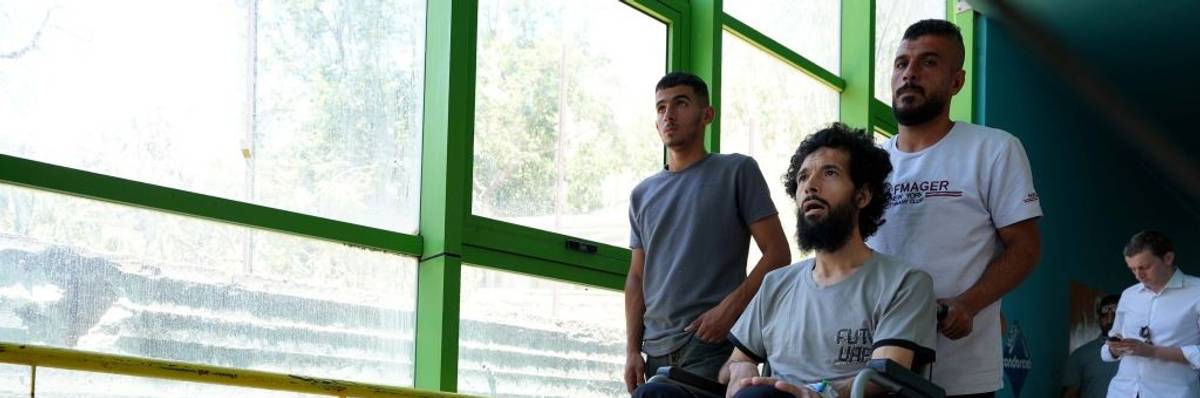
Palestinian man Muazzez Halil Abiyyat is taken for treatment in the West Bank on July 10, 2024, after being released from Israeli jail where he was kept hostage for 9 months.
"The only possible conclusion is that in carrying out these acts, Israel is committing torture that amounts to a war crime and even a crime against humanity," says the B'Tselem report.
Israeli human rights group B'Tselem on Monday published a detailed report on torture and abuse of Palestinians in the country's detention centers.
The 118-page report, "Welcome to Hell: The Israeli Prison System as a Network of Torture Camps," finds that torture, abuse, and harsh conditions are so widespread that "there is no room to doubt" that they are a systematic, organized policy of prison authorities.
The report is based on interviews with 55 released Palestinians who attested to brutal violence, sexual assault including sodomy, withholding of medical treatment, and deprivation of food, water, and sleep.
"Given the severity of the acts, the extent to which the provisions of international law are being violated, and the fact that these violations are directed at the entire population of Palestinian prisoners daily and over time—the only possible conclusion is that in carrying out these acts, Israel is committing torture that amounts to a war crime and even a crime against humanity," the report says.
Since October 7th, Israel has instated a systemic policy of abusing and torturing thousands of Palestinians in its custody.
>> pic.twitter.com/3X0yTel4nY
— B'Tselem בצלם بتسيلم (@btselem) August 5, 2024
Nearly 10,000 Palestinians are currently held in Israeli detention centers, about half of whom are in "administrative detention" without being told what the charges are against them or given a chance to defend themselves. The report says they come from widely divergent backgrounds and have only one thing in common: "being Palestinian."
At least 60 Palestinians have died in Israeli custody since October, B'Tselem found, and at least one detainee had to have a leg amputated due to injuries caused by guard violence.
After October 7, more than a dozen Israeli civilian and military prisons were converted to "de-facto torture camps" in which "every inmate is condemned to severe, relentless pain and suffering," the report says.
The violence of Israeli prison guards has come in many forms, including "setting dogs on prisoners, beating, punching, and kicking" and using "pepper spray, stun grenades, sticks, wooden clubs and metal batons, gun butts and barrels, brass knuckles, and tasers," the report says.
A Palestinian man from Hebron in the West Bank, identified as W.H., shared a particularly gruesome account with B'Tselem. Guards forcefully dragged him from his cell to a former mess hall, where other detainees had already been brought. W.H. recalled that:
Everyone was stark naked and bleeding. They threw them one on top of the other. People were crying and shouting, and the guards were yelling at them and cursing them and their mothers. They forced us to curse our mothers, as well as Hamas and [its leader Yahya] Sinwar. They also forced us to kiss the Israeli flag and sing the Israeli national anthem. I was shaking with fear, and then they pounced on me. One of them slapped me, and the other spat in my face and said to me in Arabic: "Yahya Sinwar will die." They ordered me to repeat what he said. Two of them stripped me like the other prisoners, and then threw me on top of the other prisoners. One of them brought a carrot and tried to shove it in my anus. While he was trying to shove the carrot in, some of the others filmed me on their cell phones. I screamed in pain and terror. It went on like that for about three minutes. Then they shouted at us that we had two minutes to get dressed, and left. I felt broken inside. Tears rolled down my face while I was getting dressed.
The report says that W.H. burst into tears while giving the account.
On top of "unrelenting" physical and psychological abuse, the day-to-day living conditions were extremely difficult, the report says. B'Tselem cited "overpopulation and crowding in cells"; "no sunlight and no air to breathe"—many never saw daylight during their time in detainment; "violent roll calls"; and "confiscation of personal possessions."
The detainees have no way to petition for better treatment. Most of the 55 former detainees who were interviewed didn't have access to a lawyer even once during their detainment, and they were also denied access to rights and humanitarian groups such as the International Committee of the Red Cross. Israel hasn't so far allowed such groups or neutral observers into its facilities, despite international pressure.
Those detainees who did have hearings with lawyers and judges were carefully monitored by Arabic-speaking guards who threatened them with punishment if they spoke about the harsh conditions in detainment, the report says.
The conditions are harsh by design. Israel's Minister of National Security Itamar Ben-Gvir, a far-right politician, and one of his deputies intentionally "downgraded" conditions for "terrorists" as part of an October overhaul of the prison system. Ben-Gvir even ordered changes to the prison menu, removing meat products, and said that "they will get the minimum that we are obligated to give them."
Of the 55 interviewed Palestinians, 30 were from the West Bank including East Jerusalem, 21 were from Gaza, and four had Israeli citizenship.
The B'Tselem report came as a group of United Nations special rapporteurs on Monday called out the systematic abuse in Israeli detention centers and the silence of U.N. member countries. The U.N. experts called for international observation of the prisons.
"What is required now is nothing short of an independent, international presence of human rights observers," the special rapporteurs said in a statement. "They must become the world's eyes in light of Israel's brazen failure to prevent and address the heinous rights violations against prisoners and detainees."
B'Tselem's work follows a series of other reports and accounts of abuse and mistreatment in Israeli detention centers since late last year. Last week, the Office of the United Nations High Commissioner for Human Rights released a report detailing torture and abuse, which U.N. Human Rights chief Volker Türk decried as flagrant violations of international law.
Dear Common Dreams reader, It’s been nearly 30 years since I co-founded Common Dreams with my late wife, Lina Newhouser. We had the radical notion that journalism should serve the public good, not corporate profits. It was clear to us from the outset what it would take to build such a project. No paid advertisements. No corporate sponsors. No millionaire publisher telling us what to think or do. Many people said we wouldn't last a year, but we proved those doubters wrong. Together with a tremendous team of journalists and dedicated staff, we built an independent media outlet free from the constraints of profits and corporate control. Our mission has always been simple: To inform. To inspire. To ignite change for the common good. Building Common Dreams was not easy. Our survival was never guaranteed. When you take on the most powerful forces—Wall Street greed, fossil fuel industry destruction, Big Tech lobbyists, and uber-rich oligarchs who have spent billions upon billions rigging the economy and democracy in their favor—the only bulwark you have is supporters who believe in your work. But here’s the urgent message from me today. It's never been this bad out there. And it's never been this hard to keep us going. At the very moment Common Dreams is most needed, the threats we face are intensifying. We need your support now more than ever. We don't accept corporate advertising and never will. We don't have a paywall because we don't think people should be blocked from critical news based on their ability to pay. Everything we do is funded by the donations of readers like you. When everyone does the little they can afford, we are strong. But if that support retreats or dries up, so do we. Will you donate now to make sure Common Dreams not only survives but thrives? —Craig Brown, Co-founder |
Israeli human rights group B'Tselem on Monday published a detailed report on torture and abuse of Palestinians in the country's detention centers.
The 118-page report, "Welcome to Hell: The Israeli Prison System as a Network of Torture Camps," finds that torture, abuse, and harsh conditions are so widespread that "there is no room to doubt" that they are a systematic, organized policy of prison authorities.
The report is based on interviews with 55 released Palestinians who attested to brutal violence, sexual assault including sodomy, withholding of medical treatment, and deprivation of food, water, and sleep.
"Given the severity of the acts, the extent to which the provisions of international law are being violated, and the fact that these violations are directed at the entire population of Palestinian prisoners daily and over time—the only possible conclusion is that in carrying out these acts, Israel is committing torture that amounts to a war crime and even a crime against humanity," the report says.
Since October 7th, Israel has instated a systemic policy of abusing and torturing thousands of Palestinians in its custody.
>> pic.twitter.com/3X0yTel4nY
— B'Tselem בצלם بتسيلم (@btselem) August 5, 2024
Nearly 10,000 Palestinians are currently held in Israeli detention centers, about half of whom are in "administrative detention" without being told what the charges are against them or given a chance to defend themselves. The report says they come from widely divergent backgrounds and have only one thing in common: "being Palestinian."
At least 60 Palestinians have died in Israeli custody since October, B'Tselem found, and at least one detainee had to have a leg amputated due to injuries caused by guard violence.
After October 7, more than a dozen Israeli civilian and military prisons were converted to "de-facto torture camps" in which "every inmate is condemned to severe, relentless pain and suffering," the report says.
The violence of Israeli prison guards has come in many forms, including "setting dogs on prisoners, beating, punching, and kicking" and using "pepper spray, stun grenades, sticks, wooden clubs and metal batons, gun butts and barrels, brass knuckles, and tasers," the report says.
A Palestinian man from Hebron in the West Bank, identified as W.H., shared a particularly gruesome account with B'Tselem. Guards forcefully dragged him from his cell to a former mess hall, where other detainees had already been brought. W.H. recalled that:
Everyone was stark naked and bleeding. They threw them one on top of the other. People were crying and shouting, and the guards were yelling at them and cursing them and their mothers. They forced us to curse our mothers, as well as Hamas and [its leader Yahya] Sinwar. They also forced us to kiss the Israeli flag and sing the Israeli national anthem. I was shaking with fear, and then they pounced on me. One of them slapped me, and the other spat in my face and said to me in Arabic: "Yahya Sinwar will die." They ordered me to repeat what he said. Two of them stripped me like the other prisoners, and then threw me on top of the other prisoners. One of them brought a carrot and tried to shove it in my anus. While he was trying to shove the carrot in, some of the others filmed me on their cell phones. I screamed in pain and terror. It went on like that for about three minutes. Then they shouted at us that we had two minutes to get dressed, and left. I felt broken inside. Tears rolled down my face while I was getting dressed.
The report says that W.H. burst into tears while giving the account.
On top of "unrelenting" physical and psychological abuse, the day-to-day living conditions were extremely difficult, the report says. B'Tselem cited "overpopulation and crowding in cells"; "no sunlight and no air to breathe"—many never saw daylight during their time in detainment; "violent roll calls"; and "confiscation of personal possessions."
The detainees have no way to petition for better treatment. Most of the 55 former detainees who were interviewed didn't have access to a lawyer even once during their detainment, and they were also denied access to rights and humanitarian groups such as the International Committee of the Red Cross. Israel hasn't so far allowed such groups or neutral observers into its facilities, despite international pressure.
Those detainees who did have hearings with lawyers and judges were carefully monitored by Arabic-speaking guards who threatened them with punishment if they spoke about the harsh conditions in detainment, the report says.
The conditions are harsh by design. Israel's Minister of National Security Itamar Ben-Gvir, a far-right politician, and one of his deputies intentionally "downgraded" conditions for "terrorists" as part of an October overhaul of the prison system. Ben-Gvir even ordered changes to the prison menu, removing meat products, and said that "they will get the minimum that we are obligated to give them."
Of the 55 interviewed Palestinians, 30 were from the West Bank including East Jerusalem, 21 were from Gaza, and four had Israeli citizenship.
The B'Tselem report came as a group of United Nations special rapporteurs on Monday called out the systematic abuse in Israeli detention centers and the silence of U.N. member countries. The U.N. experts called for international observation of the prisons.
"What is required now is nothing short of an independent, international presence of human rights observers," the special rapporteurs said in a statement. "They must become the world's eyes in light of Israel's brazen failure to prevent and address the heinous rights violations against prisoners and detainees."
B'Tselem's work follows a series of other reports and accounts of abuse and mistreatment in Israeli detention centers since late last year. Last week, the Office of the United Nations High Commissioner for Human Rights released a report detailing torture and abuse, which U.N. Human Rights chief Volker Türk decried as flagrant violations of international law.
Israeli human rights group B'Tselem on Monday published a detailed report on torture and abuse of Palestinians in the country's detention centers.
The 118-page report, "Welcome to Hell: The Israeli Prison System as a Network of Torture Camps," finds that torture, abuse, and harsh conditions are so widespread that "there is no room to doubt" that they are a systematic, organized policy of prison authorities.
The report is based on interviews with 55 released Palestinians who attested to brutal violence, sexual assault including sodomy, withholding of medical treatment, and deprivation of food, water, and sleep.
"Given the severity of the acts, the extent to which the provisions of international law are being violated, and the fact that these violations are directed at the entire population of Palestinian prisoners daily and over time—the only possible conclusion is that in carrying out these acts, Israel is committing torture that amounts to a war crime and even a crime against humanity," the report says.
Since October 7th, Israel has instated a systemic policy of abusing and torturing thousands of Palestinians in its custody.
>> pic.twitter.com/3X0yTel4nY
— B'Tselem בצלם بتسيلم (@btselem) August 5, 2024
Nearly 10,000 Palestinians are currently held in Israeli detention centers, about half of whom are in "administrative detention" without being told what the charges are against them or given a chance to defend themselves. The report says they come from widely divergent backgrounds and have only one thing in common: "being Palestinian."
At least 60 Palestinians have died in Israeli custody since October, B'Tselem found, and at least one detainee had to have a leg amputated due to injuries caused by guard violence.
After October 7, more than a dozen Israeli civilian and military prisons were converted to "de-facto torture camps" in which "every inmate is condemned to severe, relentless pain and suffering," the report says.
The violence of Israeli prison guards has come in many forms, including "setting dogs on prisoners, beating, punching, and kicking" and using "pepper spray, stun grenades, sticks, wooden clubs and metal batons, gun butts and barrels, brass knuckles, and tasers," the report says.
A Palestinian man from Hebron in the West Bank, identified as W.H., shared a particularly gruesome account with B'Tselem. Guards forcefully dragged him from his cell to a former mess hall, where other detainees had already been brought. W.H. recalled that:
Everyone was stark naked and bleeding. They threw them one on top of the other. People were crying and shouting, and the guards were yelling at them and cursing them and their mothers. They forced us to curse our mothers, as well as Hamas and [its leader Yahya] Sinwar. They also forced us to kiss the Israeli flag and sing the Israeli national anthem. I was shaking with fear, and then they pounced on me. One of them slapped me, and the other spat in my face and said to me in Arabic: "Yahya Sinwar will die." They ordered me to repeat what he said. Two of them stripped me like the other prisoners, and then threw me on top of the other prisoners. One of them brought a carrot and tried to shove it in my anus. While he was trying to shove the carrot in, some of the others filmed me on their cell phones. I screamed in pain and terror. It went on like that for about three minutes. Then they shouted at us that we had two minutes to get dressed, and left. I felt broken inside. Tears rolled down my face while I was getting dressed.
The report says that W.H. burst into tears while giving the account.
On top of "unrelenting" physical and psychological abuse, the day-to-day living conditions were extremely difficult, the report says. B'Tselem cited "overpopulation and crowding in cells"; "no sunlight and no air to breathe"—many never saw daylight during their time in detainment; "violent roll calls"; and "confiscation of personal possessions."
The detainees have no way to petition for better treatment. Most of the 55 former detainees who were interviewed didn't have access to a lawyer even once during their detainment, and they were also denied access to rights and humanitarian groups such as the International Committee of the Red Cross. Israel hasn't so far allowed such groups or neutral observers into its facilities, despite international pressure.
Those detainees who did have hearings with lawyers and judges were carefully monitored by Arabic-speaking guards who threatened them with punishment if they spoke about the harsh conditions in detainment, the report says.
The conditions are harsh by design. Israel's Minister of National Security Itamar Ben-Gvir, a far-right politician, and one of his deputies intentionally "downgraded" conditions for "terrorists" as part of an October overhaul of the prison system. Ben-Gvir even ordered changes to the prison menu, removing meat products, and said that "they will get the minimum that we are obligated to give them."
Of the 55 interviewed Palestinians, 30 were from the West Bank including East Jerusalem, 21 were from Gaza, and four had Israeli citizenship.
The B'Tselem report came as a group of United Nations special rapporteurs on Monday called out the systematic abuse in Israeli detention centers and the silence of U.N. member countries. The U.N. experts called for international observation of the prisons.
"What is required now is nothing short of an independent, international presence of human rights observers," the special rapporteurs said in a statement. "They must become the world's eyes in light of Israel's brazen failure to prevent and address the heinous rights violations against prisoners and detainees."
B'Tselem's work follows a series of other reports and accounts of abuse and mistreatment in Israeli detention centers since late last year. Last week, the Office of the United Nations High Commissioner for Human Rights released a report detailing torture and abuse, which U.N. Human Rights chief Volker Türk decried as flagrant violations of international law.