SUBSCRIBE TO OUR FREE NEWSLETTER
Daily news & progressive opinion—funded by the people, not the corporations—delivered straight to your inbox.
5
#000000
#FFFFFF
To donate by check, phone, or other method, see our More Ways to Give page.
Daily news & progressive opinion—funded by the people, not the corporations—delivered straight to your inbox.
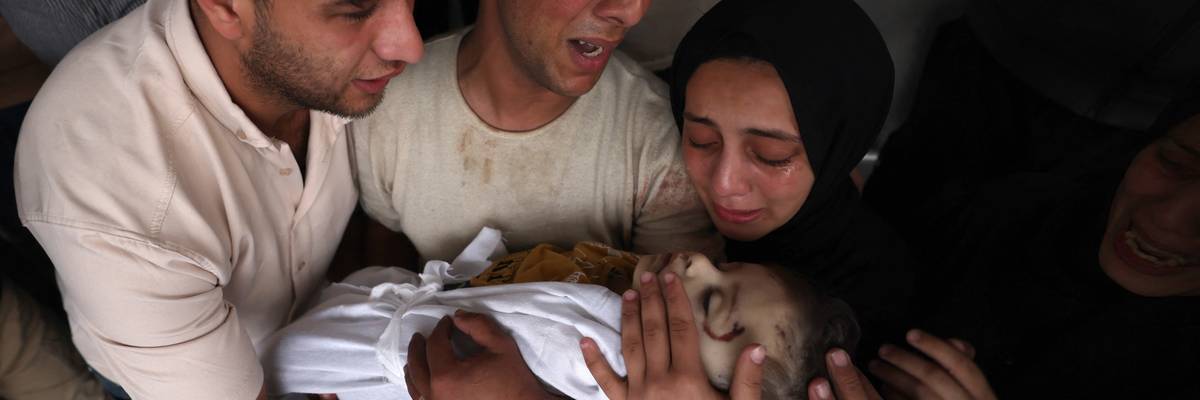
Palestinians mourn relatives killed in Israeli bombardment, at the al-Najjar hospital in Rafah in the southern Gaza Strip, on April 29, 2024 amid the ongoing conflict between Israel and the Palestinian militant group Hamas.
"This is their objective. This is the generation they're looking for. This is the safe Rafah they talk about," one surviving family member said.
Israeli airstrikes killed between 20 and 30 people in Rafah Sunday night, including at least five children.
Among the slain children was a one-year-old boy whose parents had been trying to have a child for 10 years before he was finally born.
"This is who they are targeting," the boy's uncle, Mahmoud Abu Taha, said in a video shot by CNN in the courtyard of Rafah's Abu Youssef al-Najjar Hospital. "This is their objective. This is the generation they're looking for. This is the safe Rafah they talk about."
"Nowhere is safe. The entire Gaza Strip is a target."
As Abu Taha spoke, he lifted the lifeless body of his nephew toward the camera.
"His name is Deif-Allah (meaning guest in Arabic) and he was indeed a guest," Abu Taha further told Reuters. "He came as a guest after (his parents) longed for (him) for so long, after 10 years."
"Ten people (were killed), the mother, her daughter, her granddaughters, her grandson, her son-in-law, their daughters and relatives, everyone. They're all gone, all 10 of them," Abu Taha added.
As the threat of a full-scale ground invasion of Rafah still looms, the Israeli Defense Forces have continued to regularly bomb Gaza's southernmost city, where more than 1.5 million Gazans have fled seeking relative safety from Israel's lethal assault on the enclave.
Airstrikes late Sunday into early Monday struck three homes, The Associated Press reported:
The first killed 11 people, including four siblings aged 9 to 27, according to records at the Abu Yousef al-Najjar Hospital, where the bodies were taken. The second strike killed eight people, including a 33-year-old father and his 5-day-old boy, according to hospital records. The third strike killed three siblings, aged 23, 19, and 12. An Associated Press reporter saw the bodies at the hospital.
According to the video shot by CNN, the name of the five-day-old boy was Ghaith Abu Rayya.
"We are all alone. Nobody cares about us," a man cried out in the video as he opened a small body bag show Abu Rayya's head. He said the rest of the infant's body had been destroyed by the bomb.
Another mourner at the hospital told CNN, "Nowhere is safe. The entire Gaza Strip is a target."
The AP calculated the final death toll from the Rafah bombings at 22, including five children and six women. Reuters reported that 30 were killed.
Israel also carried out deadly airstrikes in other parts of Gaza Sunday night. The IDF killed five people, including women and children, when it fired a missile at the Tartouri family home west of Gaza City, the International Middle East Media Center reported. Another missile hit the home of the Hijazi family south of Gaza City, killing two women.
Another person was killed by an IDF missile that hit a car in central Gaza, while the Palestinian Civil Defense teams discovered 13 bodies amid the ruins of bombed homes in Khan Younis' Al-Amal neighborhood.
All told, the Gaza Health Ministry announced Monday that Israel had carried out three massacres against Gazan families in the last 24 hours, killing 34 and wounding 68. This brings the total death toll from Israel's assault on the Gaza Strip to at least 34,488, though that is likely an undercount as many remain buried beneath rubble and Israel has besieged and bombarded several hospitals, damaging or destroying nearly 84% of the strip's healthcare facilities and making record keeping more difficult.
Israel's devastating campaign in the Gaza Strip began in October 7 in response to Hamas' deadly attack on Southern Israel that killed approximately 1,100 and saw around 240 taken hostage. Prior to October 7, Israel had blockaded Gaza for 16 years and occupied the Palestinian West Bank for 56 years.
Sunday's bombings came as cease-fire talks between Israel and Hamas are set to restart Monday, with Egypt hosting Hamas leaders to facilitate the discussion.
"We are hopeful the proposal has taken into account the positions of both sides, has tried to extract moderation from both sides, and we are waiting to have a final decision," Egyptian Foreign Minister Sameh Shoukry said at a World Economic Forum meeting on Monday.
In a recent piece published online, Hebrew University Holocaust and genocide scholar Amos Goldberg added his voice to the growing number of human rights and international law experts who have labeled Israel's actions in Gaza a genocide.
"What is happening in Gaza is genocide because the level and pace of indiscriminate killing, destruction, mass expulsions, displacement, famine, executions, the wiping out of cultural and religious institutions, the crushing of elites (including the killing of journalists), and the sweeping dehumanization of the Palestinians—create an overall picture of genocide, of a deliberate conscious crushing of Palestinian existence in Gaza," Goldberg wrote in the essay published in translation on Medium.
Dear Common Dreams reader, It’s been nearly 30 years since I co-founded Common Dreams with my late wife, Lina Newhouser. We had the radical notion that journalism should serve the public good, not corporate profits. It was clear to us from the outset what it would take to build such a project. No paid advertisements. No corporate sponsors. No millionaire publisher telling us what to think or do. Many people said we wouldn't last a year, but we proved those doubters wrong. Together with a tremendous team of journalists and dedicated staff, we built an independent media outlet free from the constraints of profits and corporate control. Our mission has always been simple: To inform. To inspire. To ignite change for the common good. Building Common Dreams was not easy. Our survival was never guaranteed. When you take on the most powerful forces—Wall Street greed, fossil fuel industry destruction, Big Tech lobbyists, and uber-rich oligarchs who have spent billions upon billions rigging the economy and democracy in their favor—the only bulwark you have is supporters who believe in your work. But here’s the urgent message from me today. It's never been this bad out there. And it's never been this hard to keep us going. At the very moment Common Dreams is most needed, the threats we face are intensifying. We need your support now more than ever. We don't accept corporate advertising and never will. We don't have a paywall because we don't think people should be blocked from critical news based on their ability to pay. Everything we do is funded by the donations of readers like you. When everyone does the little they can afford, we are strong. But if that support retreats or dries up, so do we. Will you donate now to make sure Common Dreams not only survives but thrives? —Craig Brown, Co-founder |
Israeli airstrikes killed between 20 and 30 people in Rafah Sunday night, including at least five children.
Among the slain children was a one-year-old boy whose parents had been trying to have a child for 10 years before he was finally born.
"This is who they are targeting," the boy's uncle, Mahmoud Abu Taha, said in a video shot by CNN in the courtyard of Rafah's Abu Youssef al-Najjar Hospital. "This is their objective. This is the generation they're looking for. This is the safe Rafah they talk about."
"Nowhere is safe. The entire Gaza Strip is a target."
As Abu Taha spoke, he lifted the lifeless body of his nephew toward the camera.
"His name is Deif-Allah (meaning guest in Arabic) and he was indeed a guest," Abu Taha further told Reuters. "He came as a guest after (his parents) longed for (him) for so long, after 10 years."
"Ten people (were killed), the mother, her daughter, her granddaughters, her grandson, her son-in-law, their daughters and relatives, everyone. They're all gone, all 10 of them," Abu Taha added.
As the threat of a full-scale ground invasion of Rafah still looms, the Israeli Defense Forces have continued to regularly bomb Gaza's southernmost city, where more than 1.5 million Gazans have fled seeking relative safety from Israel's lethal assault on the enclave.
Airstrikes late Sunday into early Monday struck three homes, The Associated Press reported:
The first killed 11 people, including four siblings aged 9 to 27, according to records at the Abu Yousef al-Najjar Hospital, where the bodies were taken. The second strike killed eight people, including a 33-year-old father and his 5-day-old boy, according to hospital records. The third strike killed three siblings, aged 23, 19, and 12. An Associated Press reporter saw the bodies at the hospital.
According to the video shot by CNN, the name of the five-day-old boy was Ghaith Abu Rayya.
"We are all alone. Nobody cares about us," a man cried out in the video as he opened a small body bag show Abu Rayya's head. He said the rest of the infant's body had been destroyed by the bomb.
Another mourner at the hospital told CNN, "Nowhere is safe. The entire Gaza Strip is a target."
The AP calculated the final death toll from the Rafah bombings at 22, including five children and six women. Reuters reported that 30 were killed.
Israel also carried out deadly airstrikes in other parts of Gaza Sunday night. The IDF killed five people, including women and children, when it fired a missile at the Tartouri family home west of Gaza City, the International Middle East Media Center reported. Another missile hit the home of the Hijazi family south of Gaza City, killing two women.
Another person was killed by an IDF missile that hit a car in central Gaza, while the Palestinian Civil Defense teams discovered 13 bodies amid the ruins of bombed homes in Khan Younis' Al-Amal neighborhood.
All told, the Gaza Health Ministry announced Monday that Israel had carried out three massacres against Gazan families in the last 24 hours, killing 34 and wounding 68. This brings the total death toll from Israel's assault on the Gaza Strip to at least 34,488, though that is likely an undercount as many remain buried beneath rubble and Israel has besieged and bombarded several hospitals, damaging or destroying nearly 84% of the strip's healthcare facilities and making record keeping more difficult.
Israel's devastating campaign in the Gaza Strip began in October 7 in response to Hamas' deadly attack on Southern Israel that killed approximately 1,100 and saw around 240 taken hostage. Prior to October 7, Israel had blockaded Gaza for 16 years and occupied the Palestinian West Bank for 56 years.
Sunday's bombings came as cease-fire talks between Israel and Hamas are set to restart Monday, with Egypt hosting Hamas leaders to facilitate the discussion.
"We are hopeful the proposal has taken into account the positions of both sides, has tried to extract moderation from both sides, and we are waiting to have a final decision," Egyptian Foreign Minister Sameh Shoukry said at a World Economic Forum meeting on Monday.
In a recent piece published online, Hebrew University Holocaust and genocide scholar Amos Goldberg added his voice to the growing number of human rights and international law experts who have labeled Israel's actions in Gaza a genocide.
"What is happening in Gaza is genocide because the level and pace of indiscriminate killing, destruction, mass expulsions, displacement, famine, executions, the wiping out of cultural and religious institutions, the crushing of elites (including the killing of journalists), and the sweeping dehumanization of the Palestinians—create an overall picture of genocide, of a deliberate conscious crushing of Palestinian existence in Gaza," Goldberg wrote in the essay published in translation on Medium.
Israeli airstrikes killed between 20 and 30 people in Rafah Sunday night, including at least five children.
Among the slain children was a one-year-old boy whose parents had been trying to have a child for 10 years before he was finally born.
"This is who they are targeting," the boy's uncle, Mahmoud Abu Taha, said in a video shot by CNN in the courtyard of Rafah's Abu Youssef al-Najjar Hospital. "This is their objective. This is the generation they're looking for. This is the safe Rafah they talk about."
"Nowhere is safe. The entire Gaza Strip is a target."
As Abu Taha spoke, he lifted the lifeless body of his nephew toward the camera.
"His name is Deif-Allah (meaning guest in Arabic) and he was indeed a guest," Abu Taha further told Reuters. "He came as a guest after (his parents) longed for (him) for so long, after 10 years."
"Ten people (were killed), the mother, her daughter, her granddaughters, her grandson, her son-in-law, their daughters and relatives, everyone. They're all gone, all 10 of them," Abu Taha added.
As the threat of a full-scale ground invasion of Rafah still looms, the Israeli Defense Forces have continued to regularly bomb Gaza's southernmost city, where more than 1.5 million Gazans have fled seeking relative safety from Israel's lethal assault on the enclave.
Airstrikes late Sunday into early Monday struck three homes, The Associated Press reported:
The first killed 11 people, including four siblings aged 9 to 27, according to records at the Abu Yousef al-Najjar Hospital, where the bodies were taken. The second strike killed eight people, including a 33-year-old father and his 5-day-old boy, according to hospital records. The third strike killed three siblings, aged 23, 19, and 12. An Associated Press reporter saw the bodies at the hospital.
According to the video shot by CNN, the name of the five-day-old boy was Ghaith Abu Rayya.
"We are all alone. Nobody cares about us," a man cried out in the video as he opened a small body bag show Abu Rayya's head. He said the rest of the infant's body had been destroyed by the bomb.
Another mourner at the hospital told CNN, "Nowhere is safe. The entire Gaza Strip is a target."
The AP calculated the final death toll from the Rafah bombings at 22, including five children and six women. Reuters reported that 30 were killed.
Israel also carried out deadly airstrikes in other parts of Gaza Sunday night. The IDF killed five people, including women and children, when it fired a missile at the Tartouri family home west of Gaza City, the International Middle East Media Center reported. Another missile hit the home of the Hijazi family south of Gaza City, killing two women.
Another person was killed by an IDF missile that hit a car in central Gaza, while the Palestinian Civil Defense teams discovered 13 bodies amid the ruins of bombed homes in Khan Younis' Al-Amal neighborhood.
All told, the Gaza Health Ministry announced Monday that Israel had carried out three massacres against Gazan families in the last 24 hours, killing 34 and wounding 68. This brings the total death toll from Israel's assault on the Gaza Strip to at least 34,488, though that is likely an undercount as many remain buried beneath rubble and Israel has besieged and bombarded several hospitals, damaging or destroying nearly 84% of the strip's healthcare facilities and making record keeping more difficult.
Israel's devastating campaign in the Gaza Strip began in October 7 in response to Hamas' deadly attack on Southern Israel that killed approximately 1,100 and saw around 240 taken hostage. Prior to October 7, Israel had blockaded Gaza for 16 years and occupied the Palestinian West Bank for 56 years.
Sunday's bombings came as cease-fire talks between Israel and Hamas are set to restart Monday, with Egypt hosting Hamas leaders to facilitate the discussion.
"We are hopeful the proposal has taken into account the positions of both sides, has tried to extract moderation from both sides, and we are waiting to have a final decision," Egyptian Foreign Minister Sameh Shoukry said at a World Economic Forum meeting on Monday.
In a recent piece published online, Hebrew University Holocaust and genocide scholar Amos Goldberg added his voice to the growing number of human rights and international law experts who have labeled Israel's actions in Gaza a genocide.
"What is happening in Gaza is genocide because the level and pace of indiscriminate killing, destruction, mass expulsions, displacement, famine, executions, the wiping out of cultural and religious institutions, the crushing of elites (including the killing of journalists), and the sweeping dehumanization of the Palestinians—create an overall picture of genocide, of a deliberate conscious crushing of Palestinian existence in Gaza," Goldberg wrote in the essay published in translation on Medium.