SUBSCRIBE TO OUR FREE NEWSLETTER
Daily news & progressive opinion—funded by the people, not the corporations—delivered straight to your inbox.
5
#000000
#FFFFFF
To donate by check, phone, or other method, see our More Ways to Give page.
Daily news & progressive opinion—funded by the people, not the corporations—delivered straight to your inbox.
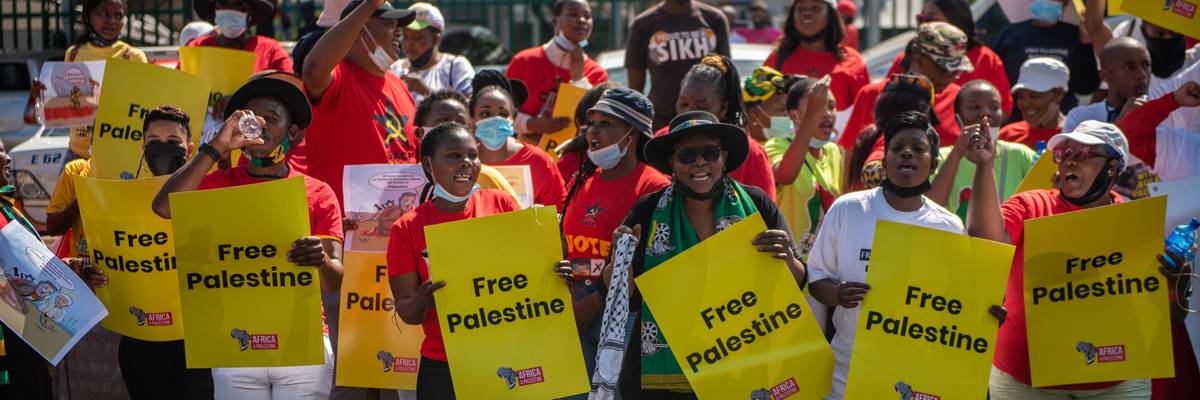
South Africans rally for Palestinian rights in Johannesburg on November 19, 2021.
The parliamentary vote came a day after South Africa's government—which accuses Israel of "genocide" in Gaza—called on the ICC to arrest Israeli Prime Minister Benjamin Netanyahu.
South Africa's Parliament on Tuesday voted overwhelmingly for a suspension of diplomatic ties with Israel over what numerous lawmakers called its "genocidal" war on Gaza, a move that came a day after the country's government urged the International Criminal Court to issue an arrest warrant for Israeli Prime Minister Benjamin Netanyahu.
Lawmakers voted 248-91 for the resolution calling on South Africa to cut ties with Israel until it agrees to a cease-fire in Gaza, where authorities say that 46 days of relentless bombardment by air, land, and sea has left more than 14,000 Palestinians—including more than 3,900 women and 5,800 children— dead, with tens of thousands more wounded, thousands missing beneath the rubble, and nearly 1.7 million people, or about 70% of the population, forcibly displaced.
Israel and Hamas on Tuesday appeared close to agreeing on a Qatar-brokered multiday cease-fire, although far-right Israeli officials including National Security Minister Itamar Ben-Gvir and Finance Minister Bezalel Smotrich expressed opposition to the deal—which reportedly involves the release of around 50 Hamas hostages and Palestinian women and minors imprisoned by Israel.
Applause and chants of "Free, Free Palestine" and "From the River to the Sea, Palestine Will Be Free" rang out in South Africa's legislative chamber as the results of Tuesday's vote were announced.
The nonbinding motion, which requires presidential approval to take effect, was introduced by the left-wing opposition party Economic Freedom Fighters (EFF). The measure is backed by the ruling African National Congress (ANC) and opposed by the mostly white, largely pro-Israel Democratic Alliance.
"We support the amendment. We want to applaud the ANC for its maturity on this matter," said EFF leader Julius Malema. "It doesn't matter; politically we disagree, but when it comes to the issue of humanity, we must protect the human rights of all human beings all over the world."
The lawmakers' vote came on the same day that ANC South African President Cyril Ramaphosa asserted during a virtual meeting with leaders of the so-called BRICS nations—Brazil, Russia, India, China, and South Africa—that "the collective punishment of Palestinian civilians through the unlawful use of force by Israel is a war crime."
"The deliberate denial of medicine, fuel, food, and water to the residents of Gaza is tantamount to genocide," Ramaphosa said.
Calling out the Palestinian militant group that controls Gaza, Ramaphosa added that "in its attacks on civilians and by taking hostages, Hamas has also violated international law and must be held accountable for these actions."
Israel recalled its ambassador to South Africa, Eli Belotserkovsk, on Monday for consultations following Pretoria's call for an International Criminal Court (ICC) arrest warrant against Netanyahu.
South Africa's government on Monday called on the International Criminal Court (ICC) to issue an arrest warrant for far-right Israeli Prime Minister Benjamin Netanyahu.
"The world cannot simply stand by and watch," ANC Minister in the Presidency Khumbudzo Ntshavheni said Monday. "The global community needs to rise to stop this genocide now."
"Given that much of the global community is witnessing the commission of these crimes in real-time, including statements of genocidal intent by mainly Israeli leaders, we expect that warrants of arrest for these leaders, including Prime Minister Benjamin Netanyahu, should be issued shortly," she added.
Earlier this month, South Africa recalled all of its diplomats from Israel over what Ntshavheni called "the genocidal acts that the Israeli government is doing to the Palestinian people."
South Africa—which was an apartheid state for most of the latter half of the 20th century—has long been critical of Israeli apartheid and other human rights crimes in Palestine. In March, South African lawmakers voted to downgrade the country's embassy in response to what it called apartheid and illegal occupation being perpetrated against the Palestinians.
Dear Common Dreams reader, It’s been nearly 30 years since I co-founded Common Dreams with my late wife, Lina Newhouser. We had the radical notion that journalism should serve the public good, not corporate profits. It was clear to us from the outset what it would take to build such a project. No paid advertisements. No corporate sponsors. No millionaire publisher telling us what to think or do. Many people said we wouldn't last a year, but we proved those doubters wrong. Together with a tremendous team of journalists and dedicated staff, we built an independent media outlet free from the constraints of profits and corporate control. Our mission has always been simple: To inform. To inspire. To ignite change for the common good. Building Common Dreams was not easy. Our survival was never guaranteed. When you take on the most powerful forces—Wall Street greed, fossil fuel industry destruction, Big Tech lobbyists, and uber-rich oligarchs who have spent billions upon billions rigging the economy and democracy in their favor—the only bulwark you have is supporters who believe in your work. But here’s the urgent message from me today. It's never been this bad out there. And it's never been this hard to keep us going. At the very moment Common Dreams is most needed, the threats we face are intensifying. We need your support now more than ever. We don't accept corporate advertising and never will. We don't have a paywall because we don't think people should be blocked from critical news based on their ability to pay. Everything we do is funded by the donations of readers like you. When everyone does the little they can afford, we are strong. But if that support retreats or dries up, so do we. Will you donate now to make sure Common Dreams not only survives but thrives? —Craig Brown, Co-founder |
South Africa's Parliament on Tuesday voted overwhelmingly for a suspension of diplomatic ties with Israel over what numerous lawmakers called its "genocidal" war on Gaza, a move that came a day after the country's government urged the International Criminal Court to issue an arrest warrant for Israeli Prime Minister Benjamin Netanyahu.
Lawmakers voted 248-91 for the resolution calling on South Africa to cut ties with Israel until it agrees to a cease-fire in Gaza, where authorities say that 46 days of relentless bombardment by air, land, and sea has left more than 14,000 Palestinians—including more than 3,900 women and 5,800 children— dead, with tens of thousands more wounded, thousands missing beneath the rubble, and nearly 1.7 million people, or about 70% of the population, forcibly displaced.
Israel and Hamas on Tuesday appeared close to agreeing on a Qatar-brokered multiday cease-fire, although far-right Israeli officials including National Security Minister Itamar Ben-Gvir and Finance Minister Bezalel Smotrich expressed opposition to the deal—which reportedly involves the release of around 50 Hamas hostages and Palestinian women and minors imprisoned by Israel.
Applause and chants of "Free, Free Palestine" and "From the River to the Sea, Palestine Will Be Free" rang out in South Africa's legislative chamber as the results of Tuesday's vote were announced.
The nonbinding motion, which requires presidential approval to take effect, was introduced by the left-wing opposition party Economic Freedom Fighters (EFF). The measure is backed by the ruling African National Congress (ANC) and opposed by the mostly white, largely pro-Israel Democratic Alliance.
"We support the amendment. We want to applaud the ANC for its maturity on this matter," said EFF leader Julius Malema. "It doesn't matter; politically we disagree, but when it comes to the issue of humanity, we must protect the human rights of all human beings all over the world."
The lawmakers' vote came on the same day that ANC South African President Cyril Ramaphosa asserted during a virtual meeting with leaders of the so-called BRICS nations—Brazil, Russia, India, China, and South Africa—that "the collective punishment of Palestinian civilians through the unlawful use of force by Israel is a war crime."
"The deliberate denial of medicine, fuel, food, and water to the residents of Gaza is tantamount to genocide," Ramaphosa said.
Calling out the Palestinian militant group that controls Gaza, Ramaphosa added that "in its attacks on civilians and by taking hostages, Hamas has also violated international law and must be held accountable for these actions."
Israel recalled its ambassador to South Africa, Eli Belotserkovsk, on Monday for consultations following Pretoria's call for an International Criminal Court (ICC) arrest warrant against Netanyahu.
South Africa's government on Monday called on the International Criminal Court (ICC) to issue an arrest warrant for far-right Israeli Prime Minister Benjamin Netanyahu.
"The world cannot simply stand by and watch," ANC Minister in the Presidency Khumbudzo Ntshavheni said Monday. "The global community needs to rise to stop this genocide now."
"Given that much of the global community is witnessing the commission of these crimes in real-time, including statements of genocidal intent by mainly Israeli leaders, we expect that warrants of arrest for these leaders, including Prime Minister Benjamin Netanyahu, should be issued shortly," she added.
Earlier this month, South Africa recalled all of its diplomats from Israel over what Ntshavheni called "the genocidal acts that the Israeli government is doing to the Palestinian people."
South Africa—which was an apartheid state for most of the latter half of the 20th century—has long been critical of Israeli apartheid and other human rights crimes in Palestine. In March, South African lawmakers voted to downgrade the country's embassy in response to what it called apartheid and illegal occupation being perpetrated against the Palestinians.
South Africa's Parliament on Tuesday voted overwhelmingly for a suspension of diplomatic ties with Israel over what numerous lawmakers called its "genocidal" war on Gaza, a move that came a day after the country's government urged the International Criminal Court to issue an arrest warrant for Israeli Prime Minister Benjamin Netanyahu.
Lawmakers voted 248-91 for the resolution calling on South Africa to cut ties with Israel until it agrees to a cease-fire in Gaza, where authorities say that 46 days of relentless bombardment by air, land, and sea has left more than 14,000 Palestinians—including more than 3,900 women and 5,800 children— dead, with tens of thousands more wounded, thousands missing beneath the rubble, and nearly 1.7 million people, or about 70% of the population, forcibly displaced.
Israel and Hamas on Tuesday appeared close to agreeing on a Qatar-brokered multiday cease-fire, although far-right Israeli officials including National Security Minister Itamar Ben-Gvir and Finance Minister Bezalel Smotrich expressed opposition to the deal—which reportedly involves the release of around 50 Hamas hostages and Palestinian women and minors imprisoned by Israel.
Applause and chants of "Free, Free Palestine" and "From the River to the Sea, Palestine Will Be Free" rang out in South Africa's legislative chamber as the results of Tuesday's vote were announced.
The nonbinding motion, which requires presidential approval to take effect, was introduced by the left-wing opposition party Economic Freedom Fighters (EFF). The measure is backed by the ruling African National Congress (ANC) and opposed by the mostly white, largely pro-Israel Democratic Alliance.
"We support the amendment. We want to applaud the ANC for its maturity on this matter," said EFF leader Julius Malema. "It doesn't matter; politically we disagree, but when it comes to the issue of humanity, we must protect the human rights of all human beings all over the world."
The lawmakers' vote came on the same day that ANC South African President Cyril Ramaphosa asserted during a virtual meeting with leaders of the so-called BRICS nations—Brazil, Russia, India, China, and South Africa—that "the collective punishment of Palestinian civilians through the unlawful use of force by Israel is a war crime."
"The deliberate denial of medicine, fuel, food, and water to the residents of Gaza is tantamount to genocide," Ramaphosa said.
Calling out the Palestinian militant group that controls Gaza, Ramaphosa added that "in its attacks on civilians and by taking hostages, Hamas has also violated international law and must be held accountable for these actions."
Israel recalled its ambassador to South Africa, Eli Belotserkovsk, on Monday for consultations following Pretoria's call for an International Criminal Court (ICC) arrest warrant against Netanyahu.
South Africa's government on Monday called on the International Criminal Court (ICC) to issue an arrest warrant for far-right Israeli Prime Minister Benjamin Netanyahu.
"The world cannot simply stand by and watch," ANC Minister in the Presidency Khumbudzo Ntshavheni said Monday. "The global community needs to rise to stop this genocide now."
"Given that much of the global community is witnessing the commission of these crimes in real-time, including statements of genocidal intent by mainly Israeli leaders, we expect that warrants of arrest for these leaders, including Prime Minister Benjamin Netanyahu, should be issued shortly," she added.
Earlier this month, South Africa recalled all of its diplomats from Israel over what Ntshavheni called "the genocidal acts that the Israeli government is doing to the Palestinian people."
South Africa—which was an apartheid state for most of the latter half of the 20th century—has long been critical of Israeli apartheid and other human rights crimes in Palestine. In March, South African lawmakers voted to downgrade the country's embassy in response to what it called apartheid and illegal occupation being perpetrated against the Palestinians.