SUBSCRIBE TO OUR FREE NEWSLETTER
Daily news & progressive opinion—funded by the people, not the corporations—delivered straight to your inbox.
5
#000000
#FFFFFF
To donate by check, phone, or other method, see our More Ways to Give page.
Daily news & progressive opinion—funded by the people, not the corporations—delivered straight to your inbox.
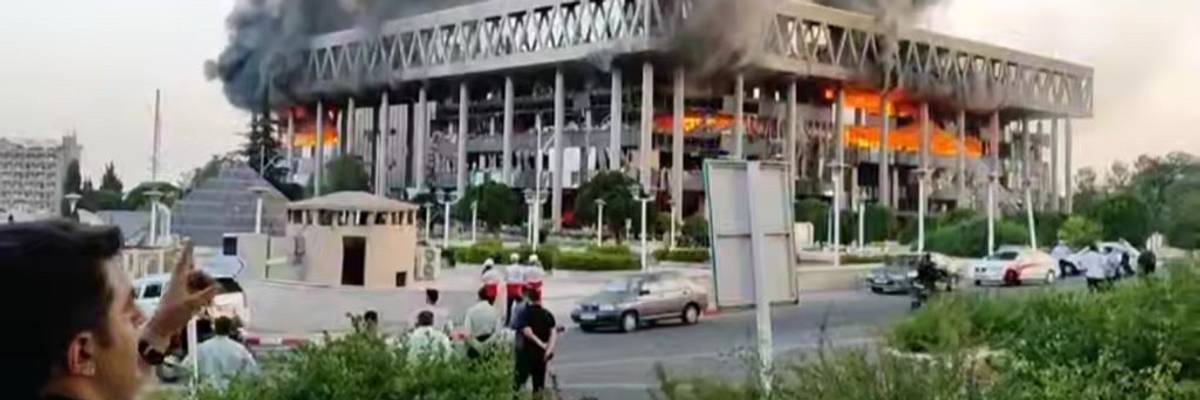
A screengrab of video footage shows the headquarters of Islamic Republic of Iran Broadcasting on fire following an Israeli attack on June 16, 2025.
A regional director of the Committee to Protect Journalists said that "Israel's killing, with impunity, of almost 200 journalists in Gaza has emboldened it to target media elsewhere in the region."
The Israeli military deliberately bombed the studio of an Iranian state television network during a live broadcast on Monday, an attack that Iran swiftly condemned as a "war crime."
Video footage posted to social media shows the moment the Islamic Republic of Iran Broadcasting (IRIB) complex was hit by Israeli forces, forcing the anchor to flee for safety as smoke and debris filled the broadcast room.
Watch:
This is the moment Iranian state TV was forced to stop its broadcast after it said it was attacked by an Israeli missile attack in Tehran. pic.twitter.com/7RoUtbCuYL
— Al Jazeera English (@AJEnglish) June 16, 2025
Shortly before the attack, Israeli Defense Minister Israel Katz declared that the "Iranian propaganda and incitement mouthpiece is on its way to disappearing."
Katz made clear in a subsequent social media post that the Israel Defense Forces (IDF) intentionally targeted the media building.
"The Iranian regime's propaganda and incitement broadcasting authority was attacked by the IDF after a widespread evacuation of residents in the area," Katz wrote.
"Calling someone a mouthpiece doesn't give you permission to kill them."
The number of casualties from the attack was not immediately clear. Foad Izadi, professor of international relations at the University of Tehran, told Al Jazeera that the number could be high.
"It's a huge building," said Izadi. "Iran's news channel is located on the first floor. It has four floors, and on every floor you have at least 200-300 people working."
“They were getting ready for the evening program. This is going to result in a lot of civilians—generally young people, young journalists—getting killed," he added. "Calling someone a mouthpiece doesn't give you permission to kill them."
Iran’s state broadcaster, the Islamic Republic of Iran Broadcasting (IRIB), is up in flames in Tehran.
The building was struck while airing footage of the war. Hours earlier, Israel’s defense minister declared that Iranian TV channels were “on their way to disappearing.” https://t.co/bfhwWWUr7e pic.twitter.com/dY6HPx7Qvq
— Drop Site (@DropSiteNews) June 16, 2025
Targeting journalists and media infrastructure is prohibited under international law—and the use of media facilities for propaganda purposes does not render them legitimate military targets.
The IDF claimed, without providing any evidence, that the targeted building "was being used for military purposes by the Iranian Armed Forces."
Esmaeil Baqaei, a spokesman for the Iranian Foreign Ministry, called the Israeli attack "a wicked act" and a "war crime." He went on to urge the United Nations Security Council to "act now to stop the genocidal aggressor from committing further atrocities against our people."
"The world is watching," he wrote.
Sara Qudah, Middle East and North Africa regional director for the Committee to Protect Journalists, said Monday that the press freedom group is "appalled by Israel's bombing of Iran's state TV channel while live on air."
"Israel's killing, with impunity, of almost 200 journalists in Gaza has emboldened it to target media elsewhere in the region," said Qudah. "This bloodshed must end now."
Dear Common Dreams reader, It’s been nearly 30 years since I co-founded Common Dreams with my late wife, Lina Newhouser. We had the radical notion that journalism should serve the public good, not corporate profits. It was clear to us from the outset what it would take to build such a project. No paid advertisements. No corporate sponsors. No millionaire publisher telling us what to think or do. Many people said we wouldn't last a year, but we proved those doubters wrong. Together with a tremendous team of journalists and dedicated staff, we built an independent media outlet free from the constraints of profits and corporate control. Our mission has always been simple: To inform. To inspire. To ignite change for the common good. Building Common Dreams was not easy. Our survival was never guaranteed. When you take on the most powerful forces—Wall Street greed, fossil fuel industry destruction, Big Tech lobbyists, and uber-rich oligarchs who have spent billions upon billions rigging the economy and democracy in their favor—the only bulwark you have is supporters who believe in your work. But here’s the urgent message from me today. It's never been this bad out there. And it's never been this hard to keep us going. At the very moment Common Dreams is most needed, the threats we face are intensifying. We need your support now more than ever. We don't accept corporate advertising and never will. We don't have a paywall because we don't think people should be blocked from critical news based on their ability to pay. Everything we do is funded by the donations of readers like you. When everyone does the little they can afford, we are strong. But if that support retreats or dries up, so do we. Will you donate now to make sure Common Dreams not only survives but thrives? —Craig Brown, Co-founder |
The Israeli military deliberately bombed the studio of an Iranian state television network during a live broadcast on Monday, an attack that Iran swiftly condemned as a "war crime."
Video footage posted to social media shows the moment the Islamic Republic of Iran Broadcasting (IRIB) complex was hit by Israeli forces, forcing the anchor to flee for safety as smoke and debris filled the broadcast room.
Watch:
This is the moment Iranian state TV was forced to stop its broadcast after it said it was attacked by an Israeli missile attack in Tehran. pic.twitter.com/7RoUtbCuYL
— Al Jazeera English (@AJEnglish) June 16, 2025
Shortly before the attack, Israeli Defense Minister Israel Katz declared that the "Iranian propaganda and incitement mouthpiece is on its way to disappearing."
Katz made clear in a subsequent social media post that the Israel Defense Forces (IDF) intentionally targeted the media building.
"The Iranian regime's propaganda and incitement broadcasting authority was attacked by the IDF after a widespread evacuation of residents in the area," Katz wrote.
"Calling someone a mouthpiece doesn't give you permission to kill them."
The number of casualties from the attack was not immediately clear. Foad Izadi, professor of international relations at the University of Tehran, told Al Jazeera that the number could be high.
"It's a huge building," said Izadi. "Iran's news channel is located on the first floor. It has four floors, and on every floor you have at least 200-300 people working."
“They were getting ready for the evening program. This is going to result in a lot of civilians—generally young people, young journalists—getting killed," he added. "Calling someone a mouthpiece doesn't give you permission to kill them."
Iran’s state broadcaster, the Islamic Republic of Iran Broadcasting (IRIB), is up in flames in Tehran.
The building was struck while airing footage of the war. Hours earlier, Israel’s defense minister declared that Iranian TV channels were “on their way to disappearing.” https://t.co/bfhwWWUr7e pic.twitter.com/dY6HPx7Qvq
— Drop Site (@DropSiteNews) June 16, 2025
Targeting journalists and media infrastructure is prohibited under international law—and the use of media facilities for propaganda purposes does not render them legitimate military targets.
The IDF claimed, without providing any evidence, that the targeted building "was being used for military purposes by the Iranian Armed Forces."
Esmaeil Baqaei, a spokesman for the Iranian Foreign Ministry, called the Israeli attack "a wicked act" and a "war crime." He went on to urge the United Nations Security Council to "act now to stop the genocidal aggressor from committing further atrocities against our people."
"The world is watching," he wrote.
Sara Qudah, Middle East and North Africa regional director for the Committee to Protect Journalists, said Monday that the press freedom group is "appalled by Israel's bombing of Iran's state TV channel while live on air."
"Israel's killing, with impunity, of almost 200 journalists in Gaza has emboldened it to target media elsewhere in the region," said Qudah. "This bloodshed must end now."
The Israeli military deliberately bombed the studio of an Iranian state television network during a live broadcast on Monday, an attack that Iran swiftly condemned as a "war crime."
Video footage posted to social media shows the moment the Islamic Republic of Iran Broadcasting (IRIB) complex was hit by Israeli forces, forcing the anchor to flee for safety as smoke and debris filled the broadcast room.
Watch:
This is the moment Iranian state TV was forced to stop its broadcast after it said it was attacked by an Israeli missile attack in Tehran. pic.twitter.com/7RoUtbCuYL
— Al Jazeera English (@AJEnglish) June 16, 2025
Shortly before the attack, Israeli Defense Minister Israel Katz declared that the "Iranian propaganda and incitement mouthpiece is on its way to disappearing."
Katz made clear in a subsequent social media post that the Israel Defense Forces (IDF) intentionally targeted the media building.
"The Iranian regime's propaganda and incitement broadcasting authority was attacked by the IDF after a widespread evacuation of residents in the area," Katz wrote.
"Calling someone a mouthpiece doesn't give you permission to kill them."
The number of casualties from the attack was not immediately clear. Foad Izadi, professor of international relations at the University of Tehran, told Al Jazeera that the number could be high.
"It's a huge building," said Izadi. "Iran's news channel is located on the first floor. It has four floors, and on every floor you have at least 200-300 people working."
“They were getting ready for the evening program. This is going to result in a lot of civilians—generally young people, young journalists—getting killed," he added. "Calling someone a mouthpiece doesn't give you permission to kill them."
Iran’s state broadcaster, the Islamic Republic of Iran Broadcasting (IRIB), is up in flames in Tehran.
The building was struck while airing footage of the war. Hours earlier, Israel’s defense minister declared that Iranian TV channels were “on their way to disappearing.” https://t.co/bfhwWWUr7e pic.twitter.com/dY6HPx7Qvq
— Drop Site (@DropSiteNews) June 16, 2025
Targeting journalists and media infrastructure is prohibited under international law—and the use of media facilities for propaganda purposes does not render them legitimate military targets.
The IDF claimed, without providing any evidence, that the targeted building "was being used for military purposes by the Iranian Armed Forces."
Esmaeil Baqaei, a spokesman for the Iranian Foreign Ministry, called the Israeli attack "a wicked act" and a "war crime." He went on to urge the United Nations Security Council to "act now to stop the genocidal aggressor from committing further atrocities against our people."
"The world is watching," he wrote.
Sara Qudah, Middle East and North Africa regional director for the Committee to Protect Journalists, said Monday that the press freedom group is "appalled by Israel's bombing of Iran's state TV channel while live on air."
"Israel's killing, with impunity, of almost 200 journalists in Gaza has emboldened it to target media elsewhere in the region," said Qudah. "This bloodshed must end now."