SUBSCRIBE TO OUR FREE NEWSLETTER
Daily news & progressive opinion—funded by the people, not the corporations—delivered straight to your inbox.
5
#000000
#FFFFFF
To donate by check, phone, or other method, see our More Ways to Give page.
Daily news & progressive opinion—funded by the people, not the corporations—delivered straight to your inbox.
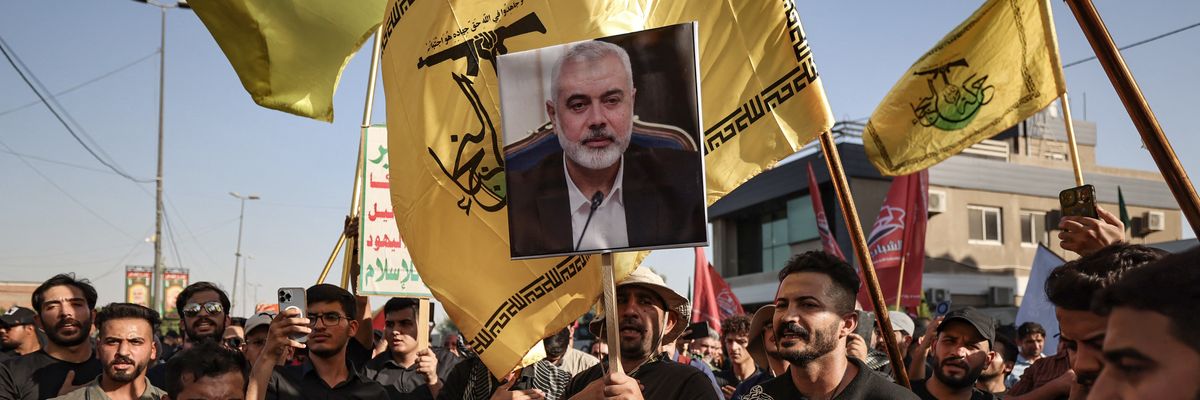
Iraqis raise a picture of assassinated Hamas leader Ismail Haniyeh during a march in Baghdad on July 31, 2024.
The U.S. must "make clear that a regional war is unacceptable and that military assistance to Israel will be leveraged to secure an end to the conflict," said the president of the National Iranian American Council.
A U.S.-based organization that represents Iranian Americans said Wednesday was among those urging the Biden administration to end its "feckless approach" toward Israel's assault on the Gaza Strip and urgently work to prevent an all-out regional war following the assassination of Hamas political leader Ismail Haniyeh in Tehran.
The assassination, widely assumed to have been carried out by the Israeli military early Wednesday morning, "killed immediate hopes of ending this war before it spirals into a regional conflagration that pulls in the United States," Jamal Abdi, president of the National Iranian American Council (NIAC), said in a statement.
"Hamas has engaged in many clear and disturbing violations of international law, including in the October 7th attacks, but the assassination of one of its prominent leaders and cease-fire negotiators in Iran's capital is a highly provocative act that tips the scales further in the direction of a bloody regional war," Abdi continued. "Israeli Prime Minister Benjamin Netanyahu, fresh off dissonant applause in the U.S. Congress, must have felt a green light to engage in further reckless attacks to extend the war—and extend his own political career that is widely believed will end if and when the war does."
Abdi called on the Biden administration—which has backed Israel's war on Gaza with diplomatic support and weaponry—to finally use its leverage to force the Israeli government to accept a cease-fire deal before the volatile situation descends into a full-blown military conflict potentially involving the U.S., Israel, Hamas, Hezbollah, Iran, and other actors.
U.S. President Joe Biden, Abdi argued, must "make clear that a regional war is unacceptable and that military assistance to Israel will be leveraged to secure an end to the conflict."
The suspected Israeli killing of Haniyeh came hours after Israel launched an attack on the Lebanese capital of Beirut,
killing a senior Hezbollah commander and amplifying fears of a wider war.
Ali Khamenei, Iran's supreme leader, pledged "harsh punishment" for Israel in the wake of Haniyeh's assassination, which could further enflame tensions between the U.S. and Iran, whose newly elected president was sworn in on Tuesday. It's possible that Iran could retaliate against Israel in concert with Hezbollah and other allies in the region.
Told @BeckyCNN assassination of Haniyeh in Tehran carries multiple messages:
- Netanyahu seeks to prolong Gaza war by sabotaging ceasefire talks
- Parallel Israeli aim to thwart any prospect for Iran-west dialogue under Pezeshkian
- Retaliation likely to include members of Axis pic.twitter.com/CM4ifD250H
— Mohammad Ali Shabani (@mashabani) July 31, 2024
While U.S. Secretary of State Antony Blinkensaid Wednesday that the Biden administration was "not aware of or involved in" Haniyeh's assassination, Iran's ambassador to the United Nations wrote in a letter to the U.N. Security Council that the killing "could not have occurred without the authorization and intelligence support of the U.S."
"The Islamic Republic of Iran will not hesitate to exercise its inherent right to self-defense, as enshrined in Article 51 of the United Nations Charter, to respond decisively and promptly," the letter added.
Axios reported Wednesday that, internally, the Biden administration is "very concerned" that Haniyeh's assassination "could derail negotiations over the Gaza hostage and cease-fire deal and increase the risk of a regional war"—a concern that Middle East leaders also expressed.
But the Biden administration has been warned repeatedly that its continued support for Israel's assault on Gaza has dramatically increased the likelihood of a broader regional war but has refused to cut off the flow of weapons.
In a televised address Wednesday, Netanyahu vowed to "exact a heavy price from any aggression against us on any front," but did not specifically mention the assassination of Haniyeh.
Phyllis Bennis, a fellow of the U.S.-based Institute for Policy Studies, wrote in an op-ed for Common Dreams on Wednesday that "the U.S. has made clear by its actions—regardless of some politicians' rhetorical support for ending the war—that it is not prepared to do the one thing that would result in a permanent cease-fire: stop sending Israel the weapons that enable the war in Gaza."
"All the talk about Washington and Tel Aviv supporting a cease-fire or wanting the hostages returned means little when a top negotiator on the other side can be assassinated with impunity," Bennis continued. "The negotiations the Hamas leader was participating in will almost certainly be stalled, if not derailed entirely, as a result of Haniyeh’s killing. The resulting continuation of Israel’s genocidal war in Gaza matches the goal of Israeli Prime Minister Benjamin Netanyahu, who has resisted cease-fire efforts and pledged to keep fighting until Hamas is destroyed."
"The likelihood of an expanding regional war is now exponentially higher," Bennis added, "with the danger of a much more direct conflict between Israel and Iran, and the possibility of even greater direct U.S. involvement."
Dear Common Dreams reader, It’s been nearly 30 years since I co-founded Common Dreams with my late wife, Lina Newhouser. We had the radical notion that journalism should serve the public good, not corporate profits. It was clear to us from the outset what it would take to build such a project. No paid advertisements. No corporate sponsors. No millionaire publisher telling us what to think or do. Many people said we wouldn't last a year, but we proved those doubters wrong. Together with a tremendous team of journalists and dedicated staff, we built an independent media outlet free from the constraints of profits and corporate control. Our mission has always been simple: To inform. To inspire. To ignite change for the common good. Building Common Dreams was not easy. Our survival was never guaranteed. When you take on the most powerful forces—Wall Street greed, fossil fuel industry destruction, Big Tech lobbyists, and uber-rich oligarchs who have spent billions upon billions rigging the economy and democracy in their favor—the only bulwark you have is supporters who believe in your work. But here’s the urgent message from me today. It's never been this bad out there. And it's never been this hard to keep us going. At the very moment Common Dreams is most needed, the threats we face are intensifying. We need your support now more than ever. We don't accept corporate advertising and never will. We don't have a paywall because we don't think people should be blocked from critical news based on their ability to pay. Everything we do is funded by the donations of readers like you. When everyone does the little they can afford, we are strong. But if that support retreats or dries up, so do we. Will you donate now to make sure Common Dreams not only survives but thrives? —Craig Brown, Co-founder |
A U.S.-based organization that represents Iranian Americans said Wednesday was among those urging the Biden administration to end its "feckless approach" toward Israel's assault on the Gaza Strip and urgently work to prevent an all-out regional war following the assassination of Hamas political leader Ismail Haniyeh in Tehran.
The assassination, widely assumed to have been carried out by the Israeli military early Wednesday morning, "killed immediate hopes of ending this war before it spirals into a regional conflagration that pulls in the United States," Jamal Abdi, president of the National Iranian American Council (NIAC), said in a statement.
"Hamas has engaged in many clear and disturbing violations of international law, including in the October 7th attacks, but the assassination of one of its prominent leaders and cease-fire negotiators in Iran's capital is a highly provocative act that tips the scales further in the direction of a bloody regional war," Abdi continued. "Israeli Prime Minister Benjamin Netanyahu, fresh off dissonant applause in the U.S. Congress, must have felt a green light to engage in further reckless attacks to extend the war—and extend his own political career that is widely believed will end if and when the war does."
Abdi called on the Biden administration—which has backed Israel's war on Gaza with diplomatic support and weaponry—to finally use its leverage to force the Israeli government to accept a cease-fire deal before the volatile situation descends into a full-blown military conflict potentially involving the U.S., Israel, Hamas, Hezbollah, Iran, and other actors.
U.S. President Joe Biden, Abdi argued, must "make clear that a regional war is unacceptable and that military assistance to Israel will be leveraged to secure an end to the conflict."
The suspected Israeli killing of Haniyeh came hours after Israel launched an attack on the Lebanese capital of Beirut,
killing a senior Hezbollah commander and amplifying fears of a wider war.
Ali Khamenei, Iran's supreme leader, pledged "harsh punishment" for Israel in the wake of Haniyeh's assassination, which could further enflame tensions between the U.S. and Iran, whose newly elected president was sworn in on Tuesday. It's possible that Iran could retaliate against Israel in concert with Hezbollah and other allies in the region.
Told @BeckyCNN assassination of Haniyeh in Tehran carries multiple messages:
- Netanyahu seeks to prolong Gaza war by sabotaging ceasefire talks
- Parallel Israeli aim to thwart any prospect for Iran-west dialogue under Pezeshkian
- Retaliation likely to include members of Axis pic.twitter.com/CM4ifD250H
— Mohammad Ali Shabani (@mashabani) July 31, 2024
While U.S. Secretary of State Antony Blinkensaid Wednesday that the Biden administration was "not aware of or involved in" Haniyeh's assassination, Iran's ambassador to the United Nations wrote in a letter to the U.N. Security Council that the killing "could not have occurred without the authorization and intelligence support of the U.S."
"The Islamic Republic of Iran will not hesitate to exercise its inherent right to self-defense, as enshrined in Article 51 of the United Nations Charter, to respond decisively and promptly," the letter added.
Axios reported Wednesday that, internally, the Biden administration is "very concerned" that Haniyeh's assassination "could derail negotiations over the Gaza hostage and cease-fire deal and increase the risk of a regional war"—a concern that Middle East leaders also expressed.
But the Biden administration has been warned repeatedly that its continued support for Israel's assault on Gaza has dramatically increased the likelihood of a broader regional war but has refused to cut off the flow of weapons.
In a televised address Wednesday, Netanyahu vowed to "exact a heavy price from any aggression against us on any front," but did not specifically mention the assassination of Haniyeh.
Phyllis Bennis, a fellow of the U.S.-based Institute for Policy Studies, wrote in an op-ed for Common Dreams on Wednesday that "the U.S. has made clear by its actions—regardless of some politicians' rhetorical support for ending the war—that it is not prepared to do the one thing that would result in a permanent cease-fire: stop sending Israel the weapons that enable the war in Gaza."
"All the talk about Washington and Tel Aviv supporting a cease-fire or wanting the hostages returned means little when a top negotiator on the other side can be assassinated with impunity," Bennis continued. "The negotiations the Hamas leader was participating in will almost certainly be stalled, if not derailed entirely, as a result of Haniyeh’s killing. The resulting continuation of Israel’s genocidal war in Gaza matches the goal of Israeli Prime Minister Benjamin Netanyahu, who has resisted cease-fire efforts and pledged to keep fighting until Hamas is destroyed."
"The likelihood of an expanding regional war is now exponentially higher," Bennis added, "with the danger of a much more direct conflict between Israel and Iran, and the possibility of even greater direct U.S. involvement."
A U.S.-based organization that represents Iranian Americans said Wednesday was among those urging the Biden administration to end its "feckless approach" toward Israel's assault on the Gaza Strip and urgently work to prevent an all-out regional war following the assassination of Hamas political leader Ismail Haniyeh in Tehran.
The assassination, widely assumed to have been carried out by the Israeli military early Wednesday morning, "killed immediate hopes of ending this war before it spirals into a regional conflagration that pulls in the United States," Jamal Abdi, president of the National Iranian American Council (NIAC), said in a statement.
"Hamas has engaged in many clear and disturbing violations of international law, including in the October 7th attacks, but the assassination of one of its prominent leaders and cease-fire negotiators in Iran's capital is a highly provocative act that tips the scales further in the direction of a bloody regional war," Abdi continued. "Israeli Prime Minister Benjamin Netanyahu, fresh off dissonant applause in the U.S. Congress, must have felt a green light to engage in further reckless attacks to extend the war—and extend his own political career that is widely believed will end if and when the war does."
Abdi called on the Biden administration—which has backed Israel's war on Gaza with diplomatic support and weaponry—to finally use its leverage to force the Israeli government to accept a cease-fire deal before the volatile situation descends into a full-blown military conflict potentially involving the U.S., Israel, Hamas, Hezbollah, Iran, and other actors.
U.S. President Joe Biden, Abdi argued, must "make clear that a regional war is unacceptable and that military assistance to Israel will be leveraged to secure an end to the conflict."
The suspected Israeli killing of Haniyeh came hours after Israel launched an attack on the Lebanese capital of Beirut,
killing a senior Hezbollah commander and amplifying fears of a wider war.
Ali Khamenei, Iran's supreme leader, pledged "harsh punishment" for Israel in the wake of Haniyeh's assassination, which could further enflame tensions between the U.S. and Iran, whose newly elected president was sworn in on Tuesday. It's possible that Iran could retaliate against Israel in concert with Hezbollah and other allies in the region.
Told @BeckyCNN assassination of Haniyeh in Tehran carries multiple messages:
- Netanyahu seeks to prolong Gaza war by sabotaging ceasefire talks
- Parallel Israeli aim to thwart any prospect for Iran-west dialogue under Pezeshkian
- Retaliation likely to include members of Axis pic.twitter.com/CM4ifD250H
— Mohammad Ali Shabani (@mashabani) July 31, 2024
While U.S. Secretary of State Antony Blinkensaid Wednesday that the Biden administration was "not aware of or involved in" Haniyeh's assassination, Iran's ambassador to the United Nations wrote in a letter to the U.N. Security Council that the killing "could not have occurred without the authorization and intelligence support of the U.S."
"The Islamic Republic of Iran will not hesitate to exercise its inherent right to self-defense, as enshrined in Article 51 of the United Nations Charter, to respond decisively and promptly," the letter added.
Axios reported Wednesday that, internally, the Biden administration is "very concerned" that Haniyeh's assassination "could derail negotiations over the Gaza hostage and cease-fire deal and increase the risk of a regional war"—a concern that Middle East leaders also expressed.
But the Biden administration has been warned repeatedly that its continued support for Israel's assault on Gaza has dramatically increased the likelihood of a broader regional war but has refused to cut off the flow of weapons.
In a televised address Wednesday, Netanyahu vowed to "exact a heavy price from any aggression against us on any front," but did not specifically mention the assassination of Haniyeh.
Phyllis Bennis, a fellow of the U.S.-based Institute for Policy Studies, wrote in an op-ed for Common Dreams on Wednesday that "the U.S. has made clear by its actions—regardless of some politicians' rhetorical support for ending the war—that it is not prepared to do the one thing that would result in a permanent cease-fire: stop sending Israel the weapons that enable the war in Gaza."
"All the talk about Washington and Tel Aviv supporting a cease-fire or wanting the hostages returned means little when a top negotiator on the other side can be assassinated with impunity," Bennis continued. "The negotiations the Hamas leader was participating in will almost certainly be stalled, if not derailed entirely, as a result of Haniyeh’s killing. The resulting continuation of Israel’s genocidal war in Gaza matches the goal of Israeli Prime Minister Benjamin Netanyahu, who has resisted cease-fire efforts and pledged to keep fighting until Hamas is destroyed."
"The likelihood of an expanding regional war is now exponentially higher," Bennis added, "with the danger of a much more direct conflict between Israel and Iran, and the possibility of even greater direct U.S. involvement."