SUBSCRIBE TO OUR FREE NEWSLETTER
Daily news & progressive opinion—funded by the people, not the corporations—delivered straight to your inbox.
5
#000000
#FFFFFF
To donate by check, phone, or other method, see our More Ways to Give page.
Daily news & progressive opinion—funded by the people, not the corporations—delivered straight to your inbox.
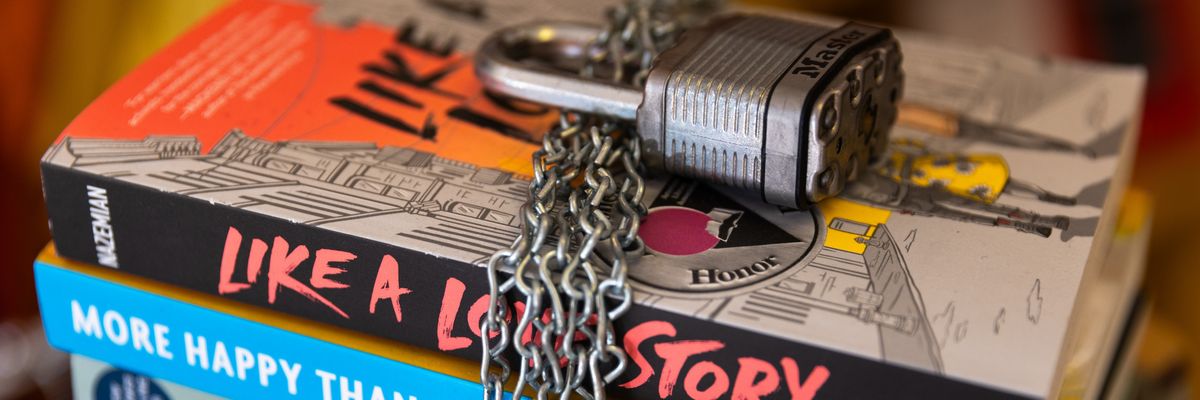
"We deserve to be able to express ourselves safely at school and we deserve to see ourselves in media at school, especially in books," said an eighth grade student who joined one of the lawsuits.
A U.S. federal judge on Friday blocked key parts of what critics called a "sweeping Iowa law that seeks to silence LGBTQ+ students, erase any recognition of LGBTQ+ people from public schools, and bans books with sexual or LGBTQ+ content."
Judge Stephen Locher determined that none of the plaintiffs in a pair of cases filed against Senate File 496 has standing to challenge the provision requiring school districts to notify parents if a child seeks an accommodation relating to gender identity, including the use of pronouns that does not match registration records.
However, Locher issued a preliminary injunction blocking enforcement of a ban on any book containing "descriptions or visual depictions of a sex act"—except for the Bible—in all public school classrooms and libraries, and a prohibition on "any program, curriculum, test, survey, questionnaire, promotion, or instruction relating to gender identity or sexual orientation" in kindergarten through sixth grade.
"This decision sends a strong message to the state that efforts to ban books based on LGBTQ+ content, or target speech that sends a message of inclusion to Iowa LGBTQ+ students cannot stand."
The law—part of a national wave of GOP-led book bans and other policies targeting LGBTQ+ youth—was passed by the Iowa Legislature and signed by Republican Gov. Kim Reynolds this spring. The Associated Press noted Friday that it "was set to take effect January 1 but already had resulted in the removal of hundreds of books from Iowa schools."
The two lawsuits against S.F. 496 were filed last month. The Iowa State Education Association, Penguin Random House, and some popular authors partnered for one of the cases. The ACLU of Iowa, Lambda Legal, and the law firm Jenner & Block also sued on behalf of Iowa Safe Schools and several students and their families—including Berry Stevens, an eighth grader from West Des Moines.
"I've known since I was in third grade that I am a part of the LGBTQIA+ community," said Stevens—whose mother, Rev. Brigit Stevens, is also a plaintiff in the case—when the suit was launched in November. "In sixth grade, I first changed my name and started using they/them pronouns because I knew I wasn't a boy or a girl. I'm just a person. This is a concept that a lot of adults have trouble understanding."
The younger Stevens explained that "I am participating in this lawsuit because this new law hurts all kinds of kids and it hurts many of my friends. We deserve to be able to express ourselves safely at school and we deserve to see ourselves in media at school, especially in books. This law is trying to shut us down and make us be quiet and not openly discuss our lives, who we like, or who we truly are."
"I know what it's like to be bullied and harassed because of being in the LGBTQIA+ community. I wish my school would do something to actually prevent bullying before it happens, not just tell kids it's wrong after the fact," they added. "But because of this law, I feel like the school is too worried about getting in trouble with the state if they try to speak out. This law gets in the way of educators trying to make a safer, more inclusive space for all students."
Another plaintiff, high school senior Puck Carlson of Iowa City, said that "like it or not, sex and sexuality are parts of the teenage experience. Refusing to provide adolescents with information about it means they'll seek out their own information—from the Internet, or from others, in ways that are significantly less safe than books reviewed by teachers or librarians."
"Removing books that discuss queer topics or people from our schools tells our queer students that they do not belong there, that their existence is shameful. I am not shameful," they added. "School is one of the main places that children read, and being able to access literature in which you can see yourself can be instrumental to a student's discovery of themselves—it certainly was to me."
In response to the judge blocking Iowa's book ban and "don't say LGBTQ" provisions, Lambda Legal senior attorney Nathan Maxwell said that "we are glad our clients, Iowa families, and students will be able to continue the school year free from the harms caused by these parts of this unconstitutional law."
"This decision sends a strong message to the state that efforts to ban books based on LGBTQ+ content, or target speech that sends a message of inclusion to Iowa LGBTQ+ students cannot stand," Maxwell added. "Lambda Legal and the ACLU of Iowa will continue our fight to ensure Iowa schools are safe for LGBTQ+ students."
Dear Common Dreams reader, It’s been nearly 30 years since I co-founded Common Dreams with my late wife, Lina Newhouser. We had the radical notion that journalism should serve the public good, not corporate profits. It was clear to us from the outset what it would take to build such a project. No paid advertisements. No corporate sponsors. No millionaire publisher telling us what to think or do. Many people said we wouldn't last a year, but we proved those doubters wrong. Together with a tremendous team of journalists and dedicated staff, we built an independent media outlet free from the constraints of profits and corporate control. Our mission has always been simple: To inform. To inspire. To ignite change for the common good. Building Common Dreams was not easy. Our survival was never guaranteed. When you take on the most powerful forces—Wall Street greed, fossil fuel industry destruction, Big Tech lobbyists, and uber-rich oligarchs who have spent billions upon billions rigging the economy and democracy in their favor—the only bulwark you have is supporters who believe in your work. But here’s the urgent message from me today. It's never been this bad out there. And it's never been this hard to keep us going. At the very moment Common Dreams is most needed, the threats we face are intensifying. We need your support now more than ever. We don't accept corporate advertising and never will. We don't have a paywall because we don't think people should be blocked from critical news based on their ability to pay. Everything we do is funded by the donations of readers like you. When everyone does the little they can afford, we are strong. But if that support retreats or dries up, so do we. Will you donate now to make sure Common Dreams not only survives but thrives? —Craig Brown, Co-founder |
A U.S. federal judge on Friday blocked key parts of what critics called a "sweeping Iowa law that seeks to silence LGBTQ+ students, erase any recognition of LGBTQ+ people from public schools, and bans books with sexual or LGBTQ+ content."
Judge Stephen Locher determined that none of the plaintiffs in a pair of cases filed against Senate File 496 has standing to challenge the provision requiring school districts to notify parents if a child seeks an accommodation relating to gender identity, including the use of pronouns that does not match registration records.
However, Locher issued a preliminary injunction blocking enforcement of a ban on any book containing "descriptions or visual depictions of a sex act"—except for the Bible—in all public school classrooms and libraries, and a prohibition on "any program, curriculum, test, survey, questionnaire, promotion, or instruction relating to gender identity or sexual orientation" in kindergarten through sixth grade.
"This decision sends a strong message to the state that efforts to ban books based on LGBTQ+ content, or target speech that sends a message of inclusion to Iowa LGBTQ+ students cannot stand."
The law—part of a national wave of GOP-led book bans and other policies targeting LGBTQ+ youth—was passed by the Iowa Legislature and signed by Republican Gov. Kim Reynolds this spring. The Associated Press noted Friday that it "was set to take effect January 1 but already had resulted in the removal of hundreds of books from Iowa schools."
The two lawsuits against S.F. 496 were filed last month. The Iowa State Education Association, Penguin Random House, and some popular authors partnered for one of the cases. The ACLU of Iowa, Lambda Legal, and the law firm Jenner & Block also sued on behalf of Iowa Safe Schools and several students and their families—including Berry Stevens, an eighth grader from West Des Moines.
"I've known since I was in third grade that I am a part of the LGBTQIA+ community," said Stevens—whose mother, Rev. Brigit Stevens, is also a plaintiff in the case—when the suit was launched in November. "In sixth grade, I first changed my name and started using they/them pronouns because I knew I wasn't a boy or a girl. I'm just a person. This is a concept that a lot of adults have trouble understanding."
The younger Stevens explained that "I am participating in this lawsuit because this new law hurts all kinds of kids and it hurts many of my friends. We deserve to be able to express ourselves safely at school and we deserve to see ourselves in media at school, especially in books. This law is trying to shut us down and make us be quiet and not openly discuss our lives, who we like, or who we truly are."
"I know what it's like to be bullied and harassed because of being in the LGBTQIA+ community. I wish my school would do something to actually prevent bullying before it happens, not just tell kids it's wrong after the fact," they added. "But because of this law, I feel like the school is too worried about getting in trouble with the state if they try to speak out. This law gets in the way of educators trying to make a safer, more inclusive space for all students."
Another plaintiff, high school senior Puck Carlson of Iowa City, said that "like it or not, sex and sexuality are parts of the teenage experience. Refusing to provide adolescents with information about it means they'll seek out their own information—from the Internet, or from others, in ways that are significantly less safe than books reviewed by teachers or librarians."
"Removing books that discuss queer topics or people from our schools tells our queer students that they do not belong there, that their existence is shameful. I am not shameful," they added. "School is one of the main places that children read, and being able to access literature in which you can see yourself can be instrumental to a student's discovery of themselves—it certainly was to me."
In response to the judge blocking Iowa's book ban and "don't say LGBTQ" provisions, Lambda Legal senior attorney Nathan Maxwell said that "we are glad our clients, Iowa families, and students will be able to continue the school year free from the harms caused by these parts of this unconstitutional law."
"This decision sends a strong message to the state that efforts to ban books based on LGBTQ+ content, or target speech that sends a message of inclusion to Iowa LGBTQ+ students cannot stand," Maxwell added. "Lambda Legal and the ACLU of Iowa will continue our fight to ensure Iowa schools are safe for LGBTQ+ students."
A U.S. federal judge on Friday blocked key parts of what critics called a "sweeping Iowa law that seeks to silence LGBTQ+ students, erase any recognition of LGBTQ+ people from public schools, and bans books with sexual or LGBTQ+ content."
Judge Stephen Locher determined that none of the plaintiffs in a pair of cases filed against Senate File 496 has standing to challenge the provision requiring school districts to notify parents if a child seeks an accommodation relating to gender identity, including the use of pronouns that does not match registration records.
However, Locher issued a preliminary injunction blocking enforcement of a ban on any book containing "descriptions or visual depictions of a sex act"—except for the Bible—in all public school classrooms and libraries, and a prohibition on "any program, curriculum, test, survey, questionnaire, promotion, or instruction relating to gender identity or sexual orientation" in kindergarten through sixth grade.
"This decision sends a strong message to the state that efforts to ban books based on LGBTQ+ content, or target speech that sends a message of inclusion to Iowa LGBTQ+ students cannot stand."
The law—part of a national wave of GOP-led book bans and other policies targeting LGBTQ+ youth—was passed by the Iowa Legislature and signed by Republican Gov. Kim Reynolds this spring. The Associated Press noted Friday that it "was set to take effect January 1 but already had resulted in the removal of hundreds of books from Iowa schools."
The two lawsuits against S.F. 496 were filed last month. The Iowa State Education Association, Penguin Random House, and some popular authors partnered for one of the cases. The ACLU of Iowa, Lambda Legal, and the law firm Jenner & Block also sued on behalf of Iowa Safe Schools and several students and their families—including Berry Stevens, an eighth grader from West Des Moines.
"I've known since I was in third grade that I am a part of the LGBTQIA+ community," said Stevens—whose mother, Rev. Brigit Stevens, is also a plaintiff in the case—when the suit was launched in November. "In sixth grade, I first changed my name and started using they/them pronouns because I knew I wasn't a boy or a girl. I'm just a person. This is a concept that a lot of adults have trouble understanding."
The younger Stevens explained that "I am participating in this lawsuit because this new law hurts all kinds of kids and it hurts many of my friends. We deserve to be able to express ourselves safely at school and we deserve to see ourselves in media at school, especially in books. This law is trying to shut us down and make us be quiet and not openly discuss our lives, who we like, or who we truly are."
"I know what it's like to be bullied and harassed because of being in the LGBTQIA+ community. I wish my school would do something to actually prevent bullying before it happens, not just tell kids it's wrong after the fact," they added. "But because of this law, I feel like the school is too worried about getting in trouble with the state if they try to speak out. This law gets in the way of educators trying to make a safer, more inclusive space for all students."
Another plaintiff, high school senior Puck Carlson of Iowa City, said that "like it or not, sex and sexuality are parts of the teenage experience. Refusing to provide adolescents with information about it means they'll seek out their own information—from the Internet, or from others, in ways that are significantly less safe than books reviewed by teachers or librarians."
"Removing books that discuss queer topics or people from our schools tells our queer students that they do not belong there, that their existence is shameful. I am not shameful," they added. "School is one of the main places that children read, and being able to access literature in which you can see yourself can be instrumental to a student's discovery of themselves—it certainly was to me."
In response to the judge blocking Iowa's book ban and "don't say LGBTQ" provisions, Lambda Legal senior attorney Nathan Maxwell said that "we are glad our clients, Iowa families, and students will be able to continue the school year free from the harms caused by these parts of this unconstitutional law."
"This decision sends a strong message to the state that efforts to ban books based on LGBTQ+ content, or target speech that sends a message of inclusion to Iowa LGBTQ+ students cannot stand," Maxwell added. "Lambda Legal and the ACLU of Iowa will continue our fight to ensure Iowa schools are safe for LGBTQ+ students."