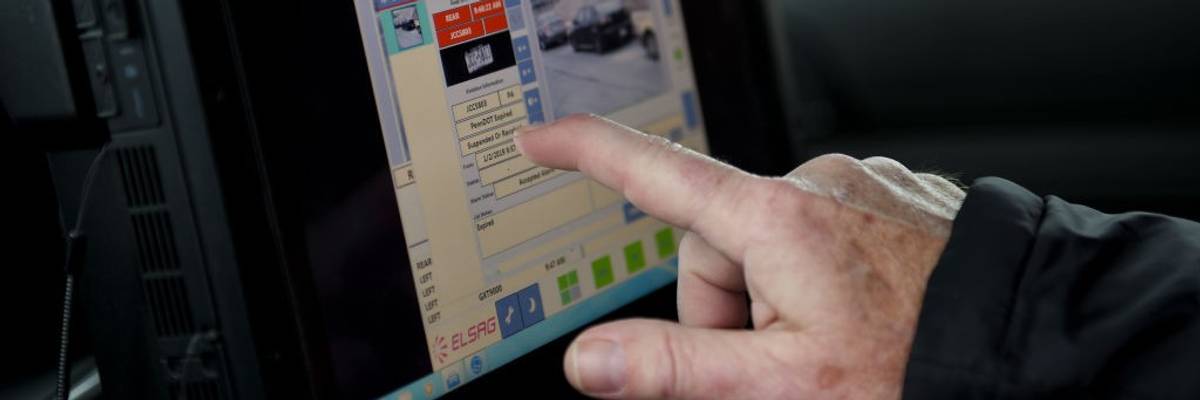
Spring Township, Pennsylvania Police Chief Bryan D. Ross shows how the license plate scanner in his duty vehicle works, on January 16, 2019.
Report: State and Local Cops Doing License Plate Lookups for ICE
"If ICE can use a nationwide network of license place readers for its purposes, what's stopping the government from using it for whatever purposes they want?" asked one critic.
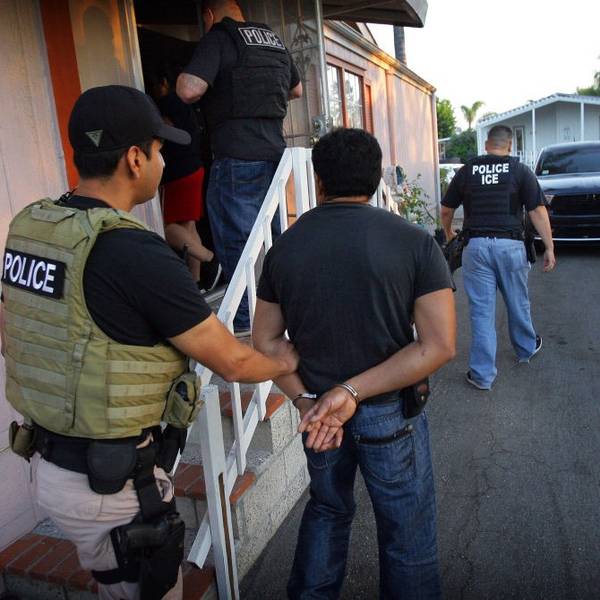
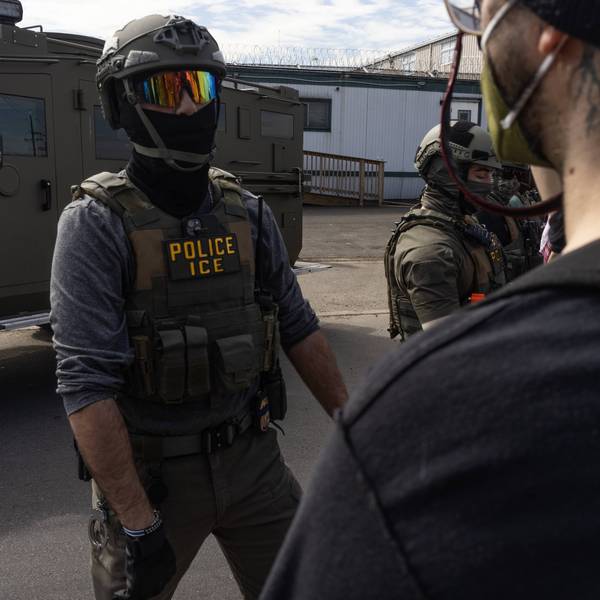
State and local law enforcement agencies across the United States are using data gleaned from automated license plate readers to assist federal immigration authorities in the Trump administration's mass deportation efforts, a report published Tuesday detailed.
Data reviewed by 404 Media found that state and local police are using an artificial-intelligence-powered automatic license plate reader (ALPR) system made by Atlanta-based Flock Safety to perform immigration-related lookups and other actions in service of U.S. Immigration and Customs Enforcement (ICE) investigations, "giving federal law enforcement side-door access to a tool that it currently does not have a formal contract for," according to report authors Jason Koebler and Joseph Cox.
Koebler and Cox found that Flock Safety's ALRP systems are being used in more than 5,000 communities from coast to coast, where law enforcement agencies have conducted over 4,000 lookups "either at the behest of the federal government or as an 'informal' favor to federal law enforcement."
According to Koebler and Cox:
As part of a Flock search, police have to provide a "reason" they are performing the lookup. In the "reason" field for searches of [Danville, Illinois'] cameras, officers from across the U.S. wrote "immigration," "ICE," "ICE+ERO"—which is ICE’s Enforcement and Removal Operations, the section that focuses on deportations—"illegal immigration," "ICE WARRANT," and other immigration-related reasons. Although lookups mentioning ICE occurred across both the Biden and Trump administrations, all of the lookups that explicitly list "immigration" as their reason were made after [U.S. President Donald] Trump was inaugurated, according to the data.
The Department of Homeland Security does use license plate scanning cameras at the border and has shown great interest in the technology. Immigration advocates have been concerned that ICE could turn to local agencies' ALPR networks, but this is the first confirmation such data access is happening during Trump's mass deportation efforts.
"Different law enforcement systems serve different purposes and might be more appropriate for one agency or another," Jay Stanley, senior policy analyst at the ACLU's Speech, Privacy, and Technology Project, told 404 Media. "There should be public conversations about what we want different agencies to be able to do."
"I assume there's a fair number of community residents who accept giving police the power to deploy license plate readers to catch a bank robber, who would absolutely gag on the idea that their community's cameras have become part of a nationwide ICE surveillance infrastructure," Stanley added. "And yet if this kind of informal backdoor access to surveillance devices is allowed, then there's functionally no limits to what systems ICE can tap into with no public oversight or control into what they are tapping into."
While state and local law enforcement agencies normally lack the authority to enforce federal immigration laws, the Trump administration has encouraged them to participate in a program called 287(g), a provision of the the Immigration and Nationality Act that authorizes DHS agencies including ICE to delegate certain immigration enforcement actions to state and municipal police.
On the first day of his second term, Trump issued an executive order "to authorize state and local law enforcement officials, as the secretary of homeland security determines are qualified and appropriate, to perform the functions of immigration officers in relation to the investigation, apprehension, or detention of aliens in the United States."
In an opinion piece published by Common Dreams in 2021, immigrant rights defenders Gabriela Viera and Cynthia Garcia wrote that 287(g) "turns local law enforcement into a gateway to deportation and deepens collaboration between ICE and local police."
Previous reporting by The Guardian's Johana Bhuiyan detailed how ICE "has gained access to troves of data from sanctuary cities that could aid its raids and enforcement actions" in municipalities where undocumented immigrants are ostensibly protected.
"This sort of mass tracking violates the promise made to undocumented residents that they will be safe in the county," Albert Fox Cahn, the director of the privacy advocacy group the Surveillance Tech Oversight Project, told Bhuiyan.
Responding to 404 Media's request for comment, Flock Safety said that "we are committed to ensuring every customer can leverage technology in a way that reflects their values, and support democratically authorized governing bodies to determine what that means for their community."
"We work with local governments across the country to adopt best practices on [license plate reader] policies, including robust auditing requirements," the company added.
However, ACLU of Illinois communications and public policy director Edwin Yohnka told
404 Media, "This is is really a national system of data once you start collecting," adding that "it is incredibly troubling to see this list of places from around the country who are performing these searches of Illinois cameras."
Responding to the 404 Media report, journalist Krishna Sai Andavolu asked, "If ICE can use a nationwide network of license place readers for its purposes, what's stopping the government from using it for whatever purposes they want?"
We are at a crossroads
This country and this world are at a monumental crossroads. In a few short weeks, US voters will have an opportunity to beat back the forces of fascism and confront the billionaires who are rigging the economy, our media system, and our democracy, making it increasingly impossible for ordinary people to get by. We’re not just talking about the election. We’re talking about what must be done once these fascist elements are vanquished from power. We need a bolder set of solutions than what either major party has so far been willing to offer and a working-class movement ready to fight like hell for it. Trump didn't emerge from nowhere. The conditions that fueled MAGA authoritarianism were created by decades of radical neoliberal economic policies and a corrupt political system dominated by corporate interests. They slashed taxes on the super-rich, promising that the benefits would trickle down. They said giveaways to the corporate titans would make life more affordable for the rest of us. It was all bullshit. And when a bitter, betrayed populace searches for someone to blame, right-wing demagogues have little trouble finding scapegoats. People know when they're being lied to, but you won't hear any of this from the corporate media. Only independent journalism—powered and funded by people who believe in building a better world—can deliver truly trustworthy daily news. Our Fall Campaign is underway, and we need your help. To power our newsroom through the rest of the year, we need to raise $125,000 by midnight on October 31. So if you share our vision, please contribute whatever you can to sustain our work. |
State and local law enforcement agencies across the United States are using data gleaned from automated license plate readers to assist federal immigration authorities in the Trump administration's mass deportation efforts, a report published Tuesday detailed.
Data reviewed by 404 Media found that state and local police are using an artificial-intelligence-powered automatic license plate reader (ALPR) system made by Atlanta-based Flock Safety to perform immigration-related lookups and other actions in service of U.S. Immigration and Customs Enforcement (ICE) investigations, "giving federal law enforcement side-door access to a tool that it currently does not have a formal contract for," according to report authors Jason Koebler and Joseph Cox.
Koebler and Cox found that Flock Safety's ALRP systems are being used in more than 5,000 communities from coast to coast, where law enforcement agencies have conducted over 4,000 lookups "either at the behest of the federal government or as an 'informal' favor to federal law enforcement."
According to Koebler and Cox:
As part of a Flock search, police have to provide a "reason" they are performing the lookup. In the "reason" field for searches of [Danville, Illinois'] cameras, officers from across the U.S. wrote "immigration," "ICE," "ICE+ERO"—which is ICE’s Enforcement and Removal Operations, the section that focuses on deportations—"illegal immigration," "ICE WARRANT," and other immigration-related reasons. Although lookups mentioning ICE occurred across both the Biden and Trump administrations, all of the lookups that explicitly list "immigration" as their reason were made after [U.S. President Donald] Trump was inaugurated, according to the data.
The Department of Homeland Security does use license plate scanning cameras at the border and has shown great interest in the technology. Immigration advocates have been concerned that ICE could turn to local agencies' ALPR networks, but this is the first confirmation such data access is happening during Trump's mass deportation efforts.
"Different law enforcement systems serve different purposes and might be more appropriate for one agency or another," Jay Stanley, senior policy analyst at the ACLU's Speech, Privacy, and Technology Project, told 404 Media. "There should be public conversations about what we want different agencies to be able to do."
"I assume there's a fair number of community residents who accept giving police the power to deploy license plate readers to catch a bank robber, who would absolutely gag on the idea that their community's cameras have become part of a nationwide ICE surveillance infrastructure," Stanley added. "And yet if this kind of informal backdoor access to surveillance devices is allowed, then there's functionally no limits to what systems ICE can tap into with no public oversight or control into what they are tapping into."
While state and local law enforcement agencies normally lack the authority to enforce federal immigration laws, the Trump administration has encouraged them to participate in a program called 287(g), a provision of the the Immigration and Nationality Act that authorizes DHS agencies including ICE to delegate certain immigration enforcement actions to state and municipal police.
On the first day of his second term, Trump issued an executive order "to authorize state and local law enforcement officials, as the secretary of homeland security determines are qualified and appropriate, to perform the functions of immigration officers in relation to the investigation, apprehension, or detention of aliens in the United States."
In an opinion piece published by Common Dreams in 2021, immigrant rights defenders Gabriela Viera and Cynthia Garcia wrote that 287(g) "turns local law enforcement into a gateway to deportation and deepens collaboration between ICE and local police."
Previous reporting by The Guardian's Johana Bhuiyan detailed how ICE "has gained access to troves of data from sanctuary cities that could aid its raids and enforcement actions" in municipalities where undocumented immigrants are ostensibly protected.
"This sort of mass tracking violates the promise made to undocumented residents that they will be safe in the county," Albert Fox Cahn, the director of the privacy advocacy group the Surveillance Tech Oversight Project, told Bhuiyan.
Responding to 404 Media's request for comment, Flock Safety said that "we are committed to ensuring every customer can leverage technology in a way that reflects their values, and support democratically authorized governing bodies to determine what that means for their community."
"We work with local governments across the country to adopt best practices on [license plate reader] policies, including robust auditing requirements," the company added.
However, ACLU of Illinois communications and public policy director Edwin Yohnka told
404 Media, "This is is really a national system of data once you start collecting," adding that "it is incredibly troubling to see this list of places from around the country who are performing these searches of Illinois cameras."
Responding to the 404 Media report, journalist Krishna Sai Andavolu asked, "If ICE can use a nationwide network of license place readers for its purposes, what's stopping the government from using it for whatever purposes they want?"
State and local law enforcement agencies across the United States are using data gleaned from automated license plate readers to assist federal immigration authorities in the Trump administration's mass deportation efforts, a report published Tuesday detailed.
Data reviewed by 404 Media found that state and local police are using an artificial-intelligence-powered automatic license plate reader (ALPR) system made by Atlanta-based Flock Safety to perform immigration-related lookups and other actions in service of U.S. Immigration and Customs Enforcement (ICE) investigations, "giving federal law enforcement side-door access to a tool that it currently does not have a formal contract for," according to report authors Jason Koebler and Joseph Cox.
Koebler and Cox found that Flock Safety's ALRP systems are being used in more than 5,000 communities from coast to coast, where law enforcement agencies have conducted over 4,000 lookups "either at the behest of the federal government or as an 'informal' favor to federal law enforcement."
According to Koebler and Cox:
As part of a Flock search, police have to provide a "reason" they are performing the lookup. In the "reason" field for searches of [Danville, Illinois'] cameras, officers from across the U.S. wrote "immigration," "ICE," "ICE+ERO"—which is ICE’s Enforcement and Removal Operations, the section that focuses on deportations—"illegal immigration," "ICE WARRANT," and other immigration-related reasons. Although lookups mentioning ICE occurred across both the Biden and Trump administrations, all of the lookups that explicitly list "immigration" as their reason were made after [U.S. President Donald] Trump was inaugurated, according to the data.
The Department of Homeland Security does use license plate scanning cameras at the border and has shown great interest in the technology. Immigration advocates have been concerned that ICE could turn to local agencies' ALPR networks, but this is the first confirmation such data access is happening during Trump's mass deportation efforts.
"Different law enforcement systems serve different purposes and might be more appropriate for one agency or another," Jay Stanley, senior policy analyst at the ACLU's Speech, Privacy, and Technology Project, told 404 Media. "There should be public conversations about what we want different agencies to be able to do."
"I assume there's a fair number of community residents who accept giving police the power to deploy license plate readers to catch a bank robber, who would absolutely gag on the idea that their community's cameras have become part of a nationwide ICE surveillance infrastructure," Stanley added. "And yet if this kind of informal backdoor access to surveillance devices is allowed, then there's functionally no limits to what systems ICE can tap into with no public oversight or control into what they are tapping into."
While state and local law enforcement agencies normally lack the authority to enforce federal immigration laws, the Trump administration has encouraged them to participate in a program called 287(g), a provision of the the Immigration and Nationality Act that authorizes DHS agencies including ICE to delegate certain immigration enforcement actions to state and municipal police.
On the first day of his second term, Trump issued an executive order "to authorize state and local law enforcement officials, as the secretary of homeland security determines are qualified and appropriate, to perform the functions of immigration officers in relation to the investigation, apprehension, or detention of aliens in the United States."
In an opinion piece published by Common Dreams in 2021, immigrant rights defenders Gabriela Viera and Cynthia Garcia wrote that 287(g) "turns local law enforcement into a gateway to deportation and deepens collaboration between ICE and local police."
Previous reporting by The Guardian's Johana Bhuiyan detailed how ICE "has gained access to troves of data from sanctuary cities that could aid its raids and enforcement actions" in municipalities where undocumented immigrants are ostensibly protected.
"This sort of mass tracking violates the promise made to undocumented residents that they will be safe in the county," Albert Fox Cahn, the director of the privacy advocacy group the Surveillance Tech Oversight Project, told Bhuiyan.
Responding to 404 Media's request for comment, Flock Safety said that "we are committed to ensuring every customer can leverage technology in a way that reflects their values, and support democratically authorized governing bodies to determine what that means for their community."
"We work with local governments across the country to adopt best practices on [license plate reader] policies, including robust auditing requirements," the company added.
However, ACLU of Illinois communications and public policy director Edwin Yohnka told
404 Media, "This is is really a national system of data once you start collecting," adding that "it is incredibly troubling to see this list of places from around the country who are performing these searches of Illinois cameras."
Responding to the 404 Media report, journalist Krishna Sai Andavolu asked, "If ICE can use a nationwide network of license place readers for its purposes, what's stopping the government from using it for whatever purposes they want?"