SUBSCRIBE TO OUR FREE NEWSLETTER
Daily news & progressive opinion—funded by the people, not the corporations—delivered straight to your inbox.
5
#000000
#FFFFFF
To donate by check, phone, or other method, see our More Ways to Give page.
Daily news & progressive opinion—funded by the people, not the corporations—delivered straight to your inbox.
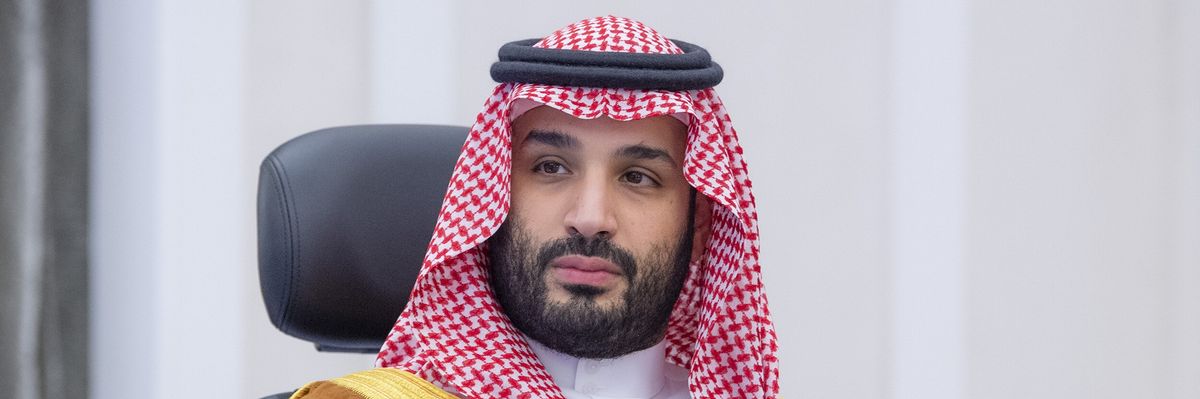
Saudi Crown Prince Mohammed bin Salman attends the G20 Leaders' Summit in Riyadh, Saudi Arabia on October 30, 2021.
Human Rights Watch examines how repressive governments use harassment, surveillance, and assassination to target dissidents.
A report published Thursday by Human Rights Watch details how governments around the world relentlessly target dissidents, journalists, and others beyond their borders, resorting to threats, harassment, and even abduction and assassination to silence those perceived as threats.
"Transnational repression looks different depending on the context," notes the new report. "Recent cases include a Rwandan refugee who was killed in Uganda following threats from the Rwandan government; a Cambodian refugee in Thailand only to be extradited to Cambodia and summarily detained; and a Belarusian activist who was abducted while aboard a commercial airline flight. Transnational repression may mean that a person's family members who remain at home become targets of collective punishment, such as the Tajik activist whose family in Tajikistan, including his 10-year-old daughter, was detained, interrogated, and threatened."
The report—titled "We Will Find You": Global Look at How Governments Repress Nationals Abroad—also highlights the well-known case of Jamal Khashoggi, a journalist and dissident who was violently murdered inside the Saudi consulate in Istanbul in 2018.
U.S. intelligence agencies concluded that Crown Prince Mohammed bin Salman, the de facto ruler of Saudi Arabia, "approved" the operation. Khashoggi's remains were never found.
The Saudi regime, an ally of the U.S., uses a number of tactics to silence dissidents, the new report notes, pointing to the targeting of family members of government critics, arbitrary arrests and disappearances, and surveillance.
In total, the report examines more than 75 cases of transnational repression committed by over two dozen governments.
"Governments responsible for transnational repression should be on notice that their efforts to silence critics, threaten human rights defenders, and target people based on their identity are no less problematic abroad than they are at home," the report states.
1/ Powerful new @HRW report today on how governments harass & abuse their citizens living abroad inc killings, kidnapping, misuse of Interpol, arrest of relatives at home. Urgent action needed by govts, EU, UN to stop this #TransnationalRepression https://t.co/zrT298Rjpo
— Hugh Williamson (@HughAWilliamson) February 22, 2024
The new report comes after the United Kingdom's High Court held two days of hearings on whether WikiLeaks founder Julian Assange—an Australian national who has spent the past five years in a high-security London prison—can appeal his extradition to the United States.
Advocacy groups, including Human Rights Watch, have described the case as a "grave" threat to press freedom and an attempt to "intimidate and silence" journalists worldwide.
Bruno Stagno, chief advocacy officer at Human Rights Watch, said Thursday that "governments, the United Nations, and other international organizations should recognize transnational repression as a specific threat to human rights."
"They should prioritize bold policy responses that are in line with a human rights framework and uphold the rights of affected individuals and communities," said Stagno.
Dear Common Dreams reader, It’s been nearly 30 years since I co-founded Common Dreams with my late wife, Lina Newhouser. We had the radical notion that journalism should serve the public good, not corporate profits. It was clear to us from the outset what it would take to build such a project. No paid advertisements. No corporate sponsors. No millionaire publisher telling us what to think or do. Many people said we wouldn't last a year, but we proved those doubters wrong. Together with a tremendous team of journalists and dedicated staff, we built an independent media outlet free from the constraints of profits and corporate control. Our mission has always been simple: To inform. To inspire. To ignite change for the common good. Building Common Dreams was not easy. Our survival was never guaranteed. When you take on the most powerful forces—Wall Street greed, fossil fuel industry destruction, Big Tech lobbyists, and uber-rich oligarchs who have spent billions upon billions rigging the economy and democracy in their favor—the only bulwark you have is supporters who believe in your work. But here’s the urgent message from me today. It's never been this bad out there. And it's never been this hard to keep us going. At the very moment Common Dreams is most needed, the threats we face are intensifying. We need your support now more than ever. We don't accept corporate advertising and never will. We don't have a paywall because we don't think people should be blocked from critical news based on their ability to pay. Everything we do is funded by the donations of readers like you. When everyone does the little they can afford, we are strong. But if that support retreats or dries up, so do we. Will you donate now to make sure Common Dreams not only survives but thrives? —Craig Brown, Co-founder |
A report published Thursday by Human Rights Watch details how governments around the world relentlessly target dissidents, journalists, and others beyond their borders, resorting to threats, harassment, and even abduction and assassination to silence those perceived as threats.
"Transnational repression looks different depending on the context," notes the new report. "Recent cases include a Rwandan refugee who was killed in Uganda following threats from the Rwandan government; a Cambodian refugee in Thailand only to be extradited to Cambodia and summarily detained; and a Belarusian activist who was abducted while aboard a commercial airline flight. Transnational repression may mean that a person's family members who remain at home become targets of collective punishment, such as the Tajik activist whose family in Tajikistan, including his 10-year-old daughter, was detained, interrogated, and threatened."
The report—titled "We Will Find You": Global Look at How Governments Repress Nationals Abroad—also highlights the well-known case of Jamal Khashoggi, a journalist and dissident who was violently murdered inside the Saudi consulate in Istanbul in 2018.
U.S. intelligence agencies concluded that Crown Prince Mohammed bin Salman, the de facto ruler of Saudi Arabia, "approved" the operation. Khashoggi's remains were never found.
The Saudi regime, an ally of the U.S., uses a number of tactics to silence dissidents, the new report notes, pointing to the targeting of family members of government critics, arbitrary arrests and disappearances, and surveillance.
In total, the report examines more than 75 cases of transnational repression committed by over two dozen governments.
"Governments responsible for transnational repression should be on notice that their efforts to silence critics, threaten human rights defenders, and target people based on their identity are no less problematic abroad than they are at home," the report states.
1/ Powerful new @HRW report today on how governments harass & abuse their citizens living abroad inc killings, kidnapping, misuse of Interpol, arrest of relatives at home. Urgent action needed by govts, EU, UN to stop this #TransnationalRepression https://t.co/zrT298Rjpo
— Hugh Williamson (@HughAWilliamson) February 22, 2024
The new report comes after the United Kingdom's High Court held two days of hearings on whether WikiLeaks founder Julian Assange—an Australian national who has spent the past five years in a high-security London prison—can appeal his extradition to the United States.
Advocacy groups, including Human Rights Watch, have described the case as a "grave" threat to press freedom and an attempt to "intimidate and silence" journalists worldwide.
Bruno Stagno, chief advocacy officer at Human Rights Watch, said Thursday that "governments, the United Nations, and other international organizations should recognize transnational repression as a specific threat to human rights."
"They should prioritize bold policy responses that are in line with a human rights framework and uphold the rights of affected individuals and communities," said Stagno.
A report published Thursday by Human Rights Watch details how governments around the world relentlessly target dissidents, journalists, and others beyond their borders, resorting to threats, harassment, and even abduction and assassination to silence those perceived as threats.
"Transnational repression looks different depending on the context," notes the new report. "Recent cases include a Rwandan refugee who was killed in Uganda following threats from the Rwandan government; a Cambodian refugee in Thailand only to be extradited to Cambodia and summarily detained; and a Belarusian activist who was abducted while aboard a commercial airline flight. Transnational repression may mean that a person's family members who remain at home become targets of collective punishment, such as the Tajik activist whose family in Tajikistan, including his 10-year-old daughter, was detained, interrogated, and threatened."
The report—titled "We Will Find You": Global Look at How Governments Repress Nationals Abroad—also highlights the well-known case of Jamal Khashoggi, a journalist and dissident who was violently murdered inside the Saudi consulate in Istanbul in 2018.
U.S. intelligence agencies concluded that Crown Prince Mohammed bin Salman, the de facto ruler of Saudi Arabia, "approved" the operation. Khashoggi's remains were never found.
The Saudi regime, an ally of the U.S., uses a number of tactics to silence dissidents, the new report notes, pointing to the targeting of family members of government critics, arbitrary arrests and disappearances, and surveillance.
In total, the report examines more than 75 cases of transnational repression committed by over two dozen governments.
"Governments responsible for transnational repression should be on notice that their efforts to silence critics, threaten human rights defenders, and target people based on their identity are no less problematic abroad than they are at home," the report states.
1/ Powerful new @HRW report today on how governments harass & abuse their citizens living abroad inc killings, kidnapping, misuse of Interpol, arrest of relatives at home. Urgent action needed by govts, EU, UN to stop this #TransnationalRepression https://t.co/zrT298Rjpo
— Hugh Williamson (@HughAWilliamson) February 22, 2024
The new report comes after the United Kingdom's High Court held two days of hearings on whether WikiLeaks founder Julian Assange—an Australian national who has spent the past five years in a high-security London prison—can appeal his extradition to the United States.
Advocacy groups, including Human Rights Watch, have described the case as a "grave" threat to press freedom and an attempt to "intimidate and silence" journalists worldwide.
Bruno Stagno, chief advocacy officer at Human Rights Watch, said Thursday that "governments, the United Nations, and other international organizations should recognize transnational repression as a specific threat to human rights."
"They should prioritize bold policy responses that are in line with a human rights framework and uphold the rights of affected individuals and communities," said Stagno.