SUBSCRIBE TO OUR FREE NEWSLETTER
Daily news & progressive opinion—funded by the people, not the corporations—delivered straight to your inbox.
5
#000000
#FFFFFF
To donate by check, phone, or other method, see our More Ways to Give page.
Daily news & progressive opinion—funded by the people, not the corporations—delivered straight to your inbox.
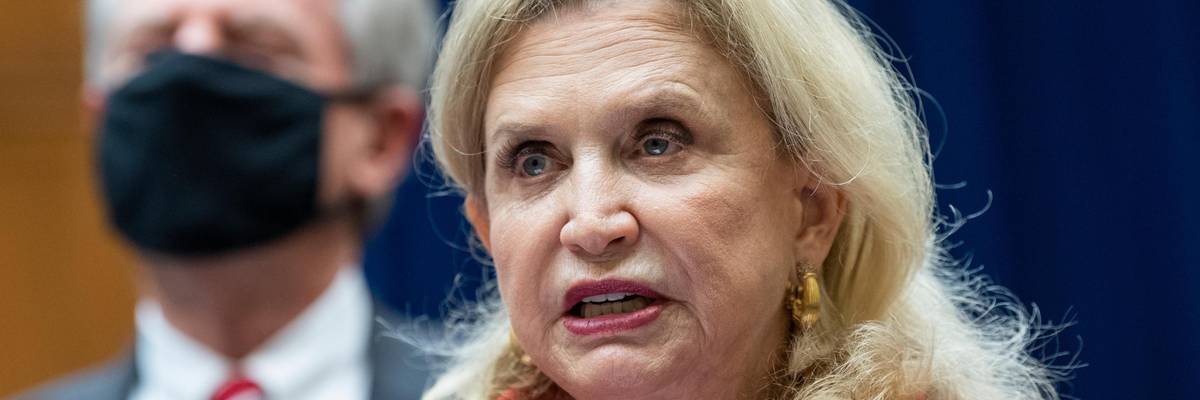
Rep. Carolyn Maloney (D-N.Y.) speaks during a September 23, 2021 press conference on Capitol Hill in Washington, D.C. while Rep. Frank Pallone (D-N.J.) stands in the background.
"I am hopeful these findings are a wake-up call for FDA to reform its practices and a call to action to my congressional colleagues to continue oversight of the pharmaceutical industry to ensure they don't put profits over patients," said Rep. Carolyn Maloney.
Nearly two years after a leading U.S. consumer advocacy group sounded the alarm on the matter, House Democrats released a report Thursday showing the Food and Drug Administration and pharma giant Biogen "inappropriately collaborated" prior to the controversial approval of a new $28,000-per-year Alzheimer's drug of questionable efficacy.
Originally carrying a $56,000 annual price tag for uninsured patients—which Biogen's then-CEO called "fair"—aducanumab, sold under the brand name Aduhelm, was approved by the FDA in June 2021. The approval came despite concerns that the drug—a monoclonal antibody treatment for patients with mild cognitive impairment caused by Alzheimer's—might not work, as well as safety trial data showing that a staggering 4 in 10 participants suffered potentially fatal brain bleeding and swelling after taking it.
"This report documents the atypical FDA review process and corporate greed that preceded FDA's controversial decision to grant accelerated approval to Aduhelm."
The new report, the result of an 18-month probe by the Democrat-led House Oversight and Reform Committee and the Energy and Commerce Committee, found that the FDA's approval process for Aduhelm was "rife with irregularities," including an "atypical" number of meetings and other contacts between the agency and the Cambridge, Massachusetts-based drugmaker.
The panel also found that Biogen and the FDA closely collaborated on a document written for outside advisers during the approval process, with at least one paragraph of the company's submission authored by agency officials.
On pricing, the lawmakers concluded that Biogen gave Aduhelm an astronomical price tag knowing that doing so would place the drug out of reach for many patients—even those with insurance—and would cost Medicare $12 billion per year.
"This report documents the atypical FDA review process and corporate greed that preceded FDA's controversial decision to grant accelerated approval to Aduhelm," outgoing House Energy and Commerce Committee Chair Frank Pallone (D-N.J.) said in a
statement.
"While we all support the search for new cures and treatments to address devastating diseases like Alzheimer's, we must ensure that expediency does not take precedence over protocols that ensure the independence and scientific rigor of FDA," Pallone added. "Patient safety and drug efficacy must remain at the core of our nation's pharmaceutical regulatory review process."
House Oversight and Reform Committee Chair Carolyn Maloney (D-N.Y.), who will leave office when Republicans take over the lower chamber next week, said that "the number of patients and families impacted by Alzheimer's disease will continue to increase, and it is crucial that FDA and drug companies adhere to established procedures and conduct themselves with the transparency necessary to earn public trust."
"I am hopeful these findings are a wake-up call for FDA to reform its practices and a call to action to my congressional colleagues to continue oversight of the pharmaceutical industry to ensure they don't put profits over patients," she added.
The new report comes nearly two years after the consumer advocacy group Public Citizen warned of exactly the sort of questionable collaboration detailed in the publication.
"After aducanumab's two identical phase three trials were stopped in 2019 at the halfway point because a preliminary analysis found that they were unlikely to show the drug benefited Alzheimer's patients, the FDA and Biogen worked collaboratively to salvage the drug," the group wrote in January 2021. "They jointly relied on dubious analyses that over-emphasized the results of one phase three trial suggesting the drug may work at a high dose but disregarded data from the other phase three trial showing no benefit of the drug at any dose. The FDA and Biogen co-authored an unprecedented joint briefing document on aducanumab that was heavily biased in favor of the drug."
Reacting to the new report, Dr. Aaron Kesselheim—a former member of the FDA's outside advisory panel who voted against green-lighting Aduhelm and resigned after it was approved—told The Wall Street Journal Thursday that "I hope this inspires a full re-examination of the nature of the communications between FDA and industry."
"Lines of communication need to be at arm's length and transparent," he added, "so that there remains trust in the FDA's decisions."
Dear Common Dreams reader, It’s been nearly 30 years since I co-founded Common Dreams with my late wife, Lina Newhouser. We had the radical notion that journalism should serve the public good, not corporate profits. It was clear to us from the outset what it would take to build such a project. No paid advertisements. No corporate sponsors. No millionaire publisher telling us what to think or do. Many people said we wouldn't last a year, but we proved those doubters wrong. Together with a tremendous team of journalists and dedicated staff, we built an independent media outlet free from the constraints of profits and corporate control. Our mission has always been simple: To inform. To inspire. To ignite change for the common good. Building Common Dreams was not easy. Our survival was never guaranteed. When you take on the most powerful forces—Wall Street greed, fossil fuel industry destruction, Big Tech lobbyists, and uber-rich oligarchs who have spent billions upon billions rigging the economy and democracy in their favor—the only bulwark you have is supporters who believe in your work. But here’s the urgent message from me today. It's never been this bad out there. And it's never been this hard to keep us going. At the very moment Common Dreams is most needed, the threats we face are intensifying. We need your support now more than ever. We don't accept corporate advertising and never will. We don't have a paywall because we don't think people should be blocked from critical news based on their ability to pay. Everything we do is funded by the donations of readers like you. When everyone does the little they can afford, we are strong. But if that support retreats or dries up, so do we. Will you donate now to make sure Common Dreams not only survives but thrives? —Craig Brown, Co-founder |
Nearly two years after a leading U.S. consumer advocacy group sounded the alarm on the matter, House Democrats released a report Thursday showing the Food and Drug Administration and pharma giant Biogen "inappropriately collaborated" prior to the controversial approval of a new $28,000-per-year Alzheimer's drug of questionable efficacy.
Originally carrying a $56,000 annual price tag for uninsured patients—which Biogen's then-CEO called "fair"—aducanumab, sold under the brand name Aduhelm, was approved by the FDA in June 2021. The approval came despite concerns that the drug—a monoclonal antibody treatment for patients with mild cognitive impairment caused by Alzheimer's—might not work, as well as safety trial data showing that a staggering 4 in 10 participants suffered potentially fatal brain bleeding and swelling after taking it.
"This report documents the atypical FDA review process and corporate greed that preceded FDA's controversial decision to grant accelerated approval to Aduhelm."
The new report, the result of an 18-month probe by the Democrat-led House Oversight and Reform Committee and the Energy and Commerce Committee, found that the FDA's approval process for Aduhelm was "rife with irregularities," including an "atypical" number of meetings and other contacts between the agency and the Cambridge, Massachusetts-based drugmaker.
The panel also found that Biogen and the FDA closely collaborated on a document written for outside advisers during the approval process, with at least one paragraph of the company's submission authored by agency officials.
On pricing, the lawmakers concluded that Biogen gave Aduhelm an astronomical price tag knowing that doing so would place the drug out of reach for many patients—even those with insurance—and would cost Medicare $12 billion per year.
"This report documents the atypical FDA review process and corporate greed that preceded FDA's controversial decision to grant accelerated approval to Aduhelm," outgoing House Energy and Commerce Committee Chair Frank Pallone (D-N.J.) said in a
statement.
"While we all support the search for new cures and treatments to address devastating diseases like Alzheimer's, we must ensure that expediency does not take precedence over protocols that ensure the independence and scientific rigor of FDA," Pallone added. "Patient safety and drug efficacy must remain at the core of our nation's pharmaceutical regulatory review process."
House Oversight and Reform Committee Chair Carolyn Maloney (D-N.Y.), who will leave office when Republicans take over the lower chamber next week, said that "the number of patients and families impacted by Alzheimer's disease will continue to increase, and it is crucial that FDA and drug companies adhere to established procedures and conduct themselves with the transparency necessary to earn public trust."
"I am hopeful these findings are a wake-up call for FDA to reform its practices and a call to action to my congressional colleagues to continue oversight of the pharmaceutical industry to ensure they don't put profits over patients," she added.
The new report comes nearly two years after the consumer advocacy group Public Citizen warned of exactly the sort of questionable collaboration detailed in the publication.
"After aducanumab's two identical phase three trials were stopped in 2019 at the halfway point because a preliminary analysis found that they were unlikely to show the drug benefited Alzheimer's patients, the FDA and Biogen worked collaboratively to salvage the drug," the group wrote in January 2021. "They jointly relied on dubious analyses that over-emphasized the results of one phase three trial suggesting the drug may work at a high dose but disregarded data from the other phase three trial showing no benefit of the drug at any dose. The FDA and Biogen co-authored an unprecedented joint briefing document on aducanumab that was heavily biased in favor of the drug."
Reacting to the new report, Dr. Aaron Kesselheim—a former member of the FDA's outside advisory panel who voted against green-lighting Aduhelm and resigned after it was approved—told The Wall Street Journal Thursday that "I hope this inspires a full re-examination of the nature of the communications between FDA and industry."
"Lines of communication need to be at arm's length and transparent," he added, "so that there remains trust in the FDA's decisions."
Nearly two years after a leading U.S. consumer advocacy group sounded the alarm on the matter, House Democrats released a report Thursday showing the Food and Drug Administration and pharma giant Biogen "inappropriately collaborated" prior to the controversial approval of a new $28,000-per-year Alzheimer's drug of questionable efficacy.
Originally carrying a $56,000 annual price tag for uninsured patients—which Biogen's then-CEO called "fair"—aducanumab, sold under the brand name Aduhelm, was approved by the FDA in June 2021. The approval came despite concerns that the drug—a monoclonal antibody treatment for patients with mild cognitive impairment caused by Alzheimer's—might not work, as well as safety trial data showing that a staggering 4 in 10 participants suffered potentially fatal brain bleeding and swelling after taking it.
"This report documents the atypical FDA review process and corporate greed that preceded FDA's controversial decision to grant accelerated approval to Aduhelm."
The new report, the result of an 18-month probe by the Democrat-led House Oversight and Reform Committee and the Energy and Commerce Committee, found that the FDA's approval process for Aduhelm was "rife with irregularities," including an "atypical" number of meetings and other contacts between the agency and the Cambridge, Massachusetts-based drugmaker.
The panel also found that Biogen and the FDA closely collaborated on a document written for outside advisers during the approval process, with at least one paragraph of the company's submission authored by agency officials.
On pricing, the lawmakers concluded that Biogen gave Aduhelm an astronomical price tag knowing that doing so would place the drug out of reach for many patients—even those with insurance—and would cost Medicare $12 billion per year.
"This report documents the atypical FDA review process and corporate greed that preceded FDA's controversial decision to grant accelerated approval to Aduhelm," outgoing House Energy and Commerce Committee Chair Frank Pallone (D-N.J.) said in a
statement.
"While we all support the search for new cures and treatments to address devastating diseases like Alzheimer's, we must ensure that expediency does not take precedence over protocols that ensure the independence and scientific rigor of FDA," Pallone added. "Patient safety and drug efficacy must remain at the core of our nation's pharmaceutical regulatory review process."
House Oversight and Reform Committee Chair Carolyn Maloney (D-N.Y.), who will leave office when Republicans take over the lower chamber next week, said that "the number of patients and families impacted by Alzheimer's disease will continue to increase, and it is crucial that FDA and drug companies adhere to established procedures and conduct themselves with the transparency necessary to earn public trust."
"I am hopeful these findings are a wake-up call for FDA to reform its practices and a call to action to my congressional colleagues to continue oversight of the pharmaceutical industry to ensure they don't put profits over patients," she added.
The new report comes nearly two years after the consumer advocacy group Public Citizen warned of exactly the sort of questionable collaboration detailed in the publication.
"After aducanumab's two identical phase three trials were stopped in 2019 at the halfway point because a preliminary analysis found that they were unlikely to show the drug benefited Alzheimer's patients, the FDA and Biogen worked collaboratively to salvage the drug," the group wrote in January 2021. "They jointly relied on dubious analyses that over-emphasized the results of one phase three trial suggesting the drug may work at a high dose but disregarded data from the other phase three trial showing no benefit of the drug at any dose. The FDA and Biogen co-authored an unprecedented joint briefing document on aducanumab that was heavily biased in favor of the drug."
Reacting to the new report, Dr. Aaron Kesselheim—a former member of the FDA's outside advisory panel who voted against green-lighting Aduhelm and resigned after it was approved—told The Wall Street Journal Thursday that "I hope this inspires a full re-examination of the nature of the communications between FDA and industry."
"Lines of communication need to be at arm's length and transparent," he added, "so that there remains trust in the FDA's decisions."