SUBSCRIBE TO OUR FREE NEWSLETTER
Daily news & progressive opinion—funded by the people, not the corporations—delivered straight to your inbox.
5
#000000
#FFFFFF
To donate by check, phone, or other method, see our More Ways to Give page.
Daily news & progressive opinion—funded by the people, not the corporations—delivered straight to your inbox.
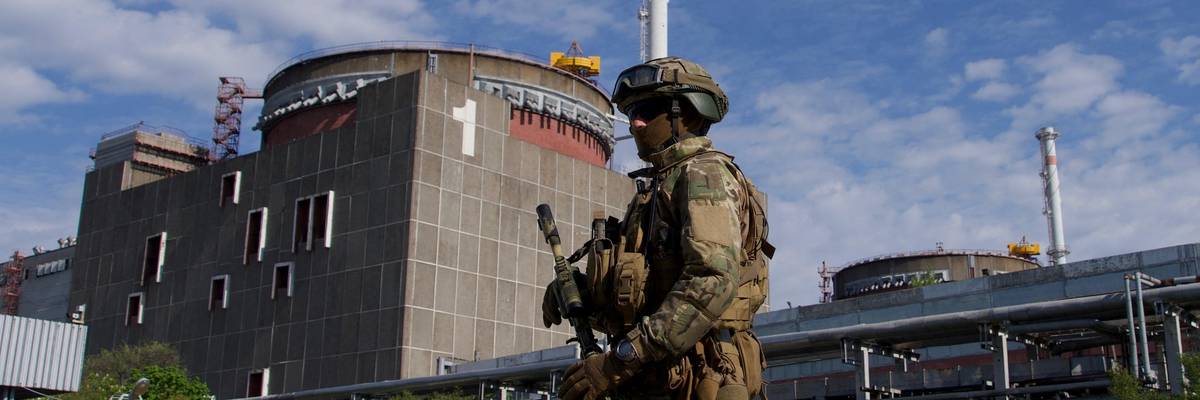
A Russian soldier patrols the territory of the Zaporizhzhia Nuclear Power Station in Energodar, Ukraine, on May 1, 2022.
A new report found that Russian troops were likely "using the plant as a shield" in violation of the safety principles laid out by the International Atomic Energy Agency.
The Russian forces occupying Ukraine's Zaporizhzhia nuclear plant have been violating the safety principles established by the International Atomic Energy Agency, and the watchdog body has not been able to effectively monitor the situation.
That's the warning from a new Greenpeace report sent to Western leaders on Thursday, which argues that the IAEA needs to be more upfront about the reality of the situation.
"The IAEA reporting risks normalizing what remains a dangerous nuclear crisis, unprecedented in the history of nuclear power, while exaggerating its actual influence on events on the ground," wrote report authors Shaun Burnie, a senior nuclear specialist from Greenpeace East Asia, and Jan Vande Putte, a Greenpeace Belgium radiation and nuclear expert.
Russian forces seized the Zaporizhzhia plant on March 4, 2022, less than a month into the invasion.
"Since 2022 we have been deeply concerned by the multiple hazards and risks to the Zaporozhzhia nuclear plant posed by the Russian armed forces and the Russian state nuclear corporation, Rosatom," Burnie and Putte wrote.
To address these concerns, Greenpeace Germany commissioned former U.K. military specialists at McKenzie Intelligence Services to report on conditions at the plant.
"The Russian armed forces and Rosatom occupation pose a constant nuclear threat to Zaporozhzhia and must be condemned."
The result, Greenpeace said, "provides detailed evidence that the Zaporizhizhia nuclear plant is being used strategically and tactically by Russian armed forces in its illegal war against Ukraine."
For example, the report found that Russian troops were firing from positions between one and 18 kilometers (approximately 0.6 to 11 miles) from the plant, had constructed small defensive positions with sandbags on the roofs of some of the reactor halls, and are using a type of truck near the plant that is commonly used to transport weapons and combustible material.
It also concluded that both Russian forces and Rosatom are acting in violation of the five principles that IAEA Director General Rafael Mariano Grossi laid out in June to prevent a nuclear accident at the plant.
These principles are:
McKenzie found evidence that Russian forces have a firing pattern of settling in one location, attacking from another, and then moving again to avoid counterattacks. In this process, they appear to be "using the plant as a shield."
"All activity observed over the reporting period does suggest a precarious environment continues to exist at the plant," Burnie and Putte concluded.
The Greenpeace experts also reviewed the IAEA's monitoring in the context of McKenzie's findings, and argued that the agency could be more upfront about its limitations and Russia's violations.
IAEA only has four monitors for the largest nuclear plant on the continent, and they must conduct their investigation with restrictions placed on their movements and access, as well as the requirement that they make access requests a week in advance.
Despite all this, Burnie said in a statement, "the director general's reporting is incomplete and misleading, including the assessment of Russian noncompliance with safety and security principles."
"The Russian armed forces and Rosatom occupation pose a constant nuclear threat to Zaporozhzhia and must be condemned—but currently the IAEA is unable to fully report on the security and safety hazards they pose," Burnie continued. "That has to change."
The advocacy group prepared the report ahead of an IAEA discussion of the situation in Ukraine in Vienna Thursday, as well as the IAEA Board of Governors meeting October 2. On Wednesday night, Greenpeace sent copies to the board's member governments, The Guardian reported.
IAEA did not comment on the report directly. However, it told The Guardian that, without its inspectors stationed there since September 2022, "the world would have no independent source of information about Europe's largest nuclear power plant."
However, Greenpeace argued the agency could take steps to improve that information.
"Greenpeace is calling on the IAEA board member governments to review the scale and scope of the IAEA mission, and to work with member states, and in particular the government of Ukraine, to institute whatever measures that will bring maximum pressure to bear on the Russian armed forces and Rosatom at the plant and to bring about an early end to the current military occupation of the Zaporizhzhia nuclear plant," Burnie and Putte wrote.
These measures could include an improved analysis by the IAEA and sanctions against Rosatom, Greenpeace said.
Dear Common Dreams reader, It’s been nearly 30 years since I co-founded Common Dreams with my late wife, Lina Newhouser. We had the radical notion that journalism should serve the public good, not corporate profits. It was clear to us from the outset what it would take to build such a project. No paid advertisements. No corporate sponsors. No millionaire publisher telling us what to think or do. Many people said we wouldn't last a year, but we proved those doubters wrong. Together with a tremendous team of journalists and dedicated staff, we built an independent media outlet free from the constraints of profits and corporate control. Our mission has always been simple: To inform. To inspire. To ignite change for the common good. Building Common Dreams was not easy. Our survival was never guaranteed. When you take on the most powerful forces—Wall Street greed, fossil fuel industry destruction, Big Tech lobbyists, and uber-rich oligarchs who have spent billions upon billions rigging the economy and democracy in their favor—the only bulwark you have is supporters who believe in your work. But here’s the urgent message from me today. It's never been this bad out there. And it's never been this hard to keep us going. At the very moment Common Dreams is most needed, the threats we face are intensifying. We need your support now more than ever. We don't accept corporate advertising and never will. We don't have a paywall because we don't think people should be blocked from critical news based on their ability to pay. Everything we do is funded by the donations of readers like you. When everyone does the little they can afford, we are strong. But if that support retreats or dries up, so do we. Will you donate now to make sure Common Dreams not only survives but thrives? —Craig Brown, Co-founder |
The Russian forces occupying Ukraine's Zaporizhzhia nuclear plant have been violating the safety principles established by the International Atomic Energy Agency, and the watchdog body has not been able to effectively monitor the situation.
That's the warning from a new Greenpeace report sent to Western leaders on Thursday, which argues that the IAEA needs to be more upfront about the reality of the situation.
"The IAEA reporting risks normalizing what remains a dangerous nuclear crisis, unprecedented in the history of nuclear power, while exaggerating its actual influence on events on the ground," wrote report authors Shaun Burnie, a senior nuclear specialist from Greenpeace East Asia, and Jan Vande Putte, a Greenpeace Belgium radiation and nuclear expert.
Russian forces seized the Zaporizhzhia plant on March 4, 2022, less than a month into the invasion.
"Since 2022 we have been deeply concerned by the multiple hazards and risks to the Zaporozhzhia nuclear plant posed by the Russian armed forces and the Russian state nuclear corporation, Rosatom," Burnie and Putte wrote.
To address these concerns, Greenpeace Germany commissioned former U.K. military specialists at McKenzie Intelligence Services to report on conditions at the plant.
"The Russian armed forces and Rosatom occupation pose a constant nuclear threat to Zaporozhzhia and must be condemned."
The result, Greenpeace said, "provides detailed evidence that the Zaporizhizhia nuclear plant is being used strategically and tactically by Russian armed forces in its illegal war against Ukraine."
For example, the report found that Russian troops were firing from positions between one and 18 kilometers (approximately 0.6 to 11 miles) from the plant, had constructed small defensive positions with sandbags on the roofs of some of the reactor halls, and are using a type of truck near the plant that is commonly used to transport weapons and combustible material.
It also concluded that both Russian forces and Rosatom are acting in violation of the five principles that IAEA Director General Rafael Mariano Grossi laid out in June to prevent a nuclear accident at the plant.
These principles are:
McKenzie found evidence that Russian forces have a firing pattern of settling in one location, attacking from another, and then moving again to avoid counterattacks. In this process, they appear to be "using the plant as a shield."
"All activity observed over the reporting period does suggest a precarious environment continues to exist at the plant," Burnie and Putte concluded.
The Greenpeace experts also reviewed the IAEA's monitoring in the context of McKenzie's findings, and argued that the agency could be more upfront about its limitations and Russia's violations.
IAEA only has four monitors for the largest nuclear plant on the continent, and they must conduct their investigation with restrictions placed on their movements and access, as well as the requirement that they make access requests a week in advance.
Despite all this, Burnie said in a statement, "the director general's reporting is incomplete and misleading, including the assessment of Russian noncompliance with safety and security principles."
"The Russian armed forces and Rosatom occupation pose a constant nuclear threat to Zaporozhzhia and must be condemned—but currently the IAEA is unable to fully report on the security and safety hazards they pose," Burnie continued. "That has to change."
The advocacy group prepared the report ahead of an IAEA discussion of the situation in Ukraine in Vienna Thursday, as well as the IAEA Board of Governors meeting October 2. On Wednesday night, Greenpeace sent copies to the board's member governments, The Guardian reported.
IAEA did not comment on the report directly. However, it told The Guardian that, without its inspectors stationed there since September 2022, "the world would have no independent source of information about Europe's largest nuclear power plant."
However, Greenpeace argued the agency could take steps to improve that information.
"Greenpeace is calling on the IAEA board member governments to review the scale and scope of the IAEA mission, and to work with member states, and in particular the government of Ukraine, to institute whatever measures that will bring maximum pressure to bear on the Russian armed forces and Rosatom at the plant and to bring about an early end to the current military occupation of the Zaporizhzhia nuclear plant," Burnie and Putte wrote.
These measures could include an improved analysis by the IAEA and sanctions against Rosatom, Greenpeace said.
The Russian forces occupying Ukraine's Zaporizhzhia nuclear plant have been violating the safety principles established by the International Atomic Energy Agency, and the watchdog body has not been able to effectively monitor the situation.
That's the warning from a new Greenpeace report sent to Western leaders on Thursday, which argues that the IAEA needs to be more upfront about the reality of the situation.
"The IAEA reporting risks normalizing what remains a dangerous nuclear crisis, unprecedented in the history of nuclear power, while exaggerating its actual influence on events on the ground," wrote report authors Shaun Burnie, a senior nuclear specialist from Greenpeace East Asia, and Jan Vande Putte, a Greenpeace Belgium radiation and nuclear expert.
Russian forces seized the Zaporizhzhia plant on March 4, 2022, less than a month into the invasion.
"Since 2022 we have been deeply concerned by the multiple hazards and risks to the Zaporozhzhia nuclear plant posed by the Russian armed forces and the Russian state nuclear corporation, Rosatom," Burnie and Putte wrote.
To address these concerns, Greenpeace Germany commissioned former U.K. military specialists at McKenzie Intelligence Services to report on conditions at the plant.
"The Russian armed forces and Rosatom occupation pose a constant nuclear threat to Zaporozhzhia and must be condemned."
The result, Greenpeace said, "provides detailed evidence that the Zaporizhizhia nuclear plant is being used strategically and tactically by Russian armed forces in its illegal war against Ukraine."
For example, the report found that Russian troops were firing from positions between one and 18 kilometers (approximately 0.6 to 11 miles) from the plant, had constructed small defensive positions with sandbags on the roofs of some of the reactor halls, and are using a type of truck near the plant that is commonly used to transport weapons and combustible material.
It also concluded that both Russian forces and Rosatom are acting in violation of the five principles that IAEA Director General Rafael Mariano Grossi laid out in June to prevent a nuclear accident at the plant.
These principles are:
McKenzie found evidence that Russian forces have a firing pattern of settling in one location, attacking from another, and then moving again to avoid counterattacks. In this process, they appear to be "using the plant as a shield."
"All activity observed over the reporting period does suggest a precarious environment continues to exist at the plant," Burnie and Putte concluded.
The Greenpeace experts also reviewed the IAEA's monitoring in the context of McKenzie's findings, and argued that the agency could be more upfront about its limitations and Russia's violations.
IAEA only has four monitors for the largest nuclear plant on the continent, and they must conduct their investigation with restrictions placed on their movements and access, as well as the requirement that they make access requests a week in advance.
Despite all this, Burnie said in a statement, "the director general's reporting is incomplete and misleading, including the assessment of Russian noncompliance with safety and security principles."
"The Russian armed forces and Rosatom occupation pose a constant nuclear threat to Zaporozhzhia and must be condemned—but currently the IAEA is unable to fully report on the security and safety hazards they pose," Burnie continued. "That has to change."
The advocacy group prepared the report ahead of an IAEA discussion of the situation in Ukraine in Vienna Thursday, as well as the IAEA Board of Governors meeting October 2. On Wednesday night, Greenpeace sent copies to the board's member governments, The Guardian reported.
IAEA did not comment on the report directly. However, it told The Guardian that, without its inspectors stationed there since September 2022, "the world would have no independent source of information about Europe's largest nuclear power plant."
However, Greenpeace argued the agency could take steps to improve that information.
"Greenpeace is calling on the IAEA board member governments to review the scale and scope of the IAEA mission, and to work with member states, and in particular the government of Ukraine, to institute whatever measures that will bring maximum pressure to bear on the Russian armed forces and Rosatom at the plant and to bring about an early end to the current military occupation of the Zaporizhzhia nuclear plant," Burnie and Putte wrote.
These measures could include an improved analysis by the IAEA and sanctions against Rosatom, Greenpeace said.