

SUBSCRIBE TO OUR FREE NEWSLETTER
Daily news & progressive opinion—funded by the people, not the corporations—delivered straight to your inbox.
5
#000000
#FFFFFF
To donate by check, phone, or other method, see our More Ways to Give page.
Daily news & progressive opinion—funded by the people, not the corporations—delivered straight to your inbox.
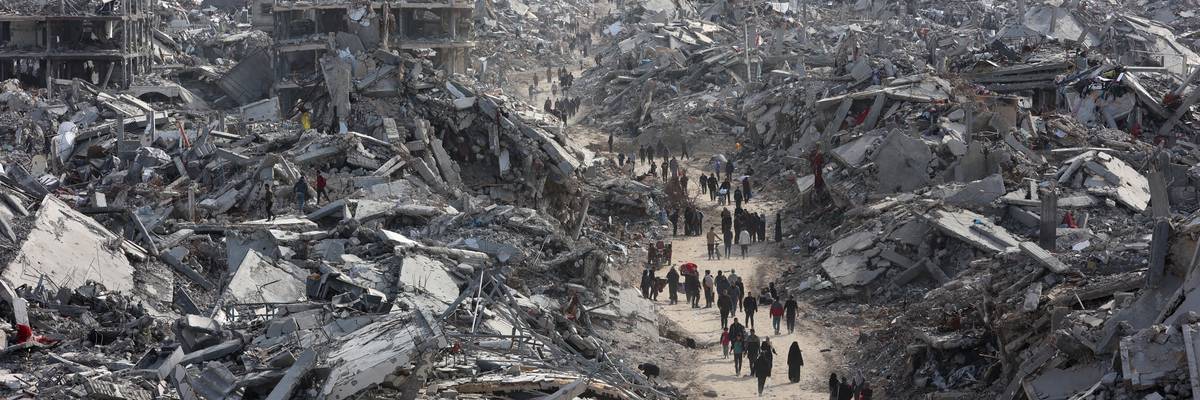
This aerial view shows displaced Palestinians returning to the war-devastated Jabalia refugee camp in the northern Gaza Strip on January 19, 2025, shortly before a ceasefire deal in the war between Israel and the Palestinian militant group Hamas was implemented.
"This wasn't an accident. The far-right members of the Israeli government wanted to render Gaza unlivable with the aim of forcing 2 million Palestinians to flee (forever)," said one human rights leader.
Palestinians living in the Gaza Strip are returning home after a cease-fire deal between Hamas and Israel went into effect Sunday, halting 15 months of war that local health officials say killed over 46,000 people. But for many, there are no homes to return to.
Footage of Gaza shows what once were houses, shops, and other buildings severely damaged or completely reduced to gray rubble.
One Gaza resident, Islam Dahliz, told The New York Times that he and his brother and father set out to find their family home—a once spacious two-story dwelling in Rafah—almost as soon as the cease-fire went into effect. What they found instead was unrecognizable.
"It took us a few minutes to accept that this pile of rubble was our home," said Dahliz. The house had been built by Dahliz's father, Abed Dahliz, in the 1970s.
"I was shocked when I saw my entire life—everything I worked for—flattened to the ground," said Abed Dahliz, according to the Times. "The home I spent so many years building, pouring my savings into, is gone."
Versions of this story are playing out all around Gaza. All told, roughly 90% of the population across Gaza was displaced from their homes, many multiple times, according to the United Nations.
"The images emerging from Gaza are haunting. This is a site where Palestinian captives were forced to strip, their clothes left behind among the ruins as a reminder of what Israeli soldiers did," wrote Assal Rad, a scholar of modern Iran, on X. Rad's post is accompanied by a video of a man showing a strip of land covered in clothes. In the video, the man says that the clothes are from Palestinians who were arrested by Israeli forces after they stormed areas in northern Gaza, like the Kamal Adwan Hospital.
In response to reporting of Gazans returning home to destruction, Kenneth Roth, the former executive director of Human Rights Watch, wrote: "This wasn't an accident. The far-right members of the Israeli government wanted to render Gaza unlivable with the aim of forcing two million Palestinians to flee (forever), "
Human Rights Watch, which late last year issued a report accusing Israel of committing "acts of genocide" by depriving Palestinians of water access in Gaza, wrote in November 2024 that "the destruction [in Gaza] is so substantial that it indicates the intention to permanently displace many people."
A preliminary U.N. satellite imagery analysis found that as of December 1, 2024, 60,000 structures in Gaza have been destroyed. The total number of damaged or destroyed structures constitutes roughly 69% of the total structures in the enclave, according to the analysis. A separate U.N. estimate published in January found that 92% of homes have been destroyed or damaged.
The footage coming out of Gaza underscores how long it will take for Palestinians to reconstruct their communities. The cease-fire deal that went into effect Sunday includes three phrases, the third of which is supposed to entail reconstruction of Gaza. Dima Toukan, a nonresident scholar at the Middle East Institute, told NPR that it's important to note the last phase could be a long way off, and could possibly never happen at all.
Dear Common Dreams reader, It’s been nearly 30 years since I co-founded Common Dreams with my late wife, Lina Newhouser. We had the radical notion that journalism should serve the public good, not corporate profits. It was clear to us from the outset what it would take to build such a project. No paid advertisements. No corporate sponsors. No millionaire publisher telling us what to think or do. Many people said we wouldn't last a year, but we proved those doubters wrong. Together with a tremendous team of journalists and dedicated staff, we built an independent media outlet free from the constraints of profits and corporate control. Our mission has always been simple: To inform. To inspire. To ignite change for the common good. Building Common Dreams was not easy. Our survival was never guaranteed. When you take on the most powerful forces—Wall Street greed, fossil fuel industry destruction, Big Tech lobbyists, and uber-rich oligarchs who have spent billions upon billions rigging the economy and democracy in their favor—the only bulwark you have is supporters who believe in your work. But here’s the urgent message from me today. It's never been this bad out there. And it's never been this hard to keep us going. At the very moment Common Dreams is most needed, the threats we face are intensifying. We need your support now more than ever. We don't accept corporate advertising and never will. We don't have a paywall because we don't think people should be blocked from critical news based on their ability to pay. Everything we do is funded by the donations of readers like you. When everyone does the little they can afford, we are strong. But if that support retreats or dries up, so do we. Will you donate now to make sure Common Dreams not only survives but thrives? —Craig Brown, Co-founder |
Palestinians living in the Gaza Strip are returning home after a cease-fire deal between Hamas and Israel went into effect Sunday, halting 15 months of war that local health officials say killed over 46,000 people. But for many, there are no homes to return to.
Footage of Gaza shows what once were houses, shops, and other buildings severely damaged or completely reduced to gray rubble.
One Gaza resident, Islam Dahliz, told The New York Times that he and his brother and father set out to find their family home—a once spacious two-story dwelling in Rafah—almost as soon as the cease-fire went into effect. What they found instead was unrecognizable.
"It took us a few minutes to accept that this pile of rubble was our home," said Dahliz. The house had been built by Dahliz's father, Abed Dahliz, in the 1970s.
"I was shocked when I saw my entire life—everything I worked for—flattened to the ground," said Abed Dahliz, according to the Times. "The home I spent so many years building, pouring my savings into, is gone."
Versions of this story are playing out all around Gaza. All told, roughly 90% of the population across Gaza was displaced from their homes, many multiple times, according to the United Nations.
"The images emerging from Gaza are haunting. This is a site where Palestinian captives were forced to strip, their clothes left behind among the ruins as a reminder of what Israeli soldiers did," wrote Assal Rad, a scholar of modern Iran, on X. Rad's post is accompanied by a video of a man showing a strip of land covered in clothes. In the video, the man says that the clothes are from Palestinians who were arrested by Israeli forces after they stormed areas in northern Gaza, like the Kamal Adwan Hospital.
In response to reporting of Gazans returning home to destruction, Kenneth Roth, the former executive director of Human Rights Watch, wrote: "This wasn't an accident. The far-right members of the Israeli government wanted to render Gaza unlivable with the aim of forcing two million Palestinians to flee (forever), "
Human Rights Watch, which late last year issued a report accusing Israel of committing "acts of genocide" by depriving Palestinians of water access in Gaza, wrote in November 2024 that "the destruction [in Gaza] is so substantial that it indicates the intention to permanently displace many people."
A preliminary U.N. satellite imagery analysis found that as of December 1, 2024, 60,000 structures in Gaza have been destroyed. The total number of damaged or destroyed structures constitutes roughly 69% of the total structures in the enclave, according to the analysis. A separate U.N. estimate published in January found that 92% of homes have been destroyed or damaged.
The footage coming out of Gaza underscores how long it will take for Palestinians to reconstruct their communities. The cease-fire deal that went into effect Sunday includes three phrases, the third of which is supposed to entail reconstruction of Gaza. Dima Toukan, a nonresident scholar at the Middle East Institute, told NPR that it's important to note the last phase could be a long way off, and could possibly never happen at all.
Palestinians living in the Gaza Strip are returning home after a cease-fire deal between Hamas and Israel went into effect Sunday, halting 15 months of war that local health officials say killed over 46,000 people. But for many, there are no homes to return to.
Footage of Gaza shows what once were houses, shops, and other buildings severely damaged or completely reduced to gray rubble.
One Gaza resident, Islam Dahliz, told The New York Times that he and his brother and father set out to find their family home—a once spacious two-story dwelling in Rafah—almost as soon as the cease-fire went into effect. What they found instead was unrecognizable.
"It took us a few minutes to accept that this pile of rubble was our home," said Dahliz. The house had been built by Dahliz's father, Abed Dahliz, in the 1970s.
"I was shocked when I saw my entire life—everything I worked for—flattened to the ground," said Abed Dahliz, according to the Times. "The home I spent so many years building, pouring my savings into, is gone."
Versions of this story are playing out all around Gaza. All told, roughly 90% of the population across Gaza was displaced from their homes, many multiple times, according to the United Nations.
"The images emerging from Gaza are haunting. This is a site where Palestinian captives were forced to strip, their clothes left behind among the ruins as a reminder of what Israeli soldiers did," wrote Assal Rad, a scholar of modern Iran, on X. Rad's post is accompanied by a video of a man showing a strip of land covered in clothes. In the video, the man says that the clothes are from Palestinians who were arrested by Israeli forces after they stormed areas in northern Gaza, like the Kamal Adwan Hospital.
In response to reporting of Gazans returning home to destruction, Kenneth Roth, the former executive director of Human Rights Watch, wrote: "This wasn't an accident. The far-right members of the Israeli government wanted to render Gaza unlivable with the aim of forcing two million Palestinians to flee (forever), "
Human Rights Watch, which late last year issued a report accusing Israel of committing "acts of genocide" by depriving Palestinians of water access in Gaza, wrote in November 2024 that "the destruction [in Gaza] is so substantial that it indicates the intention to permanently displace many people."
A preliminary U.N. satellite imagery analysis found that as of December 1, 2024, 60,000 structures in Gaza have been destroyed. The total number of damaged or destroyed structures constitutes roughly 69% of the total structures in the enclave, according to the analysis. A separate U.N. estimate published in January found that 92% of homes have been destroyed or damaged.
The footage coming out of Gaza underscores how long it will take for Palestinians to reconstruct their communities. The cease-fire deal that went into effect Sunday includes three phrases, the third of which is supposed to entail reconstruction of Gaza. Dima Toukan, a nonresident scholar at the Middle East Institute, told NPR that it's important to note the last phase could be a long way off, and could possibly never happen at all.

