SUBSCRIBE TO OUR FREE NEWSLETTER
Daily news & progressive opinion—funded by the people, not the corporations—delivered straight to your inbox.
5
#000000
#FFFFFF
To donate by check, phone, or other method, see our More Ways to Give page.
Daily news & progressive opinion—funded by the people, not the corporations—delivered straight to your inbox.
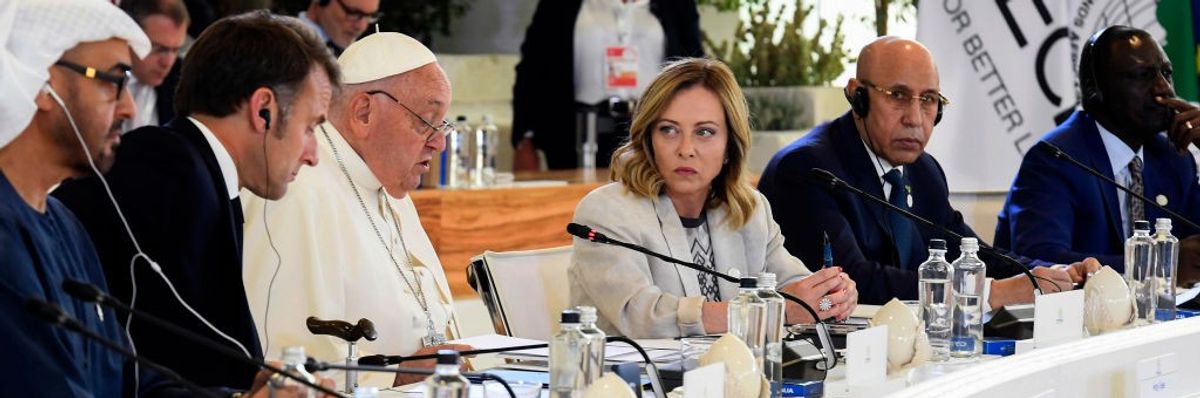
Italian Prime Minister Giorgia Meloni (center) looks toward Pope Francis as he speaks during the G7 Leaders Summit in Fasano, Italy on June 14, 2024.
"If these embattled leaders want to leave a lasting legacy, they need to heed the will of voters demanding a safe environment and climate," one campaigner asserted.
As the Group of Seven summit wrapped up Friday in Italy, climate defenders condemned G7 leaders for their continued failure to take meaningful action to combat the worsening planetary emergency.
Taking aim at what critics called the G7 leaders' largely empty pledge to undertake "concrete steps to address the triple crisis of climate change, pollution, and biodiversity loss," 350.org U.S. campaigns manager Candice Fortin lamented that "yet another meeting ends without real commitments to revert the situation rich countries like the U.S. put us in."
"As COP29 approaches and the world deals with worsening climate impacts, we can't afford to waste more time," Fortin said, referring to the United Nations Climate Change Conference scheduled to take place in Baku, the capital of Azerbaijan—a major fossil fuel-producing nation—in November. COP29 is set to be chaired by a former oil executive.
"If the U.S. wants to pride itself on being a 'world leader,' it needs to show how it will pay its climate debt to climate-vulnerable countries that bear the most significant climate impacts without the necessary funds for adaptation," Fortin added.
While G7 governments hailed their recent agreement to phase out existing unabated coal power generation in energy systems during the first half of the 2030s, critics took issue with the policy's timeline and banks' continued financing of fossil fuels.
"Our leaders are not leading. In the hottest 12 consecutive months of recorded human history, our leaders are failing us,''
argued Bronwen Tucker, Oil Change International's public finance lead. "G7 countries are adopting an inadequate coal phaseout date and endorsing increased fossil gas production, sending a terrible signal at a time when countries should be focusing on accelerating the phaseout, not delaying it."
Tucker continued:
G7 leaders can't say they're committed to a livable climate while expanding and bankrolling the fossil fuel industry at home and abroad. At the same time, these rich countries should not be congratulating themselves for delivering $100 billion for climate finance two years too late. Trillions are needed to cover climate damages and the G7's finance was largely provided as loans which only worsens unjust debts.
"The G7 must end the billions of dollars in taxpayer finance still flowing to fossil fuel projects abroad and fund the buildout of affordable renewable energy on fair terms," Tucker asserted. "If their oil and gas expansion plans are allowed to proceed, it will lock in climate chaos and an unlivable future."
Greenpeace International climate politics expert Tracy Carty said in a statement that "if these embattled leaders want to leave a lasting legacy, they need to heed the will of voters demanding a safe environment and climate."
"Taxing the billions of dollars in profits of the fossil fuel industry to fund climate action at home and abroad could be their stake in history and a win for people and planet," Carty continued. "G7 leaders need to seize the moment ahead of the U.N. climate talks in Baku and show they will lead the transition away from fossil fuels and build trust they will significantly increase climate finance support to developing countries."
Dear Common Dreams reader, It’s been nearly 30 years since I co-founded Common Dreams with my late wife, Lina Newhouser. We had the radical notion that journalism should serve the public good, not corporate profits. It was clear to us from the outset what it would take to build such a project. No paid advertisements. No corporate sponsors. No millionaire publisher telling us what to think or do. Many people said we wouldn't last a year, but we proved those doubters wrong. Together with a tremendous team of journalists and dedicated staff, we built an independent media outlet free from the constraints of profits and corporate control. Our mission has always been simple: To inform. To inspire. To ignite change for the common good. Building Common Dreams was not easy. Our survival was never guaranteed. When you take on the most powerful forces—Wall Street greed, fossil fuel industry destruction, Big Tech lobbyists, and uber-rich oligarchs who have spent billions upon billions rigging the economy and democracy in their favor—the only bulwark you have is supporters who believe in your work. But here’s the urgent message from me today. It's never been this bad out there. And it's never been this hard to keep us going. At the very moment Common Dreams is most needed, the threats we face are intensifying. We need your support now more than ever. We don't accept corporate advertising and never will. We don't have a paywall because we don't think people should be blocked from critical news based on their ability to pay. Everything we do is funded by the donations of readers like you. When everyone does the little they can afford, we are strong. But if that support retreats or dries up, so do we. Will you donate now to make sure Common Dreams not only survives but thrives? —Craig Brown, Co-founder |
As the Group of Seven summit wrapped up Friday in Italy, climate defenders condemned G7 leaders for their continued failure to take meaningful action to combat the worsening planetary emergency.
Taking aim at what critics called the G7 leaders' largely empty pledge to undertake "concrete steps to address the triple crisis of climate change, pollution, and biodiversity loss," 350.org U.S. campaigns manager Candice Fortin lamented that "yet another meeting ends without real commitments to revert the situation rich countries like the U.S. put us in."
"As COP29 approaches and the world deals with worsening climate impacts, we can't afford to waste more time," Fortin said, referring to the United Nations Climate Change Conference scheduled to take place in Baku, the capital of Azerbaijan—a major fossil fuel-producing nation—in November. COP29 is set to be chaired by a former oil executive.
"If the U.S. wants to pride itself on being a 'world leader,' it needs to show how it will pay its climate debt to climate-vulnerable countries that bear the most significant climate impacts without the necessary funds for adaptation," Fortin added.
While G7 governments hailed their recent agreement to phase out existing unabated coal power generation in energy systems during the first half of the 2030s, critics took issue with the policy's timeline and banks' continued financing of fossil fuels.
"Our leaders are not leading. In the hottest 12 consecutive months of recorded human history, our leaders are failing us,''
argued Bronwen Tucker, Oil Change International's public finance lead. "G7 countries are adopting an inadequate coal phaseout date and endorsing increased fossil gas production, sending a terrible signal at a time when countries should be focusing on accelerating the phaseout, not delaying it."
Tucker continued:
G7 leaders can't say they're committed to a livable climate while expanding and bankrolling the fossil fuel industry at home and abroad. At the same time, these rich countries should not be congratulating themselves for delivering $100 billion for climate finance two years too late. Trillions are needed to cover climate damages and the G7's finance was largely provided as loans which only worsens unjust debts.
"The G7 must end the billions of dollars in taxpayer finance still flowing to fossil fuel projects abroad and fund the buildout of affordable renewable energy on fair terms," Tucker asserted. "If their oil and gas expansion plans are allowed to proceed, it will lock in climate chaos and an unlivable future."
Greenpeace International climate politics expert Tracy Carty said in a statement that "if these embattled leaders want to leave a lasting legacy, they need to heed the will of voters demanding a safe environment and climate."
"Taxing the billions of dollars in profits of the fossil fuel industry to fund climate action at home and abroad could be their stake in history and a win for people and planet," Carty continued. "G7 leaders need to seize the moment ahead of the U.N. climate talks in Baku and show they will lead the transition away from fossil fuels and build trust they will significantly increase climate finance support to developing countries."
As the Group of Seven summit wrapped up Friday in Italy, climate defenders condemned G7 leaders for their continued failure to take meaningful action to combat the worsening planetary emergency.
Taking aim at what critics called the G7 leaders' largely empty pledge to undertake "concrete steps to address the triple crisis of climate change, pollution, and biodiversity loss," 350.org U.S. campaigns manager Candice Fortin lamented that "yet another meeting ends without real commitments to revert the situation rich countries like the U.S. put us in."
"As COP29 approaches and the world deals with worsening climate impacts, we can't afford to waste more time," Fortin said, referring to the United Nations Climate Change Conference scheduled to take place in Baku, the capital of Azerbaijan—a major fossil fuel-producing nation—in November. COP29 is set to be chaired by a former oil executive.
"If the U.S. wants to pride itself on being a 'world leader,' it needs to show how it will pay its climate debt to climate-vulnerable countries that bear the most significant climate impacts without the necessary funds for adaptation," Fortin added.
While G7 governments hailed their recent agreement to phase out existing unabated coal power generation in energy systems during the first half of the 2030s, critics took issue with the policy's timeline and banks' continued financing of fossil fuels.
"Our leaders are not leading. In the hottest 12 consecutive months of recorded human history, our leaders are failing us,''
argued Bronwen Tucker, Oil Change International's public finance lead. "G7 countries are adopting an inadequate coal phaseout date and endorsing increased fossil gas production, sending a terrible signal at a time when countries should be focusing on accelerating the phaseout, not delaying it."
Tucker continued:
G7 leaders can't say they're committed to a livable climate while expanding and bankrolling the fossil fuel industry at home and abroad. At the same time, these rich countries should not be congratulating themselves for delivering $100 billion for climate finance two years too late. Trillions are needed to cover climate damages and the G7's finance was largely provided as loans which only worsens unjust debts.
"The G7 must end the billions of dollars in taxpayer finance still flowing to fossil fuel projects abroad and fund the buildout of affordable renewable energy on fair terms," Tucker asserted. "If their oil and gas expansion plans are allowed to proceed, it will lock in climate chaos and an unlivable future."
Greenpeace International climate politics expert Tracy Carty said in a statement that "if these embattled leaders want to leave a lasting legacy, they need to heed the will of voters demanding a safe environment and climate."
"Taxing the billions of dollars in profits of the fossil fuel industry to fund climate action at home and abroad could be their stake in history and a win for people and planet," Carty continued. "G7 leaders need to seize the moment ahead of the U.N. climate talks in Baku and show they will lead the transition away from fossil fuels and build trust they will significantly increase climate finance support to developing countries."