

SUBSCRIBE TO OUR FREE NEWSLETTER
Daily news & progressive opinion—funded by the people, not the corporations—delivered straight to your inbox.
5
#000000
#FFFFFF
To donate by check, phone, or other method, see our More Ways to Give page.
Daily news & progressive opinion—funded by the people, not the corporations—delivered straight to your inbox.
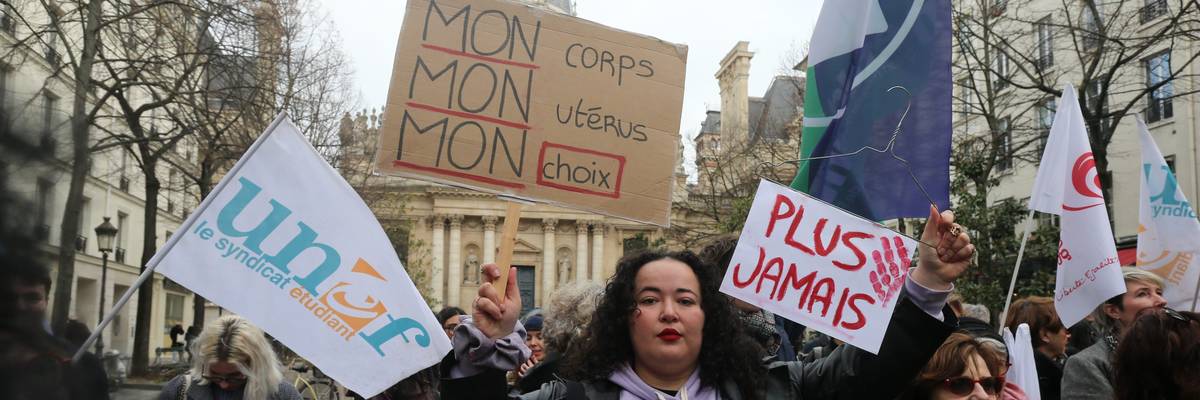
A protester holds signs that read, ''My body, my uterus, my choice'' and, "Never again" in French during a gathering at Place de la Sorbonne in Paris on February 28, 2024.
"France saw what happened in the U.S. and decided to do the RIGHT thing—enshrine abortion in its Constitution," said one advocacy group.
As U.S. President Joe Biden garnered fresh condemnation from rights advocates for his latest comments on abortion care on Monday, the Place du Trocadero in Paris was crowded with people celebrating an overwhelming vote by French lawmakers in favor of enshrining abortion rights in their country's constitution.
The French Parliament voted 780-72 to add an amendment to the constitution stating that there is a "guaranteed freedom" to obtain abortion care in France.
"The law determines the conditions by which is exercised the freedom of women to have recourse to an abortion, which is guaranteed," the amendment reads.
Demonstrating that the fight to protect abortion rights "has no borders," several legislators wore green scarves to the vote, symbolizing solidarity with the "Green Wave" that has seen advocates successfully push for reproductive freedom in Latin American countries.
The vote made France the first country to affirm a constitutional right to abortion care since 1974, when the former Yugoslavia amended its constitution.
The move was applauded by the United Nations high commissioner on human rights.
Abortion was first made legal in France—albeit without a constitutional right—in 1975, and the right is supported by more than 80% of the public.
Prime Minister Gabriel Attal said the two houses of Parliament sent "a message to all women: your body belongs to you."
French Justice Minister Eric Dupond-Moretti suggested the U.S. Supreme Court's overturning in 2022 of Roe v. Wade, which for nearly five decades had affirmed that people in the U.S. had the right to abortion care, made it clear that amending the French constitution was necessary to reflect the values of the vast majority of people in France.
“We now have irrefutable proof that no democracy, not even the largest of them all, is immune" to attacks on reproductive rights, he said.
The Eiffel Tower was emblazoned with the words, "My body, my choice" as supporters rallied in Paris to mark the historic vote—but across the Atlantic Ocean, an interview with Biden in The New Yorker included a comment in which the president, who has repeatedly said he has personal objections to abortion care but believes Roe should have been upheld, denigrated the idea embraced by the French lawmakers.
"I've never been supportive of, you know, 'It's my body, I can do what I want with it," Biden told the magazine, sparking renewed anger among reproductive justice advocates.
Biden's comments came weeks after the Alabama Supreme Court ruled that a frozen embryo created via in vitro fertilization had the same rights as a living child, prompting some Republicans to attempt to distance themselves from the decision even as supporters of forced pregnancy and "fetal personhood" laws openly embraced it.
Nearly half of U.S. states now ban abortion care or restrict it earlier in pregnancy than the standard set by Roe v. Wade. At least 15 states ban the procedure in "almost all circumstances," according to The New York Times. Republicans have advocated for a nationwide 15-week abortion ban, and former President Donald Trump—now the presumptive GOP presidential nominee—reportedly supports a 16-week ban.
Amnesty International Secretary-General Agnes Callamard said the vote in France on Monday was "of huge significance given the rollback of this essential right around the world."
"The United States has shown how devastatingly dangerous and retrogressive it is to undermine abortion as a right," said Callamard. "In Europe, there are still countries such as Poland and Andorra, where access to abortion is highly restricted and where those fighting for this right face prosecution. Today's vote in France should pave the way for stronger protection of access to abortion elsewhere."
"Enshrining abortion in the constitution is a high-water mark for women's rights and a testament to years of tireless campaigning by so many," she added. "It sends a message of hope and solidarity to women's groups and to all defenders of abortion and other sexual and reproductive rights."
Dear Common Dreams reader, It’s been nearly 30 years since I co-founded Common Dreams with my late wife, Lina Newhouser. We had the radical notion that journalism should serve the public good, not corporate profits. It was clear to us from the outset what it would take to build such a project. No paid advertisements. No corporate sponsors. No millionaire publisher telling us what to think or do. Many people said we wouldn't last a year, but we proved those doubters wrong. Together with a tremendous team of journalists and dedicated staff, we built an independent media outlet free from the constraints of profits and corporate control. Our mission has always been simple: To inform. To inspire. To ignite change for the common good. Building Common Dreams was not easy. Our survival was never guaranteed. When you take on the most powerful forces—Wall Street greed, fossil fuel industry destruction, Big Tech lobbyists, and uber-rich oligarchs who have spent billions upon billions rigging the economy and democracy in their favor—the only bulwark you have is supporters who believe in your work. But here’s the urgent message from me today. It's never been this bad out there. And it's never been this hard to keep us going. At the very moment Common Dreams is most needed, the threats we face are intensifying. We need your support now more than ever. We don't accept corporate advertising and never will. We don't have a paywall because we don't think people should be blocked from critical news based on their ability to pay. Everything we do is funded by the donations of readers like you. When everyone does the little they can afford, we are strong. But if that support retreats or dries up, so do we. Will you donate now to make sure Common Dreams not only survives but thrives? —Craig Brown, Co-founder |
As U.S. President Joe Biden garnered fresh condemnation from rights advocates for his latest comments on abortion care on Monday, the Place du Trocadero in Paris was crowded with people celebrating an overwhelming vote by French lawmakers in favor of enshrining abortion rights in their country's constitution.
The French Parliament voted 780-72 to add an amendment to the constitution stating that there is a "guaranteed freedom" to obtain abortion care in France.
"The law determines the conditions by which is exercised the freedom of women to have recourse to an abortion, which is guaranteed," the amendment reads.
Demonstrating that the fight to protect abortion rights "has no borders," several legislators wore green scarves to the vote, symbolizing solidarity with the "Green Wave" that has seen advocates successfully push for reproductive freedom in Latin American countries.
The vote made France the first country to affirm a constitutional right to abortion care since 1974, when the former Yugoslavia amended its constitution.
The move was applauded by the United Nations high commissioner on human rights.
Abortion was first made legal in France—albeit without a constitutional right—in 1975, and the right is supported by more than 80% of the public.
Prime Minister Gabriel Attal said the two houses of Parliament sent "a message to all women: your body belongs to you."
French Justice Minister Eric Dupond-Moretti suggested the U.S. Supreme Court's overturning in 2022 of Roe v. Wade, which for nearly five decades had affirmed that people in the U.S. had the right to abortion care, made it clear that amending the French constitution was necessary to reflect the values of the vast majority of people in France.
“We now have irrefutable proof that no democracy, not even the largest of them all, is immune" to attacks on reproductive rights, he said.
The Eiffel Tower was emblazoned with the words, "My body, my choice" as supporters rallied in Paris to mark the historic vote—but across the Atlantic Ocean, an interview with Biden in The New Yorker included a comment in which the president, who has repeatedly said he has personal objections to abortion care but believes Roe should have been upheld, denigrated the idea embraced by the French lawmakers.
"I've never been supportive of, you know, 'It's my body, I can do what I want with it," Biden told the magazine, sparking renewed anger among reproductive justice advocates.
Biden's comments came weeks after the Alabama Supreme Court ruled that a frozen embryo created via in vitro fertilization had the same rights as a living child, prompting some Republicans to attempt to distance themselves from the decision even as supporters of forced pregnancy and "fetal personhood" laws openly embraced it.
Nearly half of U.S. states now ban abortion care or restrict it earlier in pregnancy than the standard set by Roe v. Wade. At least 15 states ban the procedure in "almost all circumstances," according to The New York Times. Republicans have advocated for a nationwide 15-week abortion ban, and former President Donald Trump—now the presumptive GOP presidential nominee—reportedly supports a 16-week ban.
Amnesty International Secretary-General Agnes Callamard said the vote in France on Monday was "of huge significance given the rollback of this essential right around the world."
"The United States has shown how devastatingly dangerous and retrogressive it is to undermine abortion as a right," said Callamard. "In Europe, there are still countries such as Poland and Andorra, where access to abortion is highly restricted and where those fighting for this right face prosecution. Today's vote in France should pave the way for stronger protection of access to abortion elsewhere."
"Enshrining abortion in the constitution is a high-water mark for women's rights and a testament to years of tireless campaigning by so many," she added. "It sends a message of hope and solidarity to women's groups and to all defenders of abortion and other sexual and reproductive rights."
As U.S. President Joe Biden garnered fresh condemnation from rights advocates for his latest comments on abortion care on Monday, the Place du Trocadero in Paris was crowded with people celebrating an overwhelming vote by French lawmakers in favor of enshrining abortion rights in their country's constitution.
The French Parliament voted 780-72 to add an amendment to the constitution stating that there is a "guaranteed freedom" to obtain abortion care in France.
"The law determines the conditions by which is exercised the freedom of women to have recourse to an abortion, which is guaranteed," the amendment reads.
Demonstrating that the fight to protect abortion rights "has no borders," several legislators wore green scarves to the vote, symbolizing solidarity with the "Green Wave" that has seen advocates successfully push for reproductive freedom in Latin American countries.
The vote made France the first country to affirm a constitutional right to abortion care since 1974, when the former Yugoslavia amended its constitution.
The move was applauded by the United Nations high commissioner on human rights.
Abortion was first made legal in France—albeit without a constitutional right—in 1975, and the right is supported by more than 80% of the public.
Prime Minister Gabriel Attal said the two houses of Parliament sent "a message to all women: your body belongs to you."
French Justice Minister Eric Dupond-Moretti suggested the U.S. Supreme Court's overturning in 2022 of Roe v. Wade, which for nearly five decades had affirmed that people in the U.S. had the right to abortion care, made it clear that amending the French constitution was necessary to reflect the values of the vast majority of people in France.
“We now have irrefutable proof that no democracy, not even the largest of them all, is immune" to attacks on reproductive rights, he said.
The Eiffel Tower was emblazoned with the words, "My body, my choice" as supporters rallied in Paris to mark the historic vote—but across the Atlantic Ocean, an interview with Biden in The New Yorker included a comment in which the president, who has repeatedly said he has personal objections to abortion care but believes Roe should have been upheld, denigrated the idea embraced by the French lawmakers.
"I've never been supportive of, you know, 'It's my body, I can do what I want with it," Biden told the magazine, sparking renewed anger among reproductive justice advocates.
Biden's comments came weeks after the Alabama Supreme Court ruled that a frozen embryo created via in vitro fertilization had the same rights as a living child, prompting some Republicans to attempt to distance themselves from the decision even as supporters of forced pregnancy and "fetal personhood" laws openly embraced it.
Nearly half of U.S. states now ban abortion care or restrict it earlier in pregnancy than the standard set by Roe v. Wade. At least 15 states ban the procedure in "almost all circumstances," according to The New York Times. Republicans have advocated for a nationwide 15-week abortion ban, and former President Donald Trump—now the presumptive GOP presidential nominee—reportedly supports a 16-week ban.
Amnesty International Secretary-General Agnes Callamard said the vote in France on Monday was "of huge significance given the rollback of this essential right around the world."
"The United States has shown how devastatingly dangerous and retrogressive it is to undermine abortion as a right," said Callamard. "In Europe, there are still countries such as Poland and Andorra, where access to abortion is highly restricted and where those fighting for this right face prosecution. Today's vote in France should pave the way for stronger protection of access to abortion elsewhere."
"Enshrining abortion in the constitution is a high-water mark for women's rights and a testament to years of tireless campaigning by so many," she added. "It sends a message of hope and solidarity to women's groups and to all defenders of abortion and other sexual and reproductive rights."

