SUBSCRIBE TO OUR FREE NEWSLETTER
Daily news & progressive opinion—funded by the people, not the corporations—delivered straight to your inbox.
5
#000000
#FFFFFF
To donate by check, phone, or other method, see our More Ways to Give page.
Daily news & progressive opinion—funded by the people, not the corporations—delivered straight to your inbox.
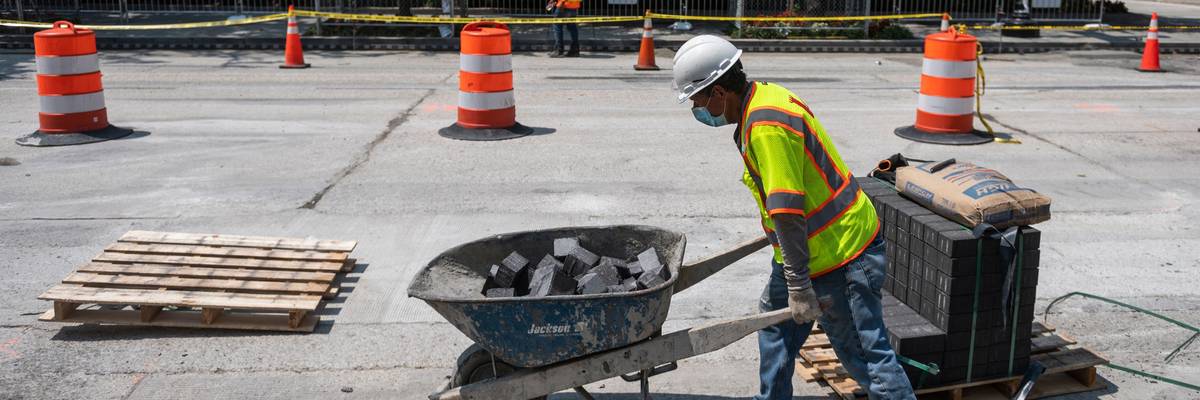
Construction workers repairs a street near the White House, in Washington, D.C., on August 10, 2021.
"A higher federal contractor wage standard is good for employers and the federal government overall," said one left-leaning think tank.
After U.S. President Donald Trump last month undid a Biden-era regulation that required businesses that contract with the federal government to pay their workers a $17.75 an hour minimum wage, the Center for American Progress released an analysis Friday which found that some workers impacted by the change could see a 25% pay cut.
Thanks to rollback from Trump, "corporations working on government contracts are free to cut wages for hundreds of thousands of workers," according to the author of the analysis, who also said that the move constitutes a new front in the Trump administration's "war on workers."
Former President Joe Biden's order, which was announced in 2021 and went into effect in 2022, initially raised the minimum wage to $15 an hour with automatic updates, which bumped it the minimum up to $17.75 in January 2025.
The rescission was part of an executive order that reversed 18 "harmful executive orders and actions" issued by Biden.
According to CAP, a liberal think tank, Trump's scrapping of the Biden minimum wage protection leaves in place an Obama-era rule, meaning some workers on federal contracts can now be paid a minimum of $13.30 an hour.
The analysis arrived at the 25% pay cut by calculating the difference between the $17.75 floor and $13.30. However, CAP noted that the U.S. Department of Labor still has to issue guidance over how it will enforce this older wage standard.
Other wage protections for workers on federal contracts exist, but CAP argues that "they are inadequate for protecting the workers who just saw their minimum wage taken away."
The Davis-Bacon Act establishes minimum prevailing wage standards for workers on federal construction sites, for example, but the wages established under the law can be much lower than $17.75 an hour, according to the analysis.
"The boost for workers from the Biden minimum wage increase that the Trump administration just nullified was substantial," according to CAP, which cites a Department of Labor estimate from 2021 that the change would impact 327,300 employees in the first year of implementation.
In 2021, the left-leaning think tank the Economic Policy Institute estimated that, taking into account the hundreds of thousands of workers who could see their wages raised through Biden's executive order, the total pay increases thanks to the rule would amount to $1.2 billion in 2022.
"A higher minimum wage for federal contractors helps ensure that taxpayer dollars incentivize good jobs, rather than low-wage jobs where contractors compete with each other in a race to the bottom," according to a statement from EPI following Trump's rescission of the minimum wage rule. "A higher federal contractor wage standard is good for employers and the federal government overall."
Dear Common Dreams reader, It’s been nearly 30 years since I co-founded Common Dreams with my late wife, Lina Newhouser. We had the radical notion that journalism should serve the public good, not corporate profits. It was clear to us from the outset what it would take to build such a project. No paid advertisements. No corporate sponsors. No millionaire publisher telling us what to think or do. Many people said we wouldn't last a year, but we proved those doubters wrong. Together with a tremendous team of journalists and dedicated staff, we built an independent media outlet free from the constraints of profits and corporate control. Our mission has always been simple: To inform. To inspire. To ignite change for the common good. Building Common Dreams was not easy. Our survival was never guaranteed. When you take on the most powerful forces—Wall Street greed, fossil fuel industry destruction, Big Tech lobbyists, and uber-rich oligarchs who have spent billions upon billions rigging the economy and democracy in their favor—the only bulwark you have is supporters who believe in your work. But here’s the urgent message from me today. It's never been this bad out there. And it's never been this hard to keep us going. At the very moment Common Dreams is most needed, the threats we face are intensifying. We need your support now more than ever. We don't accept corporate advertising and never will. We don't have a paywall because we don't think people should be blocked from critical news based on their ability to pay. Everything we do is funded by the donations of readers like you. When everyone does the little they can afford, we are strong. But if that support retreats or dries up, so do we. Will you donate now to make sure Common Dreams not only survives but thrives? —Craig Brown, Co-founder |
After U.S. President Donald Trump last month undid a Biden-era regulation that required businesses that contract with the federal government to pay their workers a $17.75 an hour minimum wage, the Center for American Progress released an analysis Friday which found that some workers impacted by the change could see a 25% pay cut.
Thanks to rollback from Trump, "corporations working on government contracts are free to cut wages for hundreds of thousands of workers," according to the author of the analysis, who also said that the move constitutes a new front in the Trump administration's "war on workers."
Former President Joe Biden's order, which was announced in 2021 and went into effect in 2022, initially raised the minimum wage to $15 an hour with automatic updates, which bumped it the minimum up to $17.75 in January 2025.
The rescission was part of an executive order that reversed 18 "harmful executive orders and actions" issued by Biden.
According to CAP, a liberal think tank, Trump's scrapping of the Biden minimum wage protection leaves in place an Obama-era rule, meaning some workers on federal contracts can now be paid a minimum of $13.30 an hour.
The analysis arrived at the 25% pay cut by calculating the difference between the $17.75 floor and $13.30. However, CAP noted that the U.S. Department of Labor still has to issue guidance over how it will enforce this older wage standard.
Other wage protections for workers on federal contracts exist, but CAP argues that "they are inadequate for protecting the workers who just saw their minimum wage taken away."
The Davis-Bacon Act establishes minimum prevailing wage standards for workers on federal construction sites, for example, but the wages established under the law can be much lower than $17.75 an hour, according to the analysis.
"The boost for workers from the Biden minimum wage increase that the Trump administration just nullified was substantial," according to CAP, which cites a Department of Labor estimate from 2021 that the change would impact 327,300 employees in the first year of implementation.
In 2021, the left-leaning think tank the Economic Policy Institute estimated that, taking into account the hundreds of thousands of workers who could see their wages raised through Biden's executive order, the total pay increases thanks to the rule would amount to $1.2 billion in 2022.
"A higher minimum wage for federal contractors helps ensure that taxpayer dollars incentivize good jobs, rather than low-wage jobs where contractors compete with each other in a race to the bottom," according to a statement from EPI following Trump's rescission of the minimum wage rule. "A higher federal contractor wage standard is good for employers and the federal government overall."
After U.S. President Donald Trump last month undid a Biden-era regulation that required businesses that contract with the federal government to pay their workers a $17.75 an hour minimum wage, the Center for American Progress released an analysis Friday which found that some workers impacted by the change could see a 25% pay cut.
Thanks to rollback from Trump, "corporations working on government contracts are free to cut wages for hundreds of thousands of workers," according to the author of the analysis, who also said that the move constitutes a new front in the Trump administration's "war on workers."
Former President Joe Biden's order, which was announced in 2021 and went into effect in 2022, initially raised the minimum wage to $15 an hour with automatic updates, which bumped it the minimum up to $17.75 in January 2025.
The rescission was part of an executive order that reversed 18 "harmful executive orders and actions" issued by Biden.
According to CAP, a liberal think tank, Trump's scrapping of the Biden minimum wage protection leaves in place an Obama-era rule, meaning some workers on federal contracts can now be paid a minimum of $13.30 an hour.
The analysis arrived at the 25% pay cut by calculating the difference between the $17.75 floor and $13.30. However, CAP noted that the U.S. Department of Labor still has to issue guidance over how it will enforce this older wage standard.
Other wage protections for workers on federal contracts exist, but CAP argues that "they are inadequate for protecting the workers who just saw their minimum wage taken away."
The Davis-Bacon Act establishes minimum prevailing wage standards for workers on federal construction sites, for example, but the wages established under the law can be much lower than $17.75 an hour, according to the analysis.
"The boost for workers from the Biden minimum wage increase that the Trump administration just nullified was substantial," according to CAP, which cites a Department of Labor estimate from 2021 that the change would impact 327,300 employees in the first year of implementation.
In 2021, the left-leaning think tank the Economic Policy Institute estimated that, taking into account the hundreds of thousands of workers who could see their wages raised through Biden's executive order, the total pay increases thanks to the rule would amount to $1.2 billion in 2022.
"A higher minimum wage for federal contractors helps ensure that taxpayer dollars incentivize good jobs, rather than low-wage jobs where contractors compete with each other in a race to the bottom," according to a statement from EPI following Trump's rescission of the minimum wage rule. "A higher federal contractor wage standard is good for employers and the federal government overall."