SUBSCRIBE TO OUR FREE NEWSLETTER
Daily news & progressive opinion—funded by the people, not the corporations—delivered straight to your inbox.
5
#000000
#FFFFFF
To donate by check, phone, or other method, see our More Ways to Give page.
Daily news & progressive opinion—funded by the people, not the corporations—delivered straight to your inbox.
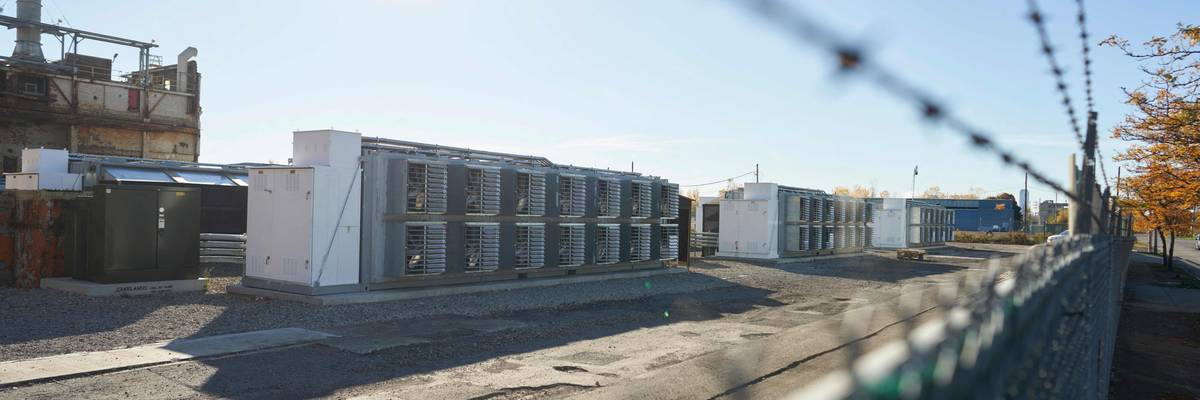
Fans cool the servers at the US Bitcoin facility in Niagara Falls, New York on October 24, 2022.
"New York's landmark climate law means that agencies can't ignore the climate and environmental justice consequences of their decisions," said one advocate.
Three climate action groups said Friday that New York's decision to allow a Canadian cryptocurrency mining company to control a fracked gas power plant is a clear violation of the state's landmark climate protection law as they sued a state commission in Albany County Supreme Court.
The lawsuit, filed by Earthjustice on behalf of Clean Air Coalition of Western New York and the Sierra Club, comes four months after the New York Public Service Commission approved the sale of the Fortistar North Tonawanda power plant in the Buffalo area to Digihost International.
The transfer gave Digihost approval to operate round-the-clock, 365 days per year, increasing the facility's greenhouse gas emissions up to 3,500% as it conducts its proof-of-work cryptocurrency mining operation, said Earthjustice.
As Sierra Club and Earthjustice explained in a report last year:
The process effectively entails millions of computing machines racing to solve a complex, but meaningless, problem. In Bitcoin's algorithm, for example, the computer or mining machine that successfully solves the problem is rewarded with Bitcoin (and functionally verifies the blockchain). As long as the reward is high enough (i.e., the price of Bitcoin is high enough), miners will attempt to use more—and faster—mining machines to increase their chances of winning that reward.
"Top-down estimates of the electricity consumption of cryptocurrency mining in the United States imply that the industry was responsible for an excess 27.4 million tons of carbon dioxide (CO2) between mid-2021 and 2022—or three times as much as emitted by the largest coal plant in the U.S. in 2021," the report said.
As it announced the lawsuit Friday, Earthjustice noted that Digistar could massively ramp up emissions as the rest of the state works to comply with the 2019 Climate Leadership and Community Protection Act, which requires all state agencies to consider the implications for disadvantaged communities and for emissions reduction when making decisions.
"New York's landmark climate law means that agencies can't ignore the climate and environmental justice consequences of their decisions. We're calling on the court to hold agencies accountable and ensure that cryptocurrency miners don't get a free pass to heat our planet and damage our communities," said Dror Ladin, senior attorney at Earthjustice.
The plant in question is located near a number of neighborhoods that have been designated by the state as "disadvantaged communities," where residents face a greater environmental burden than 90% of New York. Cryptomining at Fortistar North Tonawanda could raise the residents' risk of developing asthma, cancer, and other conditions that could lead to premature death.
"Everything changed when New York state enacted its landmark climate law," said Roger Downs, conservation director for the Sierra Club Atlantic Chapter. "The Public Service Commission can no longer ignore the impacts of its decisions, especially when they run counter to public benefit and endanger the air quality for communities already burdened with a disproportionate amount of pollution. Allowing a failing gas fired power plant to be acquired and revived by an energy-hungry cryptomine, without considering the environmental impacts, runs counter to the intent of the climate law and the justice it seeks to advance."
The local conservation group Seneca Lake Guardian applauded the groups for challenging the commission's approval of the sale.
"Clean Air will continue to fight against the burning of fossil fuels to generate power for cryptocurrency mining, especially in residential areas like North Tonawanda," said Chris Murawski, executive director of the Clean Air Coalition of Western New York.
Dear Common Dreams reader, It’s been nearly 30 years since I co-founded Common Dreams with my late wife, Lina Newhouser. We had the radical notion that journalism should serve the public good, not corporate profits. It was clear to us from the outset what it would take to build such a project. No paid advertisements. No corporate sponsors. No millionaire publisher telling us what to think or do. Many people said we wouldn't last a year, but we proved those doubters wrong. Together with a tremendous team of journalists and dedicated staff, we built an independent media outlet free from the constraints of profits and corporate control. Our mission has always been simple: To inform. To inspire. To ignite change for the common good. Building Common Dreams was not easy. Our survival was never guaranteed. When you take on the most powerful forces—Wall Street greed, fossil fuel industry destruction, Big Tech lobbyists, and uber-rich oligarchs who have spent billions upon billions rigging the economy and democracy in their favor—the only bulwark you have is supporters who believe in your work. But here’s the urgent message from me today. It's never been this bad out there. And it's never been this hard to keep us going. At the very moment Common Dreams is most needed, the threats we face are intensifying. We need your support now more than ever. We don't accept corporate advertising and never will. We don't have a paywall because we don't think people should be blocked from critical news based on their ability to pay. Everything we do is funded by the donations of readers like you. When everyone does the little they can afford, we are strong. But if that support retreats or dries up, so do we. Will you donate now to make sure Common Dreams not only survives but thrives? —Craig Brown, Co-founder |
Three climate action groups said Friday that New York's decision to allow a Canadian cryptocurrency mining company to control a fracked gas power plant is a clear violation of the state's landmark climate protection law as they sued a state commission in Albany County Supreme Court.
The lawsuit, filed by Earthjustice on behalf of Clean Air Coalition of Western New York and the Sierra Club, comes four months after the New York Public Service Commission approved the sale of the Fortistar North Tonawanda power plant in the Buffalo area to Digihost International.
The transfer gave Digihost approval to operate round-the-clock, 365 days per year, increasing the facility's greenhouse gas emissions up to 3,500% as it conducts its proof-of-work cryptocurrency mining operation, said Earthjustice.
As Sierra Club and Earthjustice explained in a report last year:
The process effectively entails millions of computing machines racing to solve a complex, but meaningless, problem. In Bitcoin's algorithm, for example, the computer or mining machine that successfully solves the problem is rewarded with Bitcoin (and functionally verifies the blockchain). As long as the reward is high enough (i.e., the price of Bitcoin is high enough), miners will attempt to use more—and faster—mining machines to increase their chances of winning that reward.
"Top-down estimates of the electricity consumption of cryptocurrency mining in the United States imply that the industry was responsible for an excess 27.4 million tons of carbon dioxide (CO2) between mid-2021 and 2022—or three times as much as emitted by the largest coal plant in the U.S. in 2021," the report said.
As it announced the lawsuit Friday, Earthjustice noted that Digistar could massively ramp up emissions as the rest of the state works to comply with the 2019 Climate Leadership and Community Protection Act, which requires all state agencies to consider the implications for disadvantaged communities and for emissions reduction when making decisions.
"New York's landmark climate law means that agencies can't ignore the climate and environmental justice consequences of their decisions. We're calling on the court to hold agencies accountable and ensure that cryptocurrency miners don't get a free pass to heat our planet and damage our communities," said Dror Ladin, senior attorney at Earthjustice.
The plant in question is located near a number of neighborhoods that have been designated by the state as "disadvantaged communities," where residents face a greater environmental burden than 90% of New York. Cryptomining at Fortistar North Tonawanda could raise the residents' risk of developing asthma, cancer, and other conditions that could lead to premature death.
"Everything changed when New York state enacted its landmark climate law," said Roger Downs, conservation director for the Sierra Club Atlantic Chapter. "The Public Service Commission can no longer ignore the impacts of its decisions, especially when they run counter to public benefit and endanger the air quality for communities already burdened with a disproportionate amount of pollution. Allowing a failing gas fired power plant to be acquired and revived by an energy-hungry cryptomine, without considering the environmental impacts, runs counter to the intent of the climate law and the justice it seeks to advance."
The local conservation group Seneca Lake Guardian applauded the groups for challenging the commission's approval of the sale.
"Clean Air will continue to fight against the burning of fossil fuels to generate power for cryptocurrency mining, especially in residential areas like North Tonawanda," said Chris Murawski, executive director of the Clean Air Coalition of Western New York.
Three climate action groups said Friday that New York's decision to allow a Canadian cryptocurrency mining company to control a fracked gas power plant is a clear violation of the state's landmark climate protection law as they sued a state commission in Albany County Supreme Court.
The lawsuit, filed by Earthjustice on behalf of Clean Air Coalition of Western New York and the Sierra Club, comes four months after the New York Public Service Commission approved the sale of the Fortistar North Tonawanda power plant in the Buffalo area to Digihost International.
The transfer gave Digihost approval to operate round-the-clock, 365 days per year, increasing the facility's greenhouse gas emissions up to 3,500% as it conducts its proof-of-work cryptocurrency mining operation, said Earthjustice.
As Sierra Club and Earthjustice explained in a report last year:
The process effectively entails millions of computing machines racing to solve a complex, but meaningless, problem. In Bitcoin's algorithm, for example, the computer or mining machine that successfully solves the problem is rewarded with Bitcoin (and functionally verifies the blockchain). As long as the reward is high enough (i.e., the price of Bitcoin is high enough), miners will attempt to use more—and faster—mining machines to increase their chances of winning that reward.
"Top-down estimates of the electricity consumption of cryptocurrency mining in the United States imply that the industry was responsible for an excess 27.4 million tons of carbon dioxide (CO2) between mid-2021 and 2022—or three times as much as emitted by the largest coal plant in the U.S. in 2021," the report said.
As it announced the lawsuit Friday, Earthjustice noted that Digistar could massively ramp up emissions as the rest of the state works to comply with the 2019 Climate Leadership and Community Protection Act, which requires all state agencies to consider the implications for disadvantaged communities and for emissions reduction when making decisions.
"New York's landmark climate law means that agencies can't ignore the climate and environmental justice consequences of their decisions. We're calling on the court to hold agencies accountable and ensure that cryptocurrency miners don't get a free pass to heat our planet and damage our communities," said Dror Ladin, senior attorney at Earthjustice.
The plant in question is located near a number of neighborhoods that have been designated by the state as "disadvantaged communities," where residents face a greater environmental burden than 90% of New York. Cryptomining at Fortistar North Tonawanda could raise the residents' risk of developing asthma, cancer, and other conditions that could lead to premature death.
"Everything changed when New York state enacted its landmark climate law," said Roger Downs, conservation director for the Sierra Club Atlantic Chapter. "The Public Service Commission can no longer ignore the impacts of its decisions, especially when they run counter to public benefit and endanger the air quality for communities already burdened with a disproportionate amount of pollution. Allowing a failing gas fired power plant to be acquired and revived by an energy-hungry cryptomine, without considering the environmental impacts, runs counter to the intent of the climate law and the justice it seeks to advance."
The local conservation group Seneca Lake Guardian applauded the groups for challenging the commission's approval of the sale.
"Clean Air will continue to fight against the burning of fossil fuels to generate power for cryptocurrency mining, especially in residential areas like North Tonawanda," said Chris Murawski, executive director of the Clean Air Coalition of Western New York.