SUBSCRIBE TO OUR FREE NEWSLETTER
Daily news & progressive opinion—funded by the people, not the corporations—delivered straight to your inbox.
5
#000000
#FFFFFF
To donate by check, phone, or other method, see our More Ways to Give page.
Daily news & progressive opinion—funded by the people, not the corporations—delivered straight to your inbox.
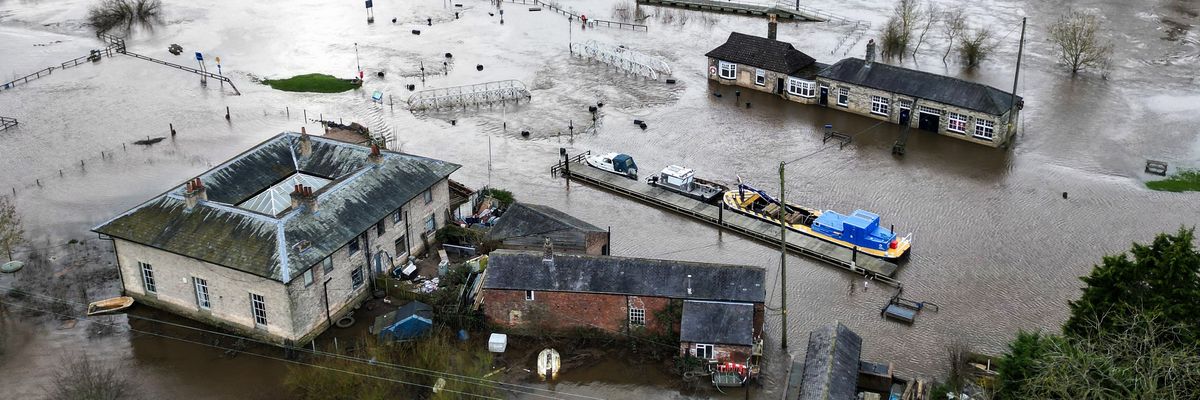
An aerial picture taken on January 24, 2024 shows Naburn Locks near York in northern England surrounded by water.
Greenpeace U.K. said in response that the Labour government must "stop new oil and gas drilling and force fossil fuel giants to pay for climate damages."
A trade group for the British insurance industry said Monday that extreme weather helped drive property insurance payouts to a record quarterly high over the past three months, underscoring the growing threat that the fossil fuel-driven climate emergency poses to homes, businesses, and the broader economy.
The Association of British Insurers (ABI) said Monday that insurance firms in the United Kingdom paid out £1.4 billion—$1.79 billion—in claims during the second quarter of 2024, a 5% increase compared to the previous quarter and the highest quarterly sum since the organization started gathering data in 2017.
"The average payout per home insurance claim was also up, rising 16% on the previous quarter to £5,284," or $6,746, ABI noted.
The last three months marked "the fifth consecutive quarter that weather-related claims have been above £100 million," according to ABI, which observed that "claims for damage to homes from storms, heavy rain, and frozen pipes reached £144 million in Q2 of this year."
Meanwhile, the average price of home insurance rose 6% compared to the previous quarter.
Louise Clark, a policy adviser at ABI, said the figures "demonstrate the devastating impact that adverse weather can have on people and their homes."
"That's why it's important that the government takes the opportunity to reform the planning system, to focus on prevention and resilience measures to help reduce our nation's vulnerability to the effects of climate change," said Clark. "Urgent government action to tackle surface water flooding and maintain flood investments and maintenance will also help reduce the future impact of flooding."
Greenpeace U.K. said it agrees with ABI's call for climate action, imploring the newly elected Labour government to "stop new oil and gas drilling and force fossil fuel giants to pay for climate damages."
Between March 2023 and February 2024, England and Wales saw their heaviest rainfall since 1766, and much of the U.K. experienced destructive flooding during that 12-month period. Research from scientists across Western Europe found that the human-caused climate crisis made the storms in the U.K. and Ireland more damaging and frequent.
Intensifying extreme weather in the U.K. and around the world has attracted greater scrutiny to the fossil fuel industry as well as the insurance companies underwriting their operations.
A report published late last year by a coalition of environmental groups noted that "as the climate crisis escalates, numerous insurance companies are withdrawing their cover from regions particularly affected by climate change in Australia, the United States, and other countries."
"Major reinsurers such as AIG Re, AXIS Capital, AXA XL, Everest Re, SCOR, and TransRe have reduced cover for natural catastrophes or left the property market altogether, causing a spike in premiums," the report continued. "Yet while companies abandon communities affected by climate risks, they continue to fuel the climate crisis by underwriting and investing in the expansion of fossil fuels."
Last month, as Common Dreams reported at the time, climate activists in the U.K. launched the "Insure Our Survival" campaign aimed at pressuring insurers to end their support for the industry whose extractive business model is driving climate chaos around the world.
"The insurance industry has a superpower," Alex Penson, a spokesperson for the campaign, said last month. "At a stroke, it could stop the fossil fuel crooks in their tracks and save the lives of billions of people threatened from the worst-case climate scenarios that scientists are saying are increasingly possible."
Dear Common Dreams reader, It’s been nearly 30 years since I co-founded Common Dreams with my late wife, Lina Newhouser. We had the radical notion that journalism should serve the public good, not corporate profits. It was clear to us from the outset what it would take to build such a project. No paid advertisements. No corporate sponsors. No millionaire publisher telling us what to think or do. Many people said we wouldn't last a year, but we proved those doubters wrong. Together with a tremendous team of journalists and dedicated staff, we built an independent media outlet free from the constraints of profits and corporate control. Our mission has always been simple: To inform. To inspire. To ignite change for the common good. Building Common Dreams was not easy. Our survival was never guaranteed. When you take on the most powerful forces—Wall Street greed, fossil fuel industry destruction, Big Tech lobbyists, and uber-rich oligarchs who have spent billions upon billions rigging the economy and democracy in their favor—the only bulwark you have is supporters who believe in your work. But here’s the urgent message from me today. It's never been this bad out there. And it's never been this hard to keep us going. At the very moment Common Dreams is most needed, the threats we face are intensifying. We need your support now more than ever. We don't accept corporate advertising and never will. We don't have a paywall because we don't think people should be blocked from critical news based on their ability to pay. Everything we do is funded by the donations of readers like you. When everyone does the little they can afford, we are strong. But if that support retreats or dries up, so do we. Will you donate now to make sure Common Dreams not only survives but thrives? —Craig Brown, Co-founder |
A trade group for the British insurance industry said Monday that extreme weather helped drive property insurance payouts to a record quarterly high over the past three months, underscoring the growing threat that the fossil fuel-driven climate emergency poses to homes, businesses, and the broader economy.
The Association of British Insurers (ABI) said Monday that insurance firms in the United Kingdom paid out £1.4 billion—$1.79 billion—in claims during the second quarter of 2024, a 5% increase compared to the previous quarter and the highest quarterly sum since the organization started gathering data in 2017.
"The average payout per home insurance claim was also up, rising 16% on the previous quarter to £5,284," or $6,746, ABI noted.
The last three months marked "the fifth consecutive quarter that weather-related claims have been above £100 million," according to ABI, which observed that "claims for damage to homes from storms, heavy rain, and frozen pipes reached £144 million in Q2 of this year."
Meanwhile, the average price of home insurance rose 6% compared to the previous quarter.
Louise Clark, a policy adviser at ABI, said the figures "demonstrate the devastating impact that adverse weather can have on people and their homes."
"That's why it's important that the government takes the opportunity to reform the planning system, to focus on prevention and resilience measures to help reduce our nation's vulnerability to the effects of climate change," said Clark. "Urgent government action to tackle surface water flooding and maintain flood investments and maintenance will also help reduce the future impact of flooding."
Greenpeace U.K. said it agrees with ABI's call for climate action, imploring the newly elected Labour government to "stop new oil and gas drilling and force fossil fuel giants to pay for climate damages."
Between March 2023 and February 2024, England and Wales saw their heaviest rainfall since 1766, and much of the U.K. experienced destructive flooding during that 12-month period. Research from scientists across Western Europe found that the human-caused climate crisis made the storms in the U.K. and Ireland more damaging and frequent.
Intensifying extreme weather in the U.K. and around the world has attracted greater scrutiny to the fossil fuel industry as well as the insurance companies underwriting their operations.
A report published late last year by a coalition of environmental groups noted that "as the climate crisis escalates, numerous insurance companies are withdrawing their cover from regions particularly affected by climate change in Australia, the United States, and other countries."
"Major reinsurers such as AIG Re, AXIS Capital, AXA XL, Everest Re, SCOR, and TransRe have reduced cover for natural catastrophes or left the property market altogether, causing a spike in premiums," the report continued. "Yet while companies abandon communities affected by climate risks, they continue to fuel the climate crisis by underwriting and investing in the expansion of fossil fuels."
Last month, as Common Dreams reported at the time, climate activists in the U.K. launched the "Insure Our Survival" campaign aimed at pressuring insurers to end their support for the industry whose extractive business model is driving climate chaos around the world.
"The insurance industry has a superpower," Alex Penson, a spokesperson for the campaign, said last month. "At a stroke, it could stop the fossil fuel crooks in their tracks and save the lives of billions of people threatened from the worst-case climate scenarios that scientists are saying are increasingly possible."
A trade group for the British insurance industry said Monday that extreme weather helped drive property insurance payouts to a record quarterly high over the past three months, underscoring the growing threat that the fossil fuel-driven climate emergency poses to homes, businesses, and the broader economy.
The Association of British Insurers (ABI) said Monday that insurance firms in the United Kingdom paid out £1.4 billion—$1.79 billion—in claims during the second quarter of 2024, a 5% increase compared to the previous quarter and the highest quarterly sum since the organization started gathering data in 2017.
"The average payout per home insurance claim was also up, rising 16% on the previous quarter to £5,284," or $6,746, ABI noted.
The last three months marked "the fifth consecutive quarter that weather-related claims have been above £100 million," according to ABI, which observed that "claims for damage to homes from storms, heavy rain, and frozen pipes reached £144 million in Q2 of this year."
Meanwhile, the average price of home insurance rose 6% compared to the previous quarter.
Louise Clark, a policy adviser at ABI, said the figures "demonstrate the devastating impact that adverse weather can have on people and their homes."
"That's why it's important that the government takes the opportunity to reform the planning system, to focus on prevention and resilience measures to help reduce our nation's vulnerability to the effects of climate change," said Clark. "Urgent government action to tackle surface water flooding and maintain flood investments and maintenance will also help reduce the future impact of flooding."
Greenpeace U.K. said it agrees with ABI's call for climate action, imploring the newly elected Labour government to "stop new oil and gas drilling and force fossil fuel giants to pay for climate damages."
Between March 2023 and February 2024, England and Wales saw their heaviest rainfall since 1766, and much of the U.K. experienced destructive flooding during that 12-month period. Research from scientists across Western Europe found that the human-caused climate crisis made the storms in the U.K. and Ireland more damaging and frequent.
Intensifying extreme weather in the U.K. and around the world has attracted greater scrutiny to the fossil fuel industry as well as the insurance companies underwriting their operations.
A report published late last year by a coalition of environmental groups noted that "as the climate crisis escalates, numerous insurance companies are withdrawing their cover from regions particularly affected by climate change in Australia, the United States, and other countries."
"Major reinsurers such as AIG Re, AXIS Capital, AXA XL, Everest Re, SCOR, and TransRe have reduced cover for natural catastrophes or left the property market altogether, causing a spike in premiums," the report continued. "Yet while companies abandon communities affected by climate risks, they continue to fuel the climate crisis by underwriting and investing in the expansion of fossil fuels."
Last month, as Common Dreams reported at the time, climate activists in the U.K. launched the "Insure Our Survival" campaign aimed at pressuring insurers to end their support for the industry whose extractive business model is driving climate chaos around the world.
"The insurance industry has a superpower," Alex Penson, a spokesperson for the campaign, said last month. "At a stroke, it could stop the fossil fuel crooks in their tracks and save the lives of billions of people threatened from the worst-case climate scenarios that scientists are saying are increasingly possible."