SUBSCRIBE TO OUR FREE NEWSLETTER
Daily news & progressive opinion—funded by the people, not the corporations—delivered straight to your inbox.
5
#000000
#FFFFFF
To donate by check, phone, or other method, see our More Ways to Give page.
Daily news & progressive opinion—funded by the people, not the corporations—delivered straight to your inbox.
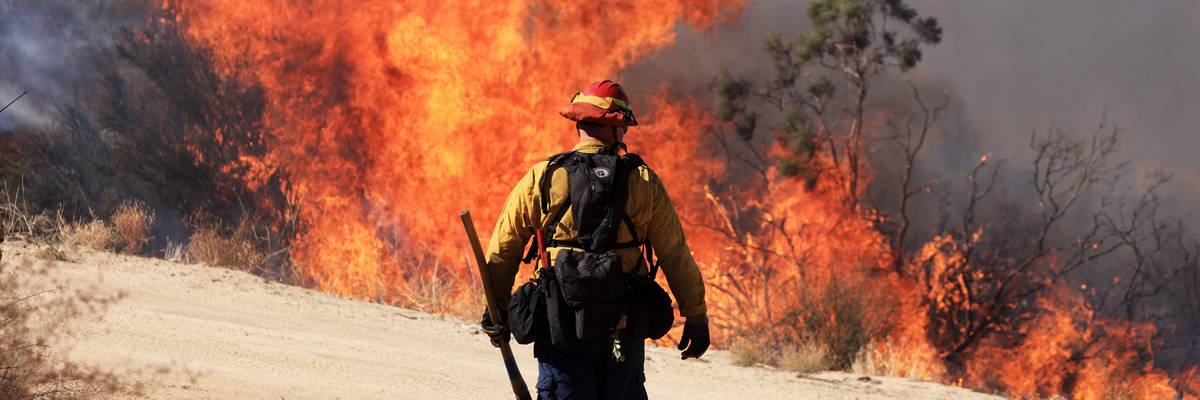
A firefighter walks toward flames as the Highland Fire burns in Aguana, California, on October 31, 2023.
"Climate change is not something off in the future," said one scientist. "It's happening before our very eyes."
New findings about the rising frequency of extreme wildfires have "the fingerprints of climate change" all over them, according to an Australian scientist who led a study published on Monday.
Calum Cunningham, a postdoctoral researcher at the University of Tasmania in Australia, told The Washington Post that he was driven to examine current trends in the frequency of wildfires after climate deniers suggested that because the global area being burned in blazes is declining, the idea of a growing wildfire crisis is being overblown by concerned scientists.
While the area destroyed by wildfires is indeed on the decline, analyses that include all fires—the majority of which are small and cause relatively little damage—obscured how the most extreme and destructive wildfires are rapidly growing more frequent.
Cunningham and his team analyzed data from National Aeronautics and Space Administration satellites, collecting four images of wildfires around the world per day over 21 years. They used the images to identify the 0.01% most extreme wildfires—those that release the most smoke and greenhouse gas emissions due to their size and uncontrollable nature.
Out of 30 million fires across the world over two decades, the researchers identified the 2,913 most extreme fire events and found that the frequency and intensity of such wildfires has more than doubled since 2003.
"Climate change is making fire weather more extreme and more frequent in a lot of the world."
The problem is rapidly getting worse, the team found: The six years with the most extreme wildfires had all occurred since 2017.
Trends were particularly troubling in particular regions, like temperate conifer forests in the western United States and the Mediterranean, where the number of extreme fires rose by more than 10 times in 20 years.
In boreal forests in places like northern Europe and Canada, the frequency of the most intense and hard-to-control blazes increased by seven times.
"It's absolutely in keeping with what climate change is doing to fire weather around the world," Cunningham told the Post. "Climate change is making fire weather more extreme and more frequent in a lot of the world."
The "fire weather" that's driven the increase includes hotter and drier conditions, with temperatures staying high even overnight when they ordinarily would have have dropped in previous decades, giving firefighters a chance to make headway in putting out blazes.
"Rarely did we have 100,000-acre fires 20 years ago," veteran firefighter Bobbie Scopa told the Post. "But now, it's not uncommon."
The researchers pointed to a "scary" feedback loop created as extreme wildfires create carbon emissions—leading to more planetary heating and even more fires.
"Climate change is not something off in the future," Cunningham told the Post. "It's happening before our very eyes. This is the manifestation of the reshaping of the climate we are doing."
The study was published in Nature Ecology & Evolution days after wildfires scorched more than 14,000 acres in Southern California and more than 24,000 acres in New Mexico, where two people were killed. Last year, climate scientists were stunned by an unprecedented wildfire season in relatively damp Eastern Canada, where wildfires were made twice as likely by the climate emergency according to the World Weather Attribution.
Climate scientist and author Bill McGuire called the findings "terrifying, of course, but just not a surprise," considering governments in the countries that produce the most fossil fuels are continuing to support and subsidize energy sources that heat the planet.
"This is certifiably insane," McGuire said.
Dear Common Dreams reader, It’s been nearly 30 years since I co-founded Common Dreams with my late wife, Lina Newhouser. We had the radical notion that journalism should serve the public good, not corporate profits. It was clear to us from the outset what it would take to build such a project. No paid advertisements. No corporate sponsors. No millionaire publisher telling us what to think or do. Many people said we wouldn't last a year, but we proved those doubters wrong. Together with a tremendous team of journalists and dedicated staff, we built an independent media outlet free from the constraints of profits and corporate control. Our mission has always been simple: To inform. To inspire. To ignite change for the common good. Building Common Dreams was not easy. Our survival was never guaranteed. When you take on the most powerful forces—Wall Street greed, fossil fuel industry destruction, Big Tech lobbyists, and uber-rich oligarchs who have spent billions upon billions rigging the economy and democracy in their favor—the only bulwark you have is supporters who believe in your work. But here’s the urgent message from me today. It's never been this bad out there. And it's never been this hard to keep us going. At the very moment Common Dreams is most needed, the threats we face are intensifying. We need your support now more than ever. We don't accept corporate advertising and never will. We don't have a paywall because we don't think people should be blocked from critical news based on their ability to pay. Everything we do is funded by the donations of readers like you. When everyone does the little they can afford, we are strong. But if that support retreats or dries up, so do we. Will you donate now to make sure Common Dreams not only survives but thrives? —Craig Brown, Co-founder |
New findings about the rising frequency of extreme wildfires have "the fingerprints of climate change" all over them, according to an Australian scientist who led a study published on Monday.
Calum Cunningham, a postdoctoral researcher at the University of Tasmania in Australia, told The Washington Post that he was driven to examine current trends in the frequency of wildfires after climate deniers suggested that because the global area being burned in blazes is declining, the idea of a growing wildfire crisis is being overblown by concerned scientists.
While the area destroyed by wildfires is indeed on the decline, analyses that include all fires—the majority of which are small and cause relatively little damage—obscured how the most extreme and destructive wildfires are rapidly growing more frequent.
Cunningham and his team analyzed data from National Aeronautics and Space Administration satellites, collecting four images of wildfires around the world per day over 21 years. They used the images to identify the 0.01% most extreme wildfires—those that release the most smoke and greenhouse gas emissions due to their size and uncontrollable nature.
Out of 30 million fires across the world over two decades, the researchers identified the 2,913 most extreme fire events and found that the frequency and intensity of such wildfires has more than doubled since 2003.
"Climate change is making fire weather more extreme and more frequent in a lot of the world."
The problem is rapidly getting worse, the team found: The six years with the most extreme wildfires had all occurred since 2017.
Trends were particularly troubling in particular regions, like temperate conifer forests in the western United States and the Mediterranean, where the number of extreme fires rose by more than 10 times in 20 years.
In boreal forests in places like northern Europe and Canada, the frequency of the most intense and hard-to-control blazes increased by seven times.
"It's absolutely in keeping with what climate change is doing to fire weather around the world," Cunningham told the Post. "Climate change is making fire weather more extreme and more frequent in a lot of the world."
The "fire weather" that's driven the increase includes hotter and drier conditions, with temperatures staying high even overnight when they ordinarily would have have dropped in previous decades, giving firefighters a chance to make headway in putting out blazes.
"Rarely did we have 100,000-acre fires 20 years ago," veteran firefighter Bobbie Scopa told the Post. "But now, it's not uncommon."
The researchers pointed to a "scary" feedback loop created as extreme wildfires create carbon emissions—leading to more planetary heating and even more fires.
"Climate change is not something off in the future," Cunningham told the Post. "It's happening before our very eyes. This is the manifestation of the reshaping of the climate we are doing."
The study was published in Nature Ecology & Evolution days after wildfires scorched more than 14,000 acres in Southern California and more than 24,000 acres in New Mexico, where two people were killed. Last year, climate scientists were stunned by an unprecedented wildfire season in relatively damp Eastern Canada, where wildfires were made twice as likely by the climate emergency according to the World Weather Attribution.
Climate scientist and author Bill McGuire called the findings "terrifying, of course, but just not a surprise," considering governments in the countries that produce the most fossil fuels are continuing to support and subsidize energy sources that heat the planet.
"This is certifiably insane," McGuire said.
New findings about the rising frequency of extreme wildfires have "the fingerprints of climate change" all over them, according to an Australian scientist who led a study published on Monday.
Calum Cunningham, a postdoctoral researcher at the University of Tasmania in Australia, told The Washington Post that he was driven to examine current trends in the frequency of wildfires after climate deniers suggested that because the global area being burned in blazes is declining, the idea of a growing wildfire crisis is being overblown by concerned scientists.
While the area destroyed by wildfires is indeed on the decline, analyses that include all fires—the majority of which are small and cause relatively little damage—obscured how the most extreme and destructive wildfires are rapidly growing more frequent.
Cunningham and his team analyzed data from National Aeronautics and Space Administration satellites, collecting four images of wildfires around the world per day over 21 years. They used the images to identify the 0.01% most extreme wildfires—those that release the most smoke and greenhouse gas emissions due to their size and uncontrollable nature.
Out of 30 million fires across the world over two decades, the researchers identified the 2,913 most extreme fire events and found that the frequency and intensity of such wildfires has more than doubled since 2003.
"Climate change is making fire weather more extreme and more frequent in a lot of the world."
The problem is rapidly getting worse, the team found: The six years with the most extreme wildfires had all occurred since 2017.
Trends were particularly troubling in particular regions, like temperate conifer forests in the western United States and the Mediterranean, where the number of extreme fires rose by more than 10 times in 20 years.
In boreal forests in places like northern Europe and Canada, the frequency of the most intense and hard-to-control blazes increased by seven times.
"It's absolutely in keeping with what climate change is doing to fire weather around the world," Cunningham told the Post. "Climate change is making fire weather more extreme and more frequent in a lot of the world."
The "fire weather" that's driven the increase includes hotter and drier conditions, with temperatures staying high even overnight when they ordinarily would have have dropped in previous decades, giving firefighters a chance to make headway in putting out blazes.
"Rarely did we have 100,000-acre fires 20 years ago," veteran firefighter Bobbie Scopa told the Post. "But now, it's not uncommon."
The researchers pointed to a "scary" feedback loop created as extreme wildfires create carbon emissions—leading to more planetary heating and even more fires.
"Climate change is not something off in the future," Cunningham told the Post. "It's happening before our very eyes. This is the manifestation of the reshaping of the climate we are doing."
The study was published in Nature Ecology & Evolution days after wildfires scorched more than 14,000 acres in Southern California and more than 24,000 acres in New Mexico, where two people were killed. Last year, climate scientists were stunned by an unprecedented wildfire season in relatively damp Eastern Canada, where wildfires were made twice as likely by the climate emergency according to the World Weather Attribution.
Climate scientist and author Bill McGuire called the findings "terrifying, of course, but just not a surprise," considering governments in the countries that produce the most fossil fuels are continuing to support and subsidize energy sources that heat the planet.
"This is certifiably insane," McGuire said.