SUBSCRIBE TO OUR FREE NEWSLETTER
Daily news & progressive opinion—funded by the people, not the corporations—delivered straight to your inbox.
5
#000000
#FFFFFF
To donate by check, phone, or other method, see our More Ways to Give page.
Daily news & progressive opinion—funded by the people, not the corporations—delivered straight to your inbox.
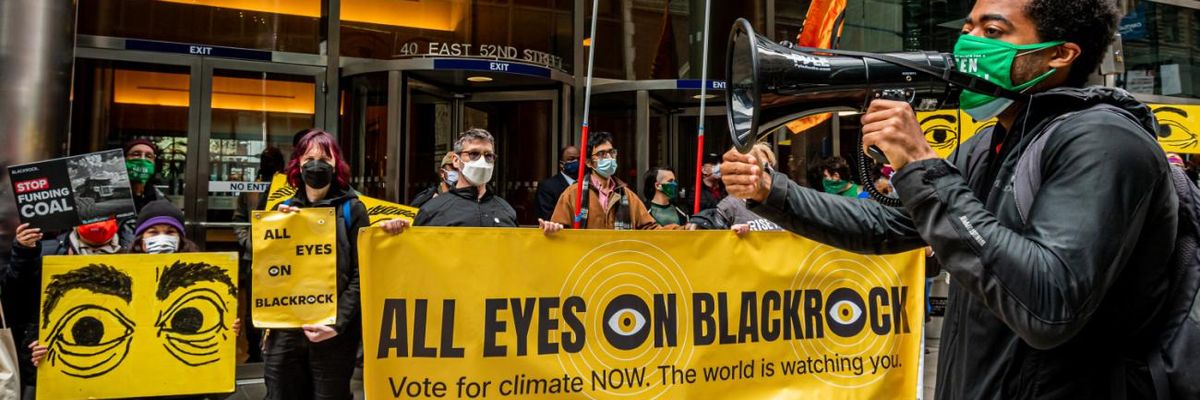
Climate activists protest outside the BlackRock building in midtown Manhattan in April, 2021.
"Private equity firms and their executives are making billions by investing public employees' retirement money into planet-destroying fossil fuel assets," said one researcher.
The energy portfolios of over 20 top U.S. private equity firms are responsible for an estimated combined 1.17 gigatons of annual greenhouse gas emissions—more than three times as much as from the energy used to power every home in the United States, according to a report published Tuesday.
The report, titled Private Equity Risks Scorecard 2024, was published by Researchers for the Americans for Financial Reform Education Fund, Global Energy Monitor, and the Private Equity Stakeholder Project. The scorecard examines the energy portfolios of 21 leading U.S. private equity firms, which manage a combined total of over $6 trillion worth of companies.
"At the end of the day, the price we pay for private equity's greed is our health and livelihoods, for ourselves and generations to come."
"Private equity firms and their executives are making billions by investing public employees' retirement money into planet-destroying fossil fuel assets," Amanda Mendoza, senior climate research and campaign coordinator of the Private Equity Stakeholder Project, said in a statement.
"These billion-dollar companies make their profits while largely avoiding liability for the damages their fossil fuel investing causes frontline communities," Mendoza added. "At the end of the day, the price we pay for private equity's greed is our health and livelihoods, for ourselves and generations to come."
According to the report, the five biggest investors in annual climate polluters are EIG Global Energy Partners, the Carlyle Group/NGP Energy Capital, Brookfield/Oakfield Capital Management, Quantum Capital Group, and BlackRock Private Equity Partners. These five firms each funded at least 100 million metric tons of CO2 equivalent (CO2e) annually.
Some of these companies, most notably BlackRock, rank among the
world's biggest investors in fossil fuels.
"Private equity continues to transform the financial markets and the daily lives of communities around the globe," the report states. "With over a trillion dollars in energy investments generating high greenhouse gas emissions and minimal public visibility, private equity firms play an outsized role in accelerating the climate crisis."
"The private equity energy portfolios covered in this report are responsible for an estimated combined total of 1.17 gigatons of annual emissions," the publication continues. "This figure equals 1.17 billion metric tons CO2 equivalent (CO2e) and is limited to the three categories covered in the scope of this research: upstream, liquefied natural gas terminals, and coal plants, and do not represent the firms' entire emissions footprint from energy investments."
"In the U.S. alone, there were 28 weather and climate disasters in 2023, resulting in at least $92.9 billion in disaster damages, according to the National Centers for Environmental Information," the report notes. "The need for transparency, accountability, and a just transition to a clean energy economy has never been more urgent."
The scorecard's authors and 22 supporting organizations—including Food & Water Watch, Friends of the Earth U.S., Greenpeace USA, LittleSis, Public Citizen, Rainforest Action Network, and Sierra Club—urge sources of capital, such as public pension funds and institutional investors, to commit to a series of climate-friendly policies and practices.
These include:
"While companies like banks and oil majors face pressure over their climate risks and fossil fuel emissions, private equity firms continue to dodge the spotlight, pouring billions into fossil fuels and pushing us further from a sustainable future," said Global Emergy Monitor's Alex Hurley.
"These firms may operate in the shadows, but the public has a right to know how private equity's debt-fueled extraction of both resources and wealth threatens our climate, communities, and financial stability," Hurley added. "We call on private equity firms to adopt climate standards... and retire any fossil fuel assets in their portfolios in short order."
Dear Common Dreams reader, It’s been nearly 30 years since I co-founded Common Dreams with my late wife, Lina Newhouser. We had the radical notion that journalism should serve the public good, not corporate profits. It was clear to us from the outset what it would take to build such a project. No paid advertisements. No corporate sponsors. No millionaire publisher telling us what to think or do. Many people said we wouldn't last a year, but we proved those doubters wrong. Together with a tremendous team of journalists and dedicated staff, we built an independent media outlet free from the constraints of profits and corporate control. Our mission has always been simple: To inform. To inspire. To ignite change for the common good. Building Common Dreams was not easy. Our survival was never guaranteed. When you take on the most powerful forces—Wall Street greed, fossil fuel industry destruction, Big Tech lobbyists, and uber-rich oligarchs who have spent billions upon billions rigging the economy and democracy in their favor—the only bulwark you have is supporters who believe in your work. But here’s the urgent message from me today. It's never been this bad out there. And it's never been this hard to keep us going. At the very moment Common Dreams is most needed, the threats we face are intensifying. We need your support now more than ever. We don't accept corporate advertising and never will. We don't have a paywall because we don't think people should be blocked from critical news based on their ability to pay. Everything we do is funded by the donations of readers like you. When everyone does the little they can afford, we are strong. But if that support retreats or dries up, so do we. Will you donate now to make sure Common Dreams not only survives but thrives? —Craig Brown, Co-founder |
The energy portfolios of over 20 top U.S. private equity firms are responsible for an estimated combined 1.17 gigatons of annual greenhouse gas emissions—more than three times as much as from the energy used to power every home in the United States, according to a report published Tuesday.
The report, titled Private Equity Risks Scorecard 2024, was published by Researchers for the Americans for Financial Reform Education Fund, Global Energy Monitor, and the Private Equity Stakeholder Project. The scorecard examines the energy portfolios of 21 leading U.S. private equity firms, which manage a combined total of over $6 trillion worth of companies.
"At the end of the day, the price we pay for private equity's greed is our health and livelihoods, for ourselves and generations to come."
"Private equity firms and their executives are making billions by investing public employees' retirement money into planet-destroying fossil fuel assets," Amanda Mendoza, senior climate research and campaign coordinator of the Private Equity Stakeholder Project, said in a statement.
"These billion-dollar companies make their profits while largely avoiding liability for the damages their fossil fuel investing causes frontline communities," Mendoza added. "At the end of the day, the price we pay for private equity's greed is our health and livelihoods, for ourselves and generations to come."
According to the report, the five biggest investors in annual climate polluters are EIG Global Energy Partners, the Carlyle Group/NGP Energy Capital, Brookfield/Oakfield Capital Management, Quantum Capital Group, and BlackRock Private Equity Partners. These five firms each funded at least 100 million metric tons of CO2 equivalent (CO2e) annually.
Some of these companies, most notably BlackRock, rank among the
world's biggest investors in fossil fuels.
"Private equity continues to transform the financial markets and the daily lives of communities around the globe," the report states. "With over a trillion dollars in energy investments generating high greenhouse gas emissions and minimal public visibility, private equity firms play an outsized role in accelerating the climate crisis."
"The private equity energy portfolios covered in this report are responsible for an estimated combined total of 1.17 gigatons of annual emissions," the publication continues. "This figure equals 1.17 billion metric tons CO2 equivalent (CO2e) and is limited to the three categories covered in the scope of this research: upstream, liquefied natural gas terminals, and coal plants, and do not represent the firms' entire emissions footprint from energy investments."
"In the U.S. alone, there were 28 weather and climate disasters in 2023, resulting in at least $92.9 billion in disaster damages, according to the National Centers for Environmental Information," the report notes. "The need for transparency, accountability, and a just transition to a clean energy economy has never been more urgent."
The scorecard's authors and 22 supporting organizations—including Food & Water Watch, Friends of the Earth U.S., Greenpeace USA, LittleSis, Public Citizen, Rainforest Action Network, and Sierra Club—urge sources of capital, such as public pension funds and institutional investors, to commit to a series of climate-friendly policies and practices.
These include:
"While companies like banks and oil majors face pressure over their climate risks and fossil fuel emissions, private equity firms continue to dodge the spotlight, pouring billions into fossil fuels and pushing us further from a sustainable future," said Global Emergy Monitor's Alex Hurley.
"These firms may operate in the shadows, but the public has a right to know how private equity's debt-fueled extraction of both resources and wealth threatens our climate, communities, and financial stability," Hurley added. "We call on private equity firms to adopt climate standards... and retire any fossil fuel assets in their portfolios in short order."
The energy portfolios of over 20 top U.S. private equity firms are responsible for an estimated combined 1.17 gigatons of annual greenhouse gas emissions—more than three times as much as from the energy used to power every home in the United States, according to a report published Tuesday.
The report, titled Private Equity Risks Scorecard 2024, was published by Researchers for the Americans for Financial Reform Education Fund, Global Energy Monitor, and the Private Equity Stakeholder Project. The scorecard examines the energy portfolios of 21 leading U.S. private equity firms, which manage a combined total of over $6 trillion worth of companies.
"At the end of the day, the price we pay for private equity's greed is our health and livelihoods, for ourselves and generations to come."
"Private equity firms and their executives are making billions by investing public employees' retirement money into planet-destroying fossil fuel assets," Amanda Mendoza, senior climate research and campaign coordinator of the Private Equity Stakeholder Project, said in a statement.
"These billion-dollar companies make their profits while largely avoiding liability for the damages their fossil fuel investing causes frontline communities," Mendoza added. "At the end of the day, the price we pay for private equity's greed is our health and livelihoods, for ourselves and generations to come."
According to the report, the five biggest investors in annual climate polluters are EIG Global Energy Partners, the Carlyle Group/NGP Energy Capital, Brookfield/Oakfield Capital Management, Quantum Capital Group, and BlackRock Private Equity Partners. These five firms each funded at least 100 million metric tons of CO2 equivalent (CO2e) annually.
Some of these companies, most notably BlackRock, rank among the
world's biggest investors in fossil fuels.
"Private equity continues to transform the financial markets and the daily lives of communities around the globe," the report states. "With over a trillion dollars in energy investments generating high greenhouse gas emissions and minimal public visibility, private equity firms play an outsized role in accelerating the climate crisis."
"The private equity energy portfolios covered in this report are responsible for an estimated combined total of 1.17 gigatons of annual emissions," the publication continues. "This figure equals 1.17 billion metric tons CO2 equivalent (CO2e) and is limited to the three categories covered in the scope of this research: upstream, liquefied natural gas terminals, and coal plants, and do not represent the firms' entire emissions footprint from energy investments."
"In the U.S. alone, there were 28 weather and climate disasters in 2023, resulting in at least $92.9 billion in disaster damages, according to the National Centers for Environmental Information," the report notes. "The need for transparency, accountability, and a just transition to a clean energy economy has never been more urgent."
The scorecard's authors and 22 supporting organizations—including Food & Water Watch, Friends of the Earth U.S., Greenpeace USA, LittleSis, Public Citizen, Rainforest Action Network, and Sierra Club—urge sources of capital, such as public pension funds and institutional investors, to commit to a series of climate-friendly policies and practices.
These include:
"While companies like banks and oil majors face pressure over their climate risks and fossil fuel emissions, private equity firms continue to dodge the spotlight, pouring billions into fossil fuels and pushing us further from a sustainable future," said Global Emergy Monitor's Alex Hurley.
"These firms may operate in the shadows, but the public has a right to know how private equity's debt-fueled extraction of both resources and wealth threatens our climate, communities, and financial stability," Hurley added. "We call on private equity firms to adopt climate standards... and retire any fossil fuel assets in their portfolios in short order."