SUBSCRIBE TO OUR FREE NEWSLETTER
Daily news & progressive opinion—funded by the people, not the corporations—delivered straight to your inbox.
5
#000000
#FFFFFF
To donate by check, phone, or other method, see our More Ways to Give page.
Daily news & progressive opinion—funded by the people, not the corporations—delivered straight to your inbox.
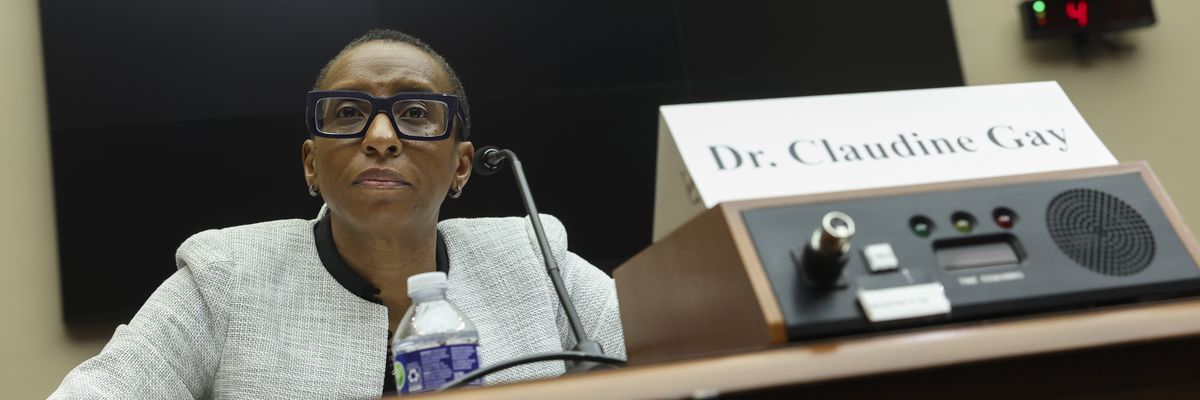
Harvard University president Claudine Gay testifies before the House Education and Workforce Committee at the Rayburn House Office Building on December 5, 2023 in Washington, D.C.
One observer called the resignation "a major victory for reactionary donors and the far-right's campaign to dismantle American higher education."
Republican Rep. Elise Stefanik declared victory Tuesday after Harvard University president Claudine Gay announced her resignation following an aggressive far-right campaign for her ouster.
"TWO DOWN," Stefanik (N.Y.) wrote on social media, referring to the resignations of Gay and former University of Pennsylvania president Liz Magill, who stepped down last month.
"Harvard knows that this long-overdue forced resignation of the antisemitic plagiarist president is just the beginning of what will be the greatest scandal of any college or university in history," Stefanik added.
Pressure on Gay to resign began after a December congressional hearing during which Stefanik questioned Gay, Magill, and other university presidents on whether "calling for the genocide of Jews" violates their institutions' rules prohibiting bullying and harassment.
Gay responded that it "depends on the context" and said, "Antisemitic rhetoric, when it crosses into conduct, it amounts to bullying, harassment, intimidation."
"That is actionable conduct," Gay continued, "and we do take action."
Gay's testimony prompted a firestorm of outrage from Republicans, far-right activists, and a billionaire hedge fund manager. Critics, including the former executive director of Harvard Hillel, have argued that right-wing forces are weaponizing antisemitism in a cynical attempt to further their assault on higher education and provide cover for Israel's war crimes in Gaza.
"This will be used by the very worst people to make higher education worse, not better. It will be used to cut funding, end diversity, stifle academic freedom."
The 13-member Harvard Corporation stood by Gay in the wake of the December congressional hearing, but calls for her resignation continued to grow after the far-right activist Christopher Rufo and conservative news outlets reported and amplified allegations of plagiarism.
"On December 12, in a statement backing Gay as president, the Corporation acknowledged findings of improper citation," The Harvard Crimson, the university's student newspaper, reported last week. "The statement also indicated Gay would make corrections to two articles, which she submitted on December 14. One week later, Harvard announced Gay would also submit corrections to her dissertation."
In her resignation letter, Gay wrote that "it has been distressing to have doubt cast on my commitments to confronting hate and to upholding scholarly rigor—two bedrock values that are fundamental to who I am—and frightening to be subjected to personal attacks and threats fueled by racial animus."
Gay, whose tenure lasted just six months, wrote that she decided to step down "after consultation with members" of the Harvard Corporation.
David Austin Walsh, a historian and postdoctoral associate at the Yale Program for the Study of Antisemitism, wrote in response to the Harvard president's resignation that while he has "no particular love for Claudine Gay... this is a major victory for reactionary donors and the far-right's campaign to dismantle American higher education."
Others echoed that assessment, warning that Gay's decision to resign would embolden the right and have reverberating impacts on U.S. higher education.
"Claudine Gay didn't do herself any favors," wrote Philadelphia Inquirer columnist Will Bunch, "but I'll say what I said when Penn's Magill resigned: This will be used by the very worst people to make higher education worse, not better. It will be used to cut funding, end diversity, stifle academic freedom."
Dear Common Dreams reader, It’s been nearly 30 years since I co-founded Common Dreams with my late wife, Lina Newhouser. We had the radical notion that journalism should serve the public good, not corporate profits. It was clear to us from the outset what it would take to build such a project. No paid advertisements. No corporate sponsors. No millionaire publisher telling us what to think or do. Many people said we wouldn't last a year, but we proved those doubters wrong. Together with a tremendous team of journalists and dedicated staff, we built an independent media outlet free from the constraints of profits and corporate control. Our mission has always been simple: To inform. To inspire. To ignite change for the common good. Building Common Dreams was not easy. Our survival was never guaranteed. When you take on the most powerful forces—Wall Street greed, fossil fuel industry destruction, Big Tech lobbyists, and uber-rich oligarchs who have spent billions upon billions rigging the economy and democracy in their favor—the only bulwark you have is supporters who believe in your work. But here’s the urgent message from me today. It's never been this bad out there. And it's never been this hard to keep us going. At the very moment Common Dreams is most needed, the threats we face are intensifying. We need your support now more than ever. We don't accept corporate advertising and never will. We don't have a paywall because we don't think people should be blocked from critical news based on their ability to pay. Everything we do is funded by the donations of readers like you. When everyone does the little they can afford, we are strong. But if that support retreats or dries up, so do we. Will you donate now to make sure Common Dreams not only survives but thrives? —Craig Brown, Co-founder |
Republican Rep. Elise Stefanik declared victory Tuesday after Harvard University president Claudine Gay announced her resignation following an aggressive far-right campaign for her ouster.
"TWO DOWN," Stefanik (N.Y.) wrote on social media, referring to the resignations of Gay and former University of Pennsylvania president Liz Magill, who stepped down last month.
"Harvard knows that this long-overdue forced resignation of the antisemitic plagiarist president is just the beginning of what will be the greatest scandal of any college or university in history," Stefanik added.
Pressure on Gay to resign began after a December congressional hearing during which Stefanik questioned Gay, Magill, and other university presidents on whether "calling for the genocide of Jews" violates their institutions' rules prohibiting bullying and harassment.
Gay responded that it "depends on the context" and said, "Antisemitic rhetoric, when it crosses into conduct, it amounts to bullying, harassment, intimidation."
"That is actionable conduct," Gay continued, "and we do take action."
Gay's testimony prompted a firestorm of outrage from Republicans, far-right activists, and a billionaire hedge fund manager. Critics, including the former executive director of Harvard Hillel, have argued that right-wing forces are weaponizing antisemitism in a cynical attempt to further their assault on higher education and provide cover for Israel's war crimes in Gaza.
"This will be used by the very worst people to make higher education worse, not better. It will be used to cut funding, end diversity, stifle academic freedom."
The 13-member Harvard Corporation stood by Gay in the wake of the December congressional hearing, but calls for her resignation continued to grow after the far-right activist Christopher Rufo and conservative news outlets reported and amplified allegations of plagiarism.
"On December 12, in a statement backing Gay as president, the Corporation acknowledged findings of improper citation," The Harvard Crimson, the university's student newspaper, reported last week. "The statement also indicated Gay would make corrections to two articles, which she submitted on December 14. One week later, Harvard announced Gay would also submit corrections to her dissertation."
In her resignation letter, Gay wrote that "it has been distressing to have doubt cast on my commitments to confronting hate and to upholding scholarly rigor—two bedrock values that are fundamental to who I am—and frightening to be subjected to personal attacks and threats fueled by racial animus."
Gay, whose tenure lasted just six months, wrote that she decided to step down "after consultation with members" of the Harvard Corporation.
David Austin Walsh, a historian and postdoctoral associate at the Yale Program for the Study of Antisemitism, wrote in response to the Harvard president's resignation that while he has "no particular love for Claudine Gay... this is a major victory for reactionary donors and the far-right's campaign to dismantle American higher education."
Others echoed that assessment, warning that Gay's decision to resign would embolden the right and have reverberating impacts on U.S. higher education.
"Claudine Gay didn't do herself any favors," wrote Philadelphia Inquirer columnist Will Bunch, "but I'll say what I said when Penn's Magill resigned: This will be used by the very worst people to make higher education worse, not better. It will be used to cut funding, end diversity, stifle academic freedom."
Republican Rep. Elise Stefanik declared victory Tuesday after Harvard University president Claudine Gay announced her resignation following an aggressive far-right campaign for her ouster.
"TWO DOWN," Stefanik (N.Y.) wrote on social media, referring to the resignations of Gay and former University of Pennsylvania president Liz Magill, who stepped down last month.
"Harvard knows that this long-overdue forced resignation of the antisemitic plagiarist president is just the beginning of what will be the greatest scandal of any college or university in history," Stefanik added.
Pressure on Gay to resign began after a December congressional hearing during which Stefanik questioned Gay, Magill, and other university presidents on whether "calling for the genocide of Jews" violates their institutions' rules prohibiting bullying and harassment.
Gay responded that it "depends on the context" and said, "Antisemitic rhetoric, when it crosses into conduct, it amounts to bullying, harassment, intimidation."
"That is actionable conduct," Gay continued, "and we do take action."
Gay's testimony prompted a firestorm of outrage from Republicans, far-right activists, and a billionaire hedge fund manager. Critics, including the former executive director of Harvard Hillel, have argued that right-wing forces are weaponizing antisemitism in a cynical attempt to further their assault on higher education and provide cover for Israel's war crimes in Gaza.
"This will be used by the very worst people to make higher education worse, not better. It will be used to cut funding, end diversity, stifle academic freedom."
The 13-member Harvard Corporation stood by Gay in the wake of the December congressional hearing, but calls for her resignation continued to grow after the far-right activist Christopher Rufo and conservative news outlets reported and amplified allegations of plagiarism.
"On December 12, in a statement backing Gay as president, the Corporation acknowledged findings of improper citation," The Harvard Crimson, the university's student newspaper, reported last week. "The statement also indicated Gay would make corrections to two articles, which she submitted on December 14. One week later, Harvard announced Gay would also submit corrections to her dissertation."
In her resignation letter, Gay wrote that "it has been distressing to have doubt cast on my commitments to confronting hate and to upholding scholarly rigor—two bedrock values that are fundamental to who I am—and frightening to be subjected to personal attacks and threats fueled by racial animus."
Gay, whose tenure lasted just six months, wrote that she decided to step down "after consultation with members" of the Harvard Corporation.
David Austin Walsh, a historian and postdoctoral associate at the Yale Program for the Study of Antisemitism, wrote in response to the Harvard president's resignation that while he has "no particular love for Claudine Gay... this is a major victory for reactionary donors and the far-right's campaign to dismantle American higher education."
Others echoed that assessment, warning that Gay's decision to resign would embolden the right and have reverberating impacts on U.S. higher education.
"Claudine Gay didn't do herself any favors," wrote Philadelphia Inquirer columnist Will Bunch, "but I'll say what I said when Penn's Magill resigned: This will be used by the very worst people to make higher education worse, not better. It will be used to cut funding, end diversity, stifle academic freedom."