SUBSCRIBE TO OUR FREE NEWSLETTER
Daily news & progressive opinion—funded by the people, not the corporations—delivered straight to your inbox.
5
#000000
#FFFFFF
To donate by check, phone, or other method, see our More Ways to Give page.
Daily news & progressive opinion—funded by the people, not the corporations—delivered straight to your inbox.
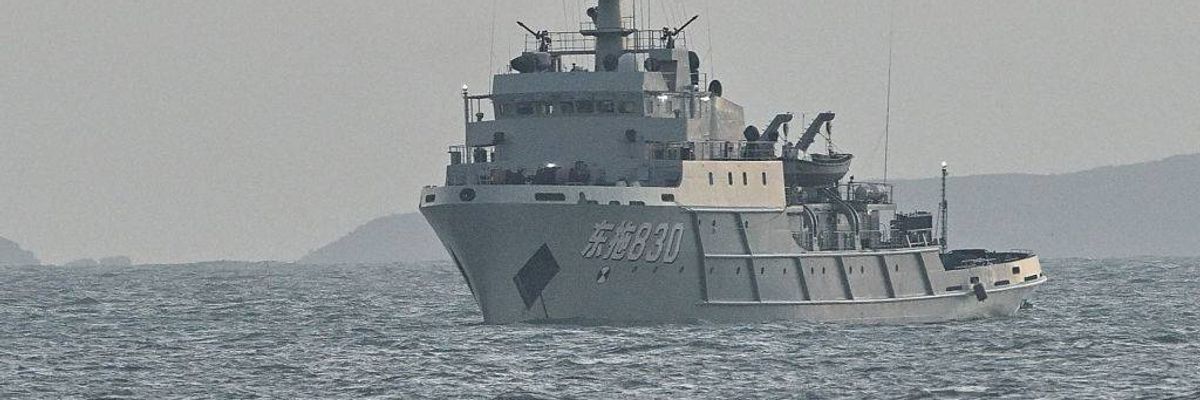
A Chinese ship is seen in waters near Pingtan island, the closest point to Taiwan, in eastern China's Fujian province on December 29, 2025.
The Chinese military drills appear to be "an effort to gain air and maritime superiority and cut off external military support" for Taiwan, said one expert.
The Chinese military on Monday announced it was conducting "major military drills" around Taiwan weeks after the US announced an $11 billion arms deal with the island nation.
As reported by CNN, China is mobilizing its army, navy, and air force units around Taiwan in a move that it says should serve as a "serious warning" to any "external" forces interfering with the island, which China has long claimed as its territory.
Taiwan's government, meanwhile, responded by accusing China of conducting a campaign of "military intimidation," while vowing to "take concrete action to defend the values of democracy and freedom."
Su Tzu-yun, a research fellow at the Institute for National Defense and Security Research in Taipei, told German broadcaster Deutsche Welle that China's military drills appear to be "an effort to gain air and maritime superiority and cut off external military support."
William Yang, a senior Northeast Asia analyst at the International Crisis Group think tank, told DW that while Chinese military exercises around Taiwan are now regular occurrences, the speed with which China ramped up its latest exercises "shows that the Chinese People's Liberation Army is becoming increasingly capable of rapidly deploying forces to combat-ready positions."
Although China did not mention the US directly when denouncing "external" powers, CNN noted that the decision to launch military drills came weeks after the US reached an $11 billion arms deal with Taiwan that included HIMARS rocket systems, anti-tank and anti-armor missiles, drones, howitzers, and military software.
China responded to this arms sale directly last week by announcing sanctions against US defense firms including Boeing, Northrop Grumman Systems Corporation, and L3Harris Maritime Services, according to the Guardian.
In announcing the sanctions against US firms, a Chinese foreign ministry spokesperson emphasized that "the Taiwan issue is the core of China's core interests and the first red line that cannot be crossed in China-US relations," while warning that "any provocative actions that cross the line on the Taiwan issue will be met with a strong response from China."
Dear Common Dreams reader, It’s been nearly 30 years since I co-founded Common Dreams with my late wife, Lina Newhouser. We had the radical notion that journalism should serve the public good, not corporate profits. It was clear to us from the outset what it would take to build such a project. No paid advertisements. No corporate sponsors. No millionaire publisher telling us what to think or do. Many people said we wouldn't last a year, but we proved those doubters wrong. Together with a tremendous team of journalists and dedicated staff, we built an independent media outlet free from the constraints of profits and corporate control. Our mission has always been simple: To inform. To inspire. To ignite change for the common good. Building Common Dreams was not easy. Our survival was never guaranteed. When you take on the most powerful forces—Wall Street greed, fossil fuel industry destruction, Big Tech lobbyists, and uber-rich oligarchs who have spent billions upon billions rigging the economy and democracy in their favor—the only bulwark you have is supporters who believe in your work. But here’s the urgent message from me today. It's never been this bad out there. And it's never been this hard to keep us going. At the very moment Common Dreams is most needed, the threats we face are intensifying. We need your support now more than ever. We don't accept corporate advertising and never will. We don't have a paywall because we don't think people should be blocked from critical news based on their ability to pay. Everything we do is funded by the donations of readers like you. When everyone does the little they can afford, we are strong. But if that support retreats or dries up, so do we. Will you donate now to make sure Common Dreams not only survives but thrives? —Craig Brown, Co-founder |
The Chinese military on Monday announced it was conducting "major military drills" around Taiwan weeks after the US announced an $11 billion arms deal with the island nation.
As reported by CNN, China is mobilizing its army, navy, and air force units around Taiwan in a move that it says should serve as a "serious warning" to any "external" forces interfering with the island, which China has long claimed as its territory.
Taiwan's government, meanwhile, responded by accusing China of conducting a campaign of "military intimidation," while vowing to "take concrete action to defend the values of democracy and freedom."
Su Tzu-yun, a research fellow at the Institute for National Defense and Security Research in Taipei, told German broadcaster Deutsche Welle that China's military drills appear to be "an effort to gain air and maritime superiority and cut off external military support."
William Yang, a senior Northeast Asia analyst at the International Crisis Group think tank, told DW that while Chinese military exercises around Taiwan are now regular occurrences, the speed with which China ramped up its latest exercises "shows that the Chinese People's Liberation Army is becoming increasingly capable of rapidly deploying forces to combat-ready positions."
Although China did not mention the US directly when denouncing "external" powers, CNN noted that the decision to launch military drills came weeks after the US reached an $11 billion arms deal with Taiwan that included HIMARS rocket systems, anti-tank and anti-armor missiles, drones, howitzers, and military software.
China responded to this arms sale directly last week by announcing sanctions against US defense firms including Boeing, Northrop Grumman Systems Corporation, and L3Harris Maritime Services, according to the Guardian.
In announcing the sanctions against US firms, a Chinese foreign ministry spokesperson emphasized that "the Taiwan issue is the core of China's core interests and the first red line that cannot be crossed in China-US relations," while warning that "any provocative actions that cross the line on the Taiwan issue will be met with a strong response from China."
The Chinese military on Monday announced it was conducting "major military drills" around Taiwan weeks after the US announced an $11 billion arms deal with the island nation.
As reported by CNN, China is mobilizing its army, navy, and air force units around Taiwan in a move that it says should serve as a "serious warning" to any "external" forces interfering with the island, which China has long claimed as its territory.
Taiwan's government, meanwhile, responded by accusing China of conducting a campaign of "military intimidation," while vowing to "take concrete action to defend the values of democracy and freedom."
Su Tzu-yun, a research fellow at the Institute for National Defense and Security Research in Taipei, told German broadcaster Deutsche Welle that China's military drills appear to be "an effort to gain air and maritime superiority and cut off external military support."
William Yang, a senior Northeast Asia analyst at the International Crisis Group think tank, told DW that while Chinese military exercises around Taiwan are now regular occurrences, the speed with which China ramped up its latest exercises "shows that the Chinese People's Liberation Army is becoming increasingly capable of rapidly deploying forces to combat-ready positions."
Although China did not mention the US directly when denouncing "external" powers, CNN noted that the decision to launch military drills came weeks after the US reached an $11 billion arms deal with Taiwan that included HIMARS rocket systems, anti-tank and anti-armor missiles, drones, howitzers, and military software.
China responded to this arms sale directly last week by announcing sanctions against US defense firms including Boeing, Northrop Grumman Systems Corporation, and L3Harris Maritime Services, according to the Guardian.
In announcing the sanctions against US firms, a Chinese foreign ministry spokesperson emphasized that "the Taiwan issue is the core of China's core interests and the first red line that cannot be crossed in China-US relations," while warning that "any provocative actions that cross the line on the Taiwan issue will be met with a strong response from China."