SUBSCRIBE TO OUR FREE NEWSLETTER
Daily news & progressive opinion—funded by the people, not the corporations—delivered straight to your inbox.
5
#000000
#FFFFFF
To donate by check, phone, or other method, see our More Ways to Give page.
Daily news & progressive opinion—funded by the people, not the corporations—delivered straight to your inbox.
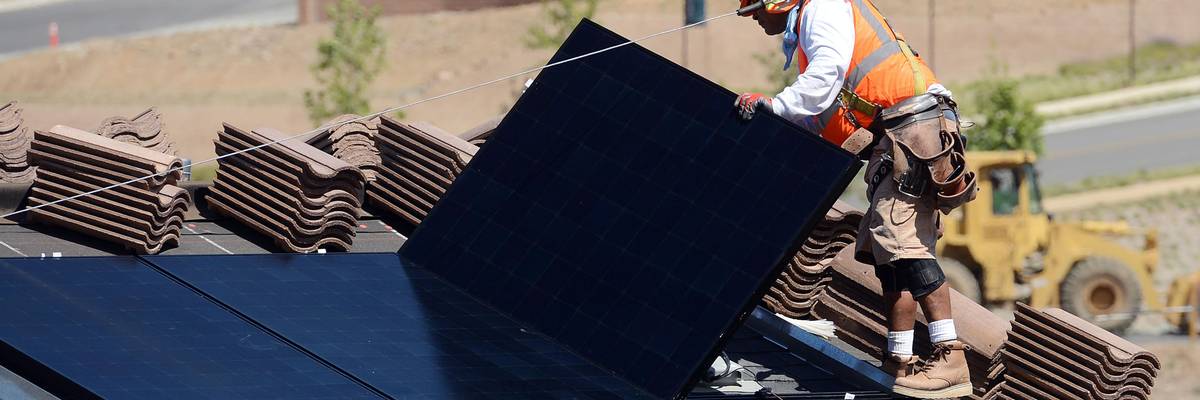
Workers install solar panels on the roofs of homes under construction in Corona, California on May 3, 2018.
New analysis shows how California "can achieve a just and equitable transition away from fossil fuels for oil and gas workers."
A new analysis out Tuesday shows how a just transition towards a green economy in California—one in which workers in the state's fossil fuel industry would be able to find new employment and receive assistance if they're displaced from their jobs—will be "both affordable and achievable," contrary to claims from oil and gas giants and anti-climate lawmakers.
The study published by the Gender Equity Policy Institute (GEPI) notes that a majority of workers in the oil and gas sectors will have numerous new job opportunities as California pushes to become carbon neutral by 2045 with a vow to construct a 100% clean electricity grid and massively reduce oil consumption and production.
"The state will need to modernize its electrical grid and build storage capacity to meet increased demand for electricity," reads the report. "Carbon management techniques, plugging orphan wells, and the development of new energy sources such as geothermal will all come into play, providing economic opportunities to workers and businesses alike."
GEPI analyzed the most recent public labor data, showing that the oil and gas industries in California employed approximately 59,200 people as of 2021 across jobs in production, sales, transportation, legal, and executive departments, among others.
The group examined potential job opportunities for fossil fuel workers "in all growing occupations, not solely in clean energy or green jobs," and found that about two-thirds of employees are likely to find promising opportunities outside of fossil fuel-related work.
"Our findings show that a sizable majority (56%) of current oil and gas workers are highly likely to find jobs in California in another industry in their current occupation, given demand in the broader California economy for workers with their existing skills," the report says.
Roughly a quarter of oil and gas workers are employed in jobs that are projected to decline over the next decade, while 18% work in production and extraction, sectors which will contract as the state begins to move away from fossil fuel extraction.
"For all declining occupations in oil and gas industries, there are available jobs in similar occupations in California that would allow workers to transition without the need for retraining," GEPI reported.
About 16,100 people who will be at risk of displacement into lower-paying jobs over the next two decades will be able to benefit from income subsidies and relocation assistance, which GEPI estimated would cost the state $68.9 million or less annually—far less than a 2021 estimate by the Department of Economics and Political Economy Research Institute (PERI) at the University of Massachusetts-Amherst, which said aid for displaced oil and gas workers would cost up to $830 million per year. Importantly, PERI's estimate included pension guarantees and income-level guarantees while GEPI's factored in only financial aid for people who face pay cuts.
GEPI's study showed that "California can achieve a just and equitable transition away from fossil fuels for oil and gas workers," said the Los Angeles-based advocacy group Climate Resolve.
"As the carbon neutral economy advances, supporting workers at risk of displacement from jobs in oil and gas industries is one important component of creating an equitable and sustainable future for all the people of California," reads GEPI's report. "These men and women are expected to be able to transition with ease to other industries without retraining or a period of unemployment."
Dear Common Dreams reader, It’s been nearly 30 years since I co-founded Common Dreams with my late wife, Lina Newhouser. We had the radical notion that journalism should serve the public good, not corporate profits. It was clear to us from the outset what it would take to build such a project. No paid advertisements. No corporate sponsors. No millionaire publisher telling us what to think or do. Many people said we wouldn't last a year, but we proved those doubters wrong. Together with a tremendous team of journalists and dedicated staff, we built an independent media outlet free from the constraints of profits and corporate control. Our mission has always been simple: To inform. To inspire. To ignite change for the common good. Building Common Dreams was not easy. Our survival was never guaranteed. When you take on the most powerful forces—Wall Street greed, fossil fuel industry destruction, Big Tech lobbyists, and uber-rich oligarchs who have spent billions upon billions rigging the economy and democracy in their favor—the only bulwark you have is supporters who believe in your work. But here’s the urgent message from me today. It's never been this bad out there. And it's never been this hard to keep us going. At the very moment Common Dreams is most needed, the threats we face are intensifying. We need your support now more than ever. We don't accept corporate advertising and never will. We don't have a paywall because we don't think people should be blocked from critical news based on their ability to pay. Everything we do is funded by the donations of readers like you. When everyone does the little they can afford, we are strong. But if that support retreats or dries up, so do we. Will you donate now to make sure Common Dreams not only survives but thrives? —Craig Brown, Co-founder |
A new analysis out Tuesday shows how a just transition towards a green economy in California—one in which workers in the state's fossil fuel industry would be able to find new employment and receive assistance if they're displaced from their jobs—will be "both affordable and achievable," contrary to claims from oil and gas giants and anti-climate lawmakers.
The study published by the Gender Equity Policy Institute (GEPI) notes that a majority of workers in the oil and gas sectors will have numerous new job opportunities as California pushes to become carbon neutral by 2045 with a vow to construct a 100% clean electricity grid and massively reduce oil consumption and production.
"The state will need to modernize its electrical grid and build storage capacity to meet increased demand for electricity," reads the report. "Carbon management techniques, plugging orphan wells, and the development of new energy sources such as geothermal will all come into play, providing economic opportunities to workers and businesses alike."
GEPI analyzed the most recent public labor data, showing that the oil and gas industries in California employed approximately 59,200 people as of 2021 across jobs in production, sales, transportation, legal, and executive departments, among others.
The group examined potential job opportunities for fossil fuel workers "in all growing occupations, not solely in clean energy or green jobs," and found that about two-thirds of employees are likely to find promising opportunities outside of fossil fuel-related work.
"Our findings show that a sizable majority (56%) of current oil and gas workers are highly likely to find jobs in California in another industry in their current occupation, given demand in the broader California economy for workers with their existing skills," the report says.
Roughly a quarter of oil and gas workers are employed in jobs that are projected to decline over the next decade, while 18% work in production and extraction, sectors which will contract as the state begins to move away from fossil fuel extraction.
"For all declining occupations in oil and gas industries, there are available jobs in similar occupations in California that would allow workers to transition without the need for retraining," GEPI reported.
About 16,100 people who will be at risk of displacement into lower-paying jobs over the next two decades will be able to benefit from income subsidies and relocation assistance, which GEPI estimated would cost the state $68.9 million or less annually—far less than a 2021 estimate by the Department of Economics and Political Economy Research Institute (PERI) at the University of Massachusetts-Amherst, which said aid for displaced oil and gas workers would cost up to $830 million per year. Importantly, PERI's estimate included pension guarantees and income-level guarantees while GEPI's factored in only financial aid for people who face pay cuts.
GEPI's study showed that "California can achieve a just and equitable transition away from fossil fuels for oil and gas workers," said the Los Angeles-based advocacy group Climate Resolve.
"As the carbon neutral economy advances, supporting workers at risk of displacement from jobs in oil and gas industries is one important component of creating an equitable and sustainable future for all the people of California," reads GEPI's report. "These men and women are expected to be able to transition with ease to other industries without retraining or a period of unemployment."
A new analysis out Tuesday shows how a just transition towards a green economy in California—one in which workers in the state's fossil fuel industry would be able to find new employment and receive assistance if they're displaced from their jobs—will be "both affordable and achievable," contrary to claims from oil and gas giants and anti-climate lawmakers.
The study published by the Gender Equity Policy Institute (GEPI) notes that a majority of workers in the oil and gas sectors will have numerous new job opportunities as California pushes to become carbon neutral by 2045 with a vow to construct a 100% clean electricity grid and massively reduce oil consumption and production.
"The state will need to modernize its electrical grid and build storage capacity to meet increased demand for electricity," reads the report. "Carbon management techniques, plugging orphan wells, and the development of new energy sources such as geothermal will all come into play, providing economic opportunities to workers and businesses alike."
GEPI analyzed the most recent public labor data, showing that the oil and gas industries in California employed approximately 59,200 people as of 2021 across jobs in production, sales, transportation, legal, and executive departments, among others.
The group examined potential job opportunities for fossil fuel workers "in all growing occupations, not solely in clean energy or green jobs," and found that about two-thirds of employees are likely to find promising opportunities outside of fossil fuel-related work.
"Our findings show that a sizable majority (56%) of current oil and gas workers are highly likely to find jobs in California in another industry in their current occupation, given demand in the broader California economy for workers with their existing skills," the report says.
Roughly a quarter of oil and gas workers are employed in jobs that are projected to decline over the next decade, while 18% work in production and extraction, sectors which will contract as the state begins to move away from fossil fuel extraction.
"For all declining occupations in oil and gas industries, there are available jobs in similar occupations in California that would allow workers to transition without the need for retraining," GEPI reported.
About 16,100 people who will be at risk of displacement into lower-paying jobs over the next two decades will be able to benefit from income subsidies and relocation assistance, which GEPI estimated would cost the state $68.9 million or less annually—far less than a 2021 estimate by the Department of Economics and Political Economy Research Institute (PERI) at the University of Massachusetts-Amherst, which said aid for displaced oil and gas workers would cost up to $830 million per year. Importantly, PERI's estimate included pension guarantees and income-level guarantees while GEPI's factored in only financial aid for people who face pay cuts.
GEPI's study showed that "California can achieve a just and equitable transition away from fossil fuels for oil and gas workers," said the Los Angeles-based advocacy group Climate Resolve.
"As the carbon neutral economy advances, supporting workers at risk of displacement from jobs in oil and gas industries is one important component of creating an equitable and sustainable future for all the people of California," reads GEPI's report. "These men and women are expected to be able to transition with ease to other industries without retraining or a period of unemployment."