SUBSCRIBE TO OUR FREE NEWSLETTER
Daily news & progressive opinion—funded by the people, not the corporations—delivered straight to your inbox.
5
#000000
#FFFFFF
To donate by check, phone, or other method, see our More Ways to Give page.
Daily news & progressive opinion—funded by the people, not the corporations—delivered straight to your inbox.
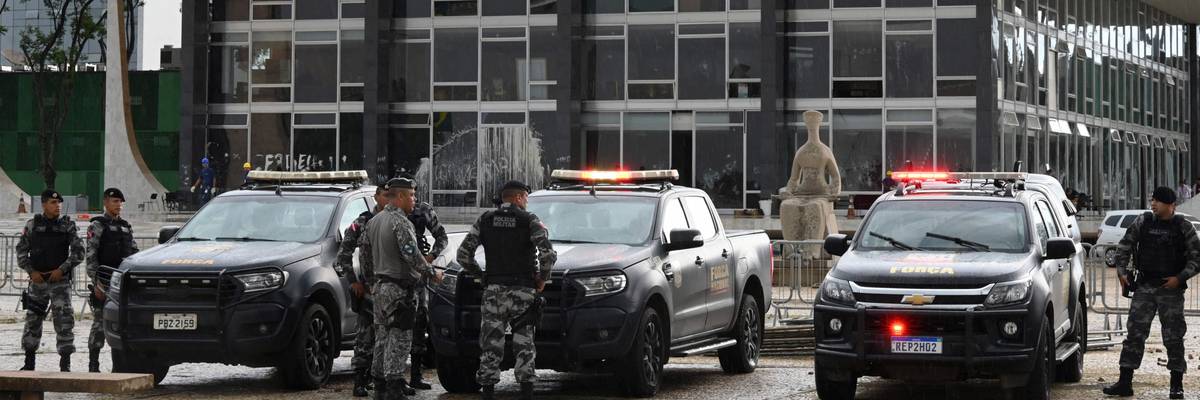
Brazilian police officers stand guard outside the presidential palace in Brasília on January 11, 2023.
"Brazilian democracy will not be struck, much less destroyed, by terrorist criminals," Supreme Court Justice Alexandre de Moraes declared Tuesday.
Brazilian authorities on Tuesday issued arrest warrants for a pair of government security officials, focused attention on people accused of bankrolling Sunday's anti-democratic assault, and asked a federal court to freeze the assets of far-right former President Jair Bolsonaro, who remains in Florida—escalating the crackdown on suspected participants in and supporters of the January 8 coup attempt against recently inaugurated leftist President Luiz Inácio Lula da Silva.
"The moves showed that, a day after arresting hundreds of people suspected of taking part in Sunday’s riot in Brazil's capital, Brasília, the nation's top officials have now turned their focus to the political and business elites suspected of inspiring, organizing, or aiding the rioters," The New York Times reported.
In response to requests from the federal police, Brazilian Supreme Court Justice Alexandre de Moraes issued warrants for Anderson Torres—a Bolsonaro ally who served as the ex-president's justice minister from 2021 to 2022 before reprising his previous position as security chief of the Federal District, a small province that includes Brasília, on January 2—and Federal District police chief Fabio Augusto Vieira.
"Brazilian democracy will not be struck, much less destroyed, by terrorist criminals," Moraes wrote in his decision.
The judge's intervention came after thousands of democracy defenders took to the streets of Rio de Janeiro and São Paulo on Monday night to demand jail time for insurrectionists and those who aided and abetted their attack. It also came as Lula's government braces for the potential of more anti-democratic violence on Wednesday, with pro-Bolsonaro social media accounts calling for mass demonstrations to "retake power."
In preparation, Reuters reported Wednesday, Moraes "issued a ban on roadblocks that have been used by anti-government demonstrators to create economic disruption and ordered local authorities to prevent the storming of public buildings."
When election-denying Bolsonaristas ransacked Brazil's presidential palace, Congress, and Supreme Court in Brasília on Sunday, Torres, the person tasked with keeping the city safe, "was a continent away in Florida—the same state his ex-boss... had relocated to after losing last year's election," Reuters noted.
The right-wing mob invaded Brazil's main government buildings under the false pretense that Bolsonaro's loss in October's election was the result of widespread fraud—a mistaken belief fueled by years of Bolsonaro and his allies' baseless attacks on the integrity of the country's election infrastructure, disinformation that spread rapidly on social media.
Torres played a key role in promoting Bolsonaro's officially debunked lies about the rigging of electronic voting machines. During his stint as justice minister, Torres also tapped Silvinei Vasques, an ardent Bolsonaro backer, to head the federal highway police. Vasques was charged in November and dismissed last month for suppressing the vote by authorizing road blockades in northeastern Brazil, a heavily pro-Lula region, during the election.
Torres lasted less than a week in his new role as Brasília's security chief. As Reuters noted, "Ibaneis Rocha, the governor of the Federal District, sacked Torres amid the chaos on Sunday afternoon, just hours before a Supreme Court order suspended Rocha from office for 90 days."
Ricardo Cappelli, appointed by Lula to lead the federal government's post-invasion takeover of Brasília's public security, told CNN Brasil that Sunday's attack "was a structured sabotage operation, commanded by Bolsonaro's ex-minister Anderson Torres."
"Torres took over as secretary for security (in Brasília), dismissed the whole chain of command, and then took a trip," said Cappelli. "If that's not sabotage, I don't know what is."
According to Moraes, who is also Brazil's elections chief, investigators have "evidence that the officials knew violence was brewing but did nothing to stop it," the Times reported. "He said that they were under investigation for terrorism, criminal association, and offenses related to the violent overthrow of democracy."
Brazil's solicitor general also issued a request for Torres' arrest, and another top federal prosecutor asked to freeze the assets of Torres and Rocha.
Torres said Tuesday on social media that he would cut his vacation short and return to Brazil to defend himself, tweeting: “I have always guided my actions with ethics and legality. I believe in the Brazilian justice system and in the strength of the institutions. I am certain that the truth will prevail."
Also on Tuesday, "a top public prosecutor asked a federal court to freeze the assets of Mr. Bolsonaro in relation to the investigation into the riots," the Times reported. The request "is now in the hands of a judge, but it is unclear whether the court has the legal power to block his accounts. And freezing assets, even if it were not challenged in court, could prove a lengthy and complex process."
In addition, authorities are "expected to take action against more than 100 companies thought to have helped the protesters, including many believed to have transported rioters to the capital or to have provided them with free food and shelter," the newspaper noted.
Per the Times:
Brazil's new justice minister, Flávio Dino, said government investigators had zeroed in on companies in at least 10 states that were suspected of having helped finance the riots. Authorities were seeking arrest warrants for "people who did not come to Brasília, but who participated in the crime, who are organizers, financiers," Mr. Dino said on Tuesday.
Both Mr. Dino and President Luiz Inácio Lula da Silva have said that they believe prominent players in the country’s powerful agriculture industry, which largely backed Mr. Bolsonaro in the election, played a role.
"These people were there today, the agribusiness," Mr. Lula said after the attacks, adding that "all these people will be investigated, found out, and will be punished."
Many Bolsonaristas spent weeks after the October 30 runoff calling for the armed forces to intervene to keep Bolsonaro—a vocal admirer of Brazil's former U.S.-backed military dictatorship, in which he served as an army officer—in power.
Bolsonaro, meanwhile, decamped to Orlando two days before Lula's January 1 inauguration. Numerous Democratic lawmakers have called on the U.S. to stop providing refuge to Brazil's former president in Florida.
Sen. Tim Kaine (D-Va.), head of the Senate Foreign Relations Committee's Western Hemisphere panel, said Tuesday that the U.S. should comply if Lula's administration requests Bolsonaro's extradition.
Dear Common Dreams reader, It’s been nearly 30 years since I co-founded Common Dreams with my late wife, Lina Newhouser. We had the radical notion that journalism should serve the public good, not corporate profits. It was clear to us from the outset what it would take to build such a project. No paid advertisements. No corporate sponsors. No millionaire publisher telling us what to think or do. Many people said we wouldn't last a year, but we proved those doubters wrong. Together with a tremendous team of journalists and dedicated staff, we built an independent media outlet free from the constraints of profits and corporate control. Our mission has always been simple: To inform. To inspire. To ignite change for the common good. Building Common Dreams was not easy. Our survival was never guaranteed. When you take on the most powerful forces—Wall Street greed, fossil fuel industry destruction, Big Tech lobbyists, and uber-rich oligarchs who have spent billions upon billions rigging the economy and democracy in their favor—the only bulwark you have is supporters who believe in your work. But here’s the urgent message from me today. It's never been this bad out there. And it's never been this hard to keep us going. At the very moment Common Dreams is most needed, the threats we face are intensifying. We need your support now more than ever. We don't accept corporate advertising and never will. We don't have a paywall because we don't think people should be blocked from critical news based on their ability to pay. Everything we do is funded by the donations of readers like you. When everyone does the little they can afford, we are strong. But if that support retreats or dries up, so do we. Will you donate now to make sure Common Dreams not only survives but thrives? —Craig Brown, Co-founder |
Brazilian authorities on Tuesday issued arrest warrants for a pair of government security officials, focused attention on people accused of bankrolling Sunday's anti-democratic assault, and asked a federal court to freeze the assets of far-right former President Jair Bolsonaro, who remains in Florida—escalating the crackdown on suspected participants in and supporters of the January 8 coup attempt against recently inaugurated leftist President Luiz Inácio Lula da Silva.
"The moves showed that, a day after arresting hundreds of people suspected of taking part in Sunday’s riot in Brazil's capital, Brasília, the nation's top officials have now turned their focus to the political and business elites suspected of inspiring, organizing, or aiding the rioters," The New York Times reported.
In response to requests from the federal police, Brazilian Supreme Court Justice Alexandre de Moraes issued warrants for Anderson Torres—a Bolsonaro ally who served as the ex-president's justice minister from 2021 to 2022 before reprising his previous position as security chief of the Federal District, a small province that includes Brasília, on January 2—and Federal District police chief Fabio Augusto Vieira.
"Brazilian democracy will not be struck, much less destroyed, by terrorist criminals," Moraes wrote in his decision.
The judge's intervention came after thousands of democracy defenders took to the streets of Rio de Janeiro and São Paulo on Monday night to demand jail time for insurrectionists and those who aided and abetted their attack. It also came as Lula's government braces for the potential of more anti-democratic violence on Wednesday, with pro-Bolsonaro social media accounts calling for mass demonstrations to "retake power."
In preparation, Reuters reported Wednesday, Moraes "issued a ban on roadblocks that have been used by anti-government demonstrators to create economic disruption and ordered local authorities to prevent the storming of public buildings."
When election-denying Bolsonaristas ransacked Brazil's presidential palace, Congress, and Supreme Court in Brasília on Sunday, Torres, the person tasked with keeping the city safe, "was a continent away in Florida—the same state his ex-boss... had relocated to after losing last year's election," Reuters noted.
The right-wing mob invaded Brazil's main government buildings under the false pretense that Bolsonaro's loss in October's election was the result of widespread fraud—a mistaken belief fueled by years of Bolsonaro and his allies' baseless attacks on the integrity of the country's election infrastructure, disinformation that spread rapidly on social media.
Torres played a key role in promoting Bolsonaro's officially debunked lies about the rigging of electronic voting machines. During his stint as justice minister, Torres also tapped Silvinei Vasques, an ardent Bolsonaro backer, to head the federal highway police. Vasques was charged in November and dismissed last month for suppressing the vote by authorizing road blockades in northeastern Brazil, a heavily pro-Lula region, during the election.
Torres lasted less than a week in his new role as Brasília's security chief. As Reuters noted, "Ibaneis Rocha, the governor of the Federal District, sacked Torres amid the chaos on Sunday afternoon, just hours before a Supreme Court order suspended Rocha from office for 90 days."
Ricardo Cappelli, appointed by Lula to lead the federal government's post-invasion takeover of Brasília's public security, told CNN Brasil that Sunday's attack "was a structured sabotage operation, commanded by Bolsonaro's ex-minister Anderson Torres."
"Torres took over as secretary for security (in Brasília), dismissed the whole chain of command, and then took a trip," said Cappelli. "If that's not sabotage, I don't know what is."
According to Moraes, who is also Brazil's elections chief, investigators have "evidence that the officials knew violence was brewing but did nothing to stop it," the Times reported. "He said that they were under investigation for terrorism, criminal association, and offenses related to the violent overthrow of democracy."
Brazil's solicitor general also issued a request for Torres' arrest, and another top federal prosecutor asked to freeze the assets of Torres and Rocha.
Torres said Tuesday on social media that he would cut his vacation short and return to Brazil to defend himself, tweeting: “I have always guided my actions with ethics and legality. I believe in the Brazilian justice system and in the strength of the institutions. I am certain that the truth will prevail."
Also on Tuesday, "a top public prosecutor asked a federal court to freeze the assets of Mr. Bolsonaro in relation to the investigation into the riots," the Times reported. The request "is now in the hands of a judge, but it is unclear whether the court has the legal power to block his accounts. And freezing assets, even if it were not challenged in court, could prove a lengthy and complex process."
In addition, authorities are "expected to take action against more than 100 companies thought to have helped the protesters, including many believed to have transported rioters to the capital or to have provided them with free food and shelter," the newspaper noted.
Per the Times:
Brazil's new justice minister, Flávio Dino, said government investigators had zeroed in on companies in at least 10 states that were suspected of having helped finance the riots. Authorities were seeking arrest warrants for "people who did not come to Brasília, but who participated in the crime, who are organizers, financiers," Mr. Dino said on Tuesday.
Both Mr. Dino and President Luiz Inácio Lula da Silva have said that they believe prominent players in the country’s powerful agriculture industry, which largely backed Mr. Bolsonaro in the election, played a role.
"These people were there today, the agribusiness," Mr. Lula said after the attacks, adding that "all these people will be investigated, found out, and will be punished."
Many Bolsonaristas spent weeks after the October 30 runoff calling for the armed forces to intervene to keep Bolsonaro—a vocal admirer of Brazil's former U.S.-backed military dictatorship, in which he served as an army officer—in power.
Bolsonaro, meanwhile, decamped to Orlando two days before Lula's January 1 inauguration. Numerous Democratic lawmakers have called on the U.S. to stop providing refuge to Brazil's former president in Florida.
Sen. Tim Kaine (D-Va.), head of the Senate Foreign Relations Committee's Western Hemisphere panel, said Tuesday that the U.S. should comply if Lula's administration requests Bolsonaro's extradition.
Brazilian authorities on Tuesday issued arrest warrants for a pair of government security officials, focused attention on people accused of bankrolling Sunday's anti-democratic assault, and asked a federal court to freeze the assets of far-right former President Jair Bolsonaro, who remains in Florida—escalating the crackdown on suspected participants in and supporters of the January 8 coup attempt against recently inaugurated leftist President Luiz Inácio Lula da Silva.
"The moves showed that, a day after arresting hundreds of people suspected of taking part in Sunday’s riot in Brazil's capital, Brasília, the nation's top officials have now turned their focus to the political and business elites suspected of inspiring, organizing, or aiding the rioters," The New York Times reported.
In response to requests from the federal police, Brazilian Supreme Court Justice Alexandre de Moraes issued warrants for Anderson Torres—a Bolsonaro ally who served as the ex-president's justice minister from 2021 to 2022 before reprising his previous position as security chief of the Federal District, a small province that includes Brasília, on January 2—and Federal District police chief Fabio Augusto Vieira.
"Brazilian democracy will not be struck, much less destroyed, by terrorist criminals," Moraes wrote in his decision.
The judge's intervention came after thousands of democracy defenders took to the streets of Rio de Janeiro and São Paulo on Monday night to demand jail time for insurrectionists and those who aided and abetted their attack. It also came as Lula's government braces for the potential of more anti-democratic violence on Wednesday, with pro-Bolsonaro social media accounts calling for mass demonstrations to "retake power."
In preparation, Reuters reported Wednesday, Moraes "issued a ban on roadblocks that have been used by anti-government demonstrators to create economic disruption and ordered local authorities to prevent the storming of public buildings."
When election-denying Bolsonaristas ransacked Brazil's presidential palace, Congress, and Supreme Court in Brasília on Sunday, Torres, the person tasked with keeping the city safe, "was a continent away in Florida—the same state his ex-boss... had relocated to after losing last year's election," Reuters noted.
The right-wing mob invaded Brazil's main government buildings under the false pretense that Bolsonaro's loss in October's election was the result of widespread fraud—a mistaken belief fueled by years of Bolsonaro and his allies' baseless attacks on the integrity of the country's election infrastructure, disinformation that spread rapidly on social media.
Torres played a key role in promoting Bolsonaro's officially debunked lies about the rigging of electronic voting machines. During his stint as justice minister, Torres also tapped Silvinei Vasques, an ardent Bolsonaro backer, to head the federal highway police. Vasques was charged in November and dismissed last month for suppressing the vote by authorizing road blockades in northeastern Brazil, a heavily pro-Lula region, during the election.
Torres lasted less than a week in his new role as Brasília's security chief. As Reuters noted, "Ibaneis Rocha, the governor of the Federal District, sacked Torres amid the chaos on Sunday afternoon, just hours before a Supreme Court order suspended Rocha from office for 90 days."
Ricardo Cappelli, appointed by Lula to lead the federal government's post-invasion takeover of Brasília's public security, told CNN Brasil that Sunday's attack "was a structured sabotage operation, commanded by Bolsonaro's ex-minister Anderson Torres."
"Torres took over as secretary for security (in Brasília), dismissed the whole chain of command, and then took a trip," said Cappelli. "If that's not sabotage, I don't know what is."
According to Moraes, who is also Brazil's elections chief, investigators have "evidence that the officials knew violence was brewing but did nothing to stop it," the Times reported. "He said that they were under investigation for terrorism, criminal association, and offenses related to the violent overthrow of democracy."
Brazil's solicitor general also issued a request for Torres' arrest, and another top federal prosecutor asked to freeze the assets of Torres and Rocha.
Torres said Tuesday on social media that he would cut his vacation short and return to Brazil to defend himself, tweeting: “I have always guided my actions with ethics and legality. I believe in the Brazilian justice system and in the strength of the institutions. I am certain that the truth will prevail."
Also on Tuesday, "a top public prosecutor asked a federal court to freeze the assets of Mr. Bolsonaro in relation to the investigation into the riots," the Times reported. The request "is now in the hands of a judge, but it is unclear whether the court has the legal power to block his accounts. And freezing assets, even if it were not challenged in court, could prove a lengthy and complex process."
In addition, authorities are "expected to take action against more than 100 companies thought to have helped the protesters, including many believed to have transported rioters to the capital or to have provided them with free food and shelter," the newspaper noted.
Per the Times:
Brazil's new justice minister, Flávio Dino, said government investigators had zeroed in on companies in at least 10 states that were suspected of having helped finance the riots. Authorities were seeking arrest warrants for "people who did not come to Brasília, but who participated in the crime, who are organizers, financiers," Mr. Dino said on Tuesday.
Both Mr. Dino and President Luiz Inácio Lula da Silva have said that they believe prominent players in the country’s powerful agriculture industry, which largely backed Mr. Bolsonaro in the election, played a role.
"These people were there today, the agribusiness," Mr. Lula said after the attacks, adding that "all these people will be investigated, found out, and will be punished."
Many Bolsonaristas spent weeks after the October 30 runoff calling for the armed forces to intervene to keep Bolsonaro—a vocal admirer of Brazil's former U.S.-backed military dictatorship, in which he served as an army officer—in power.
Bolsonaro, meanwhile, decamped to Orlando two days before Lula's January 1 inauguration. Numerous Democratic lawmakers have called on the U.S. to stop providing refuge to Brazil's former president in Florida.
Sen. Tim Kaine (D-Va.), head of the Senate Foreign Relations Committee's Western Hemisphere panel, said Tuesday that the U.S. should comply if Lula's administration requests Bolsonaro's extradition.