

SUBSCRIBE TO OUR FREE NEWSLETTER
Daily news & progressive opinion—funded by the people, not the corporations—delivered straight to your inbox.
5
#000000
#FFFFFF
To donate by check, phone, or other method, see our More Ways to Give page.
Daily news & progressive opinion—funded by the people, not the corporations—delivered straight to your inbox.
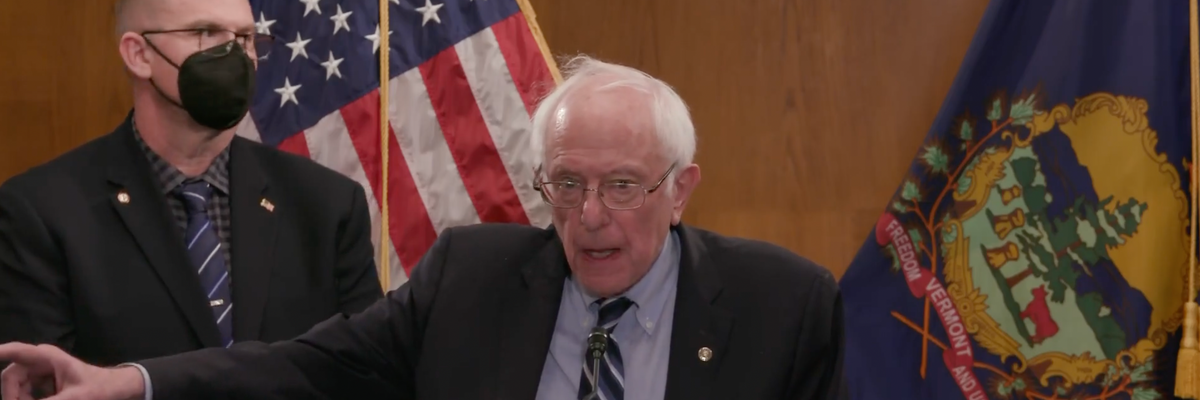
Sen. Bernie Sanders speaks at a press conference with railroad workers, calling for paid sick leave, on February 9 2023.
"The industry can and must guarantee at least seven paid sick days to every rail worker in America," said the Vermont senator in renewed push.
A day after sustained pressure from labor advocates resulted in an historic paid leave deal between one freight rail company and two unions representing thousands of its workers, U.S. Sen. Bernie Sanders on Thursday launched a renewed push for at least seven days of paid sick leave for all railroad employees in the United States, noting that the industry can easily afford to reform its stringent attendance policies.
"At a time of record-breaking profits, the industry can and must guarantee at least seven paid sick days to every rail worker in America," said the Vermont Independent senator. "In the year 2023 that is not a whole lot to ask."
Sanders noted that rail companies have recently posted record earnings for 2022, with the largest corporations reporting more than $26 billion in profits.
Late last month, Union Pacific—which defeated labor unions and progressive advocates in labor negotiations late last year, avoiding a contract that would have included paid sick leave for workers—reported $7 billion in income. It spent $6.3 billion on stock buybacks and just $4.6 billion on employee pay and benefits.
Rail giants "are doing extremely well," said Sanders, who chairs the Senate Health, Education, Labor, and Pension (HELP) Committee. "And what did they do with those record-breaking profits? Did they spend it on making the rail industry safer?... Did they spend that money on improving the horrendous working conditions that exist today in the rail industry?"
"No, they didn't do that," the senator continued. "They spent over $20 billion of their profits on stock buybacks and dividends to make their wealthy shareholders even wealthier."
Sanders added that seven guaranteed paid sick days would cost the rail industry just $321 million annually—less than 1.2% of its profits.
The senator led an effort late last year to pass an amendment to guarantee paid sick leave for workers, as Congress and the Biden administration got involved in contract negotiations to avoid a rail strike. The amendment won the support of every Senate Democrat except for Sen. Joe Manchin (D-W.Va.), and six Republicans joined them in backing the proposal, which failed to pass. Congress then voted to compel four rail unions to accept a contract without paid sick days.
At Thursday's press conference, Sanders was joined by representatives from rail unions including SMART-TD, the Brotherhood of Locomotive Engineers and Trainmen, and the Brotherhood of Maintenance of Way Employes, who applauded his efforts to ensure fair working conditions.
The lack of paid sick leave "puts an engineer and a conductor in a hard spot because when they get sick they have to make a hard decision on showing up to work not well-rested, distracted, getting on a train with 10,000 tons, possibly some seriously hazardous materials on board... or you can face the wrath of the attendance policy," said Adam West, a conductor with CSX Transportation. "If you're at the end of the attendance policy, you're not going to get to the doctor's appointment, your'e not gong to get to the dentist, and you're not going to get the preventative care that you need to stay healthy."
Sanders said that if railroad executives "do not come to the table and negotiate an acceptable agreement with the unions," he will use his authority as chairman of the HELP Committee to call on them to testify at hearings, adding "we certainly will bring legislation to the floor."
"People across the country are seeing the reality of what these workers are going through, and the American people are behind these workers overwhelmingly," he said.
Dear Common Dreams reader, It’s been nearly 30 years since I co-founded Common Dreams with my late wife, Lina Newhouser. We had the radical notion that journalism should serve the public good, not corporate profits. It was clear to us from the outset what it would take to build such a project. No paid advertisements. No corporate sponsors. No millionaire publisher telling us what to think or do. Many people said we wouldn't last a year, but we proved those doubters wrong. Together with a tremendous team of journalists and dedicated staff, we built an independent media outlet free from the constraints of profits and corporate control. Our mission has always been simple: To inform. To inspire. To ignite change for the common good. Building Common Dreams was not easy. Our survival was never guaranteed. When you take on the most powerful forces—Wall Street greed, fossil fuel industry destruction, Big Tech lobbyists, and uber-rich oligarchs who have spent billions upon billions rigging the economy and democracy in their favor—the only bulwark you have is supporters who believe in your work. But here’s the urgent message from me today. It's never been this bad out there. And it's never been this hard to keep us going. At the very moment Common Dreams is most needed, the threats we face are intensifying. We need your support now more than ever. We don't accept corporate advertising and never will. We don't have a paywall because we don't think people should be blocked from critical news based on their ability to pay. Everything we do is funded by the donations of readers like you. When everyone does the little they can afford, we are strong. But if that support retreats or dries up, so do we. Will you donate now to make sure Common Dreams not only survives but thrives? —Craig Brown, Co-founder |
A day after sustained pressure from labor advocates resulted in an historic paid leave deal between one freight rail company and two unions representing thousands of its workers, U.S. Sen. Bernie Sanders on Thursday launched a renewed push for at least seven days of paid sick leave for all railroad employees in the United States, noting that the industry can easily afford to reform its stringent attendance policies.
"At a time of record-breaking profits, the industry can and must guarantee at least seven paid sick days to every rail worker in America," said the Vermont Independent senator. "In the year 2023 that is not a whole lot to ask."
Sanders noted that rail companies have recently posted record earnings for 2022, with the largest corporations reporting more than $26 billion in profits.
Late last month, Union Pacific—which defeated labor unions and progressive advocates in labor negotiations late last year, avoiding a contract that would have included paid sick leave for workers—reported $7 billion in income. It spent $6.3 billion on stock buybacks and just $4.6 billion on employee pay and benefits.
Rail giants "are doing extremely well," said Sanders, who chairs the Senate Health, Education, Labor, and Pension (HELP) Committee. "And what did they do with those record-breaking profits? Did they spend it on making the rail industry safer?... Did they spend that money on improving the horrendous working conditions that exist today in the rail industry?"
"No, they didn't do that," the senator continued. "They spent over $20 billion of their profits on stock buybacks and dividends to make their wealthy shareholders even wealthier."
Sanders added that seven guaranteed paid sick days would cost the rail industry just $321 million annually—less than 1.2% of its profits.
The senator led an effort late last year to pass an amendment to guarantee paid sick leave for workers, as Congress and the Biden administration got involved in contract negotiations to avoid a rail strike. The amendment won the support of every Senate Democrat except for Sen. Joe Manchin (D-W.Va.), and six Republicans joined them in backing the proposal, which failed to pass. Congress then voted to compel four rail unions to accept a contract without paid sick days.
At Thursday's press conference, Sanders was joined by representatives from rail unions including SMART-TD, the Brotherhood of Locomotive Engineers and Trainmen, and the Brotherhood of Maintenance of Way Employes, who applauded his efforts to ensure fair working conditions.
The lack of paid sick leave "puts an engineer and a conductor in a hard spot because when they get sick they have to make a hard decision on showing up to work not well-rested, distracted, getting on a train with 10,000 tons, possibly some seriously hazardous materials on board... or you can face the wrath of the attendance policy," said Adam West, a conductor with CSX Transportation. "If you're at the end of the attendance policy, you're not going to get to the doctor's appointment, your'e not gong to get to the dentist, and you're not going to get the preventative care that you need to stay healthy."
Sanders said that if railroad executives "do not come to the table and negotiate an acceptable agreement with the unions," he will use his authority as chairman of the HELP Committee to call on them to testify at hearings, adding "we certainly will bring legislation to the floor."
"People across the country are seeing the reality of what these workers are going through, and the American people are behind these workers overwhelmingly," he said.
A day after sustained pressure from labor advocates resulted in an historic paid leave deal between one freight rail company and two unions representing thousands of its workers, U.S. Sen. Bernie Sanders on Thursday launched a renewed push for at least seven days of paid sick leave for all railroad employees in the United States, noting that the industry can easily afford to reform its stringent attendance policies.
"At a time of record-breaking profits, the industry can and must guarantee at least seven paid sick days to every rail worker in America," said the Vermont Independent senator. "In the year 2023 that is not a whole lot to ask."
Sanders noted that rail companies have recently posted record earnings for 2022, with the largest corporations reporting more than $26 billion in profits.
Late last month, Union Pacific—which defeated labor unions and progressive advocates in labor negotiations late last year, avoiding a contract that would have included paid sick leave for workers—reported $7 billion in income. It spent $6.3 billion on stock buybacks and just $4.6 billion on employee pay and benefits.
Rail giants "are doing extremely well," said Sanders, who chairs the Senate Health, Education, Labor, and Pension (HELP) Committee. "And what did they do with those record-breaking profits? Did they spend it on making the rail industry safer?... Did they spend that money on improving the horrendous working conditions that exist today in the rail industry?"
"No, they didn't do that," the senator continued. "They spent over $20 billion of their profits on stock buybacks and dividends to make their wealthy shareholders even wealthier."
Sanders added that seven guaranteed paid sick days would cost the rail industry just $321 million annually—less than 1.2% of its profits.
The senator led an effort late last year to pass an amendment to guarantee paid sick leave for workers, as Congress and the Biden administration got involved in contract negotiations to avoid a rail strike. The amendment won the support of every Senate Democrat except for Sen. Joe Manchin (D-W.Va.), and six Republicans joined them in backing the proposal, which failed to pass. Congress then voted to compel four rail unions to accept a contract without paid sick days.
At Thursday's press conference, Sanders was joined by representatives from rail unions including SMART-TD, the Brotherhood of Locomotive Engineers and Trainmen, and the Brotherhood of Maintenance of Way Employes, who applauded his efforts to ensure fair working conditions.
The lack of paid sick leave "puts an engineer and a conductor in a hard spot because when they get sick they have to make a hard decision on showing up to work not well-rested, distracted, getting on a train with 10,000 tons, possibly some seriously hazardous materials on board... or you can face the wrath of the attendance policy," said Adam West, a conductor with CSX Transportation. "If you're at the end of the attendance policy, you're not going to get to the doctor's appointment, your'e not gong to get to the dentist, and you're not going to get the preventative care that you need to stay healthy."
Sanders said that if railroad executives "do not come to the table and negotiate an acceptable agreement with the unions," he will use his authority as chairman of the HELP Committee to call on them to testify at hearings, adding "we certainly will bring legislation to the floor."
"People across the country are seeing the reality of what these workers are going through, and the American people are behind these workers overwhelmingly," he said.

