
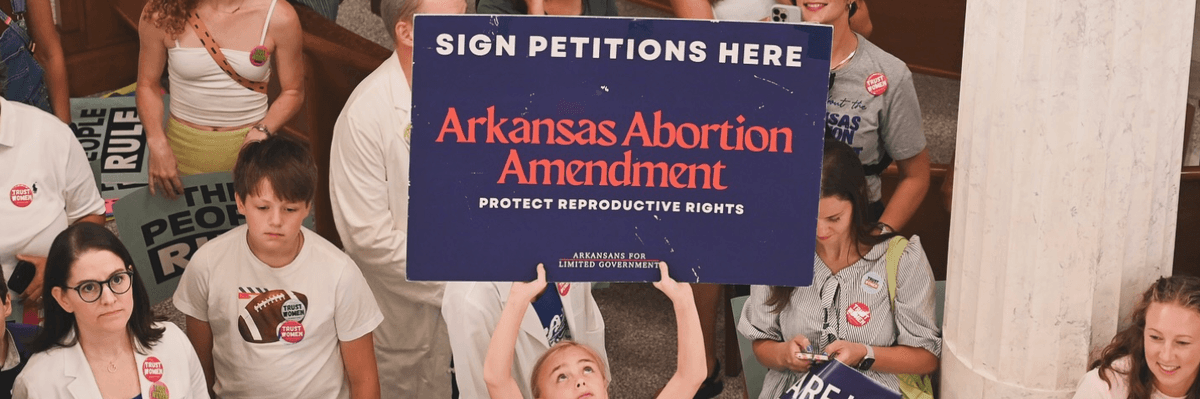
A young demonstrator holds a sign calling on supporters to sign a petition to get an abortion rights amendment on state ballots on July 6, 2024 in Little Rock, Arkansas.
'Infuriating': Arkansas Supreme Court Disqualifies Abortion Amendment From Ballot
"This effort has generated a wave of fiercely engaged Arkansas women," said one organizer. "We are outraged. We will not back down. And we will remember this in November."
Abortion rights defenders in Arkansas said Thursday it was "a dark day" after the state's Supreme Court ruled a ballot measure that would enshrine stronger reproductive rights protections for people in the state was ineligible for November election ballots.
The court ruled 4-3 in favor of arguments presented by Republican officials including Secretary of State John Thurston and Attorney General Tim Griffin, who said organizers with Arkansans for Limited Government (AFLG)—which submitted more than 101,000 signatures to secure the amendment for the ballot—had failed to correctly submit paperwork verifying that paid canvassers had been properly trained.
AFLG strategy director Rebecca Bobrow expressed agreement with Justice Karen Baker's dissent, which accused Thurston of making up statutory requirements "out of whole cloth" and of being "determined to keep this particular vote from the people" at all costs.
AFLG proposed an amendment that would have allowed people in Arkansas to obtain abortion care up to 18 weeks after fertilization, with additional exceptions for incest, rape, and fetal anomalies that would make it impossible for a fetus to survive after birth. Arkansas currently has one of the strictest abortion bans in the U.S., with abortion care allowed only in medical emergencies.
When Thurston rejected the group's petition last month, saying it had failed to submit an official statement regarding the training of its paid canvassers, AFLG sued to force the state to count all the signatures, which surpassed the 90,704 that were needed for the ballot initiative to be approved.
About 14,000 of the group's signatures were collected by paid canvassers, so the number of signatures gathered by unpaid volunteers—87,675—fell below the threshold.
As the Arkansas Times reported, the secretary of state's handbook on petitions states that an affidavit certifying that canvassers received training is a requirement for submitting petitions—but the three dissenting justices on Thursday wrote "that the actual statutory language appears to show that the paperwork oversight should not be fatal to the group's effort. And the handbook cannot overrule the law."
"Despite collecting signatures from more than 100,000 Arkansans—and despite the fact that the plain language of the statutes appeared to show that the review process for the petition should have continued—the court ruled that paperwork omission was fatal to the group's effort," wrote David Ramsey and Matt Campbell at the Arkansas Times. "For those following the case, this has always been the fear: Even if the law was on their side, the majority of the court opposes abortion. Ultimately the law is what the Supreme Court says it is. Among the grab-bag of flimsy arguments offered by Attorney General Tim Griffin, they found a couple they could stretch to suit the purpose of disqualifying the abortion petition."
Baker wrote in her dissent that "the majority has succeeded in its efforts to change the law in order to deprive the voters of the opportunity to vote on this issue, which is not the proper role of this court."
Compared to other ballot initiatives, she added, Thurston and the court's right-wing majority treated the abortion right amendment "differently for the sole purpose of preventing the people from voting on this issue."
Ramsey and Campbell wrote that AFLG could theoretically file a lawsuit in federal court challenging the ruling.
"But for procedural and timing reasons, that is extremely unlikely to help," they wrote. "In all likelihood, it's over: Citizens will not have the opportunity to vote to restore abortion rights in November."
Arkansas state Sen. Greg Leding (D-30) called the ruling "maddening and heartbreaking" and urged voters to consider abortion rights when they cast their ballots in November, regardless of whether the amendment is on ballots.
Bobrow told supporters that AFLG's fight "isn't over" despite the "infuriating" decision.
"We can't—and won't—rest until Arkansas women have access to safe, standard healthcare and the autonomy to make decisions about their bodies free from governmental interference," said Bobrow. "This effort has generated a wave of fiercely engaged Arkansas women. We are outraged. We will not back down. And we will remember this in November."
We are at a crossroads
This country and this world are at a monumental crossroads. In a few short weeks, US voters will have an opportunity to beat back the forces of fascism and confront the billionaires who are rigging the economy, our media system, and our democracy, making it increasingly impossible for ordinary people to get by. We’re not just talking about the election. We’re talking about what must be done once these fascist elements are vanquished from power. We need a bolder set of solutions than what either major party has so far been willing to offer and a working-class movement ready to fight like hell for it. Trump didn't emerge from nowhere. The conditions that fueled MAGA authoritarianism were created by decades of radical neoliberal economic policies and a corrupt political system dominated by corporate interests. They slashed taxes on the super-rich, promising that the benefits would trickle down. They said giveaways to the corporate titans would make life more affordable for the rest of us. It was all bullshit. And when a bitter, betrayed populace searches for someone to blame, right-wing demagogues have little trouble finding scapegoats. People know when they're being lied to, but you won't hear any of this from the corporate media. Only independent journalism—powered and funded by people who believe in building a better world—can deliver truly trustworthy daily news. Our Fall Campaign is underway, and we need your help. To power our newsroom through the rest of the year, we need to raise $125,000 by midnight on October 31. So if you share our vision, please contribute whatever you can to sustain our work. |
Abortion rights defenders in Arkansas said Thursday it was "a dark day" after the state's Supreme Court ruled a ballot measure that would enshrine stronger reproductive rights protections for people in the state was ineligible for November election ballots.
The court ruled 4-3 in favor of arguments presented by Republican officials including Secretary of State John Thurston and Attorney General Tim Griffin, who said organizers with Arkansans for Limited Government (AFLG)—which submitted more than 101,000 signatures to secure the amendment for the ballot—had failed to correctly submit paperwork verifying that paid canvassers had been properly trained.
AFLG strategy director Rebecca Bobrow expressed agreement with Justice Karen Baker's dissent, which accused Thurston of making up statutory requirements "out of whole cloth" and of being "determined to keep this particular vote from the people" at all costs.
AFLG proposed an amendment that would have allowed people in Arkansas to obtain abortion care up to 18 weeks after fertilization, with additional exceptions for incest, rape, and fetal anomalies that would make it impossible for a fetus to survive after birth. Arkansas currently has one of the strictest abortion bans in the U.S., with abortion care allowed only in medical emergencies.
When Thurston rejected the group's petition last month, saying it had failed to submit an official statement regarding the training of its paid canvassers, AFLG sued to force the state to count all the signatures, which surpassed the 90,704 that were needed for the ballot initiative to be approved.
About 14,000 of the group's signatures were collected by paid canvassers, so the number of signatures gathered by unpaid volunteers—87,675—fell below the threshold.
As the Arkansas Times reported, the secretary of state's handbook on petitions states that an affidavit certifying that canvassers received training is a requirement for submitting petitions—but the three dissenting justices on Thursday wrote "that the actual statutory language appears to show that the paperwork oversight should not be fatal to the group's effort. And the handbook cannot overrule the law."
"Despite collecting signatures from more than 100,000 Arkansans—and despite the fact that the plain language of the statutes appeared to show that the review process for the petition should have continued—the court ruled that paperwork omission was fatal to the group's effort," wrote David Ramsey and Matt Campbell at the Arkansas Times. "For those following the case, this has always been the fear: Even if the law was on their side, the majority of the court opposes abortion. Ultimately the law is what the Supreme Court says it is. Among the grab-bag of flimsy arguments offered by Attorney General Tim Griffin, they found a couple they could stretch to suit the purpose of disqualifying the abortion petition."
Baker wrote in her dissent that "the majority has succeeded in its efforts to change the law in order to deprive the voters of the opportunity to vote on this issue, which is not the proper role of this court."
Compared to other ballot initiatives, she added, Thurston and the court's right-wing majority treated the abortion right amendment "differently for the sole purpose of preventing the people from voting on this issue."
Ramsey and Campbell wrote that AFLG could theoretically file a lawsuit in federal court challenging the ruling.
"But for procedural and timing reasons, that is extremely unlikely to help," they wrote. "In all likelihood, it's over: Citizens will not have the opportunity to vote to restore abortion rights in November."
Arkansas state Sen. Greg Leding (D-30) called the ruling "maddening and heartbreaking" and urged voters to consider abortion rights when they cast their ballots in November, regardless of whether the amendment is on ballots.
Bobrow told supporters that AFLG's fight "isn't over" despite the "infuriating" decision.
"We can't—and won't—rest until Arkansas women have access to safe, standard healthcare and the autonomy to make decisions about their bodies free from governmental interference," said Bobrow. "This effort has generated a wave of fiercely engaged Arkansas women. We are outraged. We will not back down. And we will remember this in November."
- Arizonans Submit Over Double the Signatures Needed for Abortion Ballot Measure ›
- Arkansas Supreme Court Orders State to Count Abortion Rights Signatures ›
- Arkansas Abortion Rights Organizers Vow to Fight 'Absurd' Rejection of Ballot Measure ›
- Report Details a Doubling of GOP-Led Attacks on Democracy in 2025 | Common Dreams ›
Abortion rights defenders in Arkansas said Thursday it was "a dark day" after the state's Supreme Court ruled a ballot measure that would enshrine stronger reproductive rights protections for people in the state was ineligible for November election ballots.
The court ruled 4-3 in favor of arguments presented by Republican officials including Secretary of State John Thurston and Attorney General Tim Griffin, who said organizers with Arkansans for Limited Government (AFLG)—which submitted more than 101,000 signatures to secure the amendment for the ballot—had failed to correctly submit paperwork verifying that paid canvassers had been properly trained.
AFLG strategy director Rebecca Bobrow expressed agreement with Justice Karen Baker's dissent, which accused Thurston of making up statutory requirements "out of whole cloth" and of being "determined to keep this particular vote from the people" at all costs.
AFLG proposed an amendment that would have allowed people in Arkansas to obtain abortion care up to 18 weeks after fertilization, with additional exceptions for incest, rape, and fetal anomalies that would make it impossible for a fetus to survive after birth. Arkansas currently has one of the strictest abortion bans in the U.S., with abortion care allowed only in medical emergencies.
When Thurston rejected the group's petition last month, saying it had failed to submit an official statement regarding the training of its paid canvassers, AFLG sued to force the state to count all the signatures, which surpassed the 90,704 that were needed for the ballot initiative to be approved.
About 14,000 of the group's signatures were collected by paid canvassers, so the number of signatures gathered by unpaid volunteers—87,675—fell below the threshold.
As the Arkansas Times reported, the secretary of state's handbook on petitions states that an affidavit certifying that canvassers received training is a requirement for submitting petitions—but the three dissenting justices on Thursday wrote "that the actual statutory language appears to show that the paperwork oversight should not be fatal to the group's effort. And the handbook cannot overrule the law."
"Despite collecting signatures from more than 100,000 Arkansans—and despite the fact that the plain language of the statutes appeared to show that the review process for the petition should have continued—the court ruled that paperwork omission was fatal to the group's effort," wrote David Ramsey and Matt Campbell at the Arkansas Times. "For those following the case, this has always been the fear: Even if the law was on their side, the majority of the court opposes abortion. Ultimately the law is what the Supreme Court says it is. Among the grab-bag of flimsy arguments offered by Attorney General Tim Griffin, they found a couple they could stretch to suit the purpose of disqualifying the abortion petition."
Baker wrote in her dissent that "the majority has succeeded in its efforts to change the law in order to deprive the voters of the opportunity to vote on this issue, which is not the proper role of this court."
Compared to other ballot initiatives, she added, Thurston and the court's right-wing majority treated the abortion right amendment "differently for the sole purpose of preventing the people from voting on this issue."
Ramsey and Campbell wrote that AFLG could theoretically file a lawsuit in federal court challenging the ruling.
"But for procedural and timing reasons, that is extremely unlikely to help," they wrote. "In all likelihood, it's over: Citizens will not have the opportunity to vote to restore abortion rights in November."
Arkansas state Sen. Greg Leding (D-30) called the ruling "maddening and heartbreaking" and urged voters to consider abortion rights when they cast their ballots in November, regardless of whether the amendment is on ballots.
Bobrow told supporters that AFLG's fight "isn't over" despite the "infuriating" decision.
"We can't—and won't—rest until Arkansas women have access to safe, standard healthcare and the autonomy to make decisions about their bodies free from governmental interference," said Bobrow. "This effort has generated a wave of fiercely engaged Arkansas women. We are outraged. We will not back down. And we will remember this in November."
- Arizonans Submit Over Double the Signatures Needed for Abortion Ballot Measure ›
- Arkansas Supreme Court Orders State to Count Abortion Rights Signatures ›
- Arkansas Abortion Rights Organizers Vow to Fight 'Absurd' Rejection of Ballot Measure ›
- Report Details a Doubling of GOP-Led Attacks on Democracy in 2025 | Common Dreams ›