SUBSCRIBE TO OUR FREE NEWSLETTER
Daily news & progressive opinion—funded by the people, not the corporations—delivered straight to your inbox.
5
#000000
#FFFFFF
To donate by check, phone, or other method, see our More Ways to Give page.
Daily news & progressive opinion—funded by the people, not the corporations—delivered straight to your inbox.
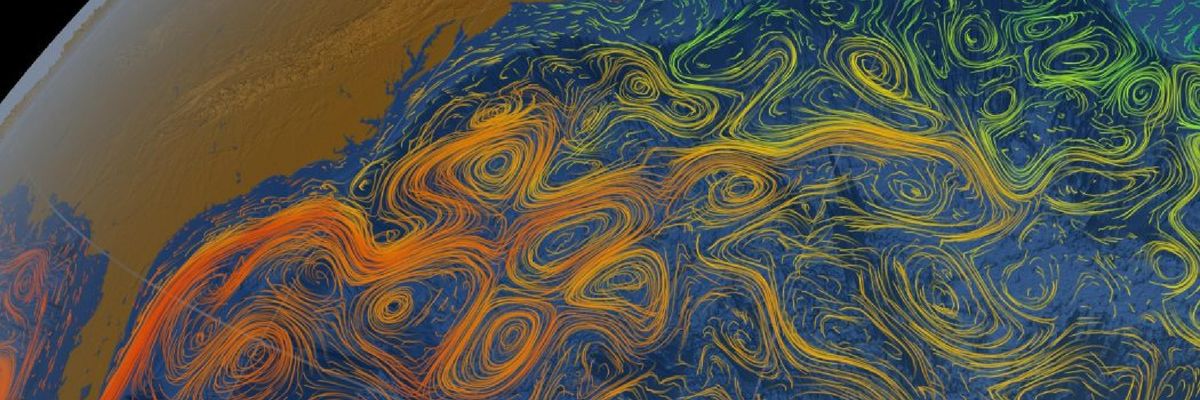
The Gulf Stream is an ocean current that carries warm water from the Gulf of Mexico into the Atlantic Ocean.
"The new study adds significantly to the rising concern about an AMOC collapse in the not-too-distant future," said one scientist. "We will ignore this at our peril."
A study published Friday warned that a systemic collapse of the Atlantic Ocean currents driving warm water from the tropics toward Europe could be more likely than researchers previously estimated—an event that would send temperatures plummeting in much of the continent.
The Atlantic Meridional Overturning Circulation (AMOC), which includes the Gulf Stream, could be headed for a relatively sudden shutdown that René Van Western, who led the Dutch study published in Science Advances, called "cliff-like."
"We are heading towards a tipping point."
For many millennia, the Gulf Stream has carried warm waters from the Gulf of Mexico northward along the eastern North American seaboard and across the Atlantic to Europe. As human-caused global heating melts the Greenland ice sheet, massive quantities of fresh water are released into the North Atlantic, cooling the AMOC—which delivers the bulk of the Gulf Stream's heat—toward a "tipping point" that could stop the current in its tracks.
An AMOC shutdown would cause temperatures to rise in the Southern Hemisphere but plunge dramatically in Europe. In the study's model, London cools by an average of 18°F and Bergen, Norway by 27°F. An AMOC failure would also cause sea levels to rise along North America's east coast.
"We are moving closer [to the collapse], but we we're not sure how much closer," van Westen told The Associated Press. "We are heading towards a tipping point."
According to the study:
Although AMOC collapses have been induced in complex global climate models by strong freshwater forcing, the processes of an AMOC tipping event have so far not been investigated. Here, we show results of the first tipping event in the Community Earth System Model, including the large climate impacts of the collapse. Using these results, we develop a physics-based and observable early warning signal of AMOC tipping: the minimum of the AMOC-induced freshwater transport at the southern boundary of the Atlantic. Reanalysis products indicate that the present-day AMOC is on route to tipping. The early warning signal is a useful alternative to classical statistical ones, which, when applied to our simulated tipping event, turn out to be sensitive to the analyzed time interval before tipping.
"The research makes a convincing case that the AMOC is approaching a tipping point based on a robust, physically based early warning indicator," said Tim Lenton, director of the University of Exeter's Global Systems Institute. "What it cannot and does not say is how close the tipping point, because... there is insufficient data to make a statistically reliable estimate of that.
"We have to plan for the worst," added Lenton, who was not involved in the Dutch study. "We should invest in collecting relevant data and improving estimation of how close a tipping point is, improving assessment of what its impacts would be, and getting pre-prepared for how we could best manage and adapt to those impacts if they start to unfold."
Stefan Rahmstorf—who leads the Earth Systems Analysis department at the Potsdam Institute for Climate Research in Germany and was not part of the new study—called the research "a major advance in AMOC stability science."
"The new study adds significantly to the rising concern about an AMOC collapse in the not-too-distant future," Rahmstorf told The Associated Press. "We will ignore this at our peril."
Dear Common Dreams reader, It’s been nearly 30 years since I co-founded Common Dreams with my late wife, Lina Newhouser. We had the radical notion that journalism should serve the public good, not corporate profits. It was clear to us from the outset what it would take to build such a project. No paid advertisements. No corporate sponsors. No millionaire publisher telling us what to think or do. Many people said we wouldn't last a year, but we proved those doubters wrong. Together with a tremendous team of journalists and dedicated staff, we built an independent media outlet free from the constraints of profits and corporate control. Our mission has always been simple: To inform. To inspire. To ignite change for the common good. Building Common Dreams was not easy. Our survival was never guaranteed. When you take on the most powerful forces—Wall Street greed, fossil fuel industry destruction, Big Tech lobbyists, and uber-rich oligarchs who have spent billions upon billions rigging the economy and democracy in their favor—the only bulwark you have is supporters who believe in your work. But here’s the urgent message from me today. It's never been this bad out there. And it's never been this hard to keep us going. At the very moment Common Dreams is most needed, the threats we face are intensifying. We need your support now more than ever. We don't accept corporate advertising and never will. We don't have a paywall because we don't think people should be blocked from critical news based on their ability to pay. Everything we do is funded by the donations of readers like you. When everyone does the little they can afford, we are strong. But if that support retreats or dries up, so do we. Will you donate now to make sure Common Dreams not only survives but thrives? —Craig Brown, Co-founder |
A study published Friday warned that a systemic collapse of the Atlantic Ocean currents driving warm water from the tropics toward Europe could be more likely than researchers previously estimated—an event that would send temperatures plummeting in much of the continent.
The Atlantic Meridional Overturning Circulation (AMOC), which includes the Gulf Stream, could be headed for a relatively sudden shutdown that René Van Western, who led the Dutch study published in Science Advances, called "cliff-like."
"We are heading towards a tipping point."
For many millennia, the Gulf Stream has carried warm waters from the Gulf of Mexico northward along the eastern North American seaboard and across the Atlantic to Europe. As human-caused global heating melts the Greenland ice sheet, massive quantities of fresh water are released into the North Atlantic, cooling the AMOC—which delivers the bulk of the Gulf Stream's heat—toward a "tipping point" that could stop the current in its tracks.
An AMOC shutdown would cause temperatures to rise in the Southern Hemisphere but plunge dramatically in Europe. In the study's model, London cools by an average of 18°F and Bergen, Norway by 27°F. An AMOC failure would also cause sea levels to rise along North America's east coast.
"We are moving closer [to the collapse], but we we're not sure how much closer," van Westen told The Associated Press. "We are heading towards a tipping point."
According to the study:
Although AMOC collapses have been induced in complex global climate models by strong freshwater forcing, the processes of an AMOC tipping event have so far not been investigated. Here, we show results of the first tipping event in the Community Earth System Model, including the large climate impacts of the collapse. Using these results, we develop a physics-based and observable early warning signal of AMOC tipping: the minimum of the AMOC-induced freshwater transport at the southern boundary of the Atlantic. Reanalysis products indicate that the present-day AMOC is on route to tipping. The early warning signal is a useful alternative to classical statistical ones, which, when applied to our simulated tipping event, turn out to be sensitive to the analyzed time interval before tipping.
"The research makes a convincing case that the AMOC is approaching a tipping point based on a robust, physically based early warning indicator," said Tim Lenton, director of the University of Exeter's Global Systems Institute. "What it cannot and does not say is how close the tipping point, because... there is insufficient data to make a statistically reliable estimate of that.
"We have to plan for the worst," added Lenton, who was not involved in the Dutch study. "We should invest in collecting relevant data and improving estimation of how close a tipping point is, improving assessment of what its impacts would be, and getting pre-prepared for how we could best manage and adapt to those impacts if they start to unfold."
Stefan Rahmstorf—who leads the Earth Systems Analysis department at the Potsdam Institute for Climate Research in Germany and was not part of the new study—called the research "a major advance in AMOC stability science."
"The new study adds significantly to the rising concern about an AMOC collapse in the not-too-distant future," Rahmstorf told The Associated Press. "We will ignore this at our peril."
A study published Friday warned that a systemic collapse of the Atlantic Ocean currents driving warm water from the tropics toward Europe could be more likely than researchers previously estimated—an event that would send temperatures plummeting in much of the continent.
The Atlantic Meridional Overturning Circulation (AMOC), which includes the Gulf Stream, could be headed for a relatively sudden shutdown that René Van Western, who led the Dutch study published in Science Advances, called "cliff-like."
"We are heading towards a tipping point."
For many millennia, the Gulf Stream has carried warm waters from the Gulf of Mexico northward along the eastern North American seaboard and across the Atlantic to Europe. As human-caused global heating melts the Greenland ice sheet, massive quantities of fresh water are released into the North Atlantic, cooling the AMOC—which delivers the bulk of the Gulf Stream's heat—toward a "tipping point" that could stop the current in its tracks.
An AMOC shutdown would cause temperatures to rise in the Southern Hemisphere but plunge dramatically in Europe. In the study's model, London cools by an average of 18°F and Bergen, Norway by 27°F. An AMOC failure would also cause sea levels to rise along North America's east coast.
"We are moving closer [to the collapse], but we we're not sure how much closer," van Westen told The Associated Press. "We are heading towards a tipping point."
According to the study:
Although AMOC collapses have been induced in complex global climate models by strong freshwater forcing, the processes of an AMOC tipping event have so far not been investigated. Here, we show results of the first tipping event in the Community Earth System Model, including the large climate impacts of the collapse. Using these results, we develop a physics-based and observable early warning signal of AMOC tipping: the minimum of the AMOC-induced freshwater transport at the southern boundary of the Atlantic. Reanalysis products indicate that the present-day AMOC is on route to tipping. The early warning signal is a useful alternative to classical statistical ones, which, when applied to our simulated tipping event, turn out to be sensitive to the analyzed time interval before tipping.
"The research makes a convincing case that the AMOC is approaching a tipping point based on a robust, physically based early warning indicator," said Tim Lenton, director of the University of Exeter's Global Systems Institute. "What it cannot and does not say is how close the tipping point, because... there is insufficient data to make a statistically reliable estimate of that.
"We have to plan for the worst," added Lenton, who was not involved in the Dutch study. "We should invest in collecting relevant data and improving estimation of how close a tipping point is, improving assessment of what its impacts would be, and getting pre-prepared for how we could best manage and adapt to those impacts if they start to unfold."
Stefan Rahmstorf—who leads the Earth Systems Analysis department at the Potsdam Institute for Climate Research in Germany and was not part of the new study—called the research "a major advance in AMOC stability science."
"The new study adds significantly to the rising concern about an AMOC collapse in the not-too-distant future," Rahmstorf told The Associated Press. "We will ignore this at our peril."