SUBSCRIBE TO OUR FREE NEWSLETTER
Daily news & progressive opinion—funded by the people, not the corporations—delivered straight to your inbox.
5
#000000
#FFFFFF
To donate by check, phone, or other method, see our More Ways to Give page.
Daily news & progressive opinion—funded by the people, not the corporations—delivered straight to your inbox.
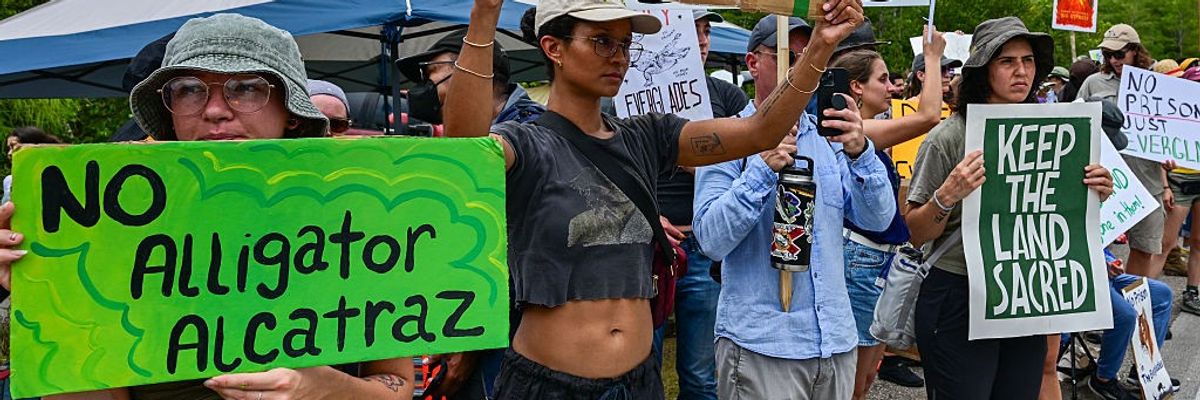
Demonstrators protest the construction of an immigrant detention center, dubbed "Alligator Alcatraz," in the Everglades near Ochopee, Florida, on June 28, 2025.
"Environmental laws must be respected by leaders at the highest levels of our government—and there are consequences for ignoring them," said one advocate.
A federal judge on Thursday ordered the shutdown of the so-called "Alligator Alcatraz" immigrant detention facility in the Florida Everglades, leading to cheers from local environmental advocates.
The ruling by Judge Kathleen Williams of the United States District Court for the Southern District of Florida sided with the plaintiffs that the facility was doing significant damage to the ecosystem of the Everglades. Williams noted the fragile wetlands have been protected from big developments for decades after a proposed commercial airport in the area was rejected in the 1960s.
"Since that time, every Florida governor, every Florida senator, and countless local and national political figures, including presidents, have publicly pledged their unequivocal support for the restoration, conservation, and protection of the Everglades," she wrote. "This order does nothing more than uphold the basic requirements of legislation designed to fulfill those promises."
Williams gave the state of Florida 60 days to shut down the site. In that time, she ordered all construction at the facility to be halted and for there to be no further increase in the number of detainees currently being held there.
Though an appeal is almost certain, environmental advocates who brought the lawsuit against the facility took a victory lap in the wake of Williams's ruling.
Eve Samples, executive director of Friends of the Everglades, hailed the decision as a "landmark victory" that "sends a clear message that environmental laws must be respected by leaders at the highest levels of our government—and there are consequences for ignoring them."
Elise Bennett, Florida and Caribbean director and attorney at the Center for Biological Diversity, said that the injunction issued by Williams was "a huge relief for millions of people who love the Everglades."
"This brutal detention center was burning a hole in the fabric of life that supports our most iconic wetland and a whole host of endangered species, from majestic Florida panthers to wizened wood storks," Bennett added. "The judge's order came just in time to stop it all from unraveling."
Tania Galloni, managing attorney for the Florida office of Earthjustice, said the judge's decision showed "the government can't just build something in the middle of the Everglades and the Big Cypress preserve with no environmental review, and no public input," and added that "this is why we have environmental laws—to protect the wetlands and ecosystems we all depend on from illegal development."
Williams's ruling came just two weeks after she ordered a temporary halt to all construction at the facility, which was first announced earlier this summer when Republican Florida Attorney General James Uthmeier unveiled a plan to renovate the Dade-Collier Training and Transition Airport and transform it into a mass detention center for immigrants.
The center has drawn criticism from human rights groups as well as from Democrats who visited the facility last month. Rep. Maxwell Frost (D-Fla.), one of the lawmakers to visit the facility, said afterward that "what I saw made my heart sink," referring to the conditions where detainees are being held.
Dear Common Dreams reader, It’s been nearly 30 years since I co-founded Common Dreams with my late wife, Lina Newhouser. We had the radical notion that journalism should serve the public good, not corporate profits. It was clear to us from the outset what it would take to build such a project. No paid advertisements. No corporate sponsors. No millionaire publisher telling us what to think or do. Many people said we wouldn't last a year, but we proved those doubters wrong. Together with a tremendous team of journalists and dedicated staff, we built an independent media outlet free from the constraints of profits and corporate control. Our mission has always been simple: To inform. To inspire. To ignite change for the common good. Building Common Dreams was not easy. Our survival was never guaranteed. When you take on the most powerful forces—Wall Street greed, fossil fuel industry destruction, Big Tech lobbyists, and uber-rich oligarchs who have spent billions upon billions rigging the economy and democracy in their favor—the only bulwark you have is supporters who believe in your work. But here’s the urgent message from me today. It's never been this bad out there. And it's never been this hard to keep us going. At the very moment Common Dreams is most needed, the threats we face are intensifying. We need your support now more than ever. We don't accept corporate advertising and never will. We don't have a paywall because we don't think people should be blocked from critical news based on their ability to pay. Everything we do is funded by the donations of readers like you. When everyone does the little they can afford, we are strong. But if that support retreats or dries up, so do we. Will you donate now to make sure Common Dreams not only survives but thrives? —Craig Brown, Co-founder |
A federal judge on Thursday ordered the shutdown of the so-called "Alligator Alcatraz" immigrant detention facility in the Florida Everglades, leading to cheers from local environmental advocates.
The ruling by Judge Kathleen Williams of the United States District Court for the Southern District of Florida sided with the plaintiffs that the facility was doing significant damage to the ecosystem of the Everglades. Williams noted the fragile wetlands have been protected from big developments for decades after a proposed commercial airport in the area was rejected in the 1960s.
"Since that time, every Florida governor, every Florida senator, and countless local and national political figures, including presidents, have publicly pledged their unequivocal support for the restoration, conservation, and protection of the Everglades," she wrote. "This order does nothing more than uphold the basic requirements of legislation designed to fulfill those promises."
Williams gave the state of Florida 60 days to shut down the site. In that time, she ordered all construction at the facility to be halted and for there to be no further increase in the number of detainees currently being held there.
Though an appeal is almost certain, environmental advocates who brought the lawsuit against the facility took a victory lap in the wake of Williams's ruling.
Eve Samples, executive director of Friends of the Everglades, hailed the decision as a "landmark victory" that "sends a clear message that environmental laws must be respected by leaders at the highest levels of our government—and there are consequences for ignoring them."
Elise Bennett, Florida and Caribbean director and attorney at the Center for Biological Diversity, said that the injunction issued by Williams was "a huge relief for millions of people who love the Everglades."
"This brutal detention center was burning a hole in the fabric of life that supports our most iconic wetland and a whole host of endangered species, from majestic Florida panthers to wizened wood storks," Bennett added. "The judge's order came just in time to stop it all from unraveling."
Tania Galloni, managing attorney for the Florida office of Earthjustice, said the judge's decision showed "the government can't just build something in the middle of the Everglades and the Big Cypress preserve with no environmental review, and no public input," and added that "this is why we have environmental laws—to protect the wetlands and ecosystems we all depend on from illegal development."
Williams's ruling came just two weeks after she ordered a temporary halt to all construction at the facility, which was first announced earlier this summer when Republican Florida Attorney General James Uthmeier unveiled a plan to renovate the Dade-Collier Training and Transition Airport and transform it into a mass detention center for immigrants.
The center has drawn criticism from human rights groups as well as from Democrats who visited the facility last month. Rep. Maxwell Frost (D-Fla.), one of the lawmakers to visit the facility, said afterward that "what I saw made my heart sink," referring to the conditions where detainees are being held.
A federal judge on Thursday ordered the shutdown of the so-called "Alligator Alcatraz" immigrant detention facility in the Florida Everglades, leading to cheers from local environmental advocates.
The ruling by Judge Kathleen Williams of the United States District Court for the Southern District of Florida sided with the plaintiffs that the facility was doing significant damage to the ecosystem of the Everglades. Williams noted the fragile wetlands have been protected from big developments for decades after a proposed commercial airport in the area was rejected in the 1960s.
"Since that time, every Florida governor, every Florida senator, and countless local and national political figures, including presidents, have publicly pledged their unequivocal support for the restoration, conservation, and protection of the Everglades," she wrote. "This order does nothing more than uphold the basic requirements of legislation designed to fulfill those promises."
Williams gave the state of Florida 60 days to shut down the site. In that time, she ordered all construction at the facility to be halted and for there to be no further increase in the number of detainees currently being held there.
Though an appeal is almost certain, environmental advocates who brought the lawsuit against the facility took a victory lap in the wake of Williams's ruling.
Eve Samples, executive director of Friends of the Everglades, hailed the decision as a "landmark victory" that "sends a clear message that environmental laws must be respected by leaders at the highest levels of our government—and there are consequences for ignoring them."
Elise Bennett, Florida and Caribbean director and attorney at the Center for Biological Diversity, said that the injunction issued by Williams was "a huge relief for millions of people who love the Everglades."
"This brutal detention center was burning a hole in the fabric of life that supports our most iconic wetland and a whole host of endangered species, from majestic Florida panthers to wizened wood storks," Bennett added. "The judge's order came just in time to stop it all from unraveling."
Tania Galloni, managing attorney for the Florida office of Earthjustice, said the judge's decision showed "the government can't just build something in the middle of the Everglades and the Big Cypress preserve with no environmental review, and no public input," and added that "this is why we have environmental laws—to protect the wetlands and ecosystems we all depend on from illegal development."
Williams's ruling came just two weeks after she ordered a temporary halt to all construction at the facility, which was first announced earlier this summer when Republican Florida Attorney General James Uthmeier unveiled a plan to renovate the Dade-Collier Training and Transition Airport and transform it into a mass detention center for immigrants.
The center has drawn criticism from human rights groups as well as from Democrats who visited the facility last month. Rep. Maxwell Frost (D-Fla.), one of the lawmakers to visit the facility, said afterward that "what I saw made my heart sink," referring to the conditions where detainees are being held.