SUBSCRIBE TO OUR FREE NEWSLETTER
Daily news & progressive opinion—funded by the people, not the corporations—delivered straight to your inbox.
5
#000000
#FFFFFF
To donate by check, phone, or other method, see our More Ways to Give page.
Daily news & progressive opinion—funded by the people, not the corporations—delivered straight to your inbox.
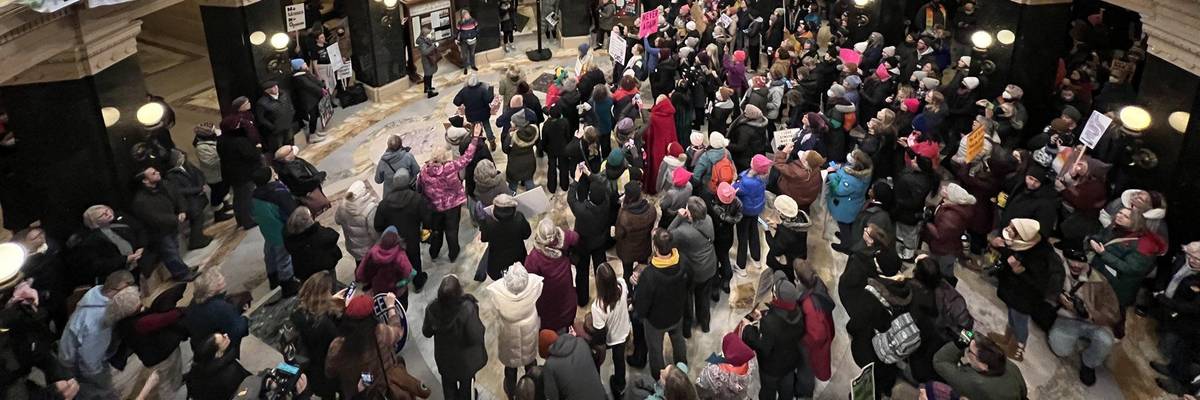
People rally for abortion rights at the Wisconsin state capitol in Madison on January 22, 2023.
"The overwhelming majority of Americans in all states support abortion rights—and women will fight to protect our rights and our lives," said the executive director of Women's March.
Thousands of people called for reproductive freedom at rallies around the United States on Sunday—the 50th anniversary of the landmark Roe v. Wade decision that made abortion a constitutional right until the Supreme Court's reactionary majority overturned it last summer.
At more than 200 events in 46 states, demonstrators condemned the court's 6-3 opinion in Dobbs v. Jackson Women's Health Organization, which enables states to curtail or even prohibit access to reproductive healthcare. Since the ruling was handed down on June 24, Republican lawmakers have enacted deadly abortion restrictions in 26 states, including near-total bans in several.
"Fifty years after the anniversary of Roe v. Wade, a radical right-wing movement hijacked our courts and eliminated federal protections for abortions," said Rachel O'Leary Carmona, executive director of Women's March, which organized Sunday's "Bigger Than Roe" day of action.
"But as the fight turns to the states, they are going to learn that the overwhelming majority of Americans in all states support abortion rights—and women will fight to protect our rights and our lives," she added.
Carmona spoke at the Wisconsin state capitol. Women's March picked Madison rather than Washington, D.C. as the location of this year's national protest because the group wanted to send "a clear message to elected leaders and to our base—we are going to where the fight is, and that is at the state level."
"We'll start in Wisconsin, where an upcoming Supreme Court election this spring will determine the balance of power on the state's Supreme Court and the future of abortion rights in Wisconsin," the group explained.
Due to legal uncertainty around the status of Wisconsin's pre-Roe abortion ban, enacted in 1849, providers have been forced to stop offering abortion care in the state.
Women's March—with the support of nearly 50 organizations, including Planned Parenthood, Working Families Power, and the National Organization for Women—orchestrated "sister marches" in cities across the country.
"We are taking the fight to the states," organizers said. "From Wisconsin, to Nebraska, to Georgia, to Arizona and Texas, women and our allies are defending abortion rights where they still stand, and working to put measures on the ballot to regain abortion rights in places where politicians are putting their agendas over the will of the people."
Dear Common Dreams reader, It’s been nearly 30 years since I co-founded Common Dreams with my late wife, Lina Newhouser. We had the radical notion that journalism should serve the public good, not corporate profits. It was clear to us from the outset what it would take to build such a project. No paid advertisements. No corporate sponsors. No millionaire publisher telling us what to think or do. Many people said we wouldn't last a year, but we proved those doubters wrong. Together with a tremendous team of journalists and dedicated staff, we built an independent media outlet free from the constraints of profits and corporate control. Our mission has always been simple: To inform. To inspire. To ignite change for the common good. Building Common Dreams was not easy. Our survival was never guaranteed. When you take on the most powerful forces—Wall Street greed, fossil fuel industry destruction, Big Tech lobbyists, and uber-rich oligarchs who have spent billions upon billions rigging the economy and democracy in their favor—the only bulwark you have is supporters who believe in your work. But here’s the urgent message from me today. It's never been this bad out there. And it's never been this hard to keep us going. At the very moment Common Dreams is most needed, the threats we face are intensifying. We need your support now more than ever. We don't accept corporate advertising and never will. We don't have a paywall because we don't think people should be blocked from critical news based on their ability to pay. Everything we do is funded by the donations of readers like you. When everyone does the little they can afford, we are strong. But if that support retreats or dries up, so do we. Will you donate now to make sure Common Dreams not only survives but thrives? —Craig Brown, Co-founder |
Thousands of people called for reproductive freedom at rallies around the United States on Sunday—the 50th anniversary of the landmark Roe v. Wade decision that made abortion a constitutional right until the Supreme Court's reactionary majority overturned it last summer.
At more than 200 events in 46 states, demonstrators condemned the court's 6-3 opinion in Dobbs v. Jackson Women's Health Organization, which enables states to curtail or even prohibit access to reproductive healthcare. Since the ruling was handed down on June 24, Republican lawmakers have enacted deadly abortion restrictions in 26 states, including near-total bans in several.
"Fifty years after the anniversary of Roe v. Wade, a radical right-wing movement hijacked our courts and eliminated federal protections for abortions," said Rachel O'Leary Carmona, executive director of Women's March, which organized Sunday's "Bigger Than Roe" day of action.
"But as the fight turns to the states, they are going to learn that the overwhelming majority of Americans in all states support abortion rights—and women will fight to protect our rights and our lives," she added.
Carmona spoke at the Wisconsin state capitol. Women's March picked Madison rather than Washington, D.C. as the location of this year's national protest because the group wanted to send "a clear message to elected leaders and to our base—we are going to where the fight is, and that is at the state level."
"We'll start in Wisconsin, where an upcoming Supreme Court election this spring will determine the balance of power on the state's Supreme Court and the future of abortion rights in Wisconsin," the group explained.
Due to legal uncertainty around the status of Wisconsin's pre-Roe abortion ban, enacted in 1849, providers have been forced to stop offering abortion care in the state.
Women's March—with the support of nearly 50 organizations, including Planned Parenthood, Working Families Power, and the National Organization for Women—orchestrated "sister marches" in cities across the country.
"We are taking the fight to the states," organizers said. "From Wisconsin, to Nebraska, to Georgia, to Arizona and Texas, women and our allies are defending abortion rights where they still stand, and working to put measures on the ballot to regain abortion rights in places where politicians are putting their agendas over the will of the people."
Thousands of people called for reproductive freedom at rallies around the United States on Sunday—the 50th anniversary of the landmark Roe v. Wade decision that made abortion a constitutional right until the Supreme Court's reactionary majority overturned it last summer.
At more than 200 events in 46 states, demonstrators condemned the court's 6-3 opinion in Dobbs v. Jackson Women's Health Organization, which enables states to curtail or even prohibit access to reproductive healthcare. Since the ruling was handed down on June 24, Republican lawmakers have enacted deadly abortion restrictions in 26 states, including near-total bans in several.
"Fifty years after the anniversary of Roe v. Wade, a radical right-wing movement hijacked our courts and eliminated federal protections for abortions," said Rachel O'Leary Carmona, executive director of Women's March, which organized Sunday's "Bigger Than Roe" day of action.
"But as the fight turns to the states, they are going to learn that the overwhelming majority of Americans in all states support abortion rights—and women will fight to protect our rights and our lives," she added.
Carmona spoke at the Wisconsin state capitol. Women's March picked Madison rather than Washington, D.C. as the location of this year's national protest because the group wanted to send "a clear message to elected leaders and to our base—we are going to where the fight is, and that is at the state level."
"We'll start in Wisconsin, where an upcoming Supreme Court election this spring will determine the balance of power on the state's Supreme Court and the future of abortion rights in Wisconsin," the group explained.
Due to legal uncertainty around the status of Wisconsin's pre-Roe abortion ban, enacted in 1849, providers have been forced to stop offering abortion care in the state.
Women's March—with the support of nearly 50 organizations, including Planned Parenthood, Working Families Power, and the National Organization for Women—orchestrated "sister marches" in cities across the country.
"We are taking the fight to the states," organizers said. "From Wisconsin, to Nebraska, to Georgia, to Arizona and Texas, women and our allies are defending abortion rights where they still stand, and working to put measures on the ballot to regain abortion rights in places where politicians are putting their agendas over the will of the people."