SUBSCRIBE TO OUR FREE NEWSLETTER
Daily news & progressive opinion—funded by the people, not the corporations—delivered straight to your inbox.
5
#000000
#FFFFFF
To donate by check, phone, or other method, see our More Ways to Give page.
Daily news & progressive opinion—funded by the people, not the corporations—delivered straight to your inbox.
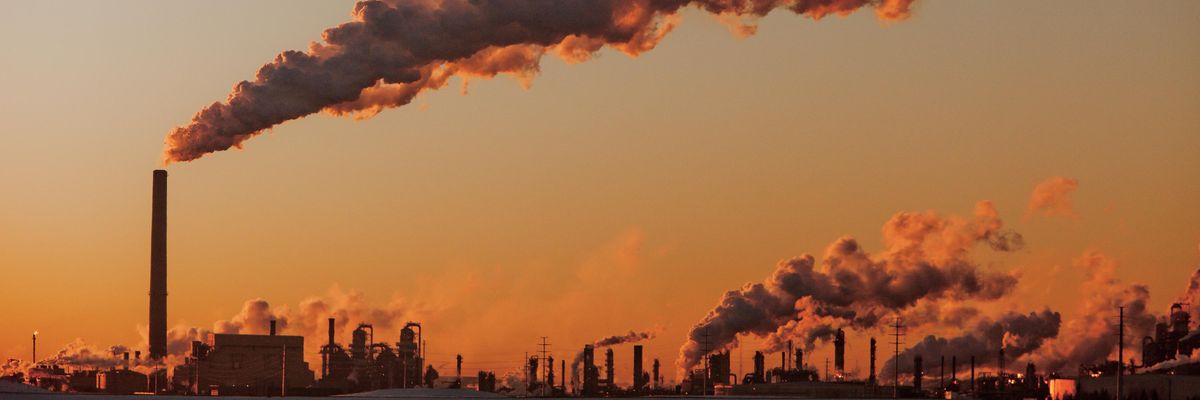
Pollution is seen rising from smokestacks in an industrial area.
"The report is very clear: This crisis is driven by the profit-driven production of coal, oil, and gas," one climate advocacy group said.
Climate-heating carbon dioxide is accumulating in the atmosphere more rapidly than at any time since humans evolved.
That's just one of the alarming findings from the World Meteorological Organization's (WMO) Greenhouse Gas Bulletin, released Monday, which found that all three main greenhouse gases reached record atmospheric levels in 2023.
"Words fail," the group Climate Defiance wrote on social media in response to the news.
"Greenhouse gas pollution at these levels will guarantee a human and economic trainwreck for every country, without exception."
Atmospheric concentrations of CO2 hit 420.0 parts per million (ppm) in 2023, an increase of 151% since the Industrial Revolution and a level not seen since 3 to 5 million years ago, when global temperatures was 2-3°C hotter than today and sea levels were 10-20 meters higher. Methane hit 1,934 parts per billion (ppb)—or 265% higher than preindustrial levels—and nitrous oxide rose to 336.9 ppb, 125% of pre-1750 levels.
"Another year. Another record," WMO Secretary-General Celeste Saulo said in a statement. "This should set alarm bells ringing among decision-makers. We are clearly off track to meet the Paris agreement goal of limiting global warming to well below 2°C and aiming for 1.5°C above preindustrial levels. These are more than just statistics. Every part per million and every fraction of a degree temperature increase has a real impact on our lives and our planet."
Carbon dioxide rose by 2.3 ppm in 2023. While that was higher than the 2022 increase, it was lower than in 2019-2021. However, on a longer-term scale, atmospheric CO2 rose by 11.4% in the past 10 years, a record increase during human existence. The burning of fossil fuels is the primary cause of this increase.
"The report is very clear: This crisis is driven by the profit-driven production of coal, oil, and gas," Climate Defiance wrote. "Because of these fuels, planet-heating pollution levels have gone up by 51.5%—since 1990 alone."
However, 2023's CO2 increases were also caused by forest fires—including a record-breaking fire season in Canada—as well as a possible reduction in the ability of Earth's natural carbon sinks to absorb the greenhouse gas. While vegetation-related CO2 emissions are partially influenced by natural cycles—El Niño years like 2023 are drier and tend to see more fires—they could also be a sign of dangerous feedback loops.
"The Bulletin warns that we face a potential vicious cycle," said WMO Deputy Secretary-General Ko Barrett. "Natural climate variability plays a big role in carbon cycle. But in the near future, climate change itself could cause ecosystems to become larger sources of greenhouse gases."
"Wildfires could release more carbon emissions into the atmosphere, whilst the warmer ocean might absorb less CO2. Consequently, more CO2 could stay in the atmosphere to accelerate global warming," Barrett explained. "These climate feedbacks are critical concerns to human society."
The report also said that even if emissions were to cease rapidly, the amount of carbon dioxide in the atmosphere means that the current rise in temperatures would linger for decades.
The rise in methane is also a concern. While it increased less in 2023 than in 2022, it hit a record-high increase over the last five years, and some of this could be due to climate feedback loops such as the melting of the Arctic permafrost or greater emissions from wetlands and other natural ecosystems as temperatures rise.
As Climate Defiance noted, WMO's graph showing the rise of methane appears to move from a linear to an exponential progression as it approaches 2023.
"It could literally be the graph that defines human history," Climate Defiance wrote.
"The most infuriating part is it didn't have to be this way," the group continued. "Had we started taking action in the 1970s—when the threat became clear—we could have easily stopped the crisis by now. Instead we gorged ourselves on SUVs and McMansions as politicians dithered and delayed."
The Greenhouse Gas Bulletin is one of several annual reports released ahead of United Nations climate conferences; this year, world leaders are scheduled to gather in Baku, Azerbaijan starting on November 11 for COP29. The Bulletin comes alongside other reports finding that national policies are not on track to reduce emissions in line with the Paris agreement temperature goals.
Last week, the U.N. Emissions Gap Report concluded that current policies put the world on course for as much as 3.1°C of warming. Also on Monday, the U.N. Framework Convention on Climate Change (UNFCCC) released its 2024 Nationally Determined Contributions (NDC) Synthesis Report, in which it assesses the commitments that different nations have made to reduce emissions under the Paris agreement.
It found that current NDCs would cut greenhouse gas emissions by 2.6% of 2019 levels by 2030, a far cry from the 43% needed to have a chance at limiting global heating to 1.5°C by 2100 and preventing ever-worsening climate impacts.
"Greenhouse gas pollution at these levels will guarantee a human and economic trainwreck for every country, without exception," U.N. Climate Change Executive Secretary Simon Stiell said in a statement of the current 2030 trajectory.
"Today's NDC Synthesis Report must be a turning point, ending the era of inadequacy and sparking a new age of acceleration, with much bolder new national climate plans from every country due next year," Stiell said. "The report's findings are stark but not surprising—current national climate plans fall miles short of what's needed to stop global heating from crippling every economy, and wrecking billions of lives and livelihoods across every country."
"By contrast," Stiell continued, "much bolder new national climate plans can not only avert climate chaos—done well, they can be transformational for people and prosperity in every nation."
Climate Defiance also called for renewed ambition.
"It is not too late," the group said. "There is still a small window of opportunity. Together, we will unite to stop our own demise. We will rise. We will defy all odds. There is no alternative."
Dear Common Dreams reader, It’s been nearly 30 years since I co-founded Common Dreams with my late wife, Lina Newhouser. We had the radical notion that journalism should serve the public good, not corporate profits. It was clear to us from the outset what it would take to build such a project. No paid advertisements. No corporate sponsors. No millionaire publisher telling us what to think or do. Many people said we wouldn't last a year, but we proved those doubters wrong. Together with a tremendous team of journalists and dedicated staff, we built an independent media outlet free from the constraints of profits and corporate control. Our mission has always been simple: To inform. To inspire. To ignite change for the common good. Building Common Dreams was not easy. Our survival was never guaranteed. When you take on the most powerful forces—Wall Street greed, fossil fuel industry destruction, Big Tech lobbyists, and uber-rich oligarchs who have spent billions upon billions rigging the economy and democracy in their favor—the only bulwark you have is supporters who believe in your work. But here’s the urgent message from me today. It's never been this bad out there. And it's never been this hard to keep us going. At the very moment Common Dreams is most needed, the threats we face are intensifying. We need your support now more than ever. We don't accept corporate advertising and never will. We don't have a paywall because we don't think people should be blocked from critical news based on their ability to pay. Everything we do is funded by the donations of readers like you. When everyone does the little they can afford, we are strong. But if that support retreats or dries up, so do we. Will you donate now to make sure Common Dreams not only survives but thrives? —Craig Brown, Co-founder |
Climate-heating carbon dioxide is accumulating in the atmosphere more rapidly than at any time since humans evolved.
That's just one of the alarming findings from the World Meteorological Organization's (WMO) Greenhouse Gas Bulletin, released Monday, which found that all three main greenhouse gases reached record atmospheric levels in 2023.
"Words fail," the group Climate Defiance wrote on social media in response to the news.
"Greenhouse gas pollution at these levels will guarantee a human and economic trainwreck for every country, without exception."
Atmospheric concentrations of CO2 hit 420.0 parts per million (ppm) in 2023, an increase of 151% since the Industrial Revolution and a level not seen since 3 to 5 million years ago, when global temperatures was 2-3°C hotter than today and sea levels were 10-20 meters higher. Methane hit 1,934 parts per billion (ppb)—or 265% higher than preindustrial levels—and nitrous oxide rose to 336.9 ppb, 125% of pre-1750 levels.
"Another year. Another record," WMO Secretary-General Celeste Saulo said in a statement. "This should set alarm bells ringing among decision-makers. We are clearly off track to meet the Paris agreement goal of limiting global warming to well below 2°C and aiming for 1.5°C above preindustrial levels. These are more than just statistics. Every part per million and every fraction of a degree temperature increase has a real impact on our lives and our planet."
Carbon dioxide rose by 2.3 ppm in 2023. While that was higher than the 2022 increase, it was lower than in 2019-2021. However, on a longer-term scale, atmospheric CO2 rose by 11.4% in the past 10 years, a record increase during human existence. The burning of fossil fuels is the primary cause of this increase.
"The report is very clear: This crisis is driven by the profit-driven production of coal, oil, and gas," Climate Defiance wrote. "Because of these fuels, planet-heating pollution levels have gone up by 51.5%—since 1990 alone."
However, 2023's CO2 increases were also caused by forest fires—including a record-breaking fire season in Canada—as well as a possible reduction in the ability of Earth's natural carbon sinks to absorb the greenhouse gas. While vegetation-related CO2 emissions are partially influenced by natural cycles—El Niño years like 2023 are drier and tend to see more fires—they could also be a sign of dangerous feedback loops.
"The Bulletin warns that we face a potential vicious cycle," said WMO Deputy Secretary-General Ko Barrett. "Natural climate variability plays a big role in carbon cycle. But in the near future, climate change itself could cause ecosystems to become larger sources of greenhouse gases."
"Wildfires could release more carbon emissions into the atmosphere, whilst the warmer ocean might absorb less CO2. Consequently, more CO2 could stay in the atmosphere to accelerate global warming," Barrett explained. "These climate feedbacks are critical concerns to human society."
The report also said that even if emissions were to cease rapidly, the amount of carbon dioxide in the atmosphere means that the current rise in temperatures would linger for decades.
The rise in methane is also a concern. While it increased less in 2023 than in 2022, it hit a record-high increase over the last five years, and some of this could be due to climate feedback loops such as the melting of the Arctic permafrost or greater emissions from wetlands and other natural ecosystems as temperatures rise.
As Climate Defiance noted, WMO's graph showing the rise of methane appears to move from a linear to an exponential progression as it approaches 2023.
"It could literally be the graph that defines human history," Climate Defiance wrote.
"The most infuriating part is it didn't have to be this way," the group continued. "Had we started taking action in the 1970s—when the threat became clear—we could have easily stopped the crisis by now. Instead we gorged ourselves on SUVs and McMansions as politicians dithered and delayed."
The Greenhouse Gas Bulletin is one of several annual reports released ahead of United Nations climate conferences; this year, world leaders are scheduled to gather in Baku, Azerbaijan starting on November 11 for COP29. The Bulletin comes alongside other reports finding that national policies are not on track to reduce emissions in line with the Paris agreement temperature goals.
Last week, the U.N. Emissions Gap Report concluded that current policies put the world on course for as much as 3.1°C of warming. Also on Monday, the U.N. Framework Convention on Climate Change (UNFCCC) released its 2024 Nationally Determined Contributions (NDC) Synthesis Report, in which it assesses the commitments that different nations have made to reduce emissions under the Paris agreement.
It found that current NDCs would cut greenhouse gas emissions by 2.6% of 2019 levels by 2030, a far cry from the 43% needed to have a chance at limiting global heating to 1.5°C by 2100 and preventing ever-worsening climate impacts.
"Greenhouse gas pollution at these levels will guarantee a human and economic trainwreck for every country, without exception," U.N. Climate Change Executive Secretary Simon Stiell said in a statement of the current 2030 trajectory.
"Today's NDC Synthesis Report must be a turning point, ending the era of inadequacy and sparking a new age of acceleration, with much bolder new national climate plans from every country due next year," Stiell said. "The report's findings are stark but not surprising—current national climate plans fall miles short of what's needed to stop global heating from crippling every economy, and wrecking billions of lives and livelihoods across every country."
"By contrast," Stiell continued, "much bolder new national climate plans can not only avert climate chaos—done well, they can be transformational for people and prosperity in every nation."
Climate Defiance also called for renewed ambition.
"It is not too late," the group said. "There is still a small window of opportunity. Together, we will unite to stop our own demise. We will rise. We will defy all odds. There is no alternative."
Climate-heating carbon dioxide is accumulating in the atmosphere more rapidly than at any time since humans evolved.
That's just one of the alarming findings from the World Meteorological Organization's (WMO) Greenhouse Gas Bulletin, released Monday, which found that all three main greenhouse gases reached record atmospheric levels in 2023.
"Words fail," the group Climate Defiance wrote on social media in response to the news.
"Greenhouse gas pollution at these levels will guarantee a human and economic trainwreck for every country, without exception."
Atmospheric concentrations of CO2 hit 420.0 parts per million (ppm) in 2023, an increase of 151% since the Industrial Revolution and a level not seen since 3 to 5 million years ago, when global temperatures was 2-3°C hotter than today and sea levels were 10-20 meters higher. Methane hit 1,934 parts per billion (ppb)—or 265% higher than preindustrial levels—and nitrous oxide rose to 336.9 ppb, 125% of pre-1750 levels.
"Another year. Another record," WMO Secretary-General Celeste Saulo said in a statement. "This should set alarm bells ringing among decision-makers. We are clearly off track to meet the Paris agreement goal of limiting global warming to well below 2°C and aiming for 1.5°C above preindustrial levels. These are more than just statistics. Every part per million and every fraction of a degree temperature increase has a real impact on our lives and our planet."
Carbon dioxide rose by 2.3 ppm in 2023. While that was higher than the 2022 increase, it was lower than in 2019-2021. However, on a longer-term scale, atmospheric CO2 rose by 11.4% in the past 10 years, a record increase during human existence. The burning of fossil fuels is the primary cause of this increase.
"The report is very clear: This crisis is driven by the profit-driven production of coal, oil, and gas," Climate Defiance wrote. "Because of these fuels, planet-heating pollution levels have gone up by 51.5%—since 1990 alone."
However, 2023's CO2 increases were also caused by forest fires—including a record-breaking fire season in Canada—as well as a possible reduction in the ability of Earth's natural carbon sinks to absorb the greenhouse gas. While vegetation-related CO2 emissions are partially influenced by natural cycles—El Niño years like 2023 are drier and tend to see more fires—they could also be a sign of dangerous feedback loops.
"The Bulletin warns that we face a potential vicious cycle," said WMO Deputy Secretary-General Ko Barrett. "Natural climate variability plays a big role in carbon cycle. But in the near future, climate change itself could cause ecosystems to become larger sources of greenhouse gases."
"Wildfires could release more carbon emissions into the atmosphere, whilst the warmer ocean might absorb less CO2. Consequently, more CO2 could stay in the atmosphere to accelerate global warming," Barrett explained. "These climate feedbacks are critical concerns to human society."
The report also said that even if emissions were to cease rapidly, the amount of carbon dioxide in the atmosphere means that the current rise in temperatures would linger for decades.
The rise in methane is also a concern. While it increased less in 2023 than in 2022, it hit a record-high increase over the last five years, and some of this could be due to climate feedback loops such as the melting of the Arctic permafrost or greater emissions from wetlands and other natural ecosystems as temperatures rise.
As Climate Defiance noted, WMO's graph showing the rise of methane appears to move from a linear to an exponential progression as it approaches 2023.
"It could literally be the graph that defines human history," Climate Defiance wrote.
"The most infuriating part is it didn't have to be this way," the group continued. "Had we started taking action in the 1970s—when the threat became clear—we could have easily stopped the crisis by now. Instead we gorged ourselves on SUVs and McMansions as politicians dithered and delayed."
The Greenhouse Gas Bulletin is one of several annual reports released ahead of United Nations climate conferences; this year, world leaders are scheduled to gather in Baku, Azerbaijan starting on November 11 for COP29. The Bulletin comes alongside other reports finding that national policies are not on track to reduce emissions in line with the Paris agreement temperature goals.
Last week, the U.N. Emissions Gap Report concluded that current policies put the world on course for as much as 3.1°C of warming. Also on Monday, the U.N. Framework Convention on Climate Change (UNFCCC) released its 2024 Nationally Determined Contributions (NDC) Synthesis Report, in which it assesses the commitments that different nations have made to reduce emissions under the Paris agreement.
It found that current NDCs would cut greenhouse gas emissions by 2.6% of 2019 levels by 2030, a far cry from the 43% needed to have a chance at limiting global heating to 1.5°C by 2100 and preventing ever-worsening climate impacts.
"Greenhouse gas pollution at these levels will guarantee a human and economic trainwreck for every country, without exception," U.N. Climate Change Executive Secretary Simon Stiell said in a statement of the current 2030 trajectory.
"Today's NDC Synthesis Report must be a turning point, ending the era of inadequacy and sparking a new age of acceleration, with much bolder new national climate plans from every country due next year," Stiell said. "The report's findings are stark but not surprising—current national climate plans fall miles short of what's needed to stop global heating from crippling every economy, and wrecking billions of lives and livelihoods across every country."
"By contrast," Stiell continued, "much bolder new national climate plans can not only avert climate chaos—done well, they can be transformational for people and prosperity in every nation."
Climate Defiance also called for renewed ambition.
"It is not too late," the group said. "There is still a small window of opportunity. Together, we will unite to stop our own demise. We will rise. We will defy all odds. There is no alternative."