SUBSCRIBE TO OUR FREE NEWSLETTER
Daily news & progressive opinion—funded by the people, not the corporations—delivered straight to your inbox.
5
#000000
#FFFFFF
To donate by check, phone, or other method, see our More Ways to Give page.
Daily news & progressive opinion—funded by the people, not the corporations—delivered straight to your inbox.
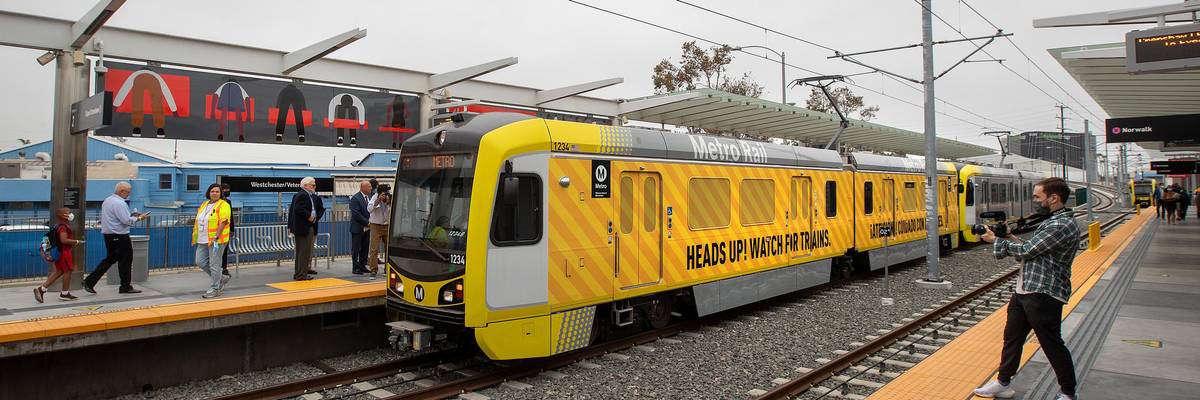
A Metro train traveling on the new K Line arrives at a station in Inglewood, California on August 22, 2022. (Photo: Mel Melcon/Los Angeles Times via Getty Images)
Progressive Rep. Cori Bush on Wednesday led the introduction of a pair of bills aimed at revamping the United States' chronically underfunded transportation infrastructure and ensuring the nation's public transit systems are efficient, accessible, and climate-friendly.
"For too long, we have let rail and bus services, which are fundamental infrastructure for essential workers and our public transit-reliant residents, go dramatically underfunded," said Bush (D-Mo.), who introduced the legislation alongside nearly dozens of fellow House Democrats.
"I am proud to introduce both the Bus Rapid Transit Act and the Light Rail Transit Act, legislation that would grant funds to transform public transit service in St. Louis and across our country," Bush continued. "Funding new and existing programs and resources needed for safer and more efficient services will upgrade infrastructure, create jobs, reduce emissions, improve connectivity, and make getting around our communities more equitable. I cannot wait to see more buses and rail cars out in our streets."
According to a summary released by Bush's office, the Bus Rapid Transit Act--backed by nearly 60 House Democrats--would "create a grant program to fund efficient publicly-owned Bus Rapid Transit systems across the country to improve on and expand high-quality bus service."
Basav Sen, director of the Climate Policy Program at the Institute for Policy Studies, called the bill "visionary" and said it is what the United States needs to "advance a just transition in our transportation system, from fossil fueled automobile dependence to reliable, accessible public transit, powered by renewable energy, and providing good union jobs."
The accompanying Light Rail Transit Act would similarly bolster light rail transportation by establishing a grant program to provide public entities with funding to implement light rail projects as an alternative to automobile transportation, a major source of U.S. greenhouse gas emissions.
"The grant program created by the bill would provide flexibility for agencies and communities applying for funds, while also maintaining strong design standards to ensure passengers have the resources and tools they need for seamless travel," Bush's office said. "The excellent labor and climate standards in the bill would ensure thousands of union jobs would be created while cars are taken off the road and new rail lines rely on renewable energy."
The light rail measure is backed by a number of climate and clean transit advocacy organizations, including Bus Riders United STL, the National Association of City Transportation Officials, the Center for Biological Diversity, Trailnet, Rise to Thrive, and Food & Water Watch.
"We applaud Representative Bush's leadership to bring equity and justice to our transportation system," said Jim Walsh, policy director at Food & Water Watch. "High-quality public transportation powered by clean renewable energy is a critical component to ensuring a just transition away from fossil fuels. This proposal would help eliminate air and climate pollution while creating affordable, convenient transportation options for all."
Citing research from TransitCenter, Alissa Walker of Curbed noted Wednesday that just "10% of Americans currently live within walking distance of transit that comes every 15 minutes or less."
"Building high-capacity trains with short headways would fix that, but not all U.S. cities have rail systems," Walker wrote. "U.S. cities of all sizes have bus systems, and transit access could increase immediately for millions of people by simply increasing how often those buses run, expanding their routes, and updating fleets."
In an interview with Curbed, Bush stressed that "people depend on the bus in order to operate in their everyday lives."
"They deserve excellent service," said the Missouri Democrat.
Dear Common Dreams reader, It’s been nearly 30 years since I co-founded Common Dreams with my late wife, Lina Newhouser. We had the radical notion that journalism should serve the public good, not corporate profits. It was clear to us from the outset what it would take to build such a project. No paid advertisements. No corporate sponsors. No millionaire publisher telling us what to think or do. Many people said we wouldn't last a year, but we proved those doubters wrong. Together with a tremendous team of journalists and dedicated staff, we built an independent media outlet free from the constraints of profits and corporate control. Our mission has always been simple: To inform. To inspire. To ignite change for the common good. Building Common Dreams was not easy. Our survival was never guaranteed. When you take on the most powerful forces—Wall Street greed, fossil fuel industry destruction, Big Tech lobbyists, and uber-rich oligarchs who have spent billions upon billions rigging the economy and democracy in their favor—the only bulwark you have is supporters who believe in your work. But here’s the urgent message from me today. It's never been this bad out there. And it's never been this hard to keep us going. At the very moment Common Dreams is most needed, the threats we face are intensifying. We need your support now more than ever. We don't accept corporate advertising and never will. We don't have a paywall because we don't think people should be blocked from critical news based on their ability to pay. Everything we do is funded by the donations of readers like you. When everyone does the little they can afford, we are strong. But if that support retreats or dries up, so do we. Will you donate now to make sure Common Dreams not only survives but thrives? —Craig Brown, Co-founder |
Progressive Rep. Cori Bush on Wednesday led the introduction of a pair of bills aimed at revamping the United States' chronically underfunded transportation infrastructure and ensuring the nation's public transit systems are efficient, accessible, and climate-friendly.
"For too long, we have let rail and bus services, which are fundamental infrastructure for essential workers and our public transit-reliant residents, go dramatically underfunded," said Bush (D-Mo.), who introduced the legislation alongside nearly dozens of fellow House Democrats.
"I am proud to introduce both the Bus Rapid Transit Act and the Light Rail Transit Act, legislation that would grant funds to transform public transit service in St. Louis and across our country," Bush continued. "Funding new and existing programs and resources needed for safer and more efficient services will upgrade infrastructure, create jobs, reduce emissions, improve connectivity, and make getting around our communities more equitable. I cannot wait to see more buses and rail cars out in our streets."
According to a summary released by Bush's office, the Bus Rapid Transit Act--backed by nearly 60 House Democrats--would "create a grant program to fund efficient publicly-owned Bus Rapid Transit systems across the country to improve on and expand high-quality bus service."
Basav Sen, director of the Climate Policy Program at the Institute for Policy Studies, called the bill "visionary" and said it is what the United States needs to "advance a just transition in our transportation system, from fossil fueled automobile dependence to reliable, accessible public transit, powered by renewable energy, and providing good union jobs."
The accompanying Light Rail Transit Act would similarly bolster light rail transportation by establishing a grant program to provide public entities with funding to implement light rail projects as an alternative to automobile transportation, a major source of U.S. greenhouse gas emissions.
"The grant program created by the bill would provide flexibility for agencies and communities applying for funds, while also maintaining strong design standards to ensure passengers have the resources and tools they need for seamless travel," Bush's office said. "The excellent labor and climate standards in the bill would ensure thousands of union jobs would be created while cars are taken off the road and new rail lines rely on renewable energy."
The light rail measure is backed by a number of climate and clean transit advocacy organizations, including Bus Riders United STL, the National Association of City Transportation Officials, the Center for Biological Diversity, Trailnet, Rise to Thrive, and Food & Water Watch.
"We applaud Representative Bush's leadership to bring equity and justice to our transportation system," said Jim Walsh, policy director at Food & Water Watch. "High-quality public transportation powered by clean renewable energy is a critical component to ensuring a just transition away from fossil fuels. This proposal would help eliminate air and climate pollution while creating affordable, convenient transportation options for all."
Citing research from TransitCenter, Alissa Walker of Curbed noted Wednesday that just "10% of Americans currently live within walking distance of transit that comes every 15 minutes or less."
"Building high-capacity trains with short headways would fix that, but not all U.S. cities have rail systems," Walker wrote. "U.S. cities of all sizes have bus systems, and transit access could increase immediately for millions of people by simply increasing how often those buses run, expanding their routes, and updating fleets."
In an interview with Curbed, Bush stressed that "people depend on the bus in order to operate in their everyday lives."
"They deserve excellent service," said the Missouri Democrat.
Progressive Rep. Cori Bush on Wednesday led the introduction of a pair of bills aimed at revamping the United States' chronically underfunded transportation infrastructure and ensuring the nation's public transit systems are efficient, accessible, and climate-friendly.
"For too long, we have let rail and bus services, which are fundamental infrastructure for essential workers and our public transit-reliant residents, go dramatically underfunded," said Bush (D-Mo.), who introduced the legislation alongside nearly dozens of fellow House Democrats.
"I am proud to introduce both the Bus Rapid Transit Act and the Light Rail Transit Act, legislation that would grant funds to transform public transit service in St. Louis and across our country," Bush continued. "Funding new and existing programs and resources needed for safer and more efficient services will upgrade infrastructure, create jobs, reduce emissions, improve connectivity, and make getting around our communities more equitable. I cannot wait to see more buses and rail cars out in our streets."
According to a summary released by Bush's office, the Bus Rapid Transit Act--backed by nearly 60 House Democrats--would "create a grant program to fund efficient publicly-owned Bus Rapid Transit systems across the country to improve on and expand high-quality bus service."
Basav Sen, director of the Climate Policy Program at the Institute for Policy Studies, called the bill "visionary" and said it is what the United States needs to "advance a just transition in our transportation system, from fossil fueled automobile dependence to reliable, accessible public transit, powered by renewable energy, and providing good union jobs."
The accompanying Light Rail Transit Act would similarly bolster light rail transportation by establishing a grant program to provide public entities with funding to implement light rail projects as an alternative to automobile transportation, a major source of U.S. greenhouse gas emissions.
"The grant program created by the bill would provide flexibility for agencies and communities applying for funds, while also maintaining strong design standards to ensure passengers have the resources and tools they need for seamless travel," Bush's office said. "The excellent labor and climate standards in the bill would ensure thousands of union jobs would be created while cars are taken off the road and new rail lines rely on renewable energy."
The light rail measure is backed by a number of climate and clean transit advocacy organizations, including Bus Riders United STL, the National Association of City Transportation Officials, the Center for Biological Diversity, Trailnet, Rise to Thrive, and Food & Water Watch.
"We applaud Representative Bush's leadership to bring equity and justice to our transportation system," said Jim Walsh, policy director at Food & Water Watch. "High-quality public transportation powered by clean renewable energy is a critical component to ensuring a just transition away from fossil fuels. This proposal would help eliminate air and climate pollution while creating affordable, convenient transportation options for all."
Citing research from TransitCenter, Alissa Walker of Curbed noted Wednesday that just "10% of Americans currently live within walking distance of transit that comes every 15 minutes or less."
"Building high-capacity trains with short headways would fix that, but not all U.S. cities have rail systems," Walker wrote. "U.S. cities of all sizes have bus systems, and transit access could increase immediately for millions of people by simply increasing how often those buses run, expanding their routes, and updating fleets."
In an interview with Curbed, Bush stressed that "people depend on the bus in order to operate in their everyday lives."
"They deserve excellent service," said the Missouri Democrat.