SUBSCRIBE TO OUR FREE NEWSLETTER
Daily news & progressive opinion—funded by the people, not the corporations—delivered straight to your inbox.
5
#000000
#FFFFFF
To donate by check, phone, or other method, see our More Ways to Give page.
Daily news & progressive opinion—funded by the people, not the corporations—delivered straight to your inbox.
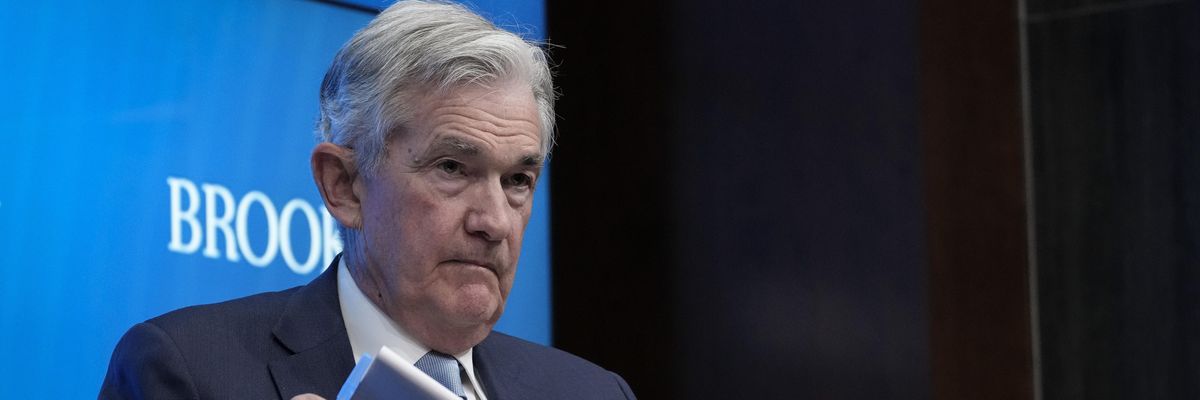
Federal Reserve Chair Jerome Powell speaks at the Brookings Institution on November 30, 2022 in Washington, D.C.
Economists and progressive policy advocates on Tuesday urged the Federal Reserve to abandon its plans for further interest rate hikes--or, at the very least, slow down significantly--after the Labor Department released data showing that inflation cooled more than expected in November, the second consecutive month of lighter-than-anticipated price increases.
The Bureau of Labor Statistics said Tuesday that the Consumer Price Index (CPI) rose just 0.1% last month compared to a 0.4% increase in October as inflationary pressures eased across the economy, from food to transportation to medical services. Compared to a year ago, inflation was up 7.1% in November, the lowest level since December 2021.
"The Fed is putting the onus of fighting inflation on workers and consumers rather than on the corporations responsible for it."
"Today's cooler-than-expected CPI report sends a clear message that [Fed Chair Jerome] Powell should think twice before hiking up interest rates again," said Michael Mitchell, director of policy and research at the Groundwork Collaborative. "Powell himself has admitted that we have yet to feel the full impact of interest rate hikes on our economy. Experts from Nobel Laureate economists to business leaders agree: adding more fuel to the fire risks throwing our economy into a painful recession."
Josh Bivens, research director at the Economic Policy Institute, similarly argued Tuesday that the new numbers "definitely should solidify any urge by the Fed to ramp down the pace of interest rate hikes."
"There was nothing in today's report that says anything but 'inflation slowing a lot,' even with the economy still looking healthy on many measures," Bivens added. "In short, a 'soft landing' remains in reach, and the Fed should try really hard to secure it."
The new CPI figures were released as Fed policymakers prepared for their latest two-day meeting, which is expected to conclude Wednesday with Chair Jerome Powell announcing another sizeable interest rate increase--likely 50 basis points, a slight slowdown after four consecutive hikes of 75 basis points.
Powell, who has faced mounting backlash from economists and lawmakers for intentionally putting the U.S. economy at greater risk of recession, has previously said the Fed intends to continue raising rates into 2023 and plans to keep them at a higher level for an extended period as long as inflation remains elevated.
That would be a major mistake, former U.S. Labor Secretary Robert Reich warned in an op-ed for The Guardian Tuesday morning.
"Domestic inflation is being driven by profits, not wages. And interest rate hikes don't reduce profit-driven inflation--at least not directly. Instead, workers and consumers take the hit," Reich wrote. "It's important that Americans know the truth. Seven Fed rate hikes in just nine months have not dented corporate power to raise prices and profit margins."
"Which is why the Fed is putting the onus of fighting inflation on workers and consumers rather than on the corporations responsible for it," Reich continued. "This is wrong. It's bad economics. It's insane politics. And it's profoundly unfair."
In recent weeks, a growing chorus of experts has joined Reich in sounding the alarm over the recessionary risks inherent in the Fed's approach, which aims to rein in prices by tamping down economic demand, slowing hiring, and cutting workers' wages. Powell has explicitly said "pain" is on the horizon for families as the Fed moves ahead with its rate increases, and the Fed's own estimates have suggested its policy moves could unnecessarily throw more than a million people out of work in the U.S.
"We do not need to crush workers to get inflation down. We do not," Claudia Sahm, a former Fed economist, argued in a blog post earlier this month. "Inflation is turning and unemployment is very low. The labor market, on most measures, is more robust and pro-worker than it was even before Covid. Good! We did not and do not need a recession. We do not need the Fed to cause one."
But despite mounting outside pressure to change course, the Wall Street Journal reported Tuesday that "the Federal Reserve remains on track to lift interest rates by 0.5 percentage point on Wednesday to fight high inflation."
Skanda Amarnath, executive director of Employ America, predicted that "the Fed is likely to tell us tomorrow that optimal policy involves pursuing recessionary unemployment rate increases. Even more so than September."
"Such an approach is so obviously problematic," he wrote on Twitter.
Dear Common Dreams reader, It’s been nearly 30 years since I co-founded Common Dreams with my late wife, Lina Newhouser. We had the radical notion that journalism should serve the public good, not corporate profits. It was clear to us from the outset what it would take to build such a project. No paid advertisements. No corporate sponsors. No millionaire publisher telling us what to think or do. Many people said we wouldn't last a year, but we proved those doubters wrong. Together with a tremendous team of journalists and dedicated staff, we built an independent media outlet free from the constraints of profits and corporate control. Our mission has always been simple: To inform. To inspire. To ignite change for the common good. Building Common Dreams was not easy. Our survival was never guaranteed. When you take on the most powerful forces—Wall Street greed, fossil fuel industry destruction, Big Tech lobbyists, and uber-rich oligarchs who have spent billions upon billions rigging the economy and democracy in their favor—the only bulwark you have is supporters who believe in your work. But here’s the urgent message from me today. It's never been this bad out there. And it's never been this hard to keep us going. At the very moment Common Dreams is most needed, the threats we face are intensifying. We need your support now more than ever. We don't accept corporate advertising and never will. We don't have a paywall because we don't think people should be blocked from critical news based on their ability to pay. Everything we do is funded by the donations of readers like you. When everyone does the little they can afford, we are strong. But if that support retreats or dries up, so do we. Will you donate now to make sure Common Dreams not only survives but thrives? —Craig Brown, Co-founder |
Economists and progressive policy advocates on Tuesday urged the Federal Reserve to abandon its plans for further interest rate hikes--or, at the very least, slow down significantly--after the Labor Department released data showing that inflation cooled more than expected in November, the second consecutive month of lighter-than-anticipated price increases.
The Bureau of Labor Statistics said Tuesday that the Consumer Price Index (CPI) rose just 0.1% last month compared to a 0.4% increase in October as inflationary pressures eased across the economy, from food to transportation to medical services. Compared to a year ago, inflation was up 7.1% in November, the lowest level since December 2021.
"The Fed is putting the onus of fighting inflation on workers and consumers rather than on the corporations responsible for it."
"Today's cooler-than-expected CPI report sends a clear message that [Fed Chair Jerome] Powell should think twice before hiking up interest rates again," said Michael Mitchell, director of policy and research at the Groundwork Collaborative. "Powell himself has admitted that we have yet to feel the full impact of interest rate hikes on our economy. Experts from Nobel Laureate economists to business leaders agree: adding more fuel to the fire risks throwing our economy into a painful recession."
Josh Bivens, research director at the Economic Policy Institute, similarly argued Tuesday that the new numbers "definitely should solidify any urge by the Fed to ramp down the pace of interest rate hikes."
"There was nothing in today's report that says anything but 'inflation slowing a lot,' even with the economy still looking healthy on many measures," Bivens added. "In short, a 'soft landing' remains in reach, and the Fed should try really hard to secure it."
The new CPI figures were released as Fed policymakers prepared for their latest two-day meeting, which is expected to conclude Wednesday with Chair Jerome Powell announcing another sizeable interest rate increase--likely 50 basis points, a slight slowdown after four consecutive hikes of 75 basis points.
Powell, who has faced mounting backlash from economists and lawmakers for intentionally putting the U.S. economy at greater risk of recession, has previously said the Fed intends to continue raising rates into 2023 and plans to keep them at a higher level for an extended period as long as inflation remains elevated.
That would be a major mistake, former U.S. Labor Secretary Robert Reich warned in an op-ed for The Guardian Tuesday morning.
"Domestic inflation is being driven by profits, not wages. And interest rate hikes don't reduce profit-driven inflation--at least not directly. Instead, workers and consumers take the hit," Reich wrote. "It's important that Americans know the truth. Seven Fed rate hikes in just nine months have not dented corporate power to raise prices and profit margins."
"Which is why the Fed is putting the onus of fighting inflation on workers and consumers rather than on the corporations responsible for it," Reich continued. "This is wrong. It's bad economics. It's insane politics. And it's profoundly unfair."
In recent weeks, a growing chorus of experts has joined Reich in sounding the alarm over the recessionary risks inherent in the Fed's approach, which aims to rein in prices by tamping down economic demand, slowing hiring, and cutting workers' wages. Powell has explicitly said "pain" is on the horizon for families as the Fed moves ahead with its rate increases, and the Fed's own estimates have suggested its policy moves could unnecessarily throw more than a million people out of work in the U.S.
"We do not need to crush workers to get inflation down. We do not," Claudia Sahm, a former Fed economist, argued in a blog post earlier this month. "Inflation is turning and unemployment is very low. The labor market, on most measures, is more robust and pro-worker than it was even before Covid. Good! We did not and do not need a recession. We do not need the Fed to cause one."
But despite mounting outside pressure to change course, the Wall Street Journal reported Tuesday that "the Federal Reserve remains on track to lift interest rates by 0.5 percentage point on Wednesday to fight high inflation."
Skanda Amarnath, executive director of Employ America, predicted that "the Fed is likely to tell us tomorrow that optimal policy involves pursuing recessionary unemployment rate increases. Even more so than September."
"Such an approach is so obviously problematic," he wrote on Twitter.
Economists and progressive policy advocates on Tuesday urged the Federal Reserve to abandon its plans for further interest rate hikes--or, at the very least, slow down significantly--after the Labor Department released data showing that inflation cooled more than expected in November, the second consecutive month of lighter-than-anticipated price increases.
The Bureau of Labor Statistics said Tuesday that the Consumer Price Index (CPI) rose just 0.1% last month compared to a 0.4% increase in October as inflationary pressures eased across the economy, from food to transportation to medical services. Compared to a year ago, inflation was up 7.1% in November, the lowest level since December 2021.
"The Fed is putting the onus of fighting inflation on workers and consumers rather than on the corporations responsible for it."
"Today's cooler-than-expected CPI report sends a clear message that [Fed Chair Jerome] Powell should think twice before hiking up interest rates again," said Michael Mitchell, director of policy and research at the Groundwork Collaborative. "Powell himself has admitted that we have yet to feel the full impact of interest rate hikes on our economy. Experts from Nobel Laureate economists to business leaders agree: adding more fuel to the fire risks throwing our economy into a painful recession."
Josh Bivens, research director at the Economic Policy Institute, similarly argued Tuesday that the new numbers "definitely should solidify any urge by the Fed to ramp down the pace of interest rate hikes."
"There was nothing in today's report that says anything but 'inflation slowing a lot,' even with the economy still looking healthy on many measures," Bivens added. "In short, a 'soft landing' remains in reach, and the Fed should try really hard to secure it."
The new CPI figures were released as Fed policymakers prepared for their latest two-day meeting, which is expected to conclude Wednesday with Chair Jerome Powell announcing another sizeable interest rate increase--likely 50 basis points, a slight slowdown after four consecutive hikes of 75 basis points.
Powell, who has faced mounting backlash from economists and lawmakers for intentionally putting the U.S. economy at greater risk of recession, has previously said the Fed intends to continue raising rates into 2023 and plans to keep them at a higher level for an extended period as long as inflation remains elevated.
That would be a major mistake, former U.S. Labor Secretary Robert Reich warned in an op-ed for The Guardian Tuesday morning.
"Domestic inflation is being driven by profits, not wages. And interest rate hikes don't reduce profit-driven inflation--at least not directly. Instead, workers and consumers take the hit," Reich wrote. "It's important that Americans know the truth. Seven Fed rate hikes in just nine months have not dented corporate power to raise prices and profit margins."
"Which is why the Fed is putting the onus of fighting inflation on workers and consumers rather than on the corporations responsible for it," Reich continued. "This is wrong. It's bad economics. It's insane politics. And it's profoundly unfair."
In recent weeks, a growing chorus of experts has joined Reich in sounding the alarm over the recessionary risks inherent in the Fed's approach, which aims to rein in prices by tamping down economic demand, slowing hiring, and cutting workers' wages. Powell has explicitly said "pain" is on the horizon for families as the Fed moves ahead with its rate increases, and the Fed's own estimates have suggested its policy moves could unnecessarily throw more than a million people out of work in the U.S.
"We do not need to crush workers to get inflation down. We do not," Claudia Sahm, a former Fed economist, argued in a blog post earlier this month. "Inflation is turning and unemployment is very low. The labor market, on most measures, is more robust and pro-worker than it was even before Covid. Good! We did not and do not need a recession. We do not need the Fed to cause one."
But despite mounting outside pressure to change course, the Wall Street Journal reported Tuesday that "the Federal Reserve remains on track to lift interest rates by 0.5 percentage point on Wednesday to fight high inflation."
Skanda Amarnath, executive director of Employ America, predicted that "the Fed is likely to tell us tomorrow that optimal policy involves pursuing recessionary unemployment rate increases. Even more so than September."
"Such an approach is so obviously problematic," he wrote on Twitter.