SUBSCRIBE TO OUR FREE NEWSLETTER
Daily news & progressive opinion—funded by the people, not the corporations—delivered straight to your inbox.
5
#000000
#FFFFFF
To donate by check, phone, or other method, see our More Ways to Give page.
Daily news & progressive opinion—funded by the people, not the corporations—delivered straight to your inbox.
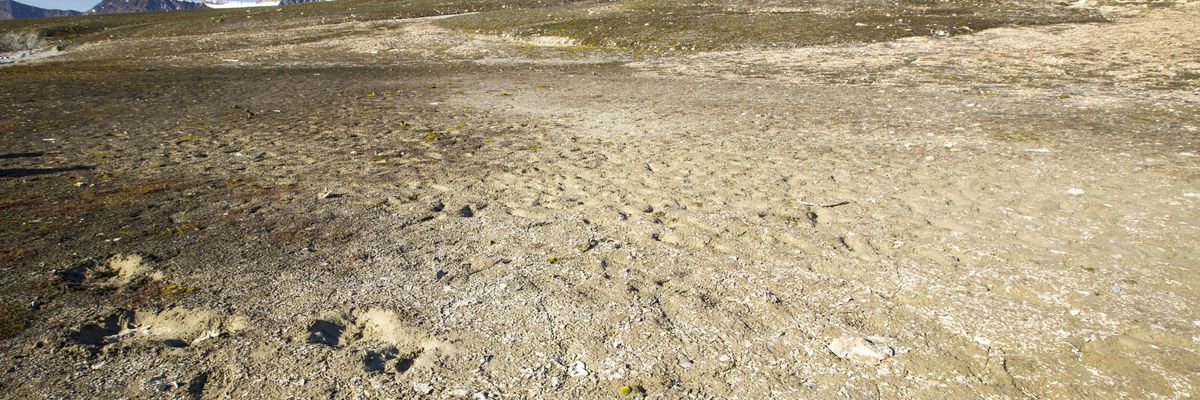
Polar Bear footprints in melting permafrost on Northern Svalbard. (Getty images)
As our world continues to warm up, vast areas of permafrost are rapidly melting, releasing material that's been trapped for up to a million years. This includes uncountable numbers of microbes that have been lying dormant for hundreds of millennia.
To study these emerging microbes, scientists from the French National Center for Scientific Research have now revived a number of these "zombie viruses" from the Siberian permafrost, including one thought to be nearly 50,000 years old - a record age for a frozen virus returning to a state capable of infecting other organisms.
The team behind the study, led by microbiologist Jean-Marie, says these ancient viruses are potentially a significant threat to public health, and further study needs to be done to assess the danger that these infectious agents could pose as the permafrost melts.
The researchers warned it may just be the tip of the iceberg:
"One-quarter of the Northern Hemisphere is underlain by permanently frozen ground, referred to as permafrost," researchers wrote in the paper.
"Due to climate warming, irreversibly thawing permafrost is releasing organic matter frozen for up to a million years, most of which decomposes into carbon dioxide and methane, further enhancing the greenhouse effect. Part of this organic matter also consists of revived cellular microbes (prokaryotes, unicellular eukaryotes) as well as viruses that remained dormant since prehistorical times."
According to Global News:
In 2014, the same researchers unearthed a 30,000-year-old virus trapped in permafrost, the BBC reported. The discovery was groundbreaking because after all that time, the virus was still able to infect organisms. But now, they've beaten their own record by reviving a virus that is 48,500 years old.
"If the authors are indeed isolating live viruses from ancient permafrost, it is likely that the even smaller, simpler mammalian viruses would also survive frozen for eons," virologist Eric Delwart from the University of California, San Francisco told New Scientist.
Dear Common Dreams reader, It’s been nearly 30 years since I co-founded Common Dreams with my late wife, Lina Newhouser. We had the radical notion that journalism should serve the public good, not corporate profits. It was clear to us from the outset what it would take to build such a project. No paid advertisements. No corporate sponsors. No millionaire publisher telling us what to think or do. Many people said we wouldn't last a year, but we proved those doubters wrong. Together with a tremendous team of journalists and dedicated staff, we built an independent media outlet free from the constraints of profits and corporate control. Our mission has always been simple: To inform. To inspire. To ignite change for the common good. Building Common Dreams was not easy. Our survival was never guaranteed. When you take on the most powerful forces—Wall Street greed, fossil fuel industry destruction, Big Tech lobbyists, and uber-rich oligarchs who have spent billions upon billions rigging the economy and democracy in their favor—the only bulwark you have is supporters who believe in your work. But here’s the urgent message from me today. It's never been this bad out there. And it's never been this hard to keep us going. At the very moment Common Dreams is most needed, the threats we face are intensifying. We need your support now more than ever. We don't accept corporate advertising and never will. We don't have a paywall because we don't think people should be blocked from critical news based on their ability to pay. Everything we do is funded by the donations of readers like you. When everyone does the little they can afford, we are strong. But if that support retreats or dries up, so do we. Will you donate now to make sure Common Dreams not only survives but thrives? —Craig Brown, Co-founder |
As our world continues to warm up, vast areas of permafrost are rapidly melting, releasing material that's been trapped for up to a million years. This includes uncountable numbers of microbes that have been lying dormant for hundreds of millennia.
To study these emerging microbes, scientists from the French National Center for Scientific Research have now revived a number of these "zombie viruses" from the Siberian permafrost, including one thought to be nearly 50,000 years old - a record age for a frozen virus returning to a state capable of infecting other organisms.
The team behind the study, led by microbiologist Jean-Marie, says these ancient viruses are potentially a significant threat to public health, and further study needs to be done to assess the danger that these infectious agents could pose as the permafrost melts.
The researchers warned it may just be the tip of the iceberg:
"One-quarter of the Northern Hemisphere is underlain by permanently frozen ground, referred to as permafrost," researchers wrote in the paper.
"Due to climate warming, irreversibly thawing permafrost is releasing organic matter frozen for up to a million years, most of which decomposes into carbon dioxide and methane, further enhancing the greenhouse effect. Part of this organic matter also consists of revived cellular microbes (prokaryotes, unicellular eukaryotes) as well as viruses that remained dormant since prehistorical times."
According to Global News:
In 2014, the same researchers unearthed a 30,000-year-old virus trapped in permafrost, the BBC reported. The discovery was groundbreaking because after all that time, the virus was still able to infect organisms. But now, they've beaten their own record by reviving a virus that is 48,500 years old.
"If the authors are indeed isolating live viruses from ancient permafrost, it is likely that the even smaller, simpler mammalian viruses would also survive frozen for eons," virologist Eric Delwart from the University of California, San Francisco told New Scientist.
As our world continues to warm up, vast areas of permafrost are rapidly melting, releasing material that's been trapped for up to a million years. This includes uncountable numbers of microbes that have been lying dormant for hundreds of millennia.
To study these emerging microbes, scientists from the French National Center for Scientific Research have now revived a number of these "zombie viruses" from the Siberian permafrost, including one thought to be nearly 50,000 years old - a record age for a frozen virus returning to a state capable of infecting other organisms.
The team behind the study, led by microbiologist Jean-Marie, says these ancient viruses are potentially a significant threat to public health, and further study needs to be done to assess the danger that these infectious agents could pose as the permafrost melts.
The researchers warned it may just be the tip of the iceberg:
"One-quarter of the Northern Hemisphere is underlain by permanently frozen ground, referred to as permafrost," researchers wrote in the paper.
"Due to climate warming, irreversibly thawing permafrost is releasing organic matter frozen for up to a million years, most of which decomposes into carbon dioxide and methane, further enhancing the greenhouse effect. Part of this organic matter also consists of revived cellular microbes (prokaryotes, unicellular eukaryotes) as well as viruses that remained dormant since prehistorical times."
According to Global News:
In 2014, the same researchers unearthed a 30,000-year-old virus trapped in permafrost, the BBC reported. The discovery was groundbreaking because after all that time, the virus was still able to infect organisms. But now, they've beaten their own record by reviving a virus that is 48,500 years old.
"If the authors are indeed isolating live viruses from ancient permafrost, it is likely that the even smaller, simpler mammalian viruses would also survive frozen for eons," virologist Eric Delwart from the University of California, San Francisco told New Scientist.