SUBSCRIBE TO OUR FREE NEWSLETTER
Daily news & progressive opinion—funded by the people, not the corporations—delivered straight to your inbox.
5
#000000
#FFFFFF
To donate by check, phone, or other method, see our More Ways to Give page.
Daily news & progressive opinion—funded by the people, not the corporations—delivered straight to your inbox.
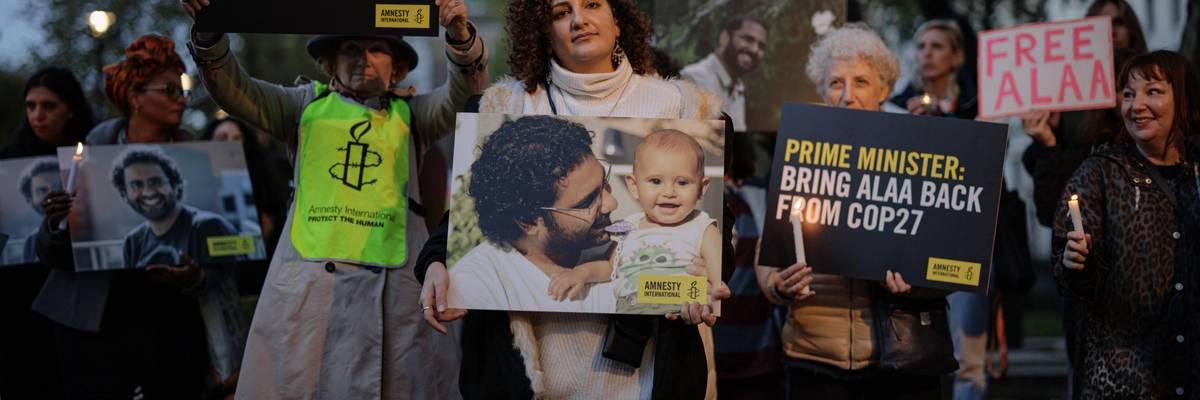
Mona Seif (center), sister of Egyptian-British political prisoner Alaa Abd El Fattah, holds a photo of her brother and his child during a November 6, 2022 candlelit vigil in London. (Photo: Rob Pinney/Getty Images)
Relatives of Alaa Abd El Fattah said Monday that they've received proof in the form of a letter that the jailed, hunger-striking Egyptian-British dissident is alive.
"I'm so relieved. We just got a note from prison to my mother, Alaa is alive, he says he's drinking water again."
"How are you, Mama? I'm sure you're really worried about me," El Fattah's letter, which is dated November 12, begins. "From today I'm drinking water again so you can stop worrying until you see me yourself. Vital signs today are OK. I'm measuring regularly and receiving medical attention."
The 40-year-old father--who according to Egyptian authorities received a "medical intervention" last week--promises to write again and asks his mother to bring him an MP3 player and vitamins when she is able to visit.
Sanaa Seif, El Fattah's sister, tweeted: "I'm so relieved. We just got a note from prison to my mother, Alaa is alive, he says he's drinking water again... He says he'll say more as soon as he can. It's definitely his handwriting. Proof of life, at last."
"Today is the first day I've been able to take a proper breath in eight days," Seif told the BBC. "Now we know he's alive. I'd know his handwriting anywhere. But when I read [the letter] again and again it leaves me with more questions. Why have they been refusing his lawyer access to him, even with a permit? Why did they hold this letter back from us for two days? Is it just cruelty to punish the family for speaking up?"
Khaled Ali, an attorney representing El Fattah's family, said on Facebook Monday that Alaa also wrote in the letter that he was "fine and under medical supervision."
El Fattah has been imprisoned for most of the past decade for his activism. He played a prominent role in the Arab Spring pro-democracy uprisings that swept the Middle East in the early 2010s and is currently serving a five-year sentence for allegedly disseminating "false news undermining national security," a common charge used to silence activists in the Middle Eastern country run by authoritarian President Gen. Abdel Fattah el-Sisi.
Subjected to torture by beating, solitary confinement, and other methods, El Fattah began his hunger strike 206 days ago on April 2. Earlier this month--with his health already dangerously deteriorated--he stopped drinking water as world leaders, activists, and others gathered in Sharm El-Sheikh, Egypt for the United Nations Climate Change Conference, or COP27.
World leaders, human rights groups, Nobel laureates, climate activists, and others have called for the release of El Fattah and the tens of thousands of other political prisoners jailed in Egypt. Demonstrations in Egypt, Britain, the United States, and elsewhere have demanded the dissident's immediate release.
In a Monday interview with Times Radio, U.K. Foreign Secretary James Cleverly said he was keeping "a very, very close eye on this case."
"What we will do," he said, "is we will keep working to secure consular access because he is British dual national and that is what we expect and we'll keep pushing to get resolution on this long standing and very difficult case."
Dear Common Dreams reader, It’s been nearly 30 years since I co-founded Common Dreams with my late wife, Lina Newhouser. We had the radical notion that journalism should serve the public good, not corporate profits. It was clear to us from the outset what it would take to build such a project. No paid advertisements. No corporate sponsors. No millionaire publisher telling us what to think or do. Many people said we wouldn't last a year, but we proved those doubters wrong. Together with a tremendous team of journalists and dedicated staff, we built an independent media outlet free from the constraints of profits and corporate control. Our mission has always been simple: To inform. To inspire. To ignite change for the common good. Building Common Dreams was not easy. Our survival was never guaranteed. When you take on the most powerful forces—Wall Street greed, fossil fuel industry destruction, Big Tech lobbyists, and uber-rich oligarchs who have spent billions upon billions rigging the economy and democracy in their favor—the only bulwark you have is supporters who believe in your work. But here’s the urgent message from me today. It's never been this bad out there. And it's never been this hard to keep us going. At the very moment Common Dreams is most needed, the threats we face are intensifying. We need your support now more than ever. We don't accept corporate advertising and never will. We don't have a paywall because we don't think people should be blocked from critical news based on their ability to pay. Everything we do is funded by the donations of readers like you. When everyone does the little they can afford, we are strong. But if that support retreats or dries up, so do we. Will you donate now to make sure Common Dreams not only survives but thrives? —Craig Brown, Co-founder |
Relatives of Alaa Abd El Fattah said Monday that they've received proof in the form of a letter that the jailed, hunger-striking Egyptian-British dissident is alive.
"I'm so relieved. We just got a note from prison to my mother, Alaa is alive, he says he's drinking water again."
"How are you, Mama? I'm sure you're really worried about me," El Fattah's letter, which is dated November 12, begins. "From today I'm drinking water again so you can stop worrying until you see me yourself. Vital signs today are OK. I'm measuring regularly and receiving medical attention."
The 40-year-old father--who according to Egyptian authorities received a "medical intervention" last week--promises to write again and asks his mother to bring him an MP3 player and vitamins when she is able to visit.
Sanaa Seif, El Fattah's sister, tweeted: "I'm so relieved. We just got a note from prison to my mother, Alaa is alive, he says he's drinking water again... He says he'll say more as soon as he can. It's definitely his handwriting. Proof of life, at last."
"Today is the first day I've been able to take a proper breath in eight days," Seif told the BBC. "Now we know he's alive. I'd know his handwriting anywhere. But when I read [the letter] again and again it leaves me with more questions. Why have they been refusing his lawyer access to him, even with a permit? Why did they hold this letter back from us for two days? Is it just cruelty to punish the family for speaking up?"
Khaled Ali, an attorney representing El Fattah's family, said on Facebook Monday that Alaa also wrote in the letter that he was "fine and under medical supervision."
El Fattah has been imprisoned for most of the past decade for his activism. He played a prominent role in the Arab Spring pro-democracy uprisings that swept the Middle East in the early 2010s and is currently serving a five-year sentence for allegedly disseminating "false news undermining national security," a common charge used to silence activists in the Middle Eastern country run by authoritarian President Gen. Abdel Fattah el-Sisi.
Subjected to torture by beating, solitary confinement, and other methods, El Fattah began his hunger strike 206 days ago on April 2. Earlier this month--with his health already dangerously deteriorated--he stopped drinking water as world leaders, activists, and others gathered in Sharm El-Sheikh, Egypt for the United Nations Climate Change Conference, or COP27.
World leaders, human rights groups, Nobel laureates, climate activists, and others have called for the release of El Fattah and the tens of thousands of other political prisoners jailed in Egypt. Demonstrations in Egypt, Britain, the United States, and elsewhere have demanded the dissident's immediate release.
In a Monday interview with Times Radio, U.K. Foreign Secretary James Cleverly said he was keeping "a very, very close eye on this case."
"What we will do," he said, "is we will keep working to secure consular access because he is British dual national and that is what we expect and we'll keep pushing to get resolution on this long standing and very difficult case."
Relatives of Alaa Abd El Fattah said Monday that they've received proof in the form of a letter that the jailed, hunger-striking Egyptian-British dissident is alive.
"I'm so relieved. We just got a note from prison to my mother, Alaa is alive, he says he's drinking water again."
"How are you, Mama? I'm sure you're really worried about me," El Fattah's letter, which is dated November 12, begins. "From today I'm drinking water again so you can stop worrying until you see me yourself. Vital signs today are OK. I'm measuring regularly and receiving medical attention."
The 40-year-old father--who according to Egyptian authorities received a "medical intervention" last week--promises to write again and asks his mother to bring him an MP3 player and vitamins when she is able to visit.
Sanaa Seif, El Fattah's sister, tweeted: "I'm so relieved. We just got a note from prison to my mother, Alaa is alive, he says he's drinking water again... He says he'll say more as soon as he can. It's definitely his handwriting. Proof of life, at last."
"Today is the first day I've been able to take a proper breath in eight days," Seif told the BBC. "Now we know he's alive. I'd know his handwriting anywhere. But when I read [the letter] again and again it leaves me with more questions. Why have they been refusing his lawyer access to him, even with a permit? Why did they hold this letter back from us for two days? Is it just cruelty to punish the family for speaking up?"
Khaled Ali, an attorney representing El Fattah's family, said on Facebook Monday that Alaa also wrote in the letter that he was "fine and under medical supervision."
El Fattah has been imprisoned for most of the past decade for his activism. He played a prominent role in the Arab Spring pro-democracy uprisings that swept the Middle East in the early 2010s and is currently serving a five-year sentence for allegedly disseminating "false news undermining national security," a common charge used to silence activists in the Middle Eastern country run by authoritarian President Gen. Abdel Fattah el-Sisi.
Subjected to torture by beating, solitary confinement, and other methods, El Fattah began his hunger strike 206 days ago on April 2. Earlier this month--with his health already dangerously deteriorated--he stopped drinking water as world leaders, activists, and others gathered in Sharm El-Sheikh, Egypt for the United Nations Climate Change Conference, or COP27.
World leaders, human rights groups, Nobel laureates, climate activists, and others have called for the release of El Fattah and the tens of thousands of other political prisoners jailed in Egypt. Demonstrations in Egypt, Britain, the United States, and elsewhere have demanded the dissident's immediate release.
In a Monday interview with Times Radio, U.K. Foreign Secretary James Cleverly said he was keeping "a very, very close eye on this case."
"What we will do," he said, "is we will keep working to secure consular access because he is British dual national and that is what we expect and we'll keep pushing to get resolution on this long standing and very difficult case."