SUBSCRIBE TO OUR FREE NEWSLETTER
Daily news & progressive opinion—funded by the people, not the corporations—delivered straight to your inbox.
5
#000000
#FFFFFF
To donate by check, phone, or other method, see our More Ways to Give page.
Daily news & progressive opinion—funded by the people, not the corporations—delivered straight to your inbox.
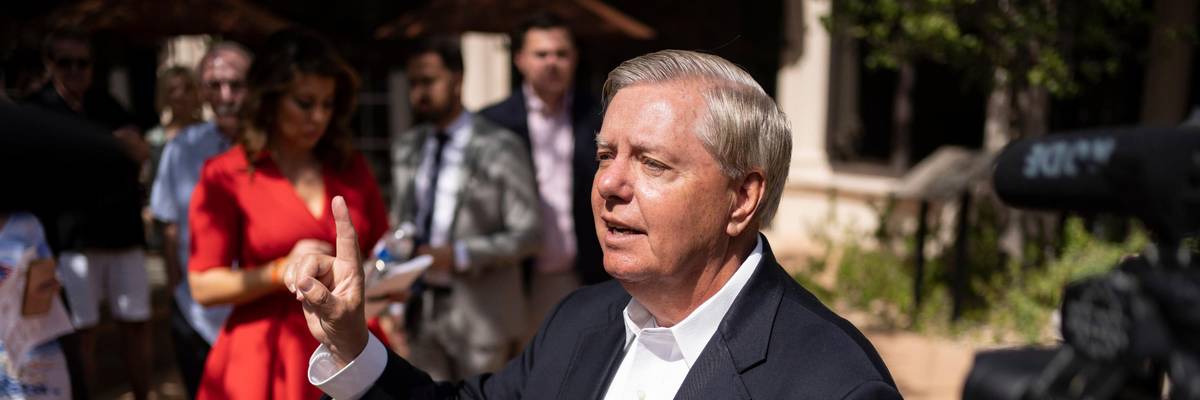
U.S. Sen. Lindsey Graham (R-S.C.) speaks to journalists after a panel discussion at a resort in Scottsdale, Arizona on October 14, 2022. (Photo: Rebecca Noble/Getty Images)
The U.S. Supreme Court on Tuesday rejected an emergency request from Sen. Lindsey Graham to block a subpoena forcing him to testify before a special purpose grand jury in Fulton County, Georgia probing efforts to overturn the 2020 presidential election results in state.
The high court's decision, which did not include any dissents or recusals, came after Justice Clarence Thomas last week temporarily blocked the subpoena following a ruling against Graham (R-S.C.) by a three-judge panel of the 11th U.S. Circuit Court of Appeals.
The Washington Post reported that Democratic Fulton County District Attorney Fani Willis wants to question Graham on November 17 about calls he made to Georgia election officials in the wake of then-President Donald Trump electoral loss two years ago.
According to the newspaper, "Prosecutors say Graham has 'unique knowledge' about the Trump campaign and the 'multistate, coordinated efforts to influence the results' of the election in Georgia and elsewhere."
The Supreme Court noted Tuesday that lower courts recognized Graham should not be questioned about any "informal investigative fact-finding" that is protected by the Constitution, and further disputes about specific questions can be settled in court.
The Post pointed out that "jurors already have heard testimony from several Trump lawyers, including Rudy Giuliani, John Eastman, and Boris Epshteyn. A judge has also ruled that former White House chief of staff Mark Meadows must testify."
Dear Common Dreams reader, It’s been nearly 30 years since I co-founded Common Dreams with my late wife, Lina Newhouser. We had the radical notion that journalism should serve the public good, not corporate profits. It was clear to us from the outset what it would take to build such a project. No paid advertisements. No corporate sponsors. No millionaire publisher telling us what to think or do. Many people said we wouldn't last a year, but we proved those doubters wrong. Together with a tremendous team of journalists and dedicated staff, we built an independent media outlet free from the constraints of profits and corporate control. Our mission has always been simple: To inform. To inspire. To ignite change for the common good. Building Common Dreams was not easy. Our survival was never guaranteed. When you take on the most powerful forces—Wall Street greed, fossil fuel industry destruction, Big Tech lobbyists, and uber-rich oligarchs who have spent billions upon billions rigging the economy and democracy in their favor—the only bulwark you have is supporters who believe in your work. But here’s the urgent message from me today. It's never been this bad out there. And it's never been this hard to keep us going. At the very moment Common Dreams is most needed, the threats we face are intensifying. We need your support now more than ever. We don't accept corporate advertising and never will. We don't have a paywall because we don't think people should be blocked from critical news based on their ability to pay. Everything we do is funded by the donations of readers like you. When everyone does the little they can afford, we are strong. But if that support retreats or dries up, so do we. Will you donate now to make sure Common Dreams not only survives but thrives? —Craig Brown, Co-founder |
The U.S. Supreme Court on Tuesday rejected an emergency request from Sen. Lindsey Graham to block a subpoena forcing him to testify before a special purpose grand jury in Fulton County, Georgia probing efforts to overturn the 2020 presidential election results in state.
The high court's decision, which did not include any dissents or recusals, came after Justice Clarence Thomas last week temporarily blocked the subpoena following a ruling against Graham (R-S.C.) by a three-judge panel of the 11th U.S. Circuit Court of Appeals.
The Washington Post reported that Democratic Fulton County District Attorney Fani Willis wants to question Graham on November 17 about calls he made to Georgia election officials in the wake of then-President Donald Trump electoral loss two years ago.
According to the newspaper, "Prosecutors say Graham has 'unique knowledge' about the Trump campaign and the 'multistate, coordinated efforts to influence the results' of the election in Georgia and elsewhere."
The Supreme Court noted Tuesday that lower courts recognized Graham should not be questioned about any "informal investigative fact-finding" that is protected by the Constitution, and further disputes about specific questions can be settled in court.
The Post pointed out that "jurors already have heard testimony from several Trump lawyers, including Rudy Giuliani, John Eastman, and Boris Epshteyn. A judge has also ruled that former White House chief of staff Mark Meadows must testify."
The U.S. Supreme Court on Tuesday rejected an emergency request from Sen. Lindsey Graham to block a subpoena forcing him to testify before a special purpose grand jury in Fulton County, Georgia probing efforts to overturn the 2020 presidential election results in state.
The high court's decision, which did not include any dissents or recusals, came after Justice Clarence Thomas last week temporarily blocked the subpoena following a ruling against Graham (R-S.C.) by a three-judge panel of the 11th U.S. Circuit Court of Appeals.
The Washington Post reported that Democratic Fulton County District Attorney Fani Willis wants to question Graham on November 17 about calls he made to Georgia election officials in the wake of then-President Donald Trump electoral loss two years ago.
According to the newspaper, "Prosecutors say Graham has 'unique knowledge' about the Trump campaign and the 'multistate, coordinated efforts to influence the results' of the election in Georgia and elsewhere."
The Supreme Court noted Tuesday that lower courts recognized Graham should not be questioned about any "informal investigative fact-finding" that is protected by the Constitution, and further disputes about specific questions can be settled in court.
The Post pointed out that "jurors already have heard testimony from several Trump lawyers, including Rudy Giuliani, John Eastman, and Boris Epshteyn. A judge has also ruled that former White House chief of staff Mark Meadows must testify."