SUBSCRIBE TO OUR FREE NEWSLETTER
Daily news & progressive opinion—funded by the people, not the corporations—delivered straight to your inbox.
5
#000000
#FFFFFF
To donate by check, phone, or other method, see our More Ways to Give page.
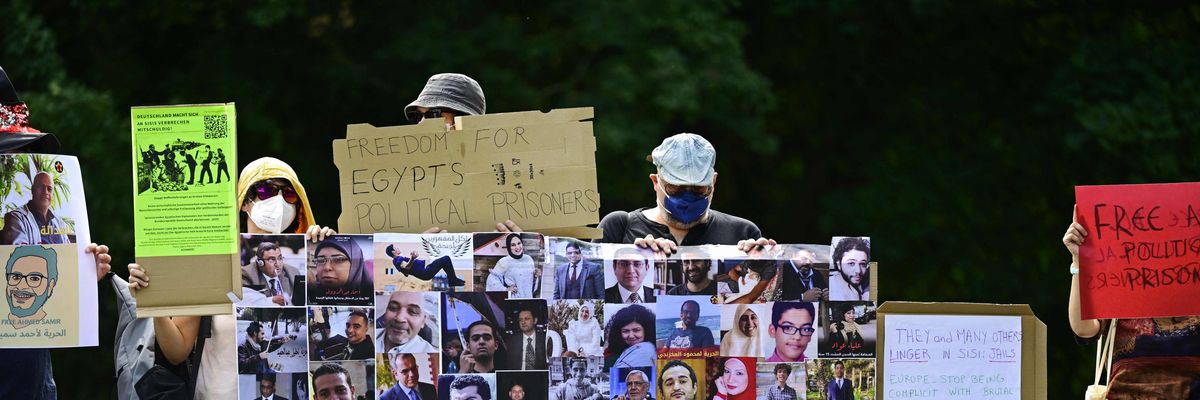
With a month to go until Egypt hosts the United Nations Climate Conference in Sharm el-Sheikh, Canadian author, social activist, and filmmaker Naomi Klein on Friday drew attention to the human rights crimes and greenwashing committed by the country's dictatorship.
"This summit is going well beyond greenwashing a polluting state; it's greenwashing a police state."
In a deep-dive article published by The Intercept, Klein centers the story of Alaa Abd El Fattah, an Egyptian-Briton who is "arguably Egypt's highest-profile political prisoner" and has been jailed "almost continuously for the past decade" for his activism, especially his prominent role in the Arab Spring pro-democracy uprisings that swept the Middle East in the early 2010s.
El Fattah is currently serving a five-year sentence after being convicted of spreading "false news undermining national security," a common charge against activists. His health has dangerously deteriorated as a result of the hunger strike he's been on since April 2 to protest the torture--including brutal beatings and solitary confinement--and other abuses perpetrated by his jailers.
Klein asks, "If international solidarity is too weak to save Alaa--an iconic symbol of a generation's liberatory dreams--what hope do we have of saving a habitable home?"
The author zooms out to "the estimated 60,000 other political prisoners behind bars in Egypt where barbaric forms of torture reportedly take place on an 'assembly line'" and the "Egyptian human rights and environmental activists, as well as critical journalists and academics, who have been harassed, spied on, and barred from travel as part of what Human Rights Watch calls Egypt's 'general atmosphere of fear' and 'relentless crackdown on civil society.'"
Klein asserts that "it's hard [to] not think of the courageous youth leaders of the Arab Spring, many of them now prematurely aged by over a decade of state violence and harassment, systems that are lavishly bankrolled by military aid from Western powers, particularly the U.S."
Related Content

"Led by Gen. Abdel Fattah el-Sisi, who seized power in a military coup in 2013 (and has held on to it through sham elections ever since), the regime is, according to human rights organizations, one of the most brutal and repressive in the world," Klein writes.
As such, she says the conference, COP27, will "have no authentic local partners" or "counter-summits where locals get to school international delegates about the truth behind their government's PR facade," because "organizing events like this would land Egyptians in prison for spreading 'false news' or for violating the protest ban--that is, if they aren't already there."
"International delegates can't even read up much on current pollution and environmental despoliation in Egypt ahead of the summit in academic or NGO reports because of a draconian 2019 law that requires researchers to get government permission before releasing information considered 'political,'" she adds.
"This summit is going well beyond greenwashing a polluting state; it's greenwashing a police state," Klein says. "And with fascism on the march from Italy to Brazil, that is no small matter."
"So far, hosting the summit has proved nothing short of a bonanza for Sisi, a man [former U.S. President] Donald Trump reportedly referred to as 'my favorite dictator,'" Klein writes, citing a rise in tourism and investment, including by an entity backed by the U.K. government--despite El Fattah's British citizenship.
"There may still be time... for the summit to become a searchlight that illuminates the many connections between surging authoritarianism and climate chaos."
"The clear implication has been that the summit is too serious and too important to be sidetracked by the supposedly small matter of the host country's shocking human rights record," Klein concludes. "The terrorized lives, brutalized bodies, and silenced truths have been treated, for the most part, as embarrassing collateral damage, an unfortunate price that needs paying in order to make climate progress."
Klein ends on a hopeful note: "There may still be time to change that sinister script, for the summit to become a searchlight that illuminates the many connections between surging authoritarianism and climate chaos around the world... There is still time to use the extreme conditions under which the summit will take place to make the case that climate justice--whether inside countries or between them--is impossible without political freedoms."
"There is still power and leverage to be organized and exercised," she insists. "The hour is late, but there is still just enough time to get this right. Human Rights Watch argues that the U.N. Framework Convention on Climate Change secretariat, which sets the rules for these summits, should 'develop human rights criteria that countries hosting future COPs must commit to meeting as part of the host agreement.'"
"That's too late for this summit," Klein adds, "but it's not too late for all of those who are concerned about climate justice to show solidarity with the revolutionaries who inspired millions around the world a decade ago when they toppled a tyrant."
With a month to go until Egypt hosts the United Nations Climate Conference in Sharm el-Sheikh, Canadian author, social activist, and filmmaker Naomi Klein on Friday drew attention to the human rights crimes and greenwashing committed by the country's dictatorship.
"This summit is going well beyond greenwashing a polluting state; it's greenwashing a police state."
In a deep-dive article published by The Intercept, Klein centers the story of Alaa Abd El Fattah, an Egyptian-Briton who is "arguably Egypt's highest-profile political prisoner" and has been jailed "almost continuously for the past decade" for his activism, especially his prominent role in the Arab Spring pro-democracy uprisings that swept the Middle East in the early 2010s.
El Fattah is currently serving a five-year sentence after being convicted of spreading "false news undermining national security," a common charge against activists. His health has dangerously deteriorated as a result of the hunger strike he's been on since April 2 to protest the torture--including brutal beatings and solitary confinement--and other abuses perpetrated by his jailers.
Klein asks, "If international solidarity is too weak to save Alaa--an iconic symbol of a generation's liberatory dreams--what hope do we have of saving a habitable home?"
The author zooms out to "the estimated 60,000 other political prisoners behind bars in Egypt where barbaric forms of torture reportedly take place on an 'assembly line'" and the "Egyptian human rights and environmental activists, as well as critical journalists and academics, who have been harassed, spied on, and barred from travel as part of what Human Rights Watch calls Egypt's 'general atmosphere of fear' and 'relentless crackdown on civil society.'"
Klein asserts that "it's hard [to] not think of the courageous youth leaders of the Arab Spring, many of them now prematurely aged by over a decade of state violence and harassment, systems that are lavishly bankrolled by military aid from Western powers, particularly the U.S."
Related Content
"Led by Gen. Abdel Fattah el-Sisi, who seized power in a military coup in 2013 (and has held on to it through sham elections ever since), the regime is, according to human rights organizations, one of the most brutal and repressive in the world," Klein writes.
As such, she says the conference, COP27, will "have no authentic local partners" or "counter-summits where locals get to school international delegates about the truth behind their government's PR facade," because "organizing events like this would land Egyptians in prison for spreading 'false news' or for violating the protest ban--that is, if they aren't already there."
"International delegates can't even read up much on current pollution and environmental despoliation in Egypt ahead of the summit in academic or NGO reports because of a draconian 2019 law that requires researchers to get government permission before releasing information considered 'political,'" she adds.
"This summit is going well beyond greenwashing a polluting state; it's greenwashing a police state," Klein says. "And with fascism on the march from Italy to Brazil, that is no small matter."
"So far, hosting the summit has proved nothing short of a bonanza for Sisi, a man [former U.S. President] Donald Trump reportedly referred to as 'my favorite dictator,'" Klein writes, citing a rise in tourism and investment, including by an entity backed by the U.K. government--despite El Fattah's British citizenship.
"There may still be time... for the summit to become a searchlight that illuminates the many connections between surging authoritarianism and climate chaos."
"The clear implication has been that the summit is too serious and too important to be sidetracked by the supposedly small matter of the host country's shocking human rights record," Klein concludes. "The terrorized lives, brutalized bodies, and silenced truths have been treated, for the most part, as embarrassing collateral damage, an unfortunate price that needs paying in order to make climate progress."
Klein ends on a hopeful note: "There may still be time to change that sinister script, for the summit to become a searchlight that illuminates the many connections between surging authoritarianism and climate chaos around the world... There is still time to use the extreme conditions under which the summit will take place to make the case that climate justice--whether inside countries or between them--is impossible without political freedoms."
"There is still power and leverage to be organized and exercised," she insists. "The hour is late, but there is still just enough time to get this right. Human Rights Watch argues that the U.N. Framework Convention on Climate Change secretariat, which sets the rules for these summits, should 'develop human rights criteria that countries hosting future COPs must commit to meeting as part of the host agreement.'"
"That's too late for this summit," Klein adds, "but it's not too late for all of those who are concerned about climate justice to show solidarity with the revolutionaries who inspired millions around the world a decade ago when they toppled a tyrant."
With a month to go until Egypt hosts the United Nations Climate Conference in Sharm el-Sheikh, Canadian author, social activist, and filmmaker Naomi Klein on Friday drew attention to the human rights crimes and greenwashing committed by the country's dictatorship.
"This summit is going well beyond greenwashing a polluting state; it's greenwashing a police state."
In a deep-dive article published by The Intercept, Klein centers the story of Alaa Abd El Fattah, an Egyptian-Briton who is "arguably Egypt's highest-profile political prisoner" and has been jailed "almost continuously for the past decade" for his activism, especially his prominent role in the Arab Spring pro-democracy uprisings that swept the Middle East in the early 2010s.
El Fattah is currently serving a five-year sentence after being convicted of spreading "false news undermining national security," a common charge against activists. His health has dangerously deteriorated as a result of the hunger strike he's been on since April 2 to protest the torture--including brutal beatings and solitary confinement--and other abuses perpetrated by his jailers.
Klein asks, "If international solidarity is too weak to save Alaa--an iconic symbol of a generation's liberatory dreams--what hope do we have of saving a habitable home?"
The author zooms out to "the estimated 60,000 other political prisoners behind bars in Egypt where barbaric forms of torture reportedly take place on an 'assembly line'" and the "Egyptian human rights and environmental activists, as well as critical journalists and academics, who have been harassed, spied on, and barred from travel as part of what Human Rights Watch calls Egypt's 'general atmosphere of fear' and 'relentless crackdown on civil society.'"
Klein asserts that "it's hard [to] not think of the courageous youth leaders of the Arab Spring, many of them now prematurely aged by over a decade of state violence and harassment, systems that are lavishly bankrolled by military aid from Western powers, particularly the U.S."
Related Content
"Led by Gen. Abdel Fattah el-Sisi, who seized power in a military coup in 2013 (and has held on to it through sham elections ever since), the regime is, according to human rights organizations, one of the most brutal and repressive in the world," Klein writes.
As such, she says the conference, COP27, will "have no authentic local partners" or "counter-summits where locals get to school international delegates about the truth behind their government's PR facade," because "organizing events like this would land Egyptians in prison for spreading 'false news' or for violating the protest ban--that is, if they aren't already there."
"International delegates can't even read up much on current pollution and environmental despoliation in Egypt ahead of the summit in academic or NGO reports because of a draconian 2019 law that requires researchers to get government permission before releasing information considered 'political,'" she adds.
"This summit is going well beyond greenwashing a polluting state; it's greenwashing a police state," Klein says. "And with fascism on the march from Italy to Brazil, that is no small matter."
"So far, hosting the summit has proved nothing short of a bonanza for Sisi, a man [former U.S. President] Donald Trump reportedly referred to as 'my favorite dictator,'" Klein writes, citing a rise in tourism and investment, including by an entity backed by the U.K. government--despite El Fattah's British citizenship.
"There may still be time... for the summit to become a searchlight that illuminates the many connections between surging authoritarianism and climate chaos."
"The clear implication has been that the summit is too serious and too important to be sidetracked by the supposedly small matter of the host country's shocking human rights record," Klein concludes. "The terrorized lives, brutalized bodies, and silenced truths have been treated, for the most part, as embarrassing collateral damage, an unfortunate price that needs paying in order to make climate progress."
Klein ends on a hopeful note: "There may still be time to change that sinister script, for the summit to become a searchlight that illuminates the many connections between surging authoritarianism and climate chaos around the world... There is still time to use the extreme conditions under which the summit will take place to make the case that climate justice--whether inside countries or between them--is impossible without political freedoms."
"There is still power and leverage to be organized and exercised," she insists. "The hour is late, but there is still just enough time to get this right. Human Rights Watch argues that the U.N. Framework Convention on Climate Change secretariat, which sets the rules for these summits, should 'develop human rights criteria that countries hosting future COPs must commit to meeting as part of the host agreement.'"
"That's too late for this summit," Klein adds, "but it's not too late for all of those who are concerned about climate justice to show solidarity with the revolutionaries who inspired millions around the world a decade ago when they toppled a tyrant."