SUBSCRIBE TO OUR FREE NEWSLETTER
Daily news & progressive opinion—funded by the people, not the corporations—delivered straight to your inbox.
5
#000000
#FFFFFF
To donate by check, phone, or other method, see our More Ways to Give page.
Daily news & progressive opinion—funded by the people, not the corporations—delivered straight to your inbox.
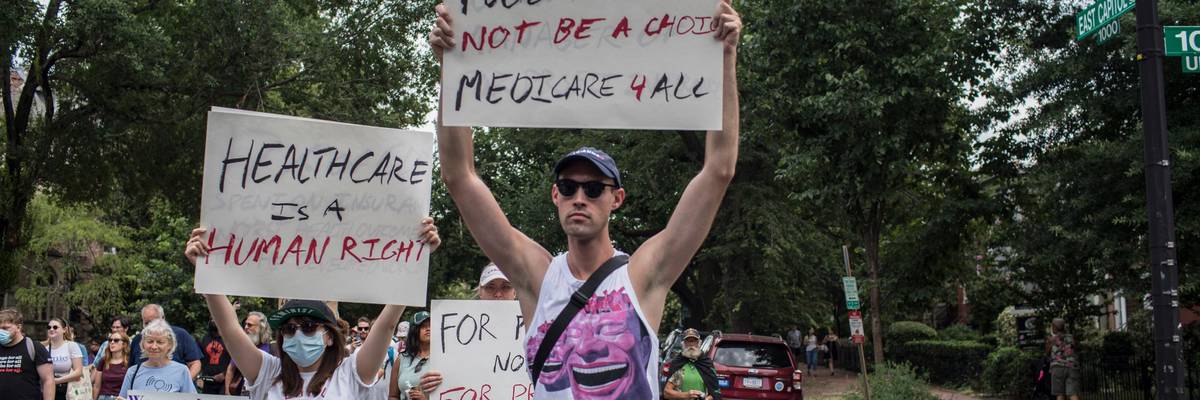
People take part in the March for Medicare for All in Washington D.C. on July 24, 2021. (Photo: Probal Rashid/LightRocket via Getty Images)
A new report reveals how a lack of health coverage, underinsurance, and unaffordable medical bills still plague millions of Americans despite healthcare reforms in recent years--and makes the latest case for improving and expanding the Medicare system to everyone in the U.S., according to progressives.
"No one should have to go into debt because they need to access healthcare. No one should have to choose between seeing a doctor and paying bills."
The Commonwealth Fund conducted a survey between March and July and found that due to high premiums, deductibles, and copays, 46% of U.S. adults have delayed or altogether avoided receiving healthcare in the last year.
Up to a quarter of people with chronic health problems were among those who had skipped getting the healthcare they need, with respondents saying out-of-pocket costs for prescription drugs--for example, life-saving insulin for diabetes--had forced them to skip doses or not fill a prescription.
Forty-two percent of respondents have struggled to pay medical bills and 43% were found to be inadequately insured, despite the often-cited statistic that the 2010 passage of the Affordable Care Act (ACA) helped 20 million Americans gain coverage.
Nearly a quarter of adults in the country are underinsured, with health insurance that fails to provide them with affordable healthcare--charging them high monthly premiums for coverage, covering medical care only after high deductibles have been fulfilled, or leaving certain kinds of healthcare out of coverage.
Those who were underinsured included 29% of people who had employer-sponsored healthcare plans and 44% of people who purchased coverage individually or through the healthcare marketplace set up by the ACA.
"The average insurance deductible for employer health plans with single coverage is more than $1,000 ($1,434 for all covered workers in 2021), and it's more than $2,000 ($2,825) for HealthCare.gov marketplace plans," reads the report. "Out-of-pocket maximums average $4,272 for single coverage in employer plans and range up to $8,700 in marketplace plans. These plan features leave people with considerable cost exposure in case of a sudden illness or accident."
Nine percent of people surveyed were completely without health insurance.
The statistics revealed in the survey amount to "a disgrace" in the American healthcare system, said the Institute for Policy Studies (IPS).
"This is shameful," said the group. "No one should have to go into debt because they need to access healthcare. No one should have to choose between seeing a doctor and paying bills."
Half of the people surveyed said they would be unable to pay an unexpected $1,000 medical bill within 30 days, including 69% of Black adults and 63% of Latinos.
The Commonwealth Fund prominently pointed out that Americans have "record-high health coverage," but Rep. Pramila Jayapal (D-Wash.), the author of the Medicare for All Act, which has 121 co-sponsors in the U.S. House, pointed out that 26 million Americans still lacking health insurance.
"Let's pass Medicare for All and guarantee health care as a right to ALL," said Jayapal.
Dear Common Dreams reader, It’s been nearly 30 years since I co-founded Common Dreams with my late wife, Lina Newhouser. We had the radical notion that journalism should serve the public good, not corporate profits. It was clear to us from the outset what it would take to build such a project. No paid advertisements. No corporate sponsors. No millionaire publisher telling us what to think or do. Many people said we wouldn't last a year, but we proved those doubters wrong. Together with a tremendous team of journalists and dedicated staff, we built an independent media outlet free from the constraints of profits and corporate control. Our mission has always been simple: To inform. To inspire. To ignite change for the common good. Building Common Dreams was not easy. Our survival was never guaranteed. When you take on the most powerful forces—Wall Street greed, fossil fuel industry destruction, Big Tech lobbyists, and uber-rich oligarchs who have spent billions upon billions rigging the economy and democracy in their favor—the only bulwark you have is supporters who believe in your work. But here’s the urgent message from me today. It's never been this bad out there. And it's never been this hard to keep us going. At the very moment Common Dreams is most needed, the threats we face are intensifying. We need your support now more than ever. We don't accept corporate advertising and never will. We don't have a paywall because we don't think people should be blocked from critical news based on their ability to pay. Everything we do is funded by the donations of readers like you. When everyone does the little they can afford, we are strong. But if that support retreats or dries up, so do we. Will you donate now to make sure Common Dreams not only survives but thrives? —Craig Brown, Co-founder |
A new report reveals how a lack of health coverage, underinsurance, and unaffordable medical bills still plague millions of Americans despite healthcare reforms in recent years--and makes the latest case for improving and expanding the Medicare system to everyone in the U.S., according to progressives.
"No one should have to go into debt because they need to access healthcare. No one should have to choose between seeing a doctor and paying bills."
The Commonwealth Fund conducted a survey between March and July and found that due to high premiums, deductibles, and copays, 46% of U.S. adults have delayed or altogether avoided receiving healthcare in the last year.
Up to a quarter of people with chronic health problems were among those who had skipped getting the healthcare they need, with respondents saying out-of-pocket costs for prescription drugs--for example, life-saving insulin for diabetes--had forced them to skip doses or not fill a prescription.
Forty-two percent of respondents have struggled to pay medical bills and 43% were found to be inadequately insured, despite the often-cited statistic that the 2010 passage of the Affordable Care Act (ACA) helped 20 million Americans gain coverage.
Nearly a quarter of adults in the country are underinsured, with health insurance that fails to provide them with affordable healthcare--charging them high monthly premiums for coverage, covering medical care only after high deductibles have been fulfilled, or leaving certain kinds of healthcare out of coverage.
Those who were underinsured included 29% of people who had employer-sponsored healthcare plans and 44% of people who purchased coverage individually or through the healthcare marketplace set up by the ACA.
"The average insurance deductible for employer health plans with single coverage is more than $1,000 ($1,434 for all covered workers in 2021), and it's more than $2,000 ($2,825) for HealthCare.gov marketplace plans," reads the report. "Out-of-pocket maximums average $4,272 for single coverage in employer plans and range up to $8,700 in marketplace plans. These plan features leave people with considerable cost exposure in case of a sudden illness or accident."
Nine percent of people surveyed were completely without health insurance.
The statistics revealed in the survey amount to "a disgrace" in the American healthcare system, said the Institute for Policy Studies (IPS).
"This is shameful," said the group. "No one should have to go into debt because they need to access healthcare. No one should have to choose between seeing a doctor and paying bills."
Half of the people surveyed said they would be unable to pay an unexpected $1,000 medical bill within 30 days, including 69% of Black adults and 63% of Latinos.
The Commonwealth Fund prominently pointed out that Americans have "record-high health coverage," but Rep. Pramila Jayapal (D-Wash.), the author of the Medicare for All Act, which has 121 co-sponsors in the U.S. House, pointed out that 26 million Americans still lacking health insurance.
"Let's pass Medicare for All and guarantee health care as a right to ALL," said Jayapal.
A new report reveals how a lack of health coverage, underinsurance, and unaffordable medical bills still plague millions of Americans despite healthcare reforms in recent years--and makes the latest case for improving and expanding the Medicare system to everyone in the U.S., according to progressives.
"No one should have to go into debt because they need to access healthcare. No one should have to choose between seeing a doctor and paying bills."
The Commonwealth Fund conducted a survey between March and July and found that due to high premiums, deductibles, and copays, 46% of U.S. adults have delayed or altogether avoided receiving healthcare in the last year.
Up to a quarter of people with chronic health problems were among those who had skipped getting the healthcare they need, with respondents saying out-of-pocket costs for prescription drugs--for example, life-saving insulin for diabetes--had forced them to skip doses or not fill a prescription.
Forty-two percent of respondents have struggled to pay medical bills and 43% were found to be inadequately insured, despite the often-cited statistic that the 2010 passage of the Affordable Care Act (ACA) helped 20 million Americans gain coverage.
Nearly a quarter of adults in the country are underinsured, with health insurance that fails to provide them with affordable healthcare--charging them high monthly premiums for coverage, covering medical care only after high deductibles have been fulfilled, or leaving certain kinds of healthcare out of coverage.
Those who were underinsured included 29% of people who had employer-sponsored healthcare plans and 44% of people who purchased coverage individually or through the healthcare marketplace set up by the ACA.
"The average insurance deductible for employer health plans with single coverage is more than $1,000 ($1,434 for all covered workers in 2021), and it's more than $2,000 ($2,825) for HealthCare.gov marketplace plans," reads the report. "Out-of-pocket maximums average $4,272 for single coverage in employer plans and range up to $8,700 in marketplace plans. These plan features leave people with considerable cost exposure in case of a sudden illness or accident."
Nine percent of people surveyed were completely without health insurance.
The statistics revealed in the survey amount to "a disgrace" in the American healthcare system, said the Institute for Policy Studies (IPS).
"This is shameful," said the group. "No one should have to go into debt because they need to access healthcare. No one should have to choose between seeing a doctor and paying bills."
Half of the people surveyed said they would be unable to pay an unexpected $1,000 medical bill within 30 days, including 69% of Black adults and 63% of Latinos.
The Commonwealth Fund prominently pointed out that Americans have "record-high health coverage," but Rep. Pramila Jayapal (D-Wash.), the author of the Medicare for All Act, which has 121 co-sponsors in the U.S. House, pointed out that 26 million Americans still lacking health insurance.
"Let's pass Medicare for All and guarantee health care as a right to ALL," said Jayapal.