
President Joe Biden's fresh assertion that "the pandemic is over"--a claim made as Covid-19 kills roughly 3,000 people each week in the U.S. alone--is being criticized by progressive commentators and medical experts who argue that such "false declarations" undermine support for public health measures and bolster the GOP's effort to nix funding for vaccines, tests, and treatments.
"We still have a problem with Covid," Biden acknowledged in a "60 Minutes" interview aired on Sunday night. "We're still doing a lotta work on it."
"But the pandemic is over," the president added. "If you notice, no one's wearing masks. Everybody seems to be in pretty good shape. And so I think it's changing."
According to artist and writer Artie Vierkant, it's difficult to think of a clearer example of "the sociological production of the end of the pandemic" than the exchange between Biden and CBS' Scott Pelley, which took place last week during Detroit's first annual auto show since 2019.
A right-wing judge appointed by former President Donald Trump struck down the federal mask mandate for public transportation in April, but as MSNBC host Mehdi Hasan pointed out Sunday, another key reason why most Americans have foregone masks in nearly all settings is "because people like Biden keep (falsely) telling them the pandemic is over."
Dr. Jonathan Reiner, a cardiologist and professor of medicine at George Washington University, asked on social media, "How do you convince Americans to get boosted again when the president declares the Covid pandemic 'is over'?"
The U.S. already has one of the lowest Covid-19 vaccination rates among high-income countries, and booster uptake has been especially low. While pervasive right-wing anti-science campaigns are certainly to blame, so too is the nation's deadly for-profit healthcare model as well as mixed messaging that downplays the pandemic.
Coronavirus mortality in the U.S. has decreased substantially since early in Biden's term when more than 3,000 people were dying every day. That decline is inseparable from the increased availability of vaccines, tests, and treatments made possible by robust government funding.
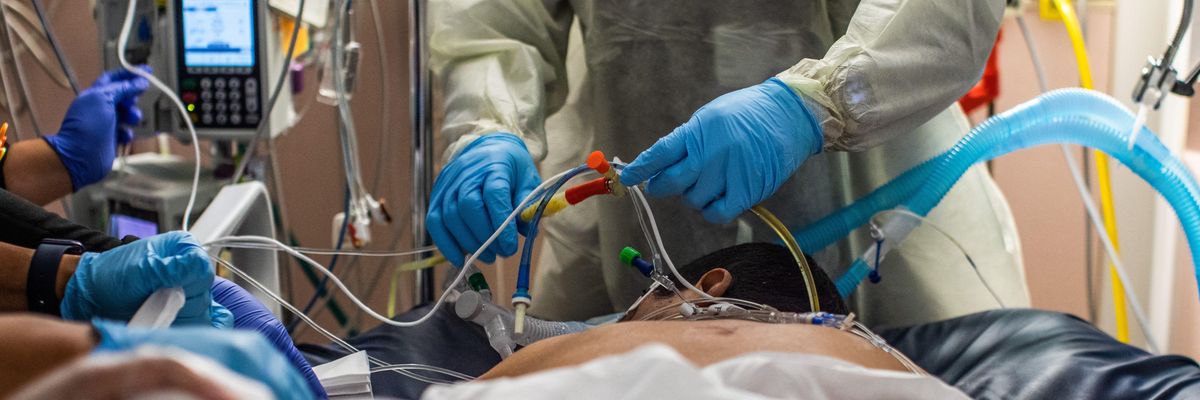
But roughly 400 people around the country continue to die from Covid-19 each day, tens of thousands are hospitalized, transmission remains high, and the White House is bracing for a potential surge in infections this fall--as money to address the ongoing crisis is drying up with no replenishments in sight.
"What's ending here," tweeted University of Washington medical anthropologist Nora Kenworthy, "is political commitment and funding, not cases or deaths."
Biden has asked federal lawmakers to appropriate $22.4 billion to support the fight against Covid-19. However, the president's "apparently off-the-cuff remarks" about the end of the pandemic "may complicate his administration's so far unsuccessful efforts to secure additional funding from Congress for more coronavirus vaccines and treatments and to take other steps intended to combat the virus," the Washington Post noted.
As the newspaper reported:
Republicans on Sunday night raised questions about why the administration would renew its ongoing public health emergency if the pandemic is over. That emergency declaration, which is set to expire next month, has allowed federal officials to pursue flexible solutions amid the crisis, including rapidly authorizing new covid treatments and keeping many Americans covered by Medicaid, the safety-net health program. The Urban Institute, a think tank that conducts economic and social policy research, has estimated that as many as 15.8 million Americans could lose Medicaid coverage after the government ends its emergency declaration.
Although Biden in February asked Congress to provide as much as $30 billion to tackle the pandemic at home and abroad, opposition from Republicans has prevented even much smaller packages from moving forward.
GOP lawmakers want to repurpose aid allocated to states under the American Rescue Plan, demanding that no new relief money be approved until existing finances are completely depleted, and they are opposed to any amount of new spending aimed at bolstering international efforts to defeat Covid-19--a disease that has been made far deadlier by global vaccine apartheid.
Republicans' refusal to provide more funding--legitimated, perhaps inadvertently, by Biden's recent comments--has resulted in what Adam Gaffney, an assistant professor of medicine at Harvard University and a pulmonary and intensive care unit doctor, calls "the rationing of Covid-care by ability to pay."
Gaffney first coined that phrase in March, when a federal health agency tapped to cover coronavirus testing and treatment for uninsured people in the U.S. ran out of money and stopped accepting claims, a move that has led to patients being charged $125 for a single PCR test.
In May, the White House announced that it is preparing to ration vaccines due to Senate Republicans' obstruction of new pandemic spending. In August, the Biden administration stopped buying monoclonal antibody treatments, transferring that responsibility to states and hospitals. And just over two weeks ago, it stopped mailing free at-home diagnostic tools "because Congress hasn't provided additional funding to replenish the nation's stockpile of tests."
Amid the GOP's defunding of the pandemic response, the Biden administration began taking steps last month to completely halt its purchases of Covid-19 vaccines and treatments over the coming months. On top of higher prices and more expensive insurance coverage, shifting acquisition from the federal government to the commercial market threatens to leave millions of uninsured people in the lurch.
Related Content

'Pandemic Is Far From Over': People's CDC Tells Congress to Fund Covid Response
Tahir Amin, an intellectual property lawyer and co-executive director of the Initiative for Medicines, Access, and Knowledge (I-MAK), has described this plan to privatize the procurement of jabs and therapeutics as a "recipe for disaster, unless you are a pharmaceutical company or other profit center in the healthcare market."
Last week, World Health Organization Director-General Tedros Adhanom Ghebreyesus said that the end of the pandemic "is in sight," with weekly deaths at their lowest level since March 2020. However, he continued, the coronavirus still poses an "acute global emergency." More than 1 million people worldwide died from Covid-19 during the first eight months of 2022, and the global death toll is now well over 15 million.
"We can see the finish line," said Ghebreyesus, "but now is the worst time to stop running."
The U.S. is already home to more than 1 million of the world's Covid-19 deaths. Experts have warned that a coronavirus surge this fall and winter could infect up to 100 million people nationwide, leading to a million hospitalizations and nearly 200,000 additional deaths in a worst-case scenario.
A recent letter from the People's CDC urges the White House and Congress "to act to stop the unchecked spread of Covid-19, immediately," by providing:
- Free access to N95-grade masks for all;
- Free access to PCR and rapid testing;
- Robust, universal, paid sick leave;
- Mask mandates in public places, including schools, public transport, and medical facilities;
- Federal funding and guidance for ventilation and filtration updates, coupled with meaningful regulation;
- Universal access to healthcare including continued Covid treatment and testing for uninsured people; and
- Updated vaccines and universal access to them globally.
"You must choose a healthier, more equitable pandemic response," the letter concludes. "We all deserve better."
President Joe Biden's fresh assertion that "the pandemic is over"--a claim made as Covid-19 kills roughly 3,000 people each week in the U.S. alone--is being criticized by progressive commentators and medical experts who argue that such "false declarations" undermine support for public health measures and bolster the GOP's effort to nix funding for vaccines, tests, and treatments.
"We still have a problem with Covid," Biden acknowledged in a "60 Minutes" interview aired on Sunday night. "We're still doing a lotta work on it."
"But the pandemic is over," the president added. "If you notice, no one's wearing masks. Everybody seems to be in pretty good shape. And so I think it's changing."
According to artist and writer Artie Vierkant, it's difficult to think of a clearer example of "the sociological production of the end of the pandemic" than the exchange between Biden and CBS' Scott Pelley, which took place last week during Detroit's first annual auto show since 2019.
A right-wing judge appointed by former President Donald Trump struck down the federal mask mandate for public transportation in April, but as MSNBC host Mehdi Hasan pointed out Sunday, another key reason why most Americans have foregone masks in nearly all settings is "because people like Biden keep (falsely) telling them the pandemic is over."
Dr. Jonathan Reiner, a cardiologist and professor of medicine at George Washington University, asked on social media, "How do you convince Americans to get boosted again when the president declares the Covid pandemic 'is over'?"
The U.S. already has one of the lowest Covid-19 vaccination rates among high-income countries, and booster uptake has been especially low. While pervasive right-wing anti-science campaigns are certainly to blame, so too is the nation's deadly for-profit healthcare model as well as mixed messaging that downplays the pandemic.
Coronavirus mortality in the U.S. has decreased substantially since early in Biden's term when more than 3,000 people were dying every day. That decline is inseparable from the increased availability of vaccines, tests, and treatments made possible by robust government funding.
But roughly 400 people around the country continue to die from Covid-19 each day, tens of thousands are hospitalized, transmission remains high, and the White House is bracing for a potential surge in infections this fall--as money to address the ongoing crisis is drying up with no replenishments in sight.
"What's ending here," tweeted University of Washington medical anthropologist Nora Kenworthy, "is political commitment and funding, not cases or deaths."
Biden has asked federal lawmakers to appropriate $22.4 billion to support the fight against Covid-19. However, the president's "apparently off-the-cuff remarks" about the end of the pandemic "may complicate his administration's so far unsuccessful efforts to secure additional funding from Congress for more coronavirus vaccines and treatments and to take other steps intended to combat the virus," the Washington Post noted.
As the newspaper reported:
Republicans on Sunday night raised questions about why the administration would renew its ongoing public health emergency if the pandemic is over. That emergency declaration, which is set to expire next month, has allowed federal officials to pursue flexible solutions amid the crisis, including rapidly authorizing new covid treatments and keeping many Americans covered by Medicaid, the safety-net health program. The Urban Institute, a think tank that conducts economic and social policy research, has estimated that as many as 15.8 million Americans could lose Medicaid coverage after the government ends its emergency declaration.
Although Biden in February asked Congress to provide as much as $30 billion to tackle the pandemic at home and abroad, opposition from Republicans has prevented even much smaller packages from moving forward.
GOP lawmakers want to repurpose aid allocated to states under the American Rescue Plan, demanding that no new relief money be approved until existing finances are completely depleted, and they are opposed to any amount of new spending aimed at bolstering international efforts to defeat Covid-19--a disease that has been made far deadlier by global vaccine apartheid.
Republicans' refusal to provide more funding--legitimated, perhaps inadvertently, by Biden's recent comments--has resulted in what Adam Gaffney, an assistant professor of medicine at Harvard University and a pulmonary and intensive care unit doctor, calls "the rationing of Covid-care by ability to pay."
Gaffney first coined that phrase in March, when a federal health agency tapped to cover coronavirus testing and treatment for uninsured people in the U.S. ran out of money and stopped accepting claims, a move that has led to patients being charged $125 for a single PCR test.
In May, the White House announced that it is preparing to ration vaccines due to Senate Republicans' obstruction of new pandemic spending. In August, the Biden administration stopped buying monoclonal antibody treatments, transferring that responsibility to states and hospitals. And just over two weeks ago, it stopped mailing free at-home diagnostic tools "because Congress hasn't provided additional funding to replenish the nation's stockpile of tests."
Amid the GOP's defunding of the pandemic response, the Biden administration began taking steps last month to completely halt its purchases of Covid-19 vaccines and treatments over the coming months. On top of higher prices and more expensive insurance coverage, shifting acquisition from the federal government to the commercial market threatens to leave millions of uninsured people in the lurch.
Related Content
'Pandemic Is Far From Over': People's CDC Tells Congress to Fund Covid Response
Tahir Amin, an intellectual property lawyer and co-executive director of the Initiative for Medicines, Access, and Knowledge (I-MAK), has described this plan to privatize the procurement of jabs and therapeutics as a "recipe for disaster, unless you are a pharmaceutical company or other profit center in the healthcare market."
Last week, World Health Organization Director-General Tedros Adhanom Ghebreyesus said that the end of the pandemic "is in sight," with weekly deaths at their lowest level since March 2020. However, he continued, the coronavirus still poses an "acute global emergency." More than 1 million people worldwide died from Covid-19 during the first eight months of 2022, and the global death toll is now well over 15 million.
"We can see the finish line," said Ghebreyesus, "but now is the worst time to stop running."
The U.S. is already home to more than 1 million of the world's Covid-19 deaths. Experts have warned that a coronavirus surge this fall and winter could infect up to 100 million people nationwide, leading to a million hospitalizations and nearly 200,000 additional deaths in a worst-case scenario.
A recent letter from the People's CDC urges the White House and Congress "to act to stop the unchecked spread of Covid-19, immediately," by providing:
- Free access to N95-grade masks for all;
- Free access to PCR and rapid testing;
- Robust, universal, paid sick leave;
- Mask mandates in public places, including schools, public transport, and medical facilities;
- Federal funding and guidance for ventilation and filtration updates, coupled with meaningful regulation;
- Universal access to healthcare including continued Covid treatment and testing for uninsured people; and
- Updated vaccines and universal access to them globally.
"You must choose a healthier, more equitable pandemic response," the letter concludes. "We all deserve better."
President Joe Biden's fresh assertion that "the pandemic is over"--a claim made as Covid-19 kills roughly 3,000 people each week in the U.S. alone--is being criticized by progressive commentators and medical experts who argue that such "false declarations" undermine support for public health measures and bolster the GOP's effort to nix funding for vaccines, tests, and treatments.
"We still have a problem with Covid," Biden acknowledged in a "60 Minutes" interview aired on Sunday night. "We're still doing a lotta work on it."
"But the pandemic is over," the president added. "If you notice, no one's wearing masks. Everybody seems to be in pretty good shape. And so I think it's changing."
According to artist and writer Artie Vierkant, it's difficult to think of a clearer example of "the sociological production of the end of the pandemic" than the exchange between Biden and CBS' Scott Pelley, which took place last week during Detroit's first annual auto show since 2019.
A right-wing judge appointed by former President Donald Trump struck down the federal mask mandate for public transportation in April, but as MSNBC host Mehdi Hasan pointed out Sunday, another key reason why most Americans have foregone masks in nearly all settings is "because people like Biden keep (falsely) telling them the pandemic is over."
Dr. Jonathan Reiner, a cardiologist and professor of medicine at George Washington University, asked on social media, "How do you convince Americans to get boosted again when the president declares the Covid pandemic 'is over'?"
The U.S. already has one of the lowest Covid-19 vaccination rates among high-income countries, and booster uptake has been especially low. While pervasive right-wing anti-science campaigns are certainly to blame, so too is the nation's deadly for-profit healthcare model as well as mixed messaging that downplays the pandemic.
Coronavirus mortality in the U.S. has decreased substantially since early in Biden's term when more than 3,000 people were dying every day. That decline is inseparable from the increased availability of vaccines, tests, and treatments made possible by robust government funding.
But roughly 400 people around the country continue to die from Covid-19 each day, tens of thousands are hospitalized, transmission remains high, and the White House is bracing for a potential surge in infections this fall--as money to address the ongoing crisis is drying up with no replenishments in sight.
"What's ending here," tweeted University of Washington medical anthropologist Nora Kenworthy, "is political commitment and funding, not cases or deaths."
Biden has asked federal lawmakers to appropriate $22.4 billion to support the fight against Covid-19. However, the president's "apparently off-the-cuff remarks" about the end of the pandemic "may complicate his administration's so far unsuccessful efforts to secure additional funding from Congress for more coronavirus vaccines and treatments and to take other steps intended to combat the virus," the Washington Post noted.
As the newspaper reported:
Republicans on Sunday night raised questions about why the administration would renew its ongoing public health emergency if the pandemic is over. That emergency declaration, which is set to expire next month, has allowed federal officials to pursue flexible solutions amid the crisis, including rapidly authorizing new covid treatments and keeping many Americans covered by Medicaid, the safety-net health program. The Urban Institute, a think tank that conducts economic and social policy research, has estimated that as many as 15.8 million Americans could lose Medicaid coverage after the government ends its emergency declaration.
Although Biden in February asked Congress to provide as much as $30 billion to tackle the pandemic at home and abroad, opposition from Republicans has prevented even much smaller packages from moving forward.
GOP lawmakers want to repurpose aid allocated to states under the American Rescue Plan, demanding that no new relief money be approved until existing finances are completely depleted, and they are opposed to any amount of new spending aimed at bolstering international efforts to defeat Covid-19--a disease that has been made far deadlier by global vaccine apartheid.
Republicans' refusal to provide more funding--legitimated, perhaps inadvertently, by Biden's recent comments--has resulted in what Adam Gaffney, an assistant professor of medicine at Harvard University and a pulmonary and intensive care unit doctor, calls "the rationing of Covid-care by ability to pay."
Gaffney first coined that phrase in March, when a federal health agency tapped to cover coronavirus testing and treatment for uninsured people in the U.S. ran out of money and stopped accepting claims, a move that has led to patients being charged $125 for a single PCR test.
In May, the White House announced that it is preparing to ration vaccines due to Senate Republicans' obstruction of new pandemic spending. In August, the Biden administration stopped buying monoclonal antibody treatments, transferring that responsibility to states and hospitals. And just over two weeks ago, it stopped mailing free at-home diagnostic tools "because Congress hasn't provided additional funding to replenish the nation's stockpile of tests."
Amid the GOP's defunding of the pandemic response, the Biden administration began taking steps last month to completely halt its purchases of Covid-19 vaccines and treatments over the coming months. On top of higher prices and more expensive insurance coverage, shifting acquisition from the federal government to the commercial market threatens to leave millions of uninsured people in the lurch.
Related Content
'Pandemic Is Far From Over': People's CDC Tells Congress to Fund Covid Response
Tahir Amin, an intellectual property lawyer and co-executive director of the Initiative for Medicines, Access, and Knowledge (I-MAK), has described this plan to privatize the procurement of jabs and therapeutics as a "recipe for disaster, unless you are a pharmaceutical company or other profit center in the healthcare market."
Last week, World Health Organization Director-General Tedros Adhanom Ghebreyesus said that the end of the pandemic "is in sight," with weekly deaths at their lowest level since March 2020. However, he continued, the coronavirus still poses an "acute global emergency." More than 1 million people worldwide died from Covid-19 during the first eight months of 2022, and the global death toll is now well over 15 million.
"We can see the finish line," said Ghebreyesus, "but now is the worst time to stop running."
The U.S. is already home to more than 1 million of the world's Covid-19 deaths. Experts have warned that a coronavirus surge this fall and winter could infect up to 100 million people nationwide, leading to a million hospitalizations and nearly 200,000 additional deaths in a worst-case scenario.
A recent letter from the People's CDC urges the White House and Congress "to act to stop the unchecked spread of Covid-19, immediately," by providing:
- Free access to N95-grade masks for all;
- Free access to PCR and rapid testing;
- Robust, universal, paid sick leave;
- Mask mandates in public places, including schools, public transport, and medical facilities;
- Federal funding and guidance for ventilation and filtration updates, coupled with meaningful regulation;
- Universal access to healthcare including continued Covid treatment and testing for uninsured people; and
- Updated vaccines and universal access to them globally.
"You must choose a healthier, more equitable pandemic response," the letter concludes. "We all deserve better."