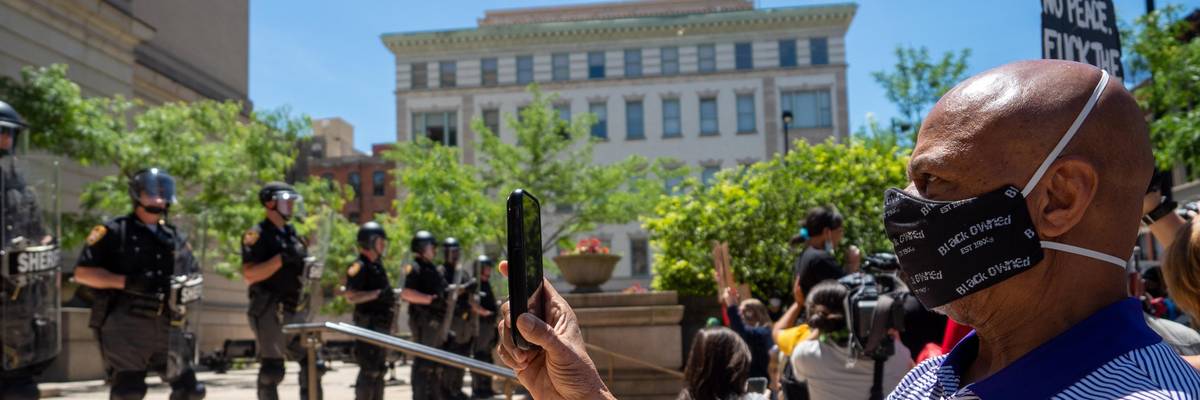
A man records police officers with his phone as demonstrators protest the police murder of George Floyd on June 1, 2020 in Cincinnati, Ohio. (Photo: ason Whitman/NurPhoto via Getty Images)
'Huge Win' for Civil Liberties as Judge Blocks Arizona Law Limiting Filming of Police
"We have a First Amendment right to film the police," said the ACLU, "and we will use it."
Civil libertarians on Friday applauded as a federal judge blocked enforcement of an Arizona law restricting how people can film police officers after agreeing that the legislation is unconstitutional.
"Recording law enforcement interactions is one of the best tools to hold police accountable."
U.S. District Judge John Tuchi granted a preliminary injunction sought by the ACLU of Arizona and media outlets on the grounds that H.B. 2319 violates their First Amendment rights.
The law--which was passed by Arizona's Republican-controlled Legislature and signed by GOP Gov. Doug Ducey in July--outlaws recording police at a distance of closer than eight feet if the officer verbally objects. It also empowers police officers to order people to stop filming them on private property, even if the property owner consents to the recording.
"Today's ruling is an incredible win for our First Amendment rights and will allow Arizonans to continue to hold police accountable," ACLU of Arizona staff attorney K.M. Bell said in a statement.
"At a time when recording law enforcement interactions is one of the best tools to hold police accountable, we should be working to protect this vital right--not undermine it," they added. "H.B. 2319 is a blatant attempt to prohibit people from exercising their constitutional right to record police in public and we're glad to see the court take action to stop it from going into effect."
The national ACLU said: "We have a First Amendment right to film police--and we will use it."
H.B. 2319 comes at a time when citizens are increasingly empowered by the ability to record and broadcast footage of officer misconduct that is sometimes used to bring perpetrators to justice. Video of former Minneapolis police officer Derek Chauvin kneeling on George Floyd's neck for over eight minutes was a key piece of evidence used to secure a murder conviction in the case.
The police department in Phoenix, the nation's fifth-largest city, is currently under federal investigation not only for alleged excessive use of deadly force and racial discrimination but also for how it handles constitutionally protected protests and the journalists covering them.
None of the defendants in the ACLU-led lawsuit--Maricopa County Attorney Rachel Mitchell, Maricopa County Sheriff Paul Penzone, and Arizona Attorney General Mark Brnovich--opposed the injunction, according to the Phoenix New Times.
The paper reports:
So, Arizonans can still film police officers freely--for now. Tuchi set a September 16 deadline for anyone else to intervene in the suit.
While Brnovich, Mitchell, and Penzone have no interest in defending the law, Arizona lawmakers--or other agencies--might. Arizona Senate President Karen Fann [R-1] has said lawmakers are considering this.
Civil libertarians would then likely seek a permanent injunction to block the law once and for all.
"We'll respond accordingly," ACLU of Arizona staff attorney Benjamin Rundall told the New Times.
We are at a crossroads
This country and this world are at a monumental crossroads. In a few short weeks, US voters will have an opportunity to beat back the forces of fascism and confront the billionaires who are rigging the economy, our media system, and our democracy, making it increasingly impossible for ordinary people to get by. We’re not just talking about the election. We’re talking about what must be done once these fascist elements are vanquished from power. We need a bolder set of solutions than what either major party has so far been willing to offer and a working-class movement ready to fight like hell for it. Trump didn't emerge from nowhere. The conditions that fueled MAGA authoritarianism were created by decades of radical neoliberal economic policies and a corrupt political system dominated by corporate interests. They slashed taxes on the super-rich, promising that the benefits would trickle down. They said giveaways to the corporate titans would make life more affordable for the rest of us. It was all bullshit. And when a bitter, betrayed populace searches for someone to blame, right-wing demagogues have little trouble finding scapegoats. People know when they're being lied to, but you won't hear any of this from the corporate media. Only independent journalism—powered and funded by people who believe in building a better world—can deliver truly trustworthy daily news. Our Fall Campaign is underway, and we need your help. To power our newsroom through the rest of the year, we need to raise $125,000 by midnight on October 31. So if you share our vision, please contribute whatever you can to sustain our work. |
Civil libertarians on Friday applauded as a federal judge blocked enforcement of an Arizona law restricting how people can film police officers after agreeing that the legislation is unconstitutional.
"Recording law enforcement interactions is one of the best tools to hold police accountable."
U.S. District Judge John Tuchi granted a preliminary injunction sought by the ACLU of Arizona and media outlets on the grounds that H.B. 2319 violates their First Amendment rights.
The law--which was passed by Arizona's Republican-controlled Legislature and signed by GOP Gov. Doug Ducey in July--outlaws recording police at a distance of closer than eight feet if the officer verbally objects. It also empowers police officers to order people to stop filming them on private property, even if the property owner consents to the recording.
"Today's ruling is an incredible win for our First Amendment rights and will allow Arizonans to continue to hold police accountable," ACLU of Arizona staff attorney K.M. Bell said in a statement.
"At a time when recording law enforcement interactions is one of the best tools to hold police accountable, we should be working to protect this vital right--not undermine it," they added. "H.B. 2319 is a blatant attempt to prohibit people from exercising their constitutional right to record police in public and we're glad to see the court take action to stop it from going into effect."
The national ACLU said: "We have a First Amendment right to film police--and we will use it."
H.B. 2319 comes at a time when citizens are increasingly empowered by the ability to record and broadcast footage of officer misconduct that is sometimes used to bring perpetrators to justice. Video of former Minneapolis police officer Derek Chauvin kneeling on George Floyd's neck for over eight minutes was a key piece of evidence used to secure a murder conviction in the case.
The police department in Phoenix, the nation's fifth-largest city, is currently under federal investigation not only for alleged excessive use of deadly force and racial discrimination but also for how it handles constitutionally protected protests and the journalists covering them.
None of the defendants in the ACLU-led lawsuit--Maricopa County Attorney Rachel Mitchell, Maricopa County Sheriff Paul Penzone, and Arizona Attorney General Mark Brnovich--opposed the injunction, according to the Phoenix New Times.
The paper reports:
So, Arizonans can still film police officers freely--for now. Tuchi set a September 16 deadline for anyone else to intervene in the suit.
While Brnovich, Mitchell, and Penzone have no interest in defending the law, Arizona lawmakers--or other agencies--might. Arizona Senate President Karen Fann [R-1] has said lawmakers are considering this.
Civil libertarians would then likely seek a permanent injunction to block the law once and for all.
"We'll respond accordingly," ACLU of Arizona staff attorney Benjamin Rundall told the New Times.
Civil libertarians on Friday applauded as a federal judge blocked enforcement of an Arizona law restricting how people can film police officers after agreeing that the legislation is unconstitutional.
"Recording law enforcement interactions is one of the best tools to hold police accountable."
U.S. District Judge John Tuchi granted a preliminary injunction sought by the ACLU of Arizona and media outlets on the grounds that H.B. 2319 violates their First Amendment rights.
The law--which was passed by Arizona's Republican-controlled Legislature and signed by GOP Gov. Doug Ducey in July--outlaws recording police at a distance of closer than eight feet if the officer verbally objects. It also empowers police officers to order people to stop filming them on private property, even if the property owner consents to the recording.
"Today's ruling is an incredible win for our First Amendment rights and will allow Arizonans to continue to hold police accountable," ACLU of Arizona staff attorney K.M. Bell said in a statement.
"At a time when recording law enforcement interactions is one of the best tools to hold police accountable, we should be working to protect this vital right--not undermine it," they added. "H.B. 2319 is a blatant attempt to prohibit people from exercising their constitutional right to record police in public and we're glad to see the court take action to stop it from going into effect."
The national ACLU said: "We have a First Amendment right to film police--and we will use it."
H.B. 2319 comes at a time when citizens are increasingly empowered by the ability to record and broadcast footage of officer misconduct that is sometimes used to bring perpetrators to justice. Video of former Minneapolis police officer Derek Chauvin kneeling on George Floyd's neck for over eight minutes was a key piece of evidence used to secure a murder conviction in the case.
The police department in Phoenix, the nation's fifth-largest city, is currently under federal investigation not only for alleged excessive use of deadly force and racial discrimination but also for how it handles constitutionally protected protests and the journalists covering them.
None of the defendants in the ACLU-led lawsuit--Maricopa County Attorney Rachel Mitchell, Maricopa County Sheriff Paul Penzone, and Arizona Attorney General Mark Brnovich--opposed the injunction, according to the Phoenix New Times.
The paper reports:
So, Arizonans can still film police officers freely--for now. Tuchi set a September 16 deadline for anyone else to intervene in the suit.
While Brnovich, Mitchell, and Penzone have no interest in defending the law, Arizona lawmakers--or other agencies--might. Arizona Senate President Karen Fann [R-1] has said lawmakers are considering this.
Civil libertarians would then likely seek a permanent injunction to block the law once and for all.
"We'll respond accordingly," ACLU of Arizona staff attorney Benjamin Rundall told the New Times.