SUBSCRIBE TO OUR FREE NEWSLETTER
Daily news & progressive opinion—funded by the people, not the corporations—delivered straight to your inbox.
5
#000000
#FFFFFF
To donate by check, phone, or other method, see our More Ways to Give page.
Daily news & progressive opinion—funded by the people, not the corporations—delivered straight to your inbox.
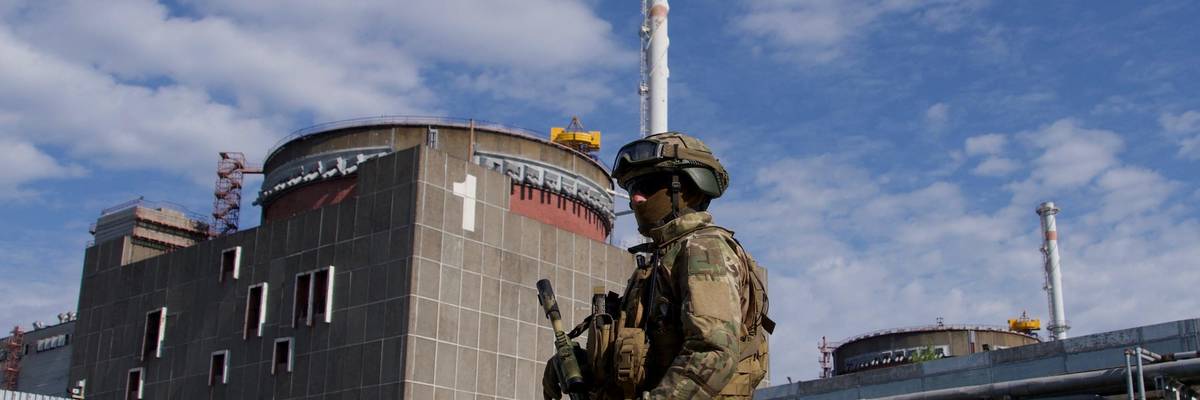
A Russian serviceman patrols the territory of the Zaporizhzhia Nuclear Power Station in Energodar, Ukraine on May 1, 2022. (Photo: Andrey Borodulin/AFP via Getty Images)
Days after United Nations officials concluded on a long-awaited visit to the Zaporizhzhia nuclear power plant in southeastern Ukraine that the Russian-occupied facility has been "violated," Ukrainian President Volodymyr Zelenskyy said Sunday night that the Russian military is effectively using a "nuclear weapon" by continuing to control the plant.
Zaporizhzhia, which the Russians took over soon after invading Ukraine on February 24, is the largest power plant in Europe, and Zelenskyy compared the occupation to the Russians occupying "six Chernobyls," referring to the deadliest nuclear disaster in history.
"It means the biggest danger in Europe," Zelenskyy told "World News Tonight" on ABC Sunday evening. "So, they occupied it. So that is--means that they use [a] nuclear weapon. That is [a] nuclear weapon."
Zelenskyy's comments followed a long-awaited inspection of the facility by the International Atomic Energy Agency (IAEA), which demanded access to the plant amid weeks of shelling, for which Russian and Ukrainian officials have blamed one another.
The inspection revealed that the plant had repeatedly been disconnected from Ukraine's power grid for the first time in its history. Fires caused by the shelling have also damaged the plant's transmission lines, as Common Dreams reported late last month.
The damaged connections to power lines forced workers to use a lower-voltage reserve line to power equipment that cools the plant's reactors.
"In the U.S., the Nuclear Regulatory Commission would not allow a reactor to operate under those conditions for more than 24 hours," Edwin Lyman, director of nuclear power safety at the Union of Concerned Scientists, told The New York Times Monday.
The fighting has sparked fears of a nuclear disaster, and IAEA Director General Rafael Mariano Grossi warned last week that continued destruction to the "physical integrity of the plant... is something that cannot happen."
Valeriia Hesse, a Ukrainian nonproliferation expert, told the Bulletin of the Atomic Scientists Saturday that a disaster like the one that happened at Chernobyl in 1986 is unlikely at Zaporizhzhia because of differences in the plants' reactors, but "there is a high risk that an accident like that of the Fukushima disaster in Japan could occur" if shelling continues.
"In my view, the two most likely scenarios threatening the safety of [Zaporizhzhia] are projectiles hitting a spent fuel storage or the plant's cooling systems being damaged," said Hesse. "Another scenario is to blow up the machine room at the working power units, which is outside the containment building. However, the plant's staff has claimed to be prepared for such a scenario."
The IAEA said it was establishing a long-term presence at the facility, which is still being operated by Ukrainian workers as Russian forces occupy the plant.
"There shouldn't be any military personnel," Zelenskyy said Sunday. "There shouldn't be any military equipment on the territory. And there shouldn't be the workers of [the] nuclear power plant who are surrounded by people with firearms."
Ukrainian officials called on the IAEA to provide more information about the status of the plant as four of the six inspectors left Zaporizhzhia Monday.
Dear Common Dreams reader, It’s been nearly 30 years since I co-founded Common Dreams with my late wife, Lina Newhouser. We had the radical notion that journalism should serve the public good, not corporate profits. It was clear to us from the outset what it would take to build such a project. No paid advertisements. No corporate sponsors. No millionaire publisher telling us what to think or do. Many people said we wouldn't last a year, but we proved those doubters wrong. Together with a tremendous team of journalists and dedicated staff, we built an independent media outlet free from the constraints of profits and corporate control. Our mission has always been simple: To inform. To inspire. To ignite change for the common good. Building Common Dreams was not easy. Our survival was never guaranteed. When you take on the most powerful forces—Wall Street greed, fossil fuel industry destruction, Big Tech lobbyists, and uber-rich oligarchs who have spent billions upon billions rigging the economy and democracy in their favor—the only bulwark you have is supporters who believe in your work. But here’s the urgent message from me today. It's never been this bad out there. And it's never been this hard to keep us going. At the very moment Common Dreams is most needed, the threats we face are intensifying. We need your support now more than ever. We don't accept corporate advertising and never will. We don't have a paywall because we don't think people should be blocked from critical news based on their ability to pay. Everything we do is funded by the donations of readers like you. When everyone does the little they can afford, we are strong. But if that support retreats or dries up, so do we. Will you donate now to make sure Common Dreams not only survives but thrives? —Craig Brown, Co-founder |
Days after United Nations officials concluded on a long-awaited visit to the Zaporizhzhia nuclear power plant in southeastern Ukraine that the Russian-occupied facility has been "violated," Ukrainian President Volodymyr Zelenskyy said Sunday night that the Russian military is effectively using a "nuclear weapon" by continuing to control the plant.
Zaporizhzhia, which the Russians took over soon after invading Ukraine on February 24, is the largest power plant in Europe, and Zelenskyy compared the occupation to the Russians occupying "six Chernobyls," referring to the deadliest nuclear disaster in history.
"It means the biggest danger in Europe," Zelenskyy told "World News Tonight" on ABC Sunday evening. "So, they occupied it. So that is--means that they use [a] nuclear weapon. That is [a] nuclear weapon."
Zelenskyy's comments followed a long-awaited inspection of the facility by the International Atomic Energy Agency (IAEA), which demanded access to the plant amid weeks of shelling, for which Russian and Ukrainian officials have blamed one another.
The inspection revealed that the plant had repeatedly been disconnected from Ukraine's power grid for the first time in its history. Fires caused by the shelling have also damaged the plant's transmission lines, as Common Dreams reported late last month.
The damaged connections to power lines forced workers to use a lower-voltage reserve line to power equipment that cools the plant's reactors.
"In the U.S., the Nuclear Regulatory Commission would not allow a reactor to operate under those conditions for more than 24 hours," Edwin Lyman, director of nuclear power safety at the Union of Concerned Scientists, told The New York Times Monday.
The fighting has sparked fears of a nuclear disaster, and IAEA Director General Rafael Mariano Grossi warned last week that continued destruction to the "physical integrity of the plant... is something that cannot happen."
Valeriia Hesse, a Ukrainian nonproliferation expert, told the Bulletin of the Atomic Scientists Saturday that a disaster like the one that happened at Chernobyl in 1986 is unlikely at Zaporizhzhia because of differences in the plants' reactors, but "there is a high risk that an accident like that of the Fukushima disaster in Japan could occur" if shelling continues.
"In my view, the two most likely scenarios threatening the safety of [Zaporizhzhia] are projectiles hitting a spent fuel storage or the plant's cooling systems being damaged," said Hesse. "Another scenario is to blow up the machine room at the working power units, which is outside the containment building. However, the plant's staff has claimed to be prepared for such a scenario."
The IAEA said it was establishing a long-term presence at the facility, which is still being operated by Ukrainian workers as Russian forces occupy the plant.
"There shouldn't be any military personnel," Zelenskyy said Sunday. "There shouldn't be any military equipment on the territory. And there shouldn't be the workers of [the] nuclear power plant who are surrounded by people with firearms."
Ukrainian officials called on the IAEA to provide more information about the status of the plant as four of the six inspectors left Zaporizhzhia Monday.
Days after United Nations officials concluded on a long-awaited visit to the Zaporizhzhia nuclear power plant in southeastern Ukraine that the Russian-occupied facility has been "violated," Ukrainian President Volodymyr Zelenskyy said Sunday night that the Russian military is effectively using a "nuclear weapon" by continuing to control the plant.
Zaporizhzhia, which the Russians took over soon after invading Ukraine on February 24, is the largest power plant in Europe, and Zelenskyy compared the occupation to the Russians occupying "six Chernobyls," referring to the deadliest nuclear disaster in history.
"It means the biggest danger in Europe," Zelenskyy told "World News Tonight" on ABC Sunday evening. "So, they occupied it. So that is--means that they use [a] nuclear weapon. That is [a] nuclear weapon."
Zelenskyy's comments followed a long-awaited inspection of the facility by the International Atomic Energy Agency (IAEA), which demanded access to the plant amid weeks of shelling, for which Russian and Ukrainian officials have blamed one another.
The inspection revealed that the plant had repeatedly been disconnected from Ukraine's power grid for the first time in its history. Fires caused by the shelling have also damaged the plant's transmission lines, as Common Dreams reported late last month.
The damaged connections to power lines forced workers to use a lower-voltage reserve line to power equipment that cools the plant's reactors.
"In the U.S., the Nuclear Regulatory Commission would not allow a reactor to operate under those conditions for more than 24 hours," Edwin Lyman, director of nuclear power safety at the Union of Concerned Scientists, told The New York Times Monday.
The fighting has sparked fears of a nuclear disaster, and IAEA Director General Rafael Mariano Grossi warned last week that continued destruction to the "physical integrity of the plant... is something that cannot happen."
Valeriia Hesse, a Ukrainian nonproliferation expert, told the Bulletin of the Atomic Scientists Saturday that a disaster like the one that happened at Chernobyl in 1986 is unlikely at Zaporizhzhia because of differences in the plants' reactors, but "there is a high risk that an accident like that of the Fukushima disaster in Japan could occur" if shelling continues.
"In my view, the two most likely scenarios threatening the safety of [Zaporizhzhia] are projectiles hitting a spent fuel storage or the plant's cooling systems being damaged," said Hesse. "Another scenario is to blow up the machine room at the working power units, which is outside the containment building. However, the plant's staff has claimed to be prepared for such a scenario."
The IAEA said it was establishing a long-term presence at the facility, which is still being operated by Ukrainian workers as Russian forces occupy the plant.
"There shouldn't be any military personnel," Zelenskyy said Sunday. "There shouldn't be any military equipment on the territory. And there shouldn't be the workers of [the] nuclear power plant who are surrounded by people with firearms."
Ukrainian officials called on the IAEA to provide more information about the status of the plant as four of the six inspectors left Zaporizhzhia Monday.