

SUBSCRIBE TO OUR FREE NEWSLETTER
Daily news & progressive opinion—funded by the people, not the corporations—delivered straight to your inbox.
5
#000000
#FFFFFF
To donate by check, phone, or other method, see our More Ways to Give page.
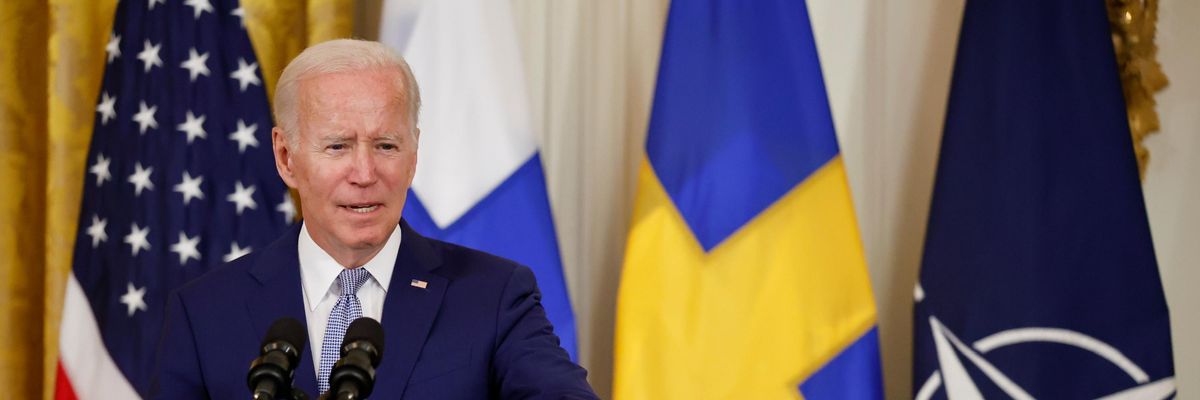
Amid heightened global fears of a nuclear war or accidental catastrophe, Veterans for Peace this week urged President Joe Biden to review its recommendations for U.S. policy related to weapons of mass destruction.
"Our Nuclear Posture Review is a blueprint for a world of peace and cooperation."
Highlighting a Veterans for Peace (VFP) report published earlier this year, the group's message to Biden--spelled out in an open letter sent to the White House--is: "Read our Nuclear Posture Review before releasing yours."
"The product of many months of research and writing, our Nuclear Posture Review is a blueprint for a world of peace and cooperation--a world that uses its precious resources for global uplift rather than mutual annihilation," the VFP letter states.
"These are not pie-in-the-sky ideas, but rather well-developed proposals from nuclear disarmament experts," the letter continues. "It is our deep hope that you will take our approach to heart for the benefit of our country and of all humanity worldwide."
Related Content

As Common Dreams previously reported, VFP's January report argues that "what we need now is a 'nuclear posture' that enables us to reduce the real risk of nuclear confrontation through accidental launch or miscalculated escalation, and to accelerate a global reduction and rapid elimination of nuclear weapons."
A Nuclear Posture Review (NPR) details the current administration's policies on such weapons. A classified version of Biden's document was sent to Congress in March and at the time the U.S. Department of Defense (DOD) summarized key takeaways in three short paragraphs.
"The NPR underscores our commitment to reducing the role of nuclear weapons and reestablishing our leadership in arms control," the DOD fact sheet says. "We will continue to emphasize strategic stability, seek to avoid costly arms races, and facilitate risk reduction and arms control arrangements where possible."
The DOD summary adds that Biden believes "the fundamental role of U.S. nuclear weapons is to deter nuclear attack," and the president would only consider using such arms "in extreme circumstances to defend the vital interests of the United States or its allies and partners."
Related Content

Air Force Magazine reported last week that Undersecretary of Defense for Policy Colin Kahl said the current NPR maintains the U.S. policy of "flexible deterrence" but Biden hopes to eventually shift to "sole purpose," or only having nuclear arms to deter or respond to an attack.
Kahl--who was speaking at a side event of an ongoing United Nations conference about the nonproliferation of nuclear arms--also said that an unclassified version of the NPR will be released "in the relatively near future."
While encouraging Biden to hold off on his release until reviewing its proposals, Veterans for Peace, in the letter, also emphasized that the group's members are "eager" to see his policy, especially considering how Russia's February invasion of Ukraine and the response by Western powers have ratcheted up concerns of a nuclear conflict.
"We deserve a full accounting of your nuclear planning," VFP wrote. "We want to know what you and your advisers consider reasonable during this time of confrontation between the U.S. and Russia, which between them hold the lion's share of the world's 15,000 nuclear weapons."
The letter to Biden continues:
We need to know if you will be keeping nuclear weapons on hair-trigger alert. Will you forswear the first use of nuclear weapons?
We need to know if you will rejoin the Anti-Ballistic Missile (ABM) Treaty, unilaterally abandoned by President George W. Bush, and the Intermediate Nuclear Forces (INF) Treaty, unilaterally abandoned by President Donald Trump.
Will you contribute to an era of peaceful relations, or will you pursue antagonistic polices toward China and Russia? Will you continue investing billions of dollars on new nuclear weapons?
Are you willing to risk a civilization-ending apocalypse by playing nuclear chicken with other nuclear-armed nations? Or will you lead us toward a planet that is free of nuclear weapons? We urge you to acknowledge and sign the Treaty on the Prohibition of Nuclear Weapons.
The Treaty on the Prohibition of Nuclear Weapons (TPNW) entered into force last year but lacks the support of the world's nine nuclear powers--and, as anti-war campaigners pointed out at the beginning of the U.N. summit earlier this month, nuclear-armed nations already refuse to abide by their existing treaty obligations.
As activists kicked off the conference by urging countries with nuclear weapons to comply with treaties they've signed, support the TPNW, and work toward global disarmament, the U.N. chief issued a chilling reminder of what is at stake.
"Today," warned U.N. Secretary-General Antonio Guterres, "humanity is just one misunderstanding, one miscalculation away from nuclear annihilation."
Amid heightened global fears of a nuclear war or accidental catastrophe, Veterans for Peace this week urged President Joe Biden to review its recommendations for U.S. policy related to weapons of mass destruction.
"Our Nuclear Posture Review is a blueprint for a world of peace and cooperation."
Highlighting a Veterans for Peace (VFP) report published earlier this year, the group's message to Biden--spelled out in an open letter sent to the White House--is: "Read our Nuclear Posture Review before releasing yours."
"The product of many months of research and writing, our Nuclear Posture Review is a blueprint for a world of peace and cooperation--a world that uses its precious resources for global uplift rather than mutual annihilation," the VFP letter states.
"These are not pie-in-the-sky ideas, but rather well-developed proposals from nuclear disarmament experts," the letter continues. "It is our deep hope that you will take our approach to heart for the benefit of our country and of all humanity worldwide."
Related Content
As Common Dreams previously reported, VFP's January report argues that "what we need now is a 'nuclear posture' that enables us to reduce the real risk of nuclear confrontation through accidental launch or miscalculated escalation, and to accelerate a global reduction and rapid elimination of nuclear weapons."
A Nuclear Posture Review (NPR) details the current administration's policies on such weapons. A classified version of Biden's document was sent to Congress in March and at the time the U.S. Department of Defense (DOD) summarized key takeaways in three short paragraphs.
"The NPR underscores our commitment to reducing the role of nuclear weapons and reestablishing our leadership in arms control," the DOD fact sheet says. "We will continue to emphasize strategic stability, seek to avoid costly arms races, and facilitate risk reduction and arms control arrangements where possible."
The DOD summary adds that Biden believes "the fundamental role of U.S. nuclear weapons is to deter nuclear attack," and the president would only consider using such arms "in extreme circumstances to defend the vital interests of the United States or its allies and partners."
Related Content
Air Force Magazine reported last week that Undersecretary of Defense for Policy Colin Kahl said the current NPR maintains the U.S. policy of "flexible deterrence" but Biden hopes to eventually shift to "sole purpose," or only having nuclear arms to deter or respond to an attack.
Kahl--who was speaking at a side event of an ongoing United Nations conference about the nonproliferation of nuclear arms--also said that an unclassified version of the NPR will be released "in the relatively near future."
While encouraging Biden to hold off on his release until reviewing its proposals, Veterans for Peace, in the letter, also emphasized that the group's members are "eager" to see his policy, especially considering how Russia's February invasion of Ukraine and the response by Western powers have ratcheted up concerns of a nuclear conflict.
"We deserve a full accounting of your nuclear planning," VFP wrote. "We want to know what you and your advisers consider reasonable during this time of confrontation between the U.S. and Russia, which between them hold the lion's share of the world's 15,000 nuclear weapons."
The letter to Biden continues:
We need to know if you will be keeping nuclear weapons on hair-trigger alert. Will you forswear the first use of nuclear weapons?
We need to know if you will rejoin the Anti-Ballistic Missile (ABM) Treaty, unilaterally abandoned by President George W. Bush, and the Intermediate Nuclear Forces (INF) Treaty, unilaterally abandoned by President Donald Trump.
Will you contribute to an era of peaceful relations, or will you pursue antagonistic polices toward China and Russia? Will you continue investing billions of dollars on new nuclear weapons?
Are you willing to risk a civilization-ending apocalypse by playing nuclear chicken with other nuclear-armed nations? Or will you lead us toward a planet that is free of nuclear weapons? We urge you to acknowledge and sign the Treaty on the Prohibition of Nuclear Weapons.
The Treaty on the Prohibition of Nuclear Weapons (TPNW) entered into force last year but lacks the support of the world's nine nuclear powers--and, as anti-war campaigners pointed out at the beginning of the U.N. summit earlier this month, nuclear-armed nations already refuse to abide by their existing treaty obligations.
As activists kicked off the conference by urging countries with nuclear weapons to comply with treaties they've signed, support the TPNW, and work toward global disarmament, the U.N. chief issued a chilling reminder of what is at stake.
"Today," warned U.N. Secretary-General Antonio Guterres, "humanity is just one misunderstanding, one miscalculation away from nuclear annihilation."
Amid heightened global fears of a nuclear war or accidental catastrophe, Veterans for Peace this week urged President Joe Biden to review its recommendations for U.S. policy related to weapons of mass destruction.
"Our Nuclear Posture Review is a blueprint for a world of peace and cooperation."
Highlighting a Veterans for Peace (VFP) report published earlier this year, the group's message to Biden--spelled out in an open letter sent to the White House--is: "Read our Nuclear Posture Review before releasing yours."
"The product of many months of research and writing, our Nuclear Posture Review is a blueprint for a world of peace and cooperation--a world that uses its precious resources for global uplift rather than mutual annihilation," the VFP letter states.
"These are not pie-in-the-sky ideas, but rather well-developed proposals from nuclear disarmament experts," the letter continues. "It is our deep hope that you will take our approach to heart for the benefit of our country and of all humanity worldwide."
Related Content
As Common Dreams previously reported, VFP's January report argues that "what we need now is a 'nuclear posture' that enables us to reduce the real risk of nuclear confrontation through accidental launch or miscalculated escalation, and to accelerate a global reduction and rapid elimination of nuclear weapons."
A Nuclear Posture Review (NPR) details the current administration's policies on such weapons. A classified version of Biden's document was sent to Congress in March and at the time the U.S. Department of Defense (DOD) summarized key takeaways in three short paragraphs.
"The NPR underscores our commitment to reducing the role of nuclear weapons and reestablishing our leadership in arms control," the DOD fact sheet says. "We will continue to emphasize strategic stability, seek to avoid costly arms races, and facilitate risk reduction and arms control arrangements where possible."
The DOD summary adds that Biden believes "the fundamental role of U.S. nuclear weapons is to deter nuclear attack," and the president would only consider using such arms "in extreme circumstances to defend the vital interests of the United States or its allies and partners."
Related Content
Air Force Magazine reported last week that Undersecretary of Defense for Policy Colin Kahl said the current NPR maintains the U.S. policy of "flexible deterrence" but Biden hopes to eventually shift to "sole purpose," or only having nuclear arms to deter or respond to an attack.
Kahl--who was speaking at a side event of an ongoing United Nations conference about the nonproliferation of nuclear arms--also said that an unclassified version of the NPR will be released "in the relatively near future."
While encouraging Biden to hold off on his release until reviewing its proposals, Veterans for Peace, in the letter, also emphasized that the group's members are "eager" to see his policy, especially considering how Russia's February invasion of Ukraine and the response by Western powers have ratcheted up concerns of a nuclear conflict.
"We deserve a full accounting of your nuclear planning," VFP wrote. "We want to know what you and your advisers consider reasonable during this time of confrontation between the U.S. and Russia, which between them hold the lion's share of the world's 15,000 nuclear weapons."
The letter to Biden continues:
We need to know if you will be keeping nuclear weapons on hair-trigger alert. Will you forswear the first use of nuclear weapons?
We need to know if you will rejoin the Anti-Ballistic Missile (ABM) Treaty, unilaterally abandoned by President George W. Bush, and the Intermediate Nuclear Forces (INF) Treaty, unilaterally abandoned by President Donald Trump.
Will you contribute to an era of peaceful relations, or will you pursue antagonistic polices toward China and Russia? Will you continue investing billions of dollars on new nuclear weapons?
Are you willing to risk a civilization-ending apocalypse by playing nuclear chicken with other nuclear-armed nations? Or will you lead us toward a planet that is free of nuclear weapons? We urge you to acknowledge and sign the Treaty on the Prohibition of Nuclear Weapons.
The Treaty on the Prohibition of Nuclear Weapons (TPNW) entered into force last year but lacks the support of the world's nine nuclear powers--and, as anti-war campaigners pointed out at the beginning of the U.N. summit earlier this month, nuclear-armed nations already refuse to abide by their existing treaty obligations.
As activists kicked off the conference by urging countries with nuclear weapons to comply with treaties they've signed, support the TPNW, and work toward global disarmament, the U.N. chief issued a chilling reminder of what is at stake.
"Today," warned U.N. Secretary-General Antonio Guterres, "humanity is just one misunderstanding, one miscalculation away from nuclear annihilation."

